Prefilled Syringes Market Summary
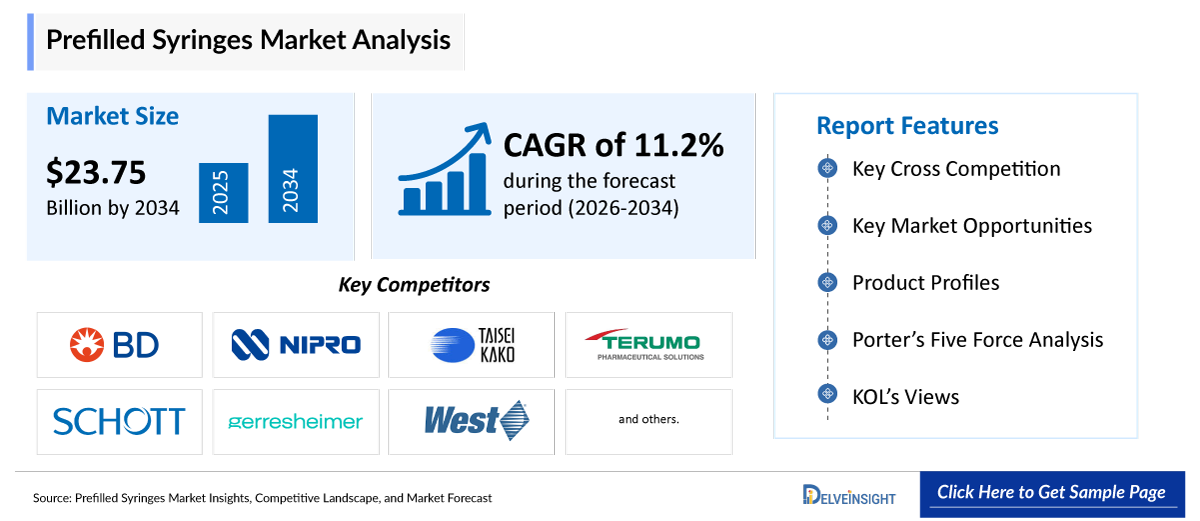
- The Prefilled Syringes market is estimated at USD 9.20 billion in 2025 and is projected to reach USD 23.75 billion by 2034. Growth is anchored in the rapid expansion of biologics, biosimilars, and GLP-1 therapies, rising chronic disease prevalence, and the accelerating shift toward patient-centric, self-administered injectable drug delivery.
- The global Prefilled Syringes market is growing at a CAGR of 11.2% during the forecast period from 2026 to 2034.
- By Product Type, the Staked Needle System segment dominated the Prefilled Syringes market with a 57% share in 2025.
- By Material, the Glass segment dominated the Prefilled Syringes market with a 66% share in 2025.
- By Type, the With Needle segment dominated the Prefilled Syringes market with a 74% share in 2025.
- By Distribution Channel, the Hospital & Retail Pharmacies segment dominated the Prefilled Syringes market with a 79% share in 2025.
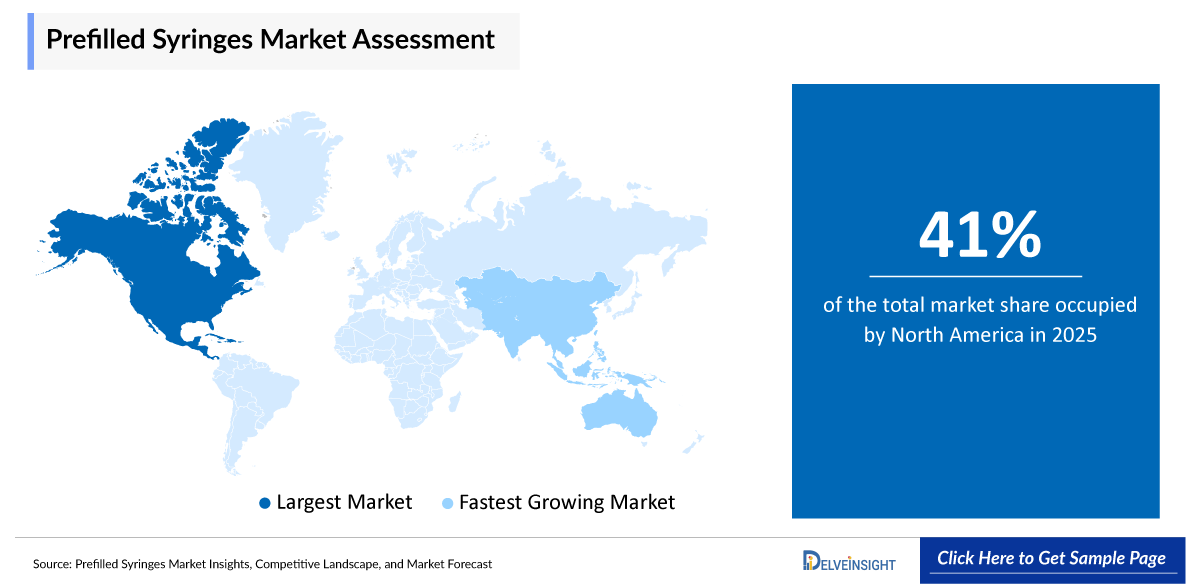
- North America dominated the global Prefilled Syringes market revenue with a 41% share in 2025, representing the highest regional market share globally.
A prefilled syringe (PFS) is a ready-to-use, single-dose drug delivery system that combines the primary drug container and the administration device in one unit, allowing pharmaceutical and biotechnology companies to supply injectable medicines pre-loaded with an exact, validated dose. Because prefilled syringes reduce dosing errors, minimize drug overfill and wastage, shorten preparation time, and enable safe self-administration outside clinical settings, they have become the primary format for delivering biologics, monoclonal antibodies, GLP-1 receptor agonists, vaccines, anticoagulants, and other chronic-disease injectables. The market is organized by product type across staked needle, luer cone, and luer lock systems; by material across glass and plastic; by type across syringes supplied with a pre-attached needle and those without a needle requiring luer attachment; and by distribution channel spanning hospital and retail pharmacies and online pharmacies. Driven by the accelerating adoption of biologics and biosimilars, the explosive growth of GLP-1 obesity and diabetes therapies, rising chronic disease prevalence, and heavy capacity investment by glass- and polymer-syringe manufacturers, prefilled syringes have become foundational infrastructure in the global injectable drug delivery supply chain.
Prefilled Syringes Market Key Growth Drivers
- The rapid clinical and commercial expansion of biologics, biosimilars, and GLP-1 receptor agonist therapies is driving demand, with Stevanato Group reporting that GLP-1-related products represented approximately 19-20% of its total 2025 revenue and grew more than 50% year-over-year.
- The rising global burden of chronic and metabolic diseases, including diabetes, obesity, autoimmune disorders, and cancer, is expanding demand for self-injectable and physician-administered biologic therapies.
- Pharmaceutical and biotechnology companies are increasingly shifting from vials and ampoules to prefilled formats to reduce dosing errors, minimize drug waste, and support patient-centric home healthcare and self-administration.
- Stringent needlestick-safety regulation, including the US Needlestick Safety and Prevention Act and the EU Sharps Directive (2010/32/EU), is accelerating adoption of safety-engineered prefilled syringe systems.
- Heavy capital investment in glass and polymer syringe manufacturing capacity, led by BD, Gerresheimer, SCHOTT, Stevanato Group, West Pharmaceutical Services, and Nipro, is expanding global supply to meet biologics and GLP-1 demand.
- Sustained global immunization and vaccination programs continue to anchor high-volume, recurring demand for single-dose prefilled syringe formats.
- Advances in high-concentration, low-viscosity glass and cyclic-olefin-polymer syringe barrels, thin-wall staked needles, and silicone-oil-free coatings are enabling delivery of next-generation, high-dose biologic formulations.
Key Companies in Prefilled Syringes Market
The competitive landscape is led by the following active manufacturers:
- BD
- NIPRO Pharma
- Taisei Kako Co., Ltd.
- TERUMO PHARMACEUTICAL SOLUTIONS
- SCHOTT AG
- Gerresheimer AG
- West Pharmaceutical Services, Inc.
- Dali Medical Devices
- Stevanato Group
- Credence MedSystems, Inc.
For illustrative purposes, only the top 10 companies are listed in the Table of Contents. The report may include analysis and references to additional companies relevant to the market assessment.
Prefilled Syringes Market Size
The following snapshot summarizes the principal report metrics for the Prefilled Syringes market.
|
Report Metrics |
Details |
|
2025 Market Size |
USD 9.20 billion |
|
2034 Projected Market Size |
USD 23.75 billion |
|
Growth Rate (2026-2034) |
11.2% CAGR |
|
Largest Market |
North America |
|
Fastest Growing Market |
Asia-Pacific |
|
Market Structure |
Moderately Consolidated |
All market values are expressed in USD and represent DelveInsight estimates synthesized from primary and secondary research.
Factors Contributing to the Growth of the Prefilled Syringes Market
Market Drivers
Rapid Growth of Biologics, Biosimilars, and GLP-1 Therapies
The single most powerful driver of the Prefilled Syringes market is the explosive clinical and commercial growth of biologics, biosimilars, and GLP-1 receptor agonist therapies for obesity and type 2 diabetes. The prefilled syringe is the dominant primary container for these high-value injectables: Stevanato Group has reported that its Nexa syringe was its fastest-growing product in 2025, driven primarily by GLP-1 demand, with GLP-1-related revenue growing more than 50% year-over-year and representing roughly 19-20% of total company revenue. As monoclonal antibodies, fusion proteins, and next-generation incretin therapies continue to expand indications and reach commercial scale, demand for validated, high-value glass and polymer prefilled syringe platforms is rising directly, anchoring market growth through 2034.
Rising Global Chronic Disease Burden and Self-Administration
The growing global burden of chronic and metabolic diseases, including diabetes, obesity, rheumatoid arthritis, psoriasis, and cancer, is expanding demand for long-term injectable therapies that patients can self-administer. Prefilled syringes reduce dosing errors, eliminate the need for manual drug drawing, and support the shift of chronic-disease treatment from hospitals and infusion centers to the home. As the treated population for chronic conditions requiring injectable biologics continues to expand worldwide, the volume of prefilled syringe-based therapies rises in step, sustaining durable demand across the forecast period.
Increasing Preference for Home Healthcare and Patient-Centric Drug Delivery
A structural shift toward home-based and patient-centric care is reshaping injectable drug delivery. Prefilled syringes, often paired with autoinjectors and safety devices, allow patients to self-administer complex biologic therapies outside clinical settings, reducing healthcare system burden and improving treatment adherence. Pharmaceutical companies are increasingly designing combination products around prefilled syringe platforms to differentiate their therapies and support decentralized, home-based treatment models, directly enlarging the addressable market for prefilled syringe components and systems.
Stringent Needlestick-Safety Regulation
Regulatory mandates addressing needlestick injuries are accelerating adoption of safety-engineered prefilled syringe systems. In the United States, the Needlestick Safety and Prevention Act requires the use of engineered sharps-injury-protection devices in healthcare settings, while the European Union's Sharps Directive (2010/32/EU) imposes similar obligations across member states. These requirements are driving hospitals, pharmacies, and pharmaceutical manufacturers toward passive safety syringe systems, such as those developed by Credence MedSystems and Owen Mumford, reinforcing sustained demand for advanced, compliant prefilled syringe technologies.
Heavy Capacity Investment by Leading Glass and Polymer Syringe Manufacturers
Substantial capital investment in glass and polymer syringe manufacturing capacity is expanding global supply to meet surging biologics and GLP-1 demand. BD has committed more than $2.5 billion to US manufacturing over five years, including a $110 million investment to establish Neopak Glass Prefillable Syringe production at its Columbus, Nebraska facility. Gerresheimer is investing to double its global syringe production capacity by 2028, including a Querétaro, Mexico expansion adding several hundred million ready-to-fill syringes annually. SCHOTT Pharma is investing $371 million in a new polymer syringe facility in Wilson, North Carolina, and Stevanato Group secured €200 million in financing in 2025 to expand syringe and cartridge production in Cisterna di Latina, Italy, and Fishers, Indiana. This wave of capacity expansion is easing supply constraints and supporting the scale-up of next-generation biologic and GLP-1 formulations.
Sustained Global Immunization and Vaccination Programs
Ongoing global immunization initiatives, including routine childhood vaccination, seasonal influenza campaigns, and emerging vaccine platforms, continue to generate high-volume, recurring demand for single-dose prefilled syringes. Government and multilateral procurement programs favor prefilled formats for their dosing accuracy, reduced contamination risk, and ease of administration in mass vaccination settings, sustaining a large and stable base of demand alongside the faster-growing biologics segment.
Technological Advancement in Syringe Barrel and Needle Design
Continuous innovation in syringe barrel materials, needle geometry, and coating technologies is expanding the addressable applications for prefilled syringes. Thin-wall, staked-needle glass syringes such as BD's Neopak XtraFlow platform reduce injection force for high-viscosity biologics, while cyclic-olefin-polymer platforms such as SCHOTT's TOPPAC, Taisei Kako's ClearJect, and Terumo's PLAJEX offer break-resistant, silicone-oil-free alternatives suited to sensitive formulations, including ophthalmic and biotech drugs. West Pharmaceutical Services' newly launched Synchrony platform offers a fully verified, system-level staked-needle and luer lock syringe portfolio designed to streamline regulatory submission and accelerate time to market. These innovations are broadening the range of drugs that can be safely and effectively delivered via prefilled syringe, supporting continued market expansion.
Market Restraints
Despite strong momentum, the Prefilled Syringes market faces material constraints. The high capital intensity of glass-forming, polymer-molding, and sterile fill-finish manufacturing creates substantial barriers to entry and favors large, vertically integrated players. Glass syringes carry inherent risks of breakage, delamination, and particulate contamination, particularly for sensitive high-concentration biologic formulations, driving a gradual but still limited shift toward polymer alternatives. Stringent regulatory and quality requirements, including ISO 11040, USP particulate-matter standards, and combination-product regulations enforced by the FDA and EMA, lengthen development and qualification timelines and raise compliance costs. Supply-chain concentration in specialized borosilicate glass tubing and syringe-grade elastomer components creates fragility, as demonstrated by periodic capacity shortages during peak biologics and GLP-1 demand. Pricing pressure from generic and biosimilar manufacturers, uneven reimbursement for advanced delivery systems across geographies, and the logistical complexity of cold-chain distribution for temperature-sensitive biologics further constrain margins. Together, these capital, supply, regulatory, and pricing barriers temper the pace of growth, even as the underlying drivers of biologics expansion, chronic disease burden, and self-administration remain firmly intact.
Prefilled Syringes Market Segment Analysis
The prefilled syringes market by product type (staked needle system, luer cone system, luer lock system), material (glass, plastic), type (with needle, without needle), distribution channel (hospital & retail pharmacies, online pharmacies), and geography (North America, Europe, Asia-Pacific, and Rest of World).
By Product Type
Dominant Subsegment: Staked Needle System.
The staked needle system segment accounted for 57% of the Prefilled Syringes market in 2025. Staked needle systems, in which the needle is permanently bonded to the syringe barrel during manufacturing, are the leading product type because they eliminate the drug loss associated with dead volume in a separate needle hub, provide a lower, more consistent injection force, and simplify the fill-finish process for pharmaceutical manufacturers. These characteristics make staked needle syringes the preferred platform for high-value biologics, monoclonal antibodies, and GLP-1 therapies, where dose accuracy and minimal product waste are critical, and they are used across BD's Neopak, West's Synchrony, and Gerresheimer's RTF platforms. Luer lock systems, which allow a separate needle or safety device to be securely attached at the point of use, are gaining share in vaccines, emergency medicine, and applications requiring needle interchangeability, while luer cone systems retain a role in cost-sensitive and legacy applications. Nonetheless, the reliability, dosing accuracy, and biologics compatibility of staked needle systems secure their leadership across the forecast period.
By Material
Dominant Subsegment: Glass.
The glass segment accounted for 66% of the Prefilled Syringes market in 2025. Glass, principally borosilicate glass, is the leading material because of its proven chemical inertness, well-established regulatory track record, excellent barrier properties, and broad compatibility with sensitive biologic formulations. Leading manufacturers, including SCHOTT, Gerresheimer, Nipro, and Stevanato Group, have invested heavily in ready-to-fill glass syringe capacity to meet surging biologics and GLP-1 demand, reinforcing glass's entrenched position across high-value therapeutic categories. Plastic, principally cyclic olefin polymer and cyclic olefin copolymer, is the fastest-growing material as it offers superior break resistance, dimensional consistency, and freedom from tungsten and glass delamination concerns, making it well suited to high-concentration biologics, ophthalmic drugs, and low-dose applications, as reflected in Taisei Kako's ClearJect and Terumo's PLAJEX polymer platforms. While plastic adoption is accelerating, the scale, regulatory familiarity, and cost efficiency of glass secure its leadership across the forecast period.
By Type
Dominant Subsegment: With Needle.
The with needle segment accounted for 74% of the Prefilled Syringes market in 2025. Prefilled syringes supplied with a pre-attached needle, most commonly in a staked-needle configuration, are the leading type because they offer a fully ready-to-use format that minimizes preparation steps, reduces contamination risk, and supports rapid, accurate self-administration for chronic-disease and biologic therapies. This format is standard across leading commercial biologics, GLP-1 therapies, and vaccines, where manufacturers prioritize dose consistency and ease of use for both clinical staff and patients administering therapy at home. Without-needle syringes, which require luer attachment of a separate needle or safety device at the point of use, retain an important role in applications requiring needle-length flexibility, hospital settings with variable administration protocols, and cost-sensitive markets. Nonetheless, the convenience, safety, and dosing precision of with-needle systems secure their leadership across the forecast period.
By Distribution Channel
Dominant Subsegment: Hospital & Retail Pharmacies.
The hospital & retail pharmacies segment accounted for 79% of the Prefilled Syringes market in 2025. Hospitals and retail pharmacies are the leading distribution channel because they remain the primary point of dispensing for prescription biologics, oncology therapies, and physician-administered injectables, and because established pharmaceutical supply chains and reimbursement pathways continue to route the majority of prefilled syringe volume through these settings. Retail and specialty pharmacies also play a growing role in dispensing self-administered chronic-disease and GLP-1 therapies directly to patients. Online pharmacies are the fastest-growing distribution channel, propelled by the expansion of telehealth, direct-to-patient specialty pharmacy models, and rising consumer comfort with home delivery of prescription injectables, particularly for GLP-1 and other self-administered chronic-disease therapies. Nonetheless, the scale and regulatory embeddedness of hospital and retail pharmacy distribution secure its leadership across the forecast period.
Prefilled Syringes Market Region Analysis
Dominant Region: North America
North America accounted for 41% of the global Prefilled Syringes market revenue in 2025, representing the highest regional market share globally. The region's dominance reflects a mature biologics and biosimilars ecosystem, high GLP-1 therapy adoption, favorable reimbursement for physician-administered and self-administered biologics, and concentrated manufacturing capacity from leading syringe producers. The United States hosts substantial capacity investment, including BD's Columbus, Nebraska Neopak Glass Prefillable Syringe expansion, Gerresheimer's Querétaro, Mexico facility serving the North American market, SCHOTT Pharma's new polymer syringe plant in Wilson, North Carolina, and Stevanato Group's continued investment at its Fishers, Indiana site. Strong regulatory clarity from the FDA, deep clinical adoption of monoclonal antibodies and GLP-1 therapies, and proximity to major biopharmaceutical sponsors anchor the region's continued leadership across the forecast period.
Fastest Growing Region: Asia-Pacific
Asia-Pacific is the fastest-growing region in the Prefilled Syringes market. The region's elevated CAGR is driven by rising chronic disease incidence, rapid expansion of biologics and biosimilars manufacturing, and growing healthcare investment across China, Japan, India, South Korea, and Australia. China is scaling biosimilar and vaccine manufacturing capacity, Japan hosts established prefilled syringe technology leaders including Taisei Kako, Terumo, and Nipro, and India is expanding low-cost glass and polymer syringe manufacturing capacity, including Nipro's Pune facility. Government healthcare investment, expanding chronic-disease patient populations, and growing local biologics production are accelerating adoption, while regional manufacturers scale GMP-compliant capacity aligned with global quality standards. The combination of high disease burden, manufacturing build-out, and rising biologics penetration positions Asia-Pacific as the principal source of incremental growth over the forecast period.
Regional Commentary
North America
North America accounted for 41% of the global Prefilled Syringes market revenue in 2025. The United States dominates on the strength of its mature biologics and GLP-1 therapy ecosystem, FDA regulatory clarity, and concentrated syringe manufacturing capacity, while heavy investment by BD, Gerresheimer, SCHOTT, and Stevanato Group in glass and polymer syringe capacity reinforces the region's leadership.
Europe
Europe is a large and advanced regional market, supported by an established base of glass and polymer syringe manufacturers including SCHOTT, Gerresheimer, and Stevanato Group, strong biosimilar adoption in Germany and the broader EU, and the EU's Pharmaceutical Strategy for Europe. Capacity investments such as SCHOTT's Hungarian glass syringe expansion and Stevanato's Cisterna di Latina plant reinforce the region's role in supplying both diagnostic-adjacent and therapeutic biologic programs across Germany, France, the United Kingdom, Italy, and Spain.
Asia-Pacific
Asia-Pacific is the fastest-growing region, propelled by rising chronic disease incidence, rapid biologics and biosimilars manufacturing build-out, and growing healthcare investment across China, Japan, India, South Korea, and Australia. Japan's established prefilled syringe technology base through Taisei Kako, Terumo, and Nipro, alongside India's expanding low-cost manufacturing capacity, is accelerating regional supply growth and adoption.
Rest of World
The Rest of World region, spanning Latin America, the Middle East, and Africa, is an emerging growth frontier. Expanding healthcare infrastructure, rising demand for chronic-disease and vaccination injectables, and efforts to align regulatory frameworks with global GMP standards are gradually broadening access, while international partnerships and local fill-finish investment support the build-out of regional prefilled syringe capacity.
Prefilled Syringes Market Competitive Landscape
The Prefilled Syringes market is classified as Moderately Consolidated. A group of vertically integrated glass and polymer syringe manufacturers, including BD, Gerresheimer, SCHOTT, and Stevanato Group, secures large, long-term supply contracts and anchors the top tier through scale, regulatory depth, and proprietary syringe platforms, while specialized providers such as Nipro, Terumo Pharmaceutical Solutions, Taisei Kako, West Pharmaceutical Services, Dali Medical Devices, and Credence MedSystems compete through material innovation, safety-device technology, and regional manufacturing footprints, increasing competition in the fastest-growing polymer and safety syringe segments.
The competitive landscape can be evaluated across the following dimensions:
- Market concentration: Moderately consolidated, with vertically integrated glass and polymer syringe leaders anchoring the top tier alongside a fast-growing field of specialized safety-device and polymer-syringe providers.
- Leading players: BD, Gerresheimer, SCHOTT, and Stevanato Group anchor the top tier through vertically integrated glass and polymer syringe manufacturing and long-standing pharmaceutical partnerships.
- Geographic reach: Leaders operate globally distributed manufacturing networks spanning North America, Europe, and Asia, essential for supplying regionally diverse biologics and GLP-1 programs.
- Product portfolio strength: Top players offer end-to-end staked needle, luer cone, and luer lock systems across both glass and polymer materials, paired with safety and autoinjector-compatible platforms.
- Material innovation: Advances in cyclic olefin polymer and copolymer syringes, silicone-oil-free coatings, and thin-wall needle cannula technology are decisive competitive advantages, exemplified by SCHOTT's TOPPAC, Taisei Kako's ClearJect, and Terumo's PLAJEX platforms.
- Strategic partnerships: Tie-ups between component manufacturers and safety-device developers, such as Credence MedSystems' collaboration with SCHOTT and Terumo's compatibility validation with Nemera's Safe'n'Sound platform, extend product reach.
- Capacity investment: Active capital deployment, including BD's $2.5 billion US manufacturing plan, Gerresheimer's plan to double syringe capacity by 2028, SCHOTT's $371 million North Carolina plant, and Stevanato Group's €200 million Italy and Indiana expansion.
- Manufacturing capabilities: Glass-forming and polymer-molding lines, needle-bonding and assembly automation, and ISO 13485-, ISO 15378-, and GMP-certified clean-room fill-finish operations are key competitive moats.
- Innovation focus: High-value biologics-grade syringe platforms, GLP-1-optimized staked needle systems, passive safety and needle-retraction devices, and sustainable, low-waste manufacturing.
Prefilled Syringes Market Recent Developmental Activities
In May 2026, B. Braun Medical Inc. launched Rocuronium Bromide Injection in a first-of-its-kind, room-temperature stable prefilled syringe (PFS). Traditionally, this medication requires refrigeration, which complicates storage and increases the risk of errors during urgent intubations. This new formulation offers a 24-month room-temperature shelf-life, providing immediate accessibility and simplifying pharmacy inventory management. The prefilled format enhances patient safety by reducing preparation steps, minimizing contamination risks and dosing inaccuracies. This innovation reinforces B. Braun's leadership in providing smart pharmacy solutions that prioritize clinician efficiency and patient outcomes.
In May 2025, Samsung Bioepis and Organon announced FDA-designated HADLIMA™ (adalimumab-bwwd) autoinjectors and a high-concentration prefilled syringe as interchangeable biosimilars to Humira®. Combined with prior approvals, HADLIMA is now interchangeable with all Humira® presentations.
In March 2025, ANI Pharmaceuticals, Inc. announced the U.S. Food and Drug Administration (FDA) approval of Purified Cortrophin® Gel (repository corticotropin injection USP) in a prefilled syringe format.
In March 2024, SCHOTT Pharma expanded in the U.S. with a new prefillable syringe manufacturing facility in Wilson, North Carolina, with a $371 million investment.
In May 2024, InvAscent through India Life Sciences IV (ILSF IV) partnered with Morgan Stanley Private Equity Asia to invest INR 10,000 million in Maiva Pharma, recognized as India’s second-largest pure-play injectables Contract Development and Manufacturing Organization (CDMO). The funds raised were intended to enhance vial, lyophilization, and suspension capacity, as well as to introduce new manufacturing capabilities, including prefilled syringes, cartridges, and bags.
Prefilled Syringes Market Segmentation
Prefilled Syringes Market by Product Type
- Staked Needle System
- Luer Cone System
- Luer Lock System
Prefilled Syringes Market by Material
- Glass
- Plastic
Prefilled Syringes Market by Type
- With Needle
- Without Needle
Prefilled Syringes Market by Distribution Channel
- Hospital & Retail Pharmacies
- Online Pharmacies
Prefilled Syringes Market by Geography
- North America Prefilled Syringes Market
- United States Prefilled Syringes Market Size in USD million (2023-2034)
- Canada Prefilled Syringes Market Size in USD million (2023-2034)
- Mexico Prefilled Syringes Market Size in USD million (2023-2034)
- Europe Prefilled Syringes Market
- Germany Prefilled Syringes Market Size in USD million (2023-2034)
- United Kingdom Prefilled Syringes Market Size in USD million (2023-2034)
- France Prefilled Syringes Market Size in USD million (2023-2034)
- Italy Prefilled Syringes Market Size in USD million (2023-2034)
- Spain Prefilled Syringes Market Size in USD million (2023-2034)
- Rest of Europe Prefilled Syringes Market Size in USD million (2023-2034)
- Asia-Pacific Prefilled Syringes Market
- China Prefilled Syringes Market Size in USD million (2023-2034)
- Japan Prefilled Syringes Market Size in USD million (2023-2034)
- India Prefilled Syringes Market Size in USD million (2023-2034)
- Australia Prefilled Syringes Market Size in USD million (2023-2034)
- South Korea Prefilled Syringes Market Size in USD million (2023-2034)
- Rest of Asia-Pacific Prefilled Syringes Market Size in USD million (2023-2034)
- Rest of the World (RoW) Prefilled Syringes Market
- Middle East Prefilled Syringes Market Size in USD million (2023-2034)
- Africa Prefilled Syringes Market Size in USD million (2023-2034)
- South America Prefilled Syringes Market Size in USD million (2023-2034)
Prefilled Syringes Market Recent Industry Trends and Milestones (2023-2026)
|
Category |
Key Developments |
|
Prefilled Syringes Market Product Approval |
Product innovation is expanding the addressable applications for prefilled syringes. West Pharmaceutical Services launched its Synchrony prefillable syringe system in October 2025, offering a fully verified staked needle and luer lock platform for biologics and vaccines. Terumo Pharmaceutical Solutions expanded its PLAJEX polymer syringe range with silicone-oil-free and tapered-needle configurations, while BD commercially released the Neopak XtraFlow Glass Prefillable Syringe featuring a thinner-wall cannula optimized for high-viscosity biologic delivery. |
|
Prefilled Syringes Market Expansion |
Manufacturers broadened capacity across glass and polymer platforms. Gerresheimer is expanding its Queretaro, Mexico facility and aims to double global syringe capacity by 2028. Nipro expanded pre-fillable glass syringe capacity by 30% at Munnerstadt, Germany. SCHOTT Pharma is building a $371 million polymer syringe plant in Wilson, North Carolina, and Stevanato Group secured EUR 200 million to expand syringe and cartridge production in Cisterna di Latina, Italy, and Fishers, Indiana. |
|
Prefilled Syringes Market Investment |
Capital deployment accelerated sharply to meet GLP-1 and biologics demand. BD committed more than $2.5 billion to US manufacturing over five years, including a $110 million Columbus, Nebraska investment. Stevanato Group's 2025 capital expenditures totaled EUR 294.9 million, with approximately 89% deployed toward growth projects. SCHOTT Pharma continued ramp-up investment in new glass syringe capacity in Hungary alongside its North Carolina polymer syringe project. |
|
Company Strategy |
BD: Domestic capacity expansion and thin-wall staked needle innovation for biologics. Gerresheimer: Global syringe capacity doubling and North American footprint expansion. SCHOTT AG: Polymer syringe diversification and US market entry. Stevanato Group: GLP-1-focused high-value syringe capacity in Italy and Indiana. West Pharmaceutical Services: System-level Synchrony platform launch to simplify regulatory submission. Nipro, Terumo Pharmaceutical Solutions, Taisei Kako, Dali Medical Devices, and Credence MedSystems: Specialized glass, polymer, and passive-safety syringe innovation and regional capacity growth. |
|
Emerging Technologies |
Polymer syringe adoption is the leading edge of innovation, with cyclic olefin polymer and copolymer platforms from SCHOTT, Taisei Kako, and Terumo gaining share in high-concentration biologics and low-dose ophthalmic applications. Silicone-oil-free coatings, thin-wall staked needle cannulas, and passive needle-retraction safety systems such as Credence MedSystems' Companion platform are addressing dosing precision and sharps-safety requirements. Sustainability initiatives, including lower-energy glass forming and reduced-waste polymer molding, are expanding, alongside growing collaboration between component manufacturers and autoinjector developers to support combination-product commercialization. |
Prefilled Syringes Market Startup Funding and Investment Trends
|
Company |
Total Funding |
Funding Stage |
Main Offering |
Core Technology |
|
Credence MedSystems, Inc. |
USD 15 million Series A (2016) plus subsequent growth capital |
Growth / Venture |
Passive safety prefilled syringe systems |
Companion needle-retraction platform |
|
Request to unlock the report on the @ Prefilled Syringes Market | ||||
Investment in the Prefilled Syringes ecosystem has concentrated on polymer syringe innovation, passive safety-device technology, and GLP-1-driven capacity expansion. The following companies illustrate recent funding and investment activity and technology focus.
Capital is flowing toward providers that combine polymer syringe innovation with passive safety technology and scalable manufacturing. Established leaders including BD, Gerresheimer, SCHOTT, and Stevanato Group continue to deploy hundreds of millions of dollars in capacity expansion to meet GLP-1 and biologics demand, while specialized innovators such as Credence MedSystems and Dali Medical Devices advance passive safety and staked-needle syringe technology. Collectively, these investments signal conviction that polymer syringe adoption, GLP-1-driven capacity scale-up, and sharps-safety innovation will define the next phase of competitive advantage in the global Prefilled Syringes market.
Key Takeaways from the Prefilled Syringes Market Report Study
- Market size analysis for the current Prefilled Syringes market size (2025), and market forecast for 9 years (2026 to 2034).
- Top key product/technology developments, mergers, acquisitions, partnerships, and joint ventures that happened over the last 3 years.
- Key companies dominating the global Prefilled Syringes market.
- Various opportunities available for competitors in the Prefilled Syringes market space.
- What are the top-performing segments in 2025? How will these segments perform in 2034?
- Which are the top-performing regions and countries in the current Prefilled Syringes market scenario?
- Which are the regions and countries where companies should concentrate their opportunities for Prefilled Syringes market growth in the future?
Target audience who can benefit from this Prefilled Syringes market report study
- Prefilled Syringes product providers
- Research organizations and consulting companies
- Prefilled Syringes -related organizations, associations, forums, and other alliances
- Government and corporate offices
- Start-up companies, venture capitalists, and private equity firms
- Distributors and traders dealing in Prefilled Syringes
- Various end-users who want to know more about the Prefilled Syringes market and the latest technological developments in the Prefilled Syringes market.