Primary Ciliary Dyskinesia Epidemiology
- According to DelveInsight's analysis, the diagnosed prevalent cases of PCD were estimated to be ~XX cases in the 7MM (the United States, the EU4 (Germany, France, Italy, and Spain), the United Kingdom, and Japan) in 2025.
- PCD is a rare inherited disorder, with contemporary epidemiological studies estimating a prevalence of approximately 1 in 10,000–20,000 individuals. More recent genomic analyses suggest that the true prevalence may be closer to 1 in 7,500, indicating that the disease is substantially underdiagnosed.
- Although PCD is a congenital disease with symptoms typically present from birth, diagnosis is frequently delayed because of heterogeneous clinical manifestations and the absence of a single definitive diagnostic test. European studies have reported a median age at diagnosis of approximately 5.3 years, with earlier diagnosis observed in patients presenting with situs inversus.
- PCD affects males and females equally, consistent with its predominantly autosomal recessive inheritance pattern. Higher disease prevalence has been reported in populations with high rates of consanguinity and founder mutations.
- Approximately 40–50% of patients with PCD present with situs inversus totalis, while around 9–12% have heterotaxy, reflecting the critical role of motile cilia in establishing left–right body asymmetry during embryonic development.
Primary Ciliary Dyskinesia (PCD) Epidemiology Forecast in the 7MM
- 2025 Diagnosed Prevalent Cases of PCD: ~XXX
- 2036 Projected PCD Diagnosed Prevalent Cases: ~XXX
- PCD Growth Rate (2026–2036): ~XX% CAGR
DelveInsight's ‘Primary Ciliary Dyskinesia (PCD)– Epidemiology Forecast – 2036’ report delivers an in-depth understanding of the PCD, historical and forecasted epidemiology, in the United States, EU4 (Germany, Spain, Italy, and France) and the United Kingdom, and Japan.
|
Study Period |
2022–2036 |
|
Historical Year |
2022–2025 |
|
Forecast Period |
2026–2036 |
|
Base Year |
2026 |
|
Geographies Covered |
|
|
Primary Ciliary Dyskinesia (PCD) Epidemiology CAGR (Forecast period) |
~XX% (2026–2036) |
|
Primary Ciliary Dyskinesia (PCD) Epidemiology Segmentation Analysis |
Patient Burden Assessment
|
Primary Ciliary Dyskinesia (PCD) Understanding and Diagnosis Algorithm
Primary Ciliary Dyskinesia (PCD) Overview and Diagnosis
PCD is a rare, inherited, genetically heterogeneous disorder characterized by structural and/or functional abnormalities of motile cilia, leading to impaired mucociliary clearance and chronic respiratory disease. Most cases follow an autosomal recessive pattern of inheritance and result from pathogenic variants in genes involved in ciliary assembly, structure, or motility. Defective ciliary function causes recurrent respiratory tract infections, chronic rhinosinusitis, otitis media, persistent productive cough, and progressive bronchiectasis. Approximately 50% of patients have situs inversus totalis, while some present with heterotaxy syndrome. Other manifestations include neonatal respiratory distress, infertility, and progressive pulmonary impairment. Advances in molecular genetics have identified more than 50 causative genes, improving genotype-phenotype characterization and supporting the development of precision therapies.
Further details are provided in the report.
Primary Ciliary Dyskinesia (PCD) Diagnosis
The diagnosis of PCD is based on a comprehensive clinical evaluation supported by specialized functional, structural, and genetic testing, as no single test can definitively confirm the disease. Patients with persistent wet cough, chronic rhinosinusitis, recurrent otitis media, neonatal respiratory distress, laterality defects, or unexplained bronchiectasis are evaluated using a combination of diagnostic modalities. Nasal nitric oxide (nNO) measurement is recommended as the first-line screening test, while confirmation typically requires high-speed video microscopy (HSVM), transmission electron microscopy (TEM), and comprehensive genetic testing. American Thoracic Society (ATS) and European Respiratory Society (ERS) guidelines recommend integrating these complementary techniques to establish an accurate diagnosis and distinguish PCD from other chronic suppurative airway diseases such as cystic fibrosis and non-cystic fibrosis bronchiectasis.
Further details are provided in the report.
Primary Ciliary Dyskinesia (PCD) Epidemiology
Key Findings from Primary Ciliary Dyskinesia (PCD) Epidemiological Analysis and Forecast
- Among the 7MM, the United States accounted for the highest number of diagnosed prevalent cases of PCD in 2025.
- Among the EU4 and the UK, Germany accounted for the highest number of diagnosed prevalent cases of PCD in 2025, followed by France, Italy, the United Kingdom, and Spain.
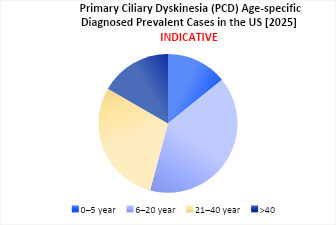
- In the United States, age-specific diagnosed prevalent cases of PCD were categorized into 0–5, 6–20, 21–40, and >40 years, with the 6–20 years age group accounting for the highest number of diagnosed prevalent cases in 2025.
- Based on clinical manifestations, the diagnosed prevalent cases of PCD in the United States were segmented into Pulmonary Disease, Situs Abnormality, Infertility, Eye Disorders, and Other Clinical Manifestations, with Pulmonary Disease accounting for the largest proportion of cases in 2025.
- Despite being a congenital disorder present from birth, PCD is frequently diagnosed later in childhood or adulthood due to heterogeneous clinical presentation and limited access to specialized diagnostic testing, contributing to an underrecognized disease burden across the 7MM.
- PCD affects males and females almost equally, consistent with its predominantly autosomal recessive inheritance pattern, and improvements in genetic testing and specialized diagnostic techniques are expected to increase the diagnosed patient population over the forecast period.
Scope of the Report
- The report covers a segment of a descriptive overview of Primary Ciliary Dyskinesia (PCD), explaining their causes, signs and symptoms, and pathogenesis.
- Comprehensive insight has been provided into the epidemiology segments and forecasts, the future growth potential of the diagnosis rate, and disease progression.
Report Insights
Primary Ciliary Dyskinesia (PCD) Patient Population Forecast
Report Key Strengths
- Epidemiology‑based (Epi‑based) Bottom‑up Forecasting
- 11-year Forecast
- Patient Burden Trends (by geography)
FAQs
- What are the disease risks, burdens, and unmet needs of PCD? What will be the growth opportunities across the 7MM concerning the patient population with PCD?
- What is the historical and forecasted PCD patient pool in the US, EU4 (Germany, France, Italy, and Spain), the UK, and Japan?
Reasons to Buy
- Insights on patient burden/disease prevalence, evolution in diagnosis, and factors contributing to the change in the epidemiology of the disease during the forecast years.
- To understand key opinion leaders’ perspectives around the diagnostic challenges to overcome barriers in the future.
- Detailed insights on various factors hampering disease diagnosis and other existing diagnostic challenges.