
Primary Progressive Aphasia Market
Key Highlights
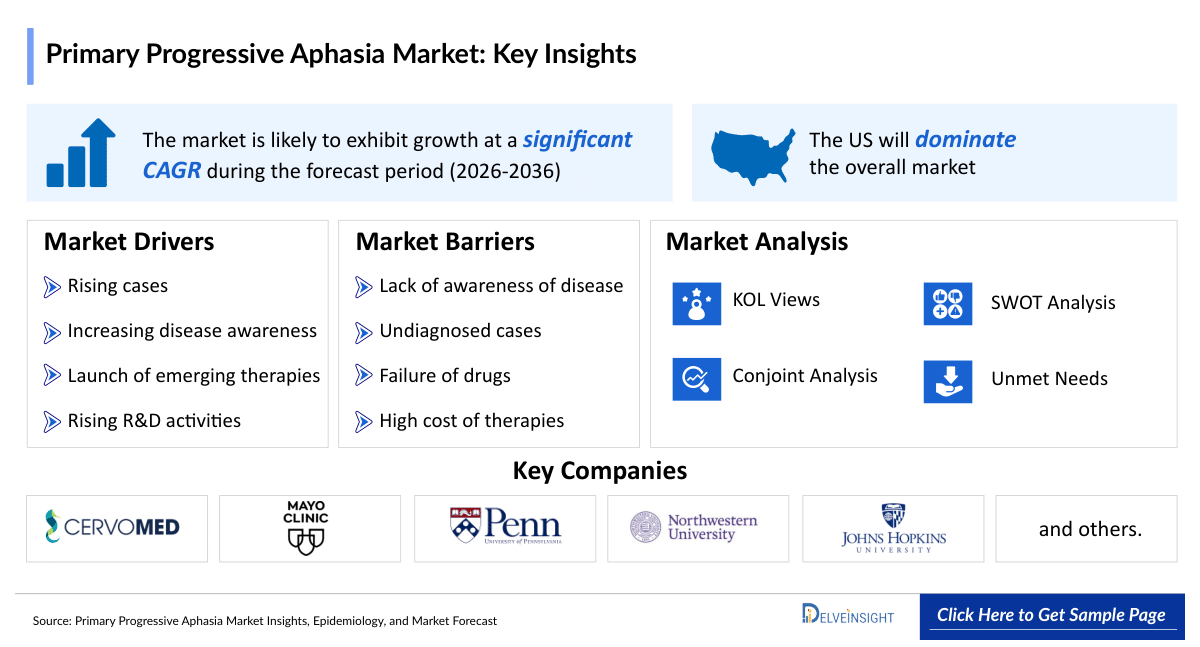
- The primary progressive aphasia market is expected to grow significantly by 2036.
- Leading companies active in the primary progressive aphasia market include CervoMed Inc. (formerly EIP Pharma), alongside academic research institutions such as Mayo Clinic, University of Pennsylvania, Northwestern University, Johns Hopkins University, and University of Chicago.
DelveInsight's "Primary Progressive Aphasia Market Insights, Epidemiology, and Market Forecast-2036" report delivers an in-depth understanding of the Primary Progressive Aphasia, historical and forecasted epidemiology as well as the Primary Progressive Aphasia market trends in the United States, EU5 (Germany, Spain, Italy, France, and United Kingdom) and Japan.
The Primary Progressive Aphasia market report provides current treatment practices, emerging drugs, Primary Progressive Aphasia market share of the individual therapies, current and forecasted Primary Progressive Aphasia market Size from 2022 to 2036 segmented by seven major markets. The Report also covers current Primary Progressive Aphasia treatment practice/algorithm, market drivers, market barriers and unmet medical needs to curate the best of the opportunities and assesses the underlying potential of the Primary Progressive Aphasia market.
Geography Covered
- The United States
- EU5 (Germany, France, Italy, Spain, and the United Kingdom)
- Japan
Study Period: 2022-2036
Key Factors Driving the Primary Progressive Aphasia (PPA) Market
- Increasing Prevalence of Neurodegenerative Disorders: The rising prevalence of neurodegenerative conditions, particularly frontotemporal lobar degeneration and Alzheimer's disease, is increasing the clinical recognition of primary progressive aphasia (PPA). Growing awareness of language-predominant neurodegenerative syndromes is supporting demand for diagnostic services, symptomatic treatments, and disease-management solutions.
- Growing Awareness and Early Diagnosis of PPA: Improved awareness among neurologists, speech-language pathologists, and caregivers is facilitating earlier identification of PPA and its clinical variants. Advancements in neuropsychological assessments, brain imaging, and biomarker-based diagnostic approaches are improving diagnostic accuracy and supporting patient identification.
- High Unmet Medical Need and Lack of Approved Therapies: The absence of disease-modifying or specifically approved pharmacological treatments for PPA represents a significant unmet medical need. This is encouraging pharmaceutical companies and academic institutions to investigate novel therapeutic approaches targeting underlying neurodegenerative mechanisms and language deterioration.
- Advancements in Neurodegenerative Disease Research: Increasing research into frontotemporal dementia, Alzheimer's disease, tauopathies, and TDP-43 proteinopathies is improving understanding of PPA pathophysiology. These developments are supporting the identification of potential therapeutic targets and expanding clinical research opportunities for disease-specific interventions.
- Expansion of Clinical Trials and Emerging Therapeutic Pipeline: Growing clinical investigation of therapies targeting neurodegeneration, including agents developed for Alzheimer's disease and frontotemporal dementia, is creating opportunities for the PPA treatment landscape. Repurposing existing drugs and developing novel neuroprotective therapies may expand future treatment options.
Primary Progressive Aphasia Disease Understanding and Treatment Algorithm
Primary Progressive Aphasia (PPA) is a rare, neurodegenerative neurological disorder characterized by the gradual deterioration of language abilities, including speaking, understanding words, reading, and writing. It is a clinical syndrome associated with progressive degeneration of brain regions responsible for language processing, particularly within the left cerebral hemisphere. PPA is generally classified into three major variants: nonfluent/agrammatic variant (nfvPPA), semantic variant (svPPA), and logopenic variant (lvPPA), each characterized by distinct language impairments and underlying pathological mechanisms. Although language dysfunction is the predominant early symptom, other cognitive and behavioral impairments may develop as the disease progresses, significantly affecting communication, independence, and quality of life.
Primary Progressive Aphasia Diagnosis
The diagnosis of Primary Progressive Aphasia involves a comprehensive clinical evaluation to identify progressive language impairment and distinguish PPA from other neurological and cognitive disorders, including Alzheimer's disease and other forms of dementia. Assessment typically includes detailed neurological examinations, speech and language evaluations, neuropsychological testing, and cognitive assessments to characterize language deficits and identify the specific PPA variant. Brain imaging techniques, particularly magnetic resonance imaging (MRI), are used to identify characteristic patterns of cerebral atrophy, while positron emission tomography (PET) may help assess metabolic abnormalities or underlying pathology. Additional investigations, including cerebrospinal fluid (CSF) biomarkers and emerging blood-based biomarkers, may support the identification of underlying neurodegenerative processes, particularly Alzheimer's disease-related pathology in patients with logopenic variant PPA.
Primary Progressive Aphasia Treatment
Currently, no approved disease-modifying treatment is available specifically for Primary Progressive Aphasia, and therapeutic management primarily focuses on symptom alleviation, preservation of communication abilities, and maintaining quality of life. Speech and language therapy represents the cornerstone of treatment, incorporating individualized interventions such as naming exercises, communication strategies, language rehabilitation, and augmentative and alternative communication (AAC) tools to support functional communication. Pharmacological approaches may be considered in selected patients, particularly those with underlying Alzheimer's disease pathology, although evidence supporting their efficacy in PPA remains limited. Supportive care, caregiver education, cognitive rehabilitation, and multidisciplinary management are essential components of treatment, while ongoing clinical research is investigating potential disease-modifying therapies targeting neurodegenerative mechanisms, including tau, amyloid-beta, and other pathological pathways.
Primary Progressive Aphasia Epidemiology
The Primary Progressive Aphasia epidemiology section provides insights about the historical and current Primary Progressive Aphasia patient pool and forecasted trends for individual seven major countries. It helps to recognize the causes of current and forecasted trends by exploring numerous studies and views of key opinion leaders. This part of the Primary Progressive Aphasia market report also provides the diagnosed patient pool and their trends along with assumptions undertaken.
Key Findings
The disease epidemiology covered in the report provides historical as well as forecasted Primary Progressive Aphasia epidemiology scenario in the 7MM covering the United States, EU5 countries (Germany, Spain, Italy, France, and the United Kingdom), and Japan from 2022 to 2036.
Country Wise- Primary Progressive Aphasia Epidemiology
The epidemiology segment also provides the Primary Progressive Aphasia epidemiology data and findings across the United States, EU5 (Germany, France, Italy, Spain, and the United Kingdom), and Japan.
Primary Progressive Aphasia Drug Chapters
The drug chapter segment of the Primary Progressive Aphasia report encloses the detailed analysis of Primary Progressive Aphasia marketed drugs and late-stage (Phase-III and Phase-II) Primary Progressive Aphasia pipeline drugs. It also helps to understand the Primary Progressive Aphasia clinical trial details, expressive pharmacological action, agreements and collaborations, approval and patent details, advantages and disadvantages of each included drug and the latest news and press releases.
Primary Progressive Aphasia Emerging Drugs
Neflamapimod: CervoMed Inc.
Neflamapimod is an investigational, orally administered, small-molecule inhibitor of p38α mitogen-activated protein kinase (MAPK), a signaling pathway associated with neuroinflammation and synaptic dysfunction. The drug is being investigated for its potential to reduce neuroinflammatory processes and improve neuronal function in patients with nonfluent variant primary progressive aphasia. CervoMed completed enrollment in its Phase 2a clinical study in July 2026, enrolling 25 participants across clinical sites in the United States and United Kingdom. Preliminary biomarker findings reported in October 2026 demonstrated a reduction in mean plasma neurofilament light chain (NfL), suggesting a potential reduction in neuronal injury. Initial clinical efficacy results are anticipated in 2027.
Verdiperstat (BHV-3241): Biohaven
Verdiperstat is an investigational oral myeloperoxidase (MPO) inhibitor being evaluated for semantic variant primary progressive aphasia associated with frontotemporal lobar degeneration and TDP-43 pathology. The drug is designed to inhibit MPO-mediated oxidative stress and neuroinflammatory processes, which may contribute to neuronal injury and disease progression. The Phase 1 Veri-T study evaluates the safety, tolerability, pharmacokinetics, pharmacodynamics, and preliminary efficacy of verdiperstat over a 24-week treatment period. Approximately 64 participants were planned for enrollment, with a randomized placebo-controlled design. The investigation also assesses changes in cerebrospinal fluid biomarkers, MRI measures, and cognitive and language outcomes.
Primary Progressive Aphasia Market Outlook
The Primary Progressive Aphasia market outlook of the report helps to build a detailed comprehension of the historic, current, and forecasted Primary Progressive Aphasia market trends by analyzing the impact of current Primary Progressive Aphasia therapies on the market, unmet needs, drivers and barriers, and demand for better technology.
This segment gives a thorough detail of Primary Progressive Aphasia market trend of each marketed drug and late-stage pipeline therapy by evaluating their impact based on the annual cost of therapy, inclusion and exclusion criteria's, mechanism of action, compliance rate, growing need of the market, increasing patient pool, covered patient segment, expected launch year, competition with other therapies, brand value, their impact on the market and view of the key opinion leaders. The calculated Primary Progressive Aphasia market data are presented with relevant tables and graphs to give a clear view of the market at first sight.
According to DelveInsight, the Primary Progressive Aphasia market in 7MM is expected to witness a major change in the study period 2022-2036.
Key Findings
This section includes a glimpse of the Primary Progressive Aphasia market in 7MM.
The United States Market Outlook
This section provides the total Primary Progressive Aphasia market size and market size by therapies in the United States.
EU-5 Countries: Market Outlook
The total Primary Progressive Aphasia market size and market size by therapies in Germany, France, Italy, Spain, and the United Kingdom is provided in this section.
Japan Market Outlook
The total Primary Progressive Aphasia market size and market size by therapies in Japan is also mentioned.
Primary Progressive Aphasia Drugs Uptake
This section focuses on the rate of uptake of the potential Primary Progressive Aphasia therapies recently launched in the Primary Progressive Aphasia market or expected to get launched in the market during the study period 2022-2036. The analysis covers Primary Progressive Aphasia market uptake by drugs; patient uptake by therapies; and sales of each drug.
Primary Progressive Aphasia Drugs Uptake helps in understanding the drugs with the most rapid uptake, reasons behind the maximal use of new drugs, and allow the comparison of the drugs on the basis of Primary Progressive Aphasia market share and size which again will be useful in investigating factors important in market uptake and in making financial and regulatory decisions.
Primary Progressive Aphasia Pipeline Development Activities
The Primary Progressive Aphasia report provides insights into different therapeutic candidates in Phase II, and Phase III stage. It also analyses Primary Progressive Aphasia key players involved in developing targeted therapeutics.
Pipeline Development Activities
The Primary Progressive Aphasia report covers the detailed information of collaborations, acquisition, and merger, licensing, patent details, and other information for Primary Progressive Aphasia emerging therapies.
Reimbursement Scenario in Primary Progressive Aphasia
Approaching reimbursement proactively can have a positive impact both during the late stages of product development and well after product launch. In a report, we take reimbursement into consideration to identify economically attractive indications and market opportunities. When working with finite resources, the ability to select the markets with the fewest reimbursement barriers can be a critical business and price strategy.
KOL- Views
To keep up with current Primary Progressive Aphasia market trends, we take KOLs and SMEs ' opinion working in the Primary Progressive Aphasia domain through primary research to fill the data gaps and validate our secondary research. Their opinion helps to understand and validate current and emerging therapies treatment patterns or Primary Progressive Aphasia market trends. This will support the clients in potential upcoming novel treatment by identifying the overall scenario of the market and the unmet needs.
Competitive Intelligence Analysis
We perform Competitive and Market Intelligence analysis of the Primary Progressive Aphasia Market by using various Competitive Intelligence tools that include - SWOT analysis, PESTLE analysis, Porter's five forces, BCG Matrix, Market entry strategies etc. The inclusion of the analysis entirely depends upon the data availability.
Scope of the Report
- The report covers the descriptive overview of Primary Progressive Aphasia, explaining its causes, signs and symptoms, pathophysiology, diagnosis and currently available therapies
- Comprehensive insight has been provided into the Primary Progressive Aphasia epidemiology and treatment in the 7MM
- Additionally, an all-inclusive account of both the current and emerging therapies for Primary Progressive Aphasia is provided, along with the assessment of new therapies, which will have an impact on the current treatment landscape
- A detailed review of the Primary Progressive Aphasia market; historical and forecasted is included in the report, covering drug outreach in the 7MM
- The report provides an edge while developing business strategies, by understanding trends shaping and driving the global Primary Progressive Aphasia market
Report Highlights
- In the coming years, the Primary Progressive Aphasia market is set to change due to the rising awareness of the disease, and incremental healthcare spending across the world; which would expand the size of the market to enable the drug manufacturers to penetrate more into the market
- The companies and academics are working to assess challenges and seek opportunities that could influence Primary Progressive Aphasia R&D. The therapies under development are focused on novel approaches to treat/improve the disease condition
- Major players are involved in developing therapies for Primary Progressive Aphasia. The launch of emerging therapies will significantly impact the Primary Progressive Aphasia market
- A better understanding of disease pathogenesis will also contribute to the development of novel therapeutics for Primary Progressive Aphasia
- Our in-depth analysis of the pipeline assets across different stages of development (Phase III and Phase II), different emerging trends and comparative analysis of pipeline products with detailed clinical profiles, key cross-competition, launch date along with product development activities will support the clients in the decision-making process regarding their therapeutic portfolio by identifying the overall scenario of the research and development activities
Primary Progressive Aphasia Report Insights
- Primary Progressive Aphasia Patient Population
- Therapeutic Approaches
- Primary Progressive Aphasia Pipeline Analysis
- Primary Progressive Aphasia Market Size and Trends
- Primary Progressive Aphasia Market Opportunities
- Impact of upcoming Primary Progressive Aphasia Therapies
Primary Progressive Aphasia Report Key Strengths
- 11 Years Forecast
- 7MM Coverage
- Primary Progressive Aphasia Epidemiology Segmentation
- Key Cross Competition
- Highly Analyzed Market
- Drugs Uptake
Primary Progressive Aphasia Report Assessment
- Current Treatment Practices
- Unmet Needs
- Primary Progressive Aphasia Pipeline Product Profiles
- Primary Progressive Aphasia Market Attractiveness
- Market Drivers and Barriers
Key Questions
Market Insights:
- What was the Primary Progressive Aphasia drug class share (%) distribution in 2022 and how it would look like in 2036?
- What would be the Primary Progressive Aphasia total market size as well as market size by therapies across the 7MM during the forecast period (2022-2036)?
- What are the key findings pertaining to the market across 7MM and which country will have the largest Primary Progressive Aphasia market size during the forecast period (2022-2036)?
- At what CAGR, the Primary Progressive Aphasia market is expected to grow by 7MM during the forecast period (2022-2036)?
- What would be the Primary Progressive Aphasia market outlook across the 7MM during the forecast period (2022-2036)?
- What would be the Primary Progressive Aphasia market growth till 2036, and what will be the resultant market Size in the year 2036?
- How would the unmet needs affect the market dynamics and subsequent analysis of the associated trends?
Epidemiology Insights:
- What are the disease risk, burden, and regional/ethnic differences of the Primary Progressive Aphasia?
- What are the key factors driving the epidemiology trend for seven major markets covering the United States, EU5 (Germany, Spain, France, Italy, UK), and Japan?
- What is the historical Primary Progressive Aphasia patient pool in seven major markets covering the United States, EU5 (Germany, Spain, France, Italy, UK), and Japan?
- What would be the forecasted patient pool of Primary Progressive Aphasia in seven major markets covering the United States, EU5 (Germany, Spain, France, Italy, UK), and Japan?
- Where will be the growth opportunities in the 7MM with respect to the patient population pertaining to Primary Progressive Aphasia?
- Out of all 7MM countries, which country would have the highest prevalent population of Primary Progressive Aphasia during the forecast period (2022-2036)?
- At what CAGR the patient population is expected to grow in 7MM during the forecast period (2022-2036)?
Current Treatment Scenario, Marketed Drugs and Emerging Therapies:
- What are the current options for the Primary Progressive Aphasia treatment in addition to the approved therapies?
- What are the current treatment guidelines for the treatment of Primary Progressive Aphasia in the USA, Europe, and Japan?
- What are the Primary Progressive Aphasia marketed drugs and their respective MOA, regulatory milestones, product development activities, advantages, disadvantages, safety and efficacy, etc.?
- How many companies are developing therapies for the treatment of Primary Progressive Aphasia?
- How many therapies are in-development by each company for Primary Progressive Aphasia treatment?
- How many are emerging therapies in mid-stage, and late stage of development for Primary Progressive Aphasia treatment?
- What are the key collaborations (Industry - Industry, Industry - Academia), Mergers and acquisitions, licensing activities related to the Primary Progressive Aphasia therapies?
- What are the recent novel therapies, targets, mechanisms of action and technologies being developed to overcome the limitation of existing therapies?
- What are the clinical studies going on for Primary Progressive Aphasia and their status?
- What are the current challenges faced in drug development?
- What are the key designations that have been granted for the emerging therapies for Primary Progressive Aphasia?
- What are the global historical and forecasted market of Primary Progressive Aphasia?
Reasons to buy
- The report will help in developing business strategies by understanding trends shaping and driving the Primary Progressive Aphasia market
- To understand the future market competition in the Primary Progressive Aphasia market and Insightful review of the key market drivers and barriers
- Organize sales and marketing efforts by identifying the best opportunities for Primary Progressive Aphasia in the US, Europe (Germany, Spain, Italy, France, and the United Kingdom) and Japan
- Identification of strong upcoming players in the market will help in devising strategies that will help in getting ahead of competitors
- Organize sales and marketing efforts by identifying the best opportunities for Primary Progressive Aphasia market
- To understand the future market competition in the Primary Progressive Aphasia market