Progeria Market
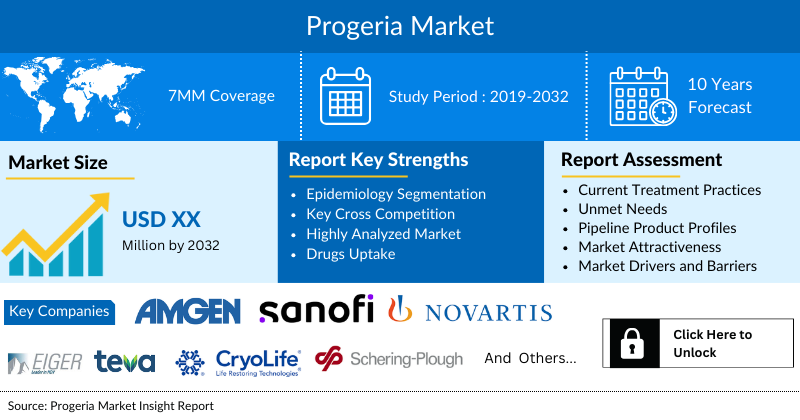
- The Progeria market is projected to experience a consistent Compound Annual Growth Rate (CAGR) during the forecast period. The growth in market revenue is primarily driven by the rising awareness of progeria disease and the increasing number of reported cases. While there is no cure for progeria, several market drivers contribute to its ongoing research, drug development, and treatment options, like advances in genetics and genomics, collaborative research efforts, clinical trials, technological advancements, and a growing market for Precision Medicine, among other factors.
- In emerging economies, the progeria treatment market is anticipated to witness a slow growth primarily due to limited treatment options available for the disease. With only a few medications currently approved, mostly addressing progeria’s complications rather than providing a definitive cure, the market expansion may get restrained.
Download the Sample PDF to Get More Insight @ Progeria Market
DelveInsight’s comprehensive report titled “Progeria Market Insights, Epidemiology, and Market Forecast – 2034” offers a detailed analysis of progeria. The report presents historical and projected epidemiological data covering Total Prevalent Cases and Diagnosed Prevalent Cases of Progeria, further segmented by Type (Hutchinson–Gilford progeria syndrome and Werner syndrome). In addition to epidemiology, the market report encompasses various aspects related to the patient population. These aspects include the diagnosis process, prescription patterns, physician perspectives, market accessibility, treatment options, and prospective developments in the market across seven major markets: the United States, EU4 (Germany, France, Italy, and Spain), the United Kingdom, and Japan, spanning from 2020 to 2034.
The report analyzes the existing treatment practices and unmet medical requirements in progeria. It evaluates the market potential and identifies potential business prospects for enhancing therapies or interventions. This valuable information enables stakeholders to make well-informed decisions regarding product development and strategic planning for the market.
|
Study Period |
2020–2034 |
|
Forecast Period |
2025–2034 |
|
Geographies Covered |
US, EU4 (Germany, France, Italy, and Spain) and the UK, and Japan |
|
Progeria Epidemiology |
|
|
Progeria Market |
|
|
Market Analysis |
|
|
Progeria Market players |
|
|
Future opportunity |
The development of breakthrough therapies, disease-modifying treatments, increased awareness and access to care, advancements in genetic research, and personalized medicine may open up new avenues for targeted treatments, providing further opportunities for market growth. |
Progeria Treatment Market
Progeria Overview
Progeria refers to a group of rare human disorders characterized by premature aging. There are two primary types of progeria: Hutchinson–Gilford Progeria Syndrome (HGPS), which starts in early childhood, and Werner syndrome (also known as adult progeria), which develops later in life.
HGPS is caused by a mutation in the LMNA gene, which leads to the production of an abnormal protein called progerin, while Werner syndrome is caused by mutations in the WRN gene, which is responsible for encoding the Werner protein.
HGPS-affected children exhibit signs of accelerated aging, including slowed growth and development, loss of body fat and hair, characteristic facial features, joint stiffness, and cardiovascular issues. Their average lifespan is around 14 years, with most not surviving beyond their teenage years. Unlike HGPS, Werner syndrome symptoms include gray hair, thinning skin, cataracts, diabetes, and an increased risk of age-related diseases, such as cardiovascular disease and certain cancers.
HGPS and Werner syndrome are categorized as progeroid syndromes due to their association with premature aging. However, they have distinct genetic causes, age of onset, and clinical features.
Progeria Diagnosis
The diagnosis of progeria, including both types (Hutchinson–Gilford Progeria Syndrome – HGPS and Werner syndrome – adult progeria), involves a combination of clinical evaluation, medical history, and genetic testing. The early diagnosis of progeria is crucial for providing appropriate medical care and support to the affected individuals and their families. Genetic testing is a definitive method to differentiate between the two types of progeria and guide management strategies accordingly.
Progeria Treatment
There is no cure for Progeria. Treatment primarily focuses on managing symptoms and providing supportive care to improve the affected individuals’ quality of life. Treatment approaches for progeria may include medications, physical therapy, cardiac care, nutritional support, and supportive care. The management of progeria requires a multidisciplinary approach involving healthcare professionals from various specialties to address the specific needs of affected individuals comprehensively. Research is ongoing to understand the condition better and explore potential therapies.
Progeria Epidemiology
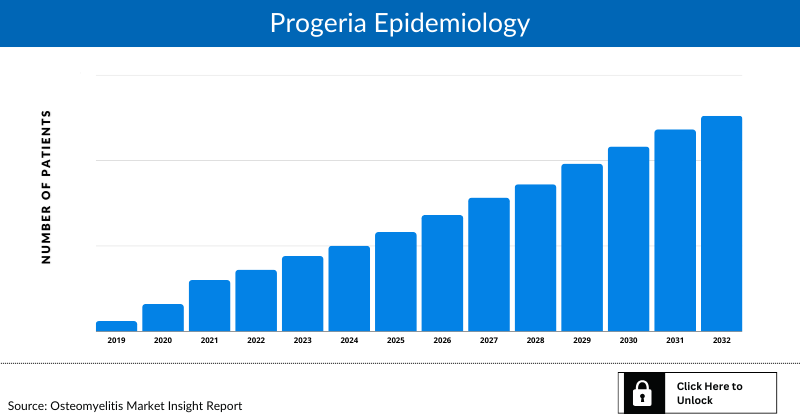
The epidemiology section on the Progeria market report offers information on the patient populations, including historical and projected trends for each of the seven major markets. Examining key opinion leader views from physicians or clinical experts can assist in identifying the reasons behind historical and projected trends. The diagnosed patient pool, their trends, and the underlying assumptions are all included in this section of the report.
This section also presents the data with relevant tables and graphs, offering a clear and concise view of the prevalence of progeria. Additionally, the report discloses the assumptions made during the analysis, ensuring data interpretation and presentation transparency. This epidemiological data is valuable for understanding the disease burden and its impact on the patient population across various regions.
Key Findings
- According to NORD (n.d.), HGPS and Werner syndrome are rare disorder that appears to affect males and females equally and all races equally. The prevalence of HGPS is approximately 1 in 20 million, so at any given time, approximately 400 children are living with progeria worldwide. It is a rare disorder that affects males and females equally. Werner syndrome’s frequency has been estimated at 1–20 per one million individuals in the United States. Although certain associated findings are present beginning during childhood, puberty, and young adulthood, the disorder is most frequently recognized in the third or fourth decades of life.
- Coppedè (2016) reported a birth prevalence of 1 in 8 million HGPS, but considering misdiagnosed or unreported cases, the estimated prevalence is 1 in 4 million births.
- As per the data by Orphanet (n.d.), the prevalence of Werner syndrome among Japanese and Sardinian populations is estimated to be 1/50,000 due to founder mutations. Prevalence in other populations is unknown but may be around 1/200,000.
- Werner syndrome is the most common form of progeria. The first signs of this disorder appear only after puberty, with the full symptoms manifesting in individuals 20–30 years old. A much rarer progeria, Hutchinson–Gilford syndrome, develops earlier: victims die, apparently of old age, typically around age 12. Fortunately, this hereditary disease occurs very infrequently.
Progeria Market Outlook
The treatment goal for progeria is to alleviate symptoms, improve the affected individuals’ quality of life, and potentially slow down the condition’s progression. While there is no cure, supportive care, management of complications, and ongoing research aim to enhance the overall well-being of individuals living with progeria.
Medications are prescribed to manage cardiovascular issues, joint stiffness, and other health concerns commonly in progeria. Regular cardiovascular monitoring is vital in identifying and addressing any potential heart-related complications.
Physical therapy is often recommended to maintain joint mobility, improve muscle strength, and manage musculoskeletal issues. This intervention helps individuals with progeria retain physical function and overall mobility, promoting a better quality of life.
In November 2020, the US Food and Drug Administration (FDA) approved the use of ZOKINVY (lonafarnib) to treat progeria. It is a significant milestone as the first and only FDA-approved treatment for progeria and processing-deficient progeroid laminopathies (PDPL) in individuals aged 12 months and above.
With ongoing research and continued dedication, the future holds hope for even more effective treatments and, ultimately, a cure for this challenging condition. According to DelveInsight, the Progeria market in the 7MM is expected to change significantly during the study period 2020–2034.
Progeria Drug Chapters
Marketed Progeria Drugs
ZOKINVY (lonafarnib): Eiger BioPharmaceuticals
ZOKINVY, developed by Eiger BioPharmaceuticals, is a groundbreaking therapy that targets the underlying cause of progeria by inhibiting the production of the toxic protein progerin. Zokinvy stands as the pioneering and sole treatment designed to address both the cause and symptoms of progeria, which is also referred to as Hutchinson–Gilford Progeria Syndrome (HGPS) and processing-deficient progeroid laminopathies (PDPL), in individuals aged 12 months and above. The drug was approved by the US FDA in 2020 and by EMA in 2022.
Note: Detailed marketed therapies assessment will be provided in the final report...
Emerging Progeria Drugs
The Progeria market is expected to experience gradual changes, mainly due to the limited availability of emerging therapies in this area. Key market players, including PRG Science & Technology Co., Ltd, Eiger BioPharmaceuticals, and others, have demonstrated a keen interest in this rare condition and are actively pursuing the development of potential treatments.
Progerinin: PRG Science & Technology Co., Ltd.
Previous research discovered that inhibiting the binding between progerin and lamin A (using a compound referred to as JH4) could improve the pathological characteristics associated with Hutchinson–Gilford Progeria Syndrome (HGPS). PRG Science & Technology is developing Progerinin (PRG-S-1 and PRG-S-2) for the treatment of progeria, including HGPS and Werner Syndrome, respectively, in Phase II clinical trials.
Note: Detailed emerging therapies assessment will be provided in the final report....
Progeria Market Segmentation
DelveInsight’s ‘Progeria Market Insights, Epidemiology, and Market Forecast – 2032’ report provides a detailed outlook of the current and future Progeria market, segmented within countries, by therapies, and by classes. Further, the market of each region is then segmented by each therapy to provide a detailed view of the current and future market share of all therapies.
Progeria Market Size by Countries
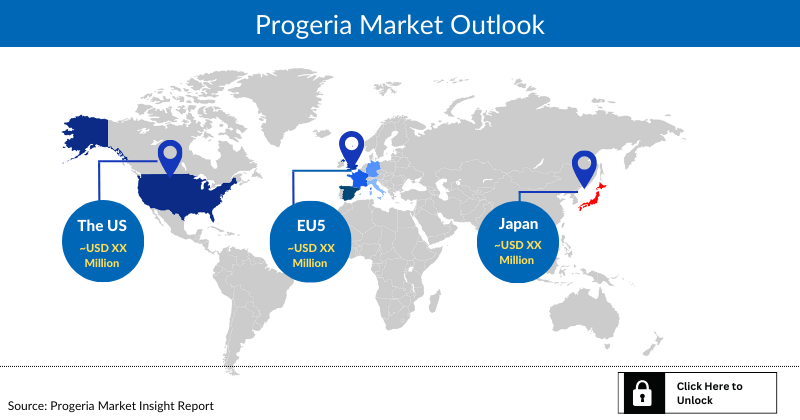
The Progeria market size is assessed separately for various countries, including the United States, EU4 (Germany, France, Italy, and Spain), the UK, and Japan. In 2022, the United States held a significant share of the overall 7MM (Seven Major Markets) Progeria market, primarily attributed to the country's higher prevalence of the condition and the elevated cost of the available treatments. This dominance is projected to persist, especially with the potential early introduction of new products.
Progeria Market Size by Therapies
Progeria Market Size by Therapies is categorized into current and emerging markets for the study period 2020–2034. One of the emerging drugs anticipated to launch during the forecast period is Progerinin under the developmental pipeline of PRG Science & Technology Co., Ltd.
Note: Detailed market segment assessment will be provided in the final report....
Progeria Drugs Uptake
This section focuses on the sales uptake of potential Progeria drugs that have recently been launched or are anticipated to be launched in the Progeria market between 2019 and 2032. It estimates the market penetration of Progeria drugs for a given country, examining their impact within and across classes and segments. It also touches upon the financial and regulatory decisions contributing to the probability of success (PoS) of the drugs in the Progeria market.
The emerging Progeria therapies are analyzed based on various attributes such as safety and efficacy in randomized clinical trials, order of entry and other market dynamics, and the unmet need they fulfill in the Progeria market.
Note: Detailed assessment of drug uptake and attribute analysis will be provided in the full report on progeria....
Progeria Market Access and Reimbursement
DelveInsight’s ‘Progeria Market Insights, Epidemiology, and Market Forecast – 2034’ report provides a descriptive overview of the market access and reimbursement scenario of progeria.
This section includes a detailed analysis of the country-wise healthcare system for each therapy, enlightening the market access, reimbursement policies, and health technology assessments.
KOL Views
To keep up with current Progeria market trends and fill gaps in secondary findings, we interview KOLs and SMEs’ working in the Progeria domain. Their opinion helps understand and validate current and emerging therapies and treatment patterns or Progeria market trends. This will support the clients in potential upcoming novel treatments by identifying the overall scenario of the market and the Progeria unmet needs.
Progeria: KOL Insights
DelveInsight’s analysts connected with 50+ KOLs to gather insights; however, interviews were conducted with 15+ KOLs in the 7MM. These KOLs were from organizations, institutes, and hospitals, such as the Boston Children’s Hospital in the US, CIBER de Enfermedades Cardiovasculares (CIBERCV) in Spain, Oita University, Yufu in Japan, University Children’s Hospital, Magdeburg, in Germany, and organizations like Progeria Research Foundation, International Progeria Registry, among others.
“Specific class of drugs, including lonafarnib, showed promise as a potential treatment for progeria.”
Note: Detailed assessment of KOL Views will be provided in the full report on progeria....
Competitive Intelligence Analysis
We conduct a Competitive and Market Intelligence analysis of the Progeria Market, utilizing various Competitive Intelligence tools such as SWOT analysis and Market entry strategies. The inclusion of these analyses is contingent upon data availability, ensuring a comprehensive and well-informed assessment of the market landscape and competitive dynamics.
Progeria Pipeline Development Activities
The Progeria report offers an analysis of Progeria Clinical Trials within Phase II and III stages and examines companies involved in developing targeted therapeutics for progeria. It provides valuable insights into the advancements and progress of potential treatments in clinical development for this condition.
Pipeline Development Activities
The report covers information on collaborations, acquisition and merger, licensing, patent details, and other information for emerging Progeria therapies.
Progeria Report Insights
- Progeria Patient Population
- Progeria Therapeutic Approaches
- Progeria Pipeline Analysis
- Progeria Market Size and Trends
- Progeria Market Opportunities
- Impact of Upcoming Progeria Therapies
Progeria Report Key Strengths
- 10 Years Forecast
- The 7MM Coverage
- Progeria Epidemiology Segmentation
- Key Cross Competition
- Highly Analyzed Progeria Market
- Progeria Drugs Uptake
Progeria Report Assessment
- Progeria Current Treatment Practices
- Progeria Unmet Needs
- Progeria Pipeline Product Profiles
- Progeria Market Attractiveness
- Progeria Market Drivers
- Progeria Market Barriers
Key Questions Answered In The Progeria Market Report
- How common is progeria?
- What are the key findings of Progeria epidemiology across the 7MM, and which country will have the highest number of patients during the study period (2020–2034)?
- What are the currently available treatments for progeria?
- What is the disease risk, burden, and unmet needs of progeria?
- At what CAGR is the Progeria market and its epidemiology expected to grow in the 7MM during the forecast period (2025–2034)?
- How would the unmet needs impact the Progeria market dynamics and subsequently influence the analysis of the related trends?
- What would be the forecasted patient pool of progeria in the 7MM covering the United States, EU4 (Germany, France, Italy, and Spain), the UK, and Japan?
- Among EU4 and the UK, which country will have the highest number of patients during the forecast period (2020–2034)?
- How many companies are currently developing therapies for the treatment of progeria?
-market.png&w=256&q=75)