
Prosthetic Liners Market Summary
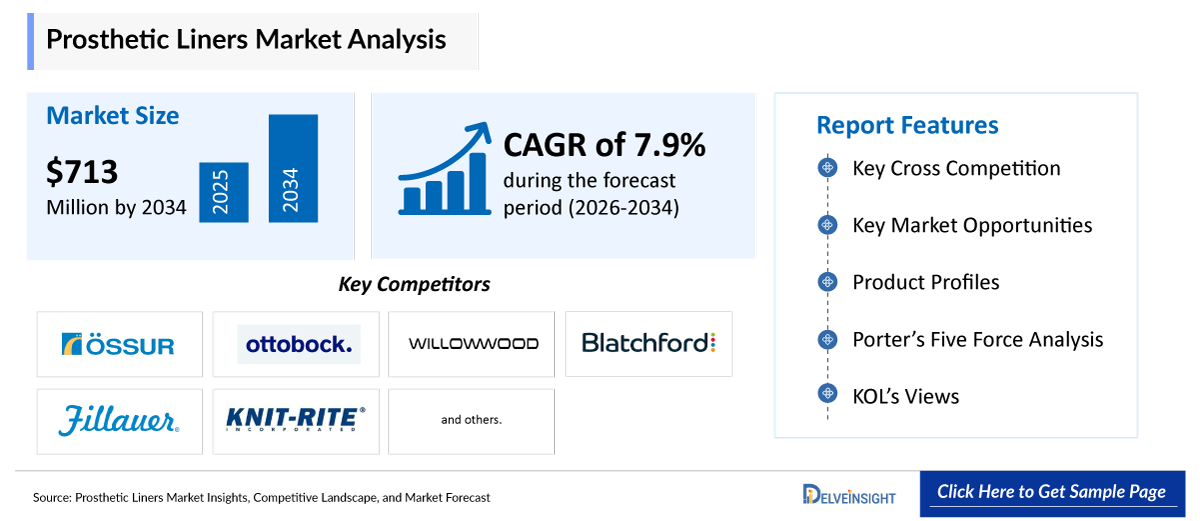
- The Prosthetic Liners market is estimated at USD 359.5 million in 2025 and is projected to reach USD 713.0 million by 2034. Growth is anchored in the rising global prevalence of limb loss due to diabetes and vascular disease, expanding adoption of silicone and gel-based liner technologies, and growing prosthetic and orthotic clinic infrastructure worldwide.
- The global Prosthetic Liners market is growing at a CAGR of 7.9% during the forecast period from 2026 to 2034.
- By product type, the locking liners segment dominated the Prosthetic Liners market with a 38% share in 2025.
- By material, the silicone segment dominated the Prosthetic Liners market with a 57% share in 2025.
- By prosthesis type, the lower-limb prosthetic liners segment dominated the Prosthetic Liners market with a 65% share in 2025.
- By end-user, the prosthetic & orthotic clinics segment dominated the Prosthetic Liners market with a 44% share in 2025.
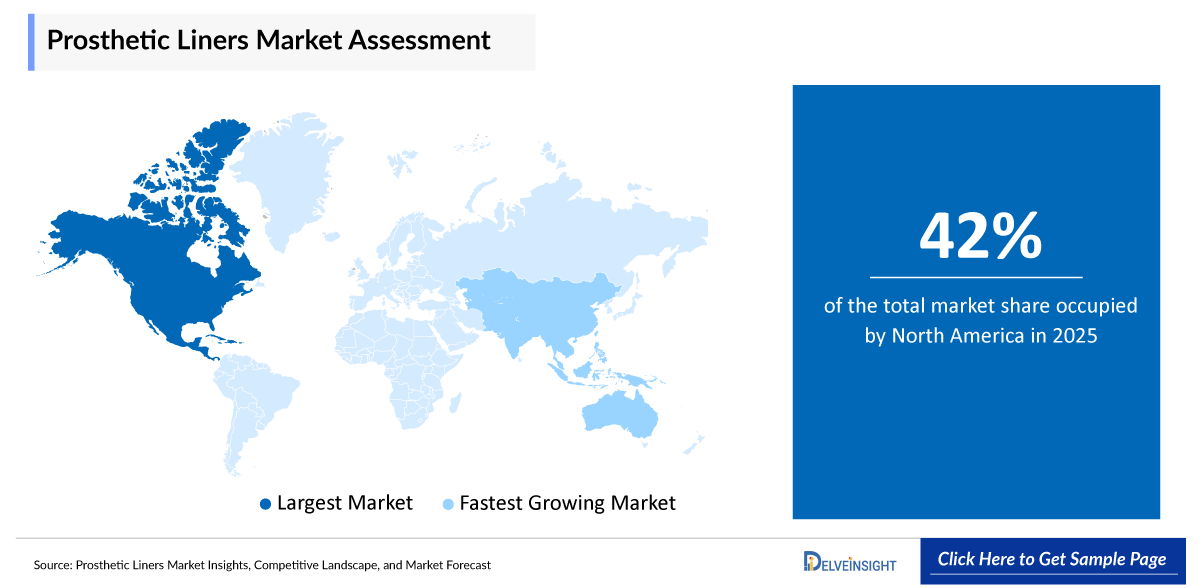
- North America dominated the global Prosthetic Liners market revenue with a 42% share in 2025, representing the highest regional market share globally.
A prosthetic liner is a protective interface layer worn between the residual limb and the prosthetic socket that cushions the limb, distributes pressure, reduces shear and friction, and, in many designs, provides suspension that keeps the prosthesis securely attached during use. Because the residual limb changes shape with activity, volume fluctuation, and perspiration, liners must balance comfort, hygiene, durability, and secure fit, and are manufactured from medical-grade silicone, polyurethane, and other advanced elastomeric materials. The market is organized by product type across cushion liners, locking liners, seal-in liners, suction liners, and other specialty designs; by material across silicone, polyurethane, and other materials; by prosthesis type across lower-limb and upper-limb prosthetic liners; and by end-user across prosthetic and orthotic clinics, hospitals, rehabilitation centers, and other care settings. Driven by rising amputation incidence linked to diabetes and vascular disease, growing geriatric and trauma caseloads, technological advances such as 3D-printed and sensor-embedded liners, and expanding rehabilitation infrastructure, prosthetic liners have become essential components of the modern prosthetic-fitting ecosystem.
Prosthetic Liners Market Key Growth Drivers
- The rising global prevalence of diabetes and peripheral vascular disease is expanding the population of lower-limb amputees who require prosthetic liners for daily use.
- Technological innovation is accelerating, exemplified by Ottobock's 2026 launch of iconiq, its first 3D-printed silicone liner, and WillowWood's Alpha Control Liner System with integrated electronics for upper-limb myoelectric control.
- Growing incidence of trauma- and accident-related amputations, alongside a rising geriatric population susceptible to vascular disease, is expanding demand for comfort- and hygiene-focused liner designs.
- Increasing adoption of antimicrobial, moisture-wicking, and sensor-enabled smart liners, such as TG0's wireless pressure-mapping liner unveiled in January 2025, is improving skin health outcomes and reducing device abandonment.
- Expansion of prosthetic and orthotic clinic networks and rehabilitation infrastructure across developed and emerging markets is broadening patient access to advanced liner fittings.
- Rising demand for active and sport-specific prosthetic use is driving adoption of premium silicone and hybrid liners engineered for durability, breathability, and secure suspension.
- The convergence of material science advances, digital fabrication, and expanding rehabilitation access is expected to sustain steady, high-single-digit growth in the market through 2034.
Key Companies in Prosthetic Liners Market
The competitive landscape is led by the following active manufacturers:
- Össur
- Ottobock
- WillowWood
- Blatchford
- ALPS South
- Fillauer
- Knit-Rite
- Ortho Europe
- Streifeneder
- College Park Industries
For illustrative purposes, only the top 10 companies are listed in the Table of Contents. The report may include analysis and references to additional companies relevant to the market assessment.
Prosthetic Liners Market Size
The following snapshot summarizes the principal report metrics for the prosthetic liners market.
|
Report Metrics |
Details |
|
2025 Market Size |
USD 359.5 million |
|
2034 Projected Market Size |
USD 713.0 million |
|
Growth Rate (2026-2034) |
7.9% CAGR |
|
Largest Market |
North America |
|
Fastest Growing Market |
Asia-Pacific |
|
Market Structure |
Highly Concentrated |
All market values are expressed in USD and represent DelveInsight estimates synthesized from primary and secondary research.
Factors Contributing to the Growth of the Prosthetic Liners Market
Market Drivers
Rising Prevalence of Diabetes, Vascular Disease, and Limb Loss
The most fundamental driver of the Prosthetic Liners market is the rising global prevalence of diabetes, peripheral vascular disease, and trauma-related limb loss. Diabetes-related complications, including peripheral neuropathy and poor circulation, remain a leading cause of lower-limb amputation worldwide, while vascular disease and traumatic injury continue to add to the amputee population. Every prosthesis wearer requires a liner as the interface between residual limb and socket, and liners must be replaced periodically as they wear or as limb volume changes, creating a large and recurring demand base. As the global amputee population grows and clinical pathways increasingly emphasize early, well-fitted prosthetic rehabilitation, demand for cushion, locking, seal-in, and suction liner designs expands directly, anchoring market growth through 2034.
Technological Advancement in Liner Materials and Digital Fabrication
Innovation in liner materials and manufacturing is reshaping competitive dynamics and expanding the addressable market. Ottobock's 2026 introduction of iconiq, its first 3D-printed silicone liner, uses a fully digital scan-to-production workflow to deliver individualized fit without the cost and lead time of traditional custom fabrication. WillowWood's Alpha Control Liner System, developed with Coapt, embeds electronics directly into the liner to enable intuitive myoelectric control for upper-limb users. Parallel advances in antimicrobial coatings, moisture-control gels, and sensor-enabled pressure-mapping liners, such as the wireless liner unveiled by TG0 in January 2025, are improving comfort and reducing skin breakdown. These innovations are widening the price and performance spectrum of the market and encouraging upgrade cycles among established liner users.
Expansion of Prosthetic and Orthotic Clinic Networks and Rehabilitation Access
Growing investment in prosthetic and orthotic clinic infrastructure, hospital rehabilitation departments, and dedicated rehabilitation centers is broadening patient access to professional liner fitting and follow-up care. Because liners must be sized and fitted to the individual residual limb and periodically replaced, the density and reach of clinical fitting infrastructure directly determines addressable demand. Expanding insurance coverage and reimbursement frameworks in developed markets, alongside government-backed rehabilitation programs in emerging economies, are increasing the number of patients who can access and afford advanced liner technologies. This infrastructure build-out is expected to sustain broad-based volume growth across the forecast period.
Growing Demand for Comfort, Hygiene, and Active-Lifestyle Performance
Patient expectations for liners have shifted from basic cushioning toward comfort, hygiene, and performance suited to active lifestyles. Rising adoption of antimicrobial and moisture-wicking silicone and gel formulations reflects growing patient and clinician emphasis on reducing skin irritation, odor, and infection risk during extended daily wear. At the same time, increasing participation of amputees in sport and recreational activity is driving demand for hybrid and reinforced liners engineered for secure suspension and durability under higher mechanical loads. Manufacturers are responding with expanded silicone and polyurethane product lines targeting both everyday comfort and high-activity use cases, broadening the addressable market across patient segments.
Rising Geriatric Population and Increasing Trauma Caseloads
The growing global geriatric population, which is disproportionately affected by vascular disease and diabetes-related amputation, together with sustained levels of trauma- and accident-related limb loss, is expanding the base of prosthesis users who require liners. Aging populations in North America, Europe, and parts of Asia-Pacific are increasing demand for comfortable, easy-to-don liner designs suited to patients with reduced dexterity, while trauma centers in both developed and emerging markets continue to generate a steady flow of new lower- and upper-limb amputees. This demographic and epidemiological backdrop provides a durable, non-cyclical foundation for market demand through 2034.
Market Restraints
Despite favorable long-term demand fundamentals, the Prosthetic Liners market faces material constraints. Premium silicone, sensor-enabled, and 3D-printed liners carry high costs relative to basic cushion designs, and reimbursement for advanced products remains inconsistent across geographies, limiting adoption among cost-sensitive patients and in emerging markets with underdeveloped insurance infrastructure. Skin irritation, allergic reactions, and heat and moisture buildup remain persistent clinical challenges that can reduce patient compliance and liner lifespan, particularly in warm climates and among highly active users. The need for individualized fitting by trained prosthetists constrains scalability, and a shortage of skilled prosthetic and orthotic professionals in many regions slows patient access even where liners are available. Competition from alternative suspension systems, such as pin-free vacuum and elevated-vacuum sockets that reduce reliance on certain liner designs, adds further competitive pressure. Together, these cost, reimbursement, clinical, workforce, and substitution-related barriers temper the pace of growth, even as the underlying drivers of rising amputation incidence and rehabilitation access remain firmly intact.
Prosthetic Liners Market Segment Analysis
The prosthetic liners market by product type (cushion liners, locking liners, seal-in liners, suction liners, and others), material (silicone, polyurethane, and others), prosthesis type (lower-limb prosthetic liners and upper-limb prosthetic liners), end-users (prosthetic & orthotic clinics, hospitals, rehabilitation centers, and others), and geography (North America, Europe, Asia-Pacific, and Rest of World).
By Product Type
Dominant Subsegment: Locking Liners.
The locking liners segment accounted for 38% of the Prosthetic Liners market in 2025. Locking liners are the leading product type because their integrated distal locking pin provides secure, reliable suspension that is widely prescribed for both transtibial and transfemoral amputees, particularly active users who require dependable attachment during ambulation. Their compatibility with a broad range of prosthetic sockets and their proven clinical track record make them a default choice among prosthetists fitting new patients. Cushion liners remain a large and accessible category valued for comfort and affordability, while seal-in liners are gaining share among users who prioritize airtight suction suspension without a locking pin, and suction liners serve users of elevated-vacuum and passive-vacuum systems. Others, including hybrid and multi-layer designs, address niche fitting requirements. While seal-in and suction liners are growing quickly alongside vacuum-suspension adoption, the reliability, familiarity, and broad clinical applicability of locking liners secure their leadership across the forecast period.
By Material
Dominant Subsegment: Silicone.
The silicone segment accounted for 57% of the Prosthetic Liners market in 2025. Silicone is the leading material because it offers superior cushioning, durability, and biocompatibility relative to alternative elastomers, along with a long clinical history that has made it the default choice among prosthetists and patients. Medical-grade silicone formulations support a wide range of gel hardness levels, antimicrobial additives, and moisture-control properties, allowing manufacturers such as Össur, Ottobock, and WillowWood to tailor products across comfort, locking, and seal-in liner designs. Polyurethane liners are valued for their durability and lower cost in certain segments and continue to see steady adoption, particularly in cushion and entry-level liner categories. Other materials, including thermoplastic elastomers and emerging bio-based gels, are gaining incremental interest as manufacturers pursue lighter-weight and more sustainable formulations. Nonetheless, the performance, customization flexibility, and clinical familiarity of silicone secure its leadership across the forecast period.
By Prosthesis Type
Dominant Subsegment: Lower-Limb Prosthetic Liners.
The lower-limb prosthetic liners segment accounted for 65% of the Prosthetic Liners market in 2025. Lower-limb liners are the leading prosthesis type because the majority of amputations worldwide are transtibial and transfemoral procedures linked to diabetes-related vascular complications, which vastly outnumber upper-limb amputations caused primarily by trauma. Lower-limb users also depend more heavily on liners for both cushioning and suspension during weight-bearing activity, sustaining high per-patient liner replacement frequency. Upper-limb prosthetic liners represent a smaller but technologically dynamic segment, gaining momentum from innovations such as WillowWood's Alpha Control myoelectric liner system that integrates sensing electronics to improve control of powered prosthetic hands. While upper-limb liners are advancing quickly on the back of myoelectric and bionic prosthesis adoption, the sheer volume of lower-limb amputees secures the segment's clear leadership across the forecast period.
By End-User
Dominant Subsegment: Prosthetic & Orthotic Clinics.
The prosthetic & orthotic clinics segment accounted for 44% of the Prosthetic Liners market in 2025. Prosthetic and orthotic clinics are the leading end-user because they serve as the primary point of care for liner fitting, sizing, and periodic replacement, supported by certified prosthetists who manage the full patient relationship from initial fitting through follow-up adjustments. Hospitals play an important role in initial post-amputation care and early prosthetic referral, while rehabilitation centers support gait training and adaptation for new prosthesis users, both channels frequently referring patients onward to dedicated clinics for ongoing liner management. Other end-users, including home healthcare and direct-to-patient distribution models, represent a smaller but growing channel as digital ordering and remote scanning technologies mature. The specialized expertise, ongoing patient relationships, and recurring replacement cycles managed by prosthetic and orthotic clinics secure their leadership across the forecast period,
Prosthetic Liners Market Region Analysis
Dominant Region: North America
North America accounted for 42% of the global Prosthetic Liners market revenue in 2025, representing the highest regional market share globally. The region's dominance reflects a high prevalence of diabetes- and vascular disease-related amputation, a well-established network of prosthetic and orthotic clinics, strong reimbursement frameworks, and the presence of leading manufacturers with deep clinical relationships across the United States and Canada. North America hosts a dense concentration of certified prosthetists and rehabilitation infrastructure, and sponsors benefit from proximity to major manufacturers and distributors serving both standard and advanced liner categories. Rising adoption of smart and sensor-enabled liners, alongside strong insurance coverage for prosthetic devices, continues to support premium product uptake. Robust reimbursement, regulatory clarity, and mature clinical infrastructure anchor the region's continued leadership across the forecast period.
Fastest Growing Region: Asia-Pacific
Asia-Pacific is the fastest-growing region in the Prosthetic Liners market. The region's elevated CAGR is driven by rising diabetes prevalence, rapid expansion of rehabilitation infrastructure, and growing healthcare investment across China, Japan, India, South Korea, and Australia. China and India are expanding domestic prosthetic and orthotic clinic networks, Japan is advancing adoption of technologically sophisticated liner designs amid an aging population, and Australia benefits from strong public rehabilitation programs that support consistent patient access. Government healthcare investment, expanding diabetic and geriatric populations, and growing awareness of advanced prosthetic rehabilitation are accelerating adoption, while regional distributors increasingly partner with global manufacturers to broaden product availability. The combination of high disease burden, infrastructure build-out, and rising healthcare spending positions Asia-Pacific as the principal source of incremental growth over the forecast period.
Regional Commentary
North America
North America accounted for 42% of the global Prosthetic Liners market revenue in 2025. The United States dominates on the strength of its dense prosthetic and orthotic clinic network, high diabetes- and vascular disease-related amputation incidence, strong insurance reimbursement, and the presence of leading manufacturers, while Canada continues to expand access through public and private rehabilitation programs.
Europe
Europe is a large and advanced regional market, supported by strong national healthcare systems, established reimbursement pathways, and a concentration of manufacturers including Ottobock, Blatchford, and Streifeneder headquartered or with major operations across Germany, the United Kingdom, and neighboring countries. Distribution partnerships, such as Blatchford's supply of ALPS liners across the United Kingdom and France, reinforce regional product availability across diagnostic and rehabilitation care settings.
Asia-Pacific
Asia-Pacific is the fastest-growing region, propelled by rising diabetes and vascular disease prevalence, rapid expansion of rehabilitation infrastructure, and growing healthcare investment across China, Japan, India, South Korea, and Australia. Expanding clinic networks, rising awareness of advanced prosthetic technologies, and government-backed rehabilitation initiatives are accelerating regional adoption and clinical-fitting capacity.
Rest of World
The Rest of the World region, spanning Latin America, the Middle East, and Africa, is an emerging growth frontier. Expanding rehabilitation and healthcare infrastructure, rising incidence of diabetes-related amputation, and international humanitarian and government initiatives to broaden prosthetic access are gradually improving availability, while local distribution partnerships support the build-out of regional clinical capacity.
Prosthetic Liners Market Competitive Landscape
The Prosthetic Liners market is classified as Moderately Concentrated. A group of established, vertically integrated manufacturers with global distribution and deep clinical relationships, including Össur, Ottobock, and WillowWood, anchors the top tier, while specialized and regionally strong providers such as Blatchford, ALPS South, Fillauer, Knit-Rite, Ortho Europe, Streifeneder, and College Park Industries compete through material innovation, regional distribution strength, and targeted product portfolios, sustaining active competition across comfort, locking, seal-in, and suction liner categories.
The competitive landscape can be evaluated across the following dimensions:
- Market concentration: Moderately concentrated, with a small group of global leaders anchoring the top tier alongside a diverse field of regionally strong specialized manufacturers.
- Leading players: Össur, Ottobock, and WillowWood anchor the top tier through global distribution, deep clinical relationships, and continuous product innovation.
- Geographic reach: Leaders operate global distribution and clinical-partner networks; Blatchford supplies ALPS South liners exclusively across the United Kingdom and France, illustrating cross-manufacturer regional distribution strategies.
- Product portfolio strength: Top players offer end-to-end liner ranges spanning cushion, locking, seal-in, and suction designs across silicone, polyurethane, and other material formulations.
- Material and design innovation: Advances such as Ottobock's 3D-printed iconiq liner and WillowWood's Alpha Control myoelectric liner system are decisive competitive differentiators.
- Strategic partnerships: Collaborations between manufacturers and technology developers, such as WillowWood's partnership with Coapt on integrated liner electronics, extend clinical capability and reach.
- Ownership and capital activity: Private-equity-backed ownership transitions, including WillowWood's partnership with Blue Sea Capital following its earlier association with DW Healthcare Partners, support continued product investment and expansion.
- Manufacturing capabilities: Medical-grade silicone formulation expertise, digital scanning and additive-manufacturing capacity, and quality-controlled production are key competitive moats.
- Innovation focus: Antimicrobial and moisture-control coatings, sensor-enabled smart liners, 3D-printed customization, and lightweight, sustainable material development.
Prosthetic Liners Market Recent Developmental Activities
In 2026, Ottobock launched iconiq, its first 3D-printed silicone liner, unveiled at OTWorld 2026 in Leipzig, using a digital scan-to-production workflow to deliver individualized fit at industrial scale. Strategic significance: Positions Ottobock at the forefront of digital liner customization and strengthens its innovation leadership in the prosthetics interface segment.
In January 2025, TG0, a United Kingdom health-tech company, unveiled a wireless-sensor prosthetic liner that continuously maps pressure spots to pre-empt skin breakdown. Strategic significance: Introduces continuous pressure-monitoring technology aimed at reducing device abandonment linked to skin complications.
In April 2024, Össur received grant funding to engineer an adjustable seal system merging a textile sleeve with a vacuum skirt, targeting suspension leakage issues common among elderly transtibial users. Strategic significance: Expands Össur's seal-in and vacuum-suspension liner technology pipeline for aging patient populations.
In September 2023, WillowWood Global LLC launched a refreshed brand identity reflecting its expansion into diverse product lines, including Alpha SmartTemp gel liners, META Line prosthetic feet, and the PDAC-approved INTUY Knee. Strategic significance: Signals broader diversification beyond core liner products while reinforcing its liner technology heritage.
In May 2023, WillowWood Global LLC partnered with Coapt LLC to introduce the Alpha Control Liner System, the first prosthetic liner with integrated electronics for upper-limb myoelectric control. Strategic significance: Establishes a new smart-liner category bridging prosthetic interface and control-system technology.
In 2021, Blue Sea Capital LLC, a healthcare-focused private equity investor, entered a strategic partnership with WillowWood following DW Healthcare Partners' earlier majority stake acquisition in 2019. Strategic significance: Provides continued capital support for product innovation and portfolio expansion in the liner and broader prosthetics business.
In 2024 and 2025, Blatchford continued distribution of ALPS South liner products exclusively across the United Kingdom and France, reinforcing regional access to specialized silicone liner and sleeve technologies. Strategic significance: Strengthens cross-manufacturer distribution reach and regional product availability across Western Europe.
Prosthetic Liners Market Segmentation
Prosthetic Liners Market by Product Type
- Cushion Liners
- Locking Liners
- Seal-In Liners
- Suction Liners
- Others
Prosthetic Liners Market by Material
- Silicone
- Polyurethane
- Others
Prosthetic Liners Market by Prosthesis Type
- Lower-Limb Prosthetic Liners
- Upper-Limb Prosthetic Liners
Prosthetic Liners Market by End-User
- Prosthetic & Orthotic Clinics
- Hospitals
- Rehabilitation Centers
- Others
Prosthetic Liners Market by Geography
- North America Prosthetic Liners Market
- United States Prosthetic Liners Market Size in USD million (2023-2034)
- Canada Prosthetic Liners Market Size in USD million (2023-2034)
- Mexico Prosthetic Liners Market Size in USD million (2023-2034)
- Europe Prosthetic Liners Market
- Germany Prosthetic Liners Market Size in USD million (2023-2034)
- United Kingdom Prosthetic Liners Market Size in USD million (2023-2034)
- France Prosthetic Liners Market Size in USD million (2023-2034)
- Italy Prosthetic Liners Market Size in USD million (2023-2034)
- Spain Prosthetic Liners Market Size in USD million (2023-2034)
- Rest of Europe Prosthetic Liners Market Size in USD million (2023-2034)
- Asia-Pacific Prosthetic Liners Market
- China Prosthetic Liners Market Size in USD million (2023-2034)
- Japan Prosthetic Liners Market Size in USD million (2023-2034)
- India Prosthetic Liners Market Size in USD million (2023-2034)
- Australia Prosthetic Liners Market Size in USD million (2023-2034)
- South Korea Prosthetic Liners Market Size in USD million (2023-2034)
- Rest of Asia-Pacific Prosthetic Liners Market Size in USD million (2023-2034)
- Rest of the World (RoW) Prosthetic Liners Market
- Middle East Prosthetic Liners Market Size in USD million (2023-2034)
- Africa Prosthetic Liners Market Size in USD million (2023-2034)
- South America Prosthetic Liners Market Size in USD million (2023-2034)
Prosthetic Liners Market Recent Industry Trends and Milestones (2023-2026)
|
Category |
Key Developments |
|
Prosthetic Liners Market Product Approval |
Manufacturers are focusing on anatomically contoured, breathable, antimicrobial, and custom-fit prosthetic liners to improve suspension, comfort, skin protection, and residual-limb management. Ottobock has expanded its liner portfolio with Skeo 3D and Skeo Sealing 3D, featuring anatomically shaped designs, continuous matrices, silicone materials, and integrated sealing features for transfemoral applications. WillowWood's 2025 Alpha DESIGN Liners provide customized gel profiles with adjustable gel thickness of up to 25 mm for transtibial, transfemoral, and upper-extremity applications, supporting patients with atypical residual-limb contours. |
|
Prosthetic Liners Market Expansion |
Manufacturers are expanding their product portfolios and geographic reach to address the growing demand for improved prosthetic interfaces. WillowWood maintains a broad portfolio of standard and custom liner solutions, while Blatchford offers Silcare, Silcare Active, Silcare Walk, and Silcare Breathe liners for different activity levels and residual-limb requirements. Blatchford's Silcare Breathe incorporates laser-drilled perforations designed to allow air and moisture to escape, supporting skin health and socket fit. These portfolio expansions strengthen manufacturers' positions across different activity levels and amputation profiles. |
|
Prosthetic Liners Market Investment |
Strategic investment in the prosthetics sector is supporting product innovation, manufacturing expansion, and international commercialization. In June 2026, CVC Catalyst agreed to acquire a majority stake in WillowWood, with the transaction subsequently closing in July 2026. WillowWood's portfolio includes prosthetic liners, feet, knees, and other prosthetic technologies, while the investment is expected to support continued growth, R&D acceleration, commercial development, and international expansion. |
|
Company Strategy |
Ottobock: differentiation through anatomically contoured liners, continuous matrices, sealing technology, antimicrobial features, and products designed for different residual-limb shapes. Össur: continued emphasis on its Iceross liner platform and silicone expertise, supported by ongoing product improvements and portfolio updates. WillowWood: emphasis on broad liner customization, including Alpha DESIGN solutions tailored to individual residual-limb anatomy. Blatchford: focus on activity-specific liner designs, breathable interfaces, moisture management, and improved skin protection. Overall, manufacturers are pursuing product differentiation through material innovation, custom fitting, improved suspension, and enhanced residual-limb comfort. |
|
Emerging Technologies |
Emerging innovation is shifting prosthetic liners from passive cushioning interfaces toward customized, adaptive, digitally designed, and potentially smart interfaces. A 2024 clinical study demonstrated a digital, image-based approach for designing customized transtibial liner-socket interfaces using MRI or CT scans to improve comfort compared with conventional designs. In addition, research published in Nature Communications demonstrated Roliner, an adaptive robotic liner using embedded millifluidic structures, electro-pneumatic actuation, an electronic control unit, and a cloud-enabled smartphone application to dynamically compensate for residual-limb volume fluctuations. These developments indicate future opportunities for digitally customized, dynamically adjustable, and connected prosthetic liners. |
Prosthetic Liners Market Startup Funding and Investment Trends
Investment in the Prosthetic Liners ecosystem has concentrated on smart, sensor-enabled liner technology, digital and additive manufacturing, and integrated electronic control systems for upper-limb prosthetics. The following companies illustrate recent funding and investment activity and technology focus.
|
Company |
Total Funding |
Funding Stage |
Main Offering |
Core Technology |
|
WillowWood |
Not Disclosed |
- |
Alpha® Liners/custom liners |
CVC Catalyst acquired a majority stake in a company whose portfolio prominently includes prosthetic liners |
|
Request for unlocking the report of the @ Prosthetic Liners Market | ||||
Capital and strategic investment are flowing toward providers that combine material science expertise with digital fabrication and sensing technology. TG0's January 2025 wireless-sensor liner and Ottobock's 2026 iconiq 3D-printed liner illustrate accelerating investment in pressure-mapping and additive-manufacturing capability, while WillowWood's continued private-equity backing from Blue Sea Capital supports sustained investment in its Alpha liner and myoelectric control portfolio developed with Coapt. Established manufacturers including Össur and Ottobock continue to direct R&D investment toward antimicrobial, moisture-control, and vacuum-suspension seal technologies aimed at improving long-term wear comfort. Collectively, these investments signal conviction that smart-liner sensing, digital customization, and integrated electronics will define the next phase of competitive advantage in the global Prosthetic Liners market.
Key Takeaways from the Prosthetic Liners Market Report Study
- Market size analysis for the current prosthetic liners market size (2025), and market forecast for 9 years (2026 to 2034).
- Top key product/technology developments, mergers, acquisitions, partnerships, and joint ventures that happened over the last 3 years.
- Key companies dominating the global prosthetic liners market.
- Various opportunities available for competitors in the prosthetic liners market space.
- What are the top-performing segments in 2025? How will these segments perform in 2034?
- Which are the top-performing regions and countries in the current prosthetic liners market scenario?
- Which are the regions and countries where companies should concentrate their opportunities for prosthetic liners market growth in the future?
Target audience who can benefit from this Prosthetic Liners market report study
- Prosthetic liners product providers
- Research organizations and consulting companies
- Neurodegenerative disease therapeutics-related organizations, associations, forums, and other alliances
- Government and corporate offices
- Start-up companies, venture capitalists, and private equity firms
- Distributors and traders dealing in prosthetic liners
- Various end-users who want to know more about the prosthetic liners market and the latest technological developments in the prosthetic liners market.

