
PROTAC Market Summary
- The PROTAC Market Forecast technology is a groundbreaking therapeutic approach with significant clinical potential for degrading disease-inducing proteins within targeted cells.
- The leading PROTAC Companies, such as Pfizer/Arvinas, Celgene/Bristol Myers Squibb, Hinova Pharmaceuticals, and others.
PROTAC Market Insights and Forecast
- Several PROTAC molecules are currently under evaluation in clinical trials. One such example is vepdegestrant, a joint development by Pfizer and Arvinas.
- Vepdegestrant is an investigational PROTAC protein degrader designed to target and degrade the estrogen receptor (ER) protein. Currently, vepdegestrant is being evaluated as a monotherapy in the second-line setting in the ongoing Phase III VERITAC-2 clinical trial and the first-line setting in combination with palbociclib in the ongoing study lead-in cohort of the Phase III VERITAC-3 Clinical Trials.
- PROTAC molecules work by the ubiquitin-proteasome system, which is the natural cellular protein degradation system to break the proteins. There are promising opportunities for research in the field of PROTAC molecules.
- In February 2024, vepdegestrant received FDA Fast Track Designation for the treatment of adult patients with ER+/HER2- locally advanced or metastatic breast cancer that received prior treatment with endocrine-based therapy as a monotherapy.
- In February 2024, Arvinas announced the first-in-human dosing of ARV-102, an investigational PROTAC protein degrader for neurodegenerative disease. It is designed to cross the blood-brain barrier and target leucine-rich repeat kinase 2 (LRRK2).
Request for Unlocking the Sample Page @ Protac Market Forecast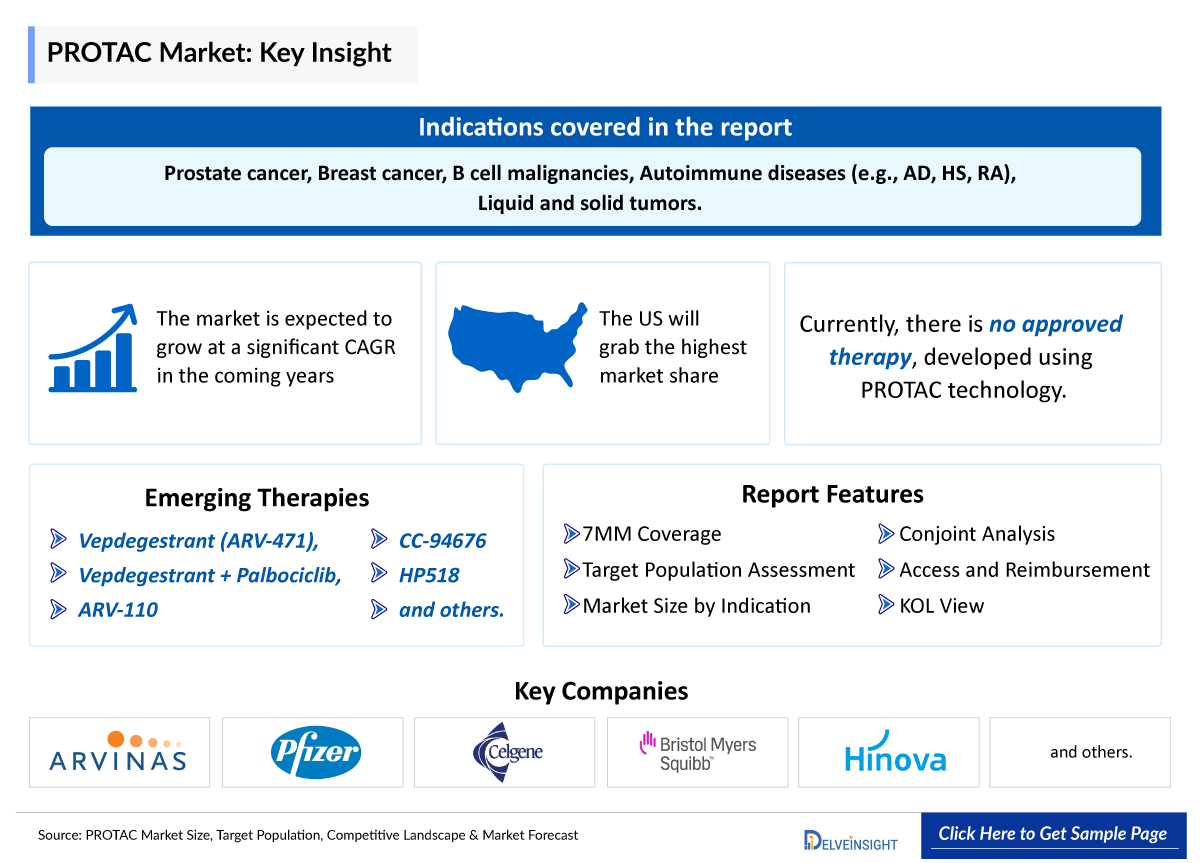
Key Factors Driving the PROTAC Market Growth
Unique Targeted Protein Degradation Mechanism
PROTACs represent a transformative therapeutic modality that selectively degrade disease-causing proteins through the ubiquitin-proteasome system rather than simply inhibiting their activity. Their catalytic mode of action enables repeated degradation of target proteins and offers the ability to eliminate proteins previously considered "undruggable," including targets such as KRAS and STAT3. In addition, PROTACs can disrupt both enzymatic and non-enzymatic protein functions, broadening their therapeutic potential.
Growing Clinical Development Across Oncology
The expanding clinical pipeline for PROTAC therapies is driving market growth, particularly in oncology. Several investigational candidates, including vepdegestrant (ARV-471), luxdegalutamide (ARV-766), ASP3082, and DT2216, are advancing through clinical development for breast cancer, metastatic castration-resistant prostate cancer (mCRPC), KRAS G12D-mutated solid tumors, and other malignancies. Positive clinical outcomes and increasing pipeline activity continue to strengthen confidence in the technology.
Technological Advancements Enhancing PROTAC Delivery and Design
Continuous innovations in PROTAC engineering are improving the pharmacological profile of these molecules. Advances such as nano-PROTACs, ligand-modified PROTAC prodrugs, and biomacromolecule-PROTAC conjugates are enhancing tumor specificity, membrane permeability, controlled drug release, and targeted delivery. These developments aim to overcome challenges associated with high molecular weight, limited bioavailability, and poor cell permeability, thereby expanding the clinical applicability of PROTAC therapies.
Increasing Strategic Collaborations and Licensing Agreements
Strategic partnerships between biotechnology companies and pharmaceutical organizations are accelerating PROTAC development and commercialization. Collaborations such as Arvinas–Pfizer for vepdegestrant and Arvinas–Novartis for luxdegalutamide demonstrate growing industry confidence in targeted protein degradation technology. These alliances provide financial support, scientific expertise, and global commercialization capabilities, facilitating faster clinical advancement.
Expansion of the Targeted Protein Degradation (TPD) Platform
The success of PROTACs has stimulated broader innovation within the Targeted Protein Degradation (TPD) field. Emerging degradation technologies such as LYTACs (Lysosome-Targeting Chimeras), AUTACs (Autophagy-Targeting Chimeras), and ATTECs (Autophagosome-Tethering Compounds) are expanding the scope of degradable therapeutic targets. This evolution reinforces the long-term growth potential of the protein degradation market while positioning PROTACs as a foundational platform for next-generation precision therapeutics.
DelveInsight’s “ PROTAC Market Forecast, Target Population, Competitive Landscape, and Market Forecast – 2036” report delivers an in-depth understanding of the PROTAC, historical and forecasted epidemiology, competitive landscape as well as the PROTAC market trends in the United States, EU4 (Germany, France, Italy, and Spain), and the United Kingdom, and Japan.
The PROTAC Market Size Report provides current treatment practices, emerging drugs, market share of individual therapies, and current and forecasted 7MM PROTAC market size from 2026 to 2036. The report also covers current PROTAC treatment practices/algorithms and unmet medical needs to curate the best opportunities and assess the market’s potential.
Scope of the PROTAC Market Report | |
|
Study Period |
2022 to 2036 |
|
Forecast Period |
2026-2036 |
|
Geographies Covered |
|
|
PROTAC Market |
|
|
PROTAC Market Size | |
|
PROTAC Companies |
|
PROTAC Understanding
PROTAC (PROteolysis TArgeting Chimera) is a drug development technology that is currently garnering significant attention. PROTACs are heterobifunctional molecules that degrade target proteins by hijacking the ubiquitin-proteasome system. Unlike traditional small molecules, PROTACs inhibit the entire biological function of the target protein by binding to it and inducing subsequent proteasomal degradation. Researchers categorize PROTACs into different types based on their composition and mechanism of action.
PROTACs can be classified into three primary types:
- Traditional small-molecule PROTACs: These are heterobifunctional molecules that consist of two covalently linked protein-binding molecules. One of these molecules is capable of engaging an E3 ubiquitin ligase, and the other binds to a target protein meant for degradation.
- BioPROTACs: These are PROTACs composed of peptides or other biological products. They function similarly to traditional small-molecule PROTACs but utilize biological molecules for target protein engagement.
- Hybrid PROTACs: These PROTACs contain both peptide and traditional small-molecule “warheads”. They leverage the advantages of both small molecules and peptides to achieve efficient and selective protein degradation.
This makes the technology about 23 years old as of 2024. In 2013–2014, Yale University licensed the PROTAC Oncology Market to Arvinas. By 2019, Arvinas had conducted two PROTAC clinical trials: bavdegalutamide (ARV-110), an androgen receptor degrader, and vepdegestrant (ARV-471), an estrogen receptor degrader. This technology has since emerged as a paradigm-shifting approach in small molecule drug discovery and has been driving unprecedented innovations in drug development in the past several years. Excitingly, multiple PROTACs are being evaluated in phase I, II, and III clinical trials.
The main advantages of PROTAC are targeted degradation of “unavailable drug targets” such as KRAS, STAT3, etc., overcoming tumor drug resistance, and prolonging the action time. PROTAC can not only affect the enzyme activity function of the protein but also regulate the non-enzyme activity function. With these advances, PROTAC technology is increasingly poised to lead to new targeted therapies that benefit patients with lung cancer.
|
DRUG NAME* |
TARGET |
INDICATION |
SPONSOR |
|
ARV-110 |
Androgen receptor |
Prostate cancer |
Arvinas |
|
CC-94676 |
Androgen receptor |
Prostate cancer |
BMS |
|
ARV-471 |
Estrogen receptor |
Breast cancer |
Arvinas/Pfizer |
|
AC682 |
Estrogen receptor |
Breast cancer |
Accutar Biotech |
|
NX-2127 |
BTK |
B cell malignancies |
Nurix therapeutics |
|
NX-5948 |
BTK |
B cell malignancies and autoimmune diseases |
Nurix therapeutics |
|
DT2216 |
BCL-xL |
Liquid and solid tumors |
Dialectic Therapeutics |
|
ARV-766 |
Androgen receptor |
Prostate cancer |
Arvinas |
|
KT-474 |
IRAK4 |
Autoimmune diseases (e.g., AD, HS, RA) |
Kymera/Sanofi |
Key Epidemiology Insights
According to the American Cancer Society (2023), HR+/HER2− breast cancer accounts for approximately 65–70% of all breast cancers, with incidence increasing with age.
According to Urru et al. (2018), among 841 TNBC patients evaluated in Italy, approximately 48% were diagnosed at Stage II, whereas approximately 1% were diagnosed at Stage IV.
According to Breastcancer.org (2023), nearly 30% of women diagnosed with early-stage breast cancer eventually develop metastatic disease.
According to the CDC (2019), 142,462 colorectal cancer cases were reported in the United States.
According to SEER (2021), approximately 3.39 million men were living with prostate cancer in the United States.
PROTAC Oncology Market Treatment
PROTAC Drug Analysis
PROTAC Marketed Drugs
PROTAC Oncology Market Emerging Drugs
ARV-471 (vepdegestrant): Arvinas/Pfizer
Vepdegestrant is an investigational, orally bioavailable PROTAC protein degrader designed to specifically target and degrade the estrogen receptor for the treatment of patients with ER+/HER2− breast cancer.
In November 2025, Arvinas presented multiple abstracts on vepdegestrant at the San Antonio Breast Cancer Symposium (SABCS).
In March 2025, Arvinas and Pfizer announced positive topline results from the Phase III VERITAC-2 trial, which met its primary endpoint in the ESR1m population, demonstrating a significant improvement in progression-free survival (PFS) compared with fulvestrant and exceeding the pre-specified Hazard Ratio target of 0.60. However, the study did not achieve statistical significance in the intent-to-treat (ITT) population.
In July 2021, Arvinas announced a global collaboration with Pfizer for the co-development and co-commercialization of vepdegestrant, with both companies sharing worldwide development costs, commercialization expenses, and profits.
Luxdegalutamide (ARV-766): Arvinas and Novartis
ARV-766 is an investigational orally bioavailable PROTAC protein degrader designed to selectively target and degrade the androgen receptor. Preclinically, ARV-766 has demonstrated activity against both wild-type androgen receptor tumors and tumors harboring androgen receptor mutations or amplification, which are common mechanisms of resistance to currently available androgen receptor-targeted therapies. It is currently being evaluated in Phase II for metastatic prostate cancer.
In April 2024, Arvinas entered into an exclusive strategic license agreement with Novartis for the worldwide development and commercialization of ARV-766. The transaction also included an asset purchase agreement for the sale of Arvinas' preclinical AR-V7 program to Novartis.
ASP3082: Astellas Pharma
ASP3082 is a PROTAC that selectively degrades the KRAS G12D protein and is the first targeted protein degrader to enter clinical development for this target. It has the potential to become a first-in-class treatment for solid tumors associated with KRAS G12D mutations.
A Phase I clinical trial is ongoing in patients with solid tumors harboring KRAS G12D mutations, and the company is preparing for future registration studies.
In September 2024, Astellas Pharma presented preliminary safety and clinical activity data for ASP3082 in adults with advanced pancreatic cancer, colorectal cancer, and non-small cell lung cancer at ESMO 2024. The results demonstrated an acceptable safety profile and promising antitumor activity, particularly in heavily pretreated pancreatic cancer patients.
DT2216: Dialectic Therapeutics
DT2216 is a PROTAC protein degrader targeting BCL-xL and is being investigated for the treatment of liquid and solid tumors.
List of Emerging Drugs | |||||
|
Vepdegestrant (ARV-471) |
Arvinas/Pfizer |
ER+/HER2-Breast Cancer
|
PROTAC |
III |
NCT05654623 |
|
Vepdegestrant (ARV-471) + Palbociclib |
Arvinas/Pfizer |
ER+/HER2-Breast Cancer |
PROTAC |
III |
NCT05909397 |
|
ARV-110 |
Arvinas |
Prostate Cancer Metastatic |
PROTAC |
II |
NCT03888612 |
|
CC-94676 (BMS-986365) |
Celgene/BMS |
Advanced Solid Tumor |
PROTAC |
I |
NCT04428788 |
|
HP518 |
Hinova Pharmaceuticals |
Metastatic Castration-resistant Prostate Cancer |
PROTAC |
I |
NCT05252364 |
PROTAC Market Outlook
PROTAC is currently regarded as one of the most revolutionary frontiers in small-molecule drug development. Its unique mechanism provides broad therapeutic potential; however, its three-component molecular structure results in high molecular weight, making drug development challenging. Structural optimization is being employed to improve selectivity, permeability, and pharmacokinetic properties, while innovative delivery systems provide alternative strategies to enhance PROTAC drug delivery.
Recent advances such as nano-PROTACs have demonstrated the potential to improve tissue-specific accumulation, enhance membrane permeability, and enable controlled drug release, thereby improving targeted protein degradation. In addition, ligand-modified PROTAC prodrugs, including folate-targeting PROTACs and biomacromolecule-PROTAC conjugates, improve tumor specificity by selectively delivering degrader molecules to diseased tissues while minimizing exposure to healthy tissues. These targeted delivery strategies also offer the potential to overcome poor cellular permeability associated with conventional small-molecule drugs.
The success of PROTACs has accelerated the broader evolution of the Targeted Protein Degradation (TPD) field, expanding degradation strategies to include LYTACs, AUTACs, and ATTECs, thereby broadening the range of therapeutic targets. Furthermore, PROTACs possess the unique ability to selectively degrade proteins of interest that were previously considered undruggable and can catalytically overcome resistance caused by mutations in target proteins. Despite these significant advances, challenges including high molecular weight, poor permeability, and clinical translation remain key barriers to widespread clinical adoption.
Heterobifunctional PROTACs have emerged as a highly promising therapeutic modality in recent years. These innovative molecules offer significant potential in drug development by selectively targeting and degrading proteins of interest (POIs) that were previously considered difficult or impossible to target pharmacologically. This capability expands therapeutic opportunities across multiple disease areas.
One of the most important advantages of PROTACs is their catalytic mechanism of action, enabling repeated degradation of target proteins rather than transient inhibition. This approach has the potential to overcome drug resistance caused by mutations in target proteins while prolonging therapeutic activity compared to conventional small-molecule inhibitors.
The utilization of nano-PROTAC technology has demonstrated considerable promise in improving tissue-specific accumulation, enhancing membrane permeability, and enabling controlled drug release. These improvements may significantly enhance the efficiency and controllability of targeted protein degradation.
The success of PROTACs has accelerated the evolution of the broader Targeted Protein Degradation (TPD) field. Beyond the ubiquitin-proteasome pathway, emerging degradation platforms such as Lysosome-Targeting Chimeras (LYTACs), Autophagy-Targeting Chimeras (AUTACs), and Autophagosome-Tethering Compounds (ATTECs) are expanding the spectrum of degradable therapeutic targets.
Ligand-modified PROTAC prodrugs, including folate-targeting PROTACs and biomacromolecule-PROTAC conjugates, have emerged as promising therapeutic strategies for targeted protein degradation in tumor cells. These conjugates exhibit high tumor specificity through selective binding to receptors or biomolecules expressed on cancer cells.
By exploiting ligand-mediated target selection, these conjugates can effectively transport degrader molecules directly to diseased tissues while minimizing exposure to healthy tissues. This targeted delivery strategy offers the potential to overcome poor cellular permeability associated with conventional small-molecule therapies while improving therapeutic specificity.
Ligand modification also enables responsive drug-release characteristics within PROTAC prodrugs, further enhancing targeted protein degradation and improving the pharmacological performance of these molecules.
Despite significant progress in targeted protein degradation, several challenges remain before widespread clinical translation can be achieved. These include optimizing molecular size, improving permeability, enhancing pharmacokinetic properties, and developing efficient delivery systems while maintaining therapeutic efficacy.
- In 2019, the first PROTAC molecule, ARV-110, entered clinical testing. In 2020, these trials provided the first clinical proof-of-concept for the modality against two well-established cancer targets: the estrogen receptor (ER) and the androgen receptor (AR).
- Currently, Pfizer, in collaboration with Arvina,s is testing vepdegestrant in clinical trials as a monotherapy and as in combination therapy with other drugs for the treatment of various diseases such as ER+/HER2-Breast Cancer and others.
- The leading PROTAC Companies such as Pfizer/Arvinas, Celgene/BMS, Hinova, and others, are involved in developing drugs for PROTAC for various indications such as ER+/HER2-Breast Cancer, Prostate Cancer Metastatic, Metastatic Castration-resistant Prostate Cancer, and others.
- Overall, this is an exciting new class of agents with great potential for development. The maturation of current studies over the next few years will lead to a better understanding of PROTAC molecules and define their role in the therapy of cancer and other diseases.
Recent Development
- In Aug 2026, Rigel Pharmaceuticals announced the commercial availability of VEPPANU (vepdegestrant) for adult patients diagnosed with ER+/HER2-, ESR1-mutated advanced or metastatic breast cancer. As an oral proteolysis targeting chimera (PROTAC) estrogen receptor degrader, VEPPANU offers a targeted therapeutic option designed to specifically degrade estrogen receptors and inhibit tumor growth. The product's availability provides oncology providers and eligible post-endocrine therapy patients across the United States immediate access to this novel target-directed treatment option.
PROTAC Drugs Uptake
This section focuses on the uptake rate of potential approved and emerging PROTAC expected to be launched in the market during 2022–2036.
PROTAC Clinical Trials Activities
The PROTAC Therapeutics Market Report provides insights into different therapeutic candidates in Phase III, Phase II, and Phase I. It also analyzes key PROTAC Companies involved in developing targeted therapeutics. The presence of numerous drugs at different stages is expected to generate immense opportunities for TROPAC Market Growth over the forecasted period.
PROTAC Pipeline Development Activities
In October 2025, Arvinas announced new patient-reported outcomes data from the Phase III VERITAC-2 clinical trial evaluating vepdegestrant, which will be presented in a mini oral session at the 2025 European Society for Medical Oncology (ESMO) Congress.
In November 2025, Arvinas presented multiple abstracts on vepdegestrant at the San Antonio Breast Cancer Symposium (SABCS).
In March 2025, Arvinas and Pfizer announced positive topline results from the Phase III VERITAC-2 trial. The study met its primary endpoint in the ESR1-mutant (ESR1m) population by demonstrating a significant improvement in progression-free survival (PFS) compared with fulvestrant and exceeded the pre-specified Hazard Ratio target of 0.60. However, the study did not achieve statistical significance in the overall intent-to-treat (ITT) population.
In April 2024, Arvinas entered into an exclusive strategic license agreement with Novartis for the worldwide development and commercialization of luxdegalutamide (ARV-766). The agreement also included the sale of Arvinas' preclinical AR-V7 program to Novartis.
In September 2024, Astellas Pharma presented preliminary safety and clinical activity results for ASP3082 in adults with advanced pancreatic cancer, colorectal cancer, and non-small cell lung cancer at ESMO 2024. ASP3082 demonstrated an acceptable safety profile and promising antitumor activity, particularly in heavily pretreated pancreatic cancer patients.
In July 2021, Arvinas and Pfizer entered into a global collaboration for the co-development and co-commercialization of vepdegestrant, with both companies sharing worldwide development costs, commercialization expenses, and profits.
Latest KOL Views on PROTAC
To keep up with current and future market trends, we take Industry Experts’ opinions working in the domain through primary research to fill the data gaps and validate our secondary research. Industry experts were contacted for insights on PROTAC's evolving treatment landscape, patient reliance on conventional therapies, patient therapy switching acceptability, drug uptake, along challenges related to accessibility. DelveInsight’s analysts connected with 25+ KOLs to gather insights; however, interviews were conducted with 10+ KOLs in the 7MM. Their opinion helps understand and validate current and emerging therapy treatment patterns or PROTAC market trends. This will support the clients in potential upcoming novel treatments by identifying the overall scenario of the market and the unmet needs.
KOL Views |
|
“Several promising novel agents for hormone receptor-positive breast cancer beyond selective estrogen receptor degraders (SERDs). These include proteolysis-targeting chimeras [PROTACs] like ARV-471 (vepdegestrant) and selective estrogen receptor covalent antagonists (SERCAs) like H3B-6527 which may more potently inhibit estrogen receptor signaling.” |
|
“Data support further development of vepdegestrant, and two ongoing Phase III studies are evaluating the agent in patients with ER-positive/HER2-negative advanced breast cancer.” |
PROTAC Qualitative Analysis Report
Key Updates on PROTAC Market Forecast
- Many Pharma companies presented the data of their PROTAC during the ASCO GU 2024 conference including Hinova Pharmaceuticals and others. Hinova study’s concluded that HP518 is a novel AR PROTAC degrader and shows favorable safety/tolerability and efficacy signals in unselected mCRPC patients. AR LBD mutations may indicate potential benefit from HP518, warranting further investigation.
- In February 2024, vepdegestrant received FDA Fast Track Designation for the treatment of adult patients with ER+/HER2- locally advanced or metastatic breast cancer that received prior treatment with endocrine-based therapy as a monotherapy.
- In February 2024, Arvinas announced the first-in-human dosing of ARV-102, an investigational PROTAC protein degrader for neurodegenerative disease. It is designed to cross the blood-brain barrier and target leucine-rich repeat kinase 2 (LRRK2).
Scope of the PROTAC Market Report
- The PROTAC Market Forecast Report covers a segment of key events, an executive summary, and a descriptive overview, explaining its mechanism and therapies (current and emerging).
- Comprehensive insight into the PROTAC Competitive Landscape, and forecasts, the future growth potential of treatment rate, drug uptake, and drug information have been provided.
- Additionally, an all-inclusive account of emerging therapies and the elaborate profiles of late-stage and prominent therapies will impact the current PROTAC Treatment Market Landscape.
- A detailed review of the PROTAC Market, historical and forecasted PROTAC Market Size, market share by therapies, detailed assumptions, and rationale behind our approach is included in the report, covering the 7MM drug outreach.
- The PROTAC Therapeutics Market Report provides an edge while developing business strategies, by understanding trends, through SWOT analysis expert insights/KOL views, and treatment preferences that help shape and drive the 7MM PROTAC market.
PROTAC Market Report Insights
- PROTAC Targeted Patient Pool
- Therapeutic Approaches
- PROTAC Pipeline Analysis
- PROTAC Market Size and Trends
- Existing and future PROTAC Market Opportunity
PROTAC Market Report Key Strengths
- 11 Years PROTAC Market Forecast
- The 7MM Coverage
- Key Cross Competition
- PROTAC Drugs Uptake
- Key PROTAC Market Forecast Assumptions
PROTAC Market Report Assessment
- Current PROTAC Treatment Practices
- PROTAC Unmet Needs
- PROTAC Pipeline Drugs Profiles
- PROTAC Drugs Market Attractiveness
- PROTAC Qualitative Analysis (SWOT)
Key Questions Answered in the PROTAC Market Report
PROTAC Market Insights
- What was the PROTAC market size, the market size by therapies, market share (%) distribution, and what would it look like in 2034? What are the contributing factors for this growth?
- Which drug is going to be the largest contributor in 2036?
- Which is the most lucrative market for PROTAC?
- Which drug type segment accounts for the maximum PROTAC Sales?
- What are the pricing variations among different geographies for emerging therapies?
- What are the risks, burdens, and unmet needs of treatment with PROTAC? What will be the growth opportunities across the 7MM for the patient population of PROTAC?
- What are the key factors hampering the growth of the PROTAC market?
- What are the indications for which recent novel therapies and technologies have been developed to overcome the limitations of existing treatments?
- What key designations have been granted to the therapies for PROTAC?
- Patient acceptability in terms of preferred therapy options as per real-world scenarios?
Reasons to buy the PROTAC Oncology Market Report
- The PROTAC Therapeutics Market Report will help develop business strategies by understanding the latest trends and changing dynamics driving the PROTAC Drugs Market.
- Understand the existing PROTAC Drugs Market opportunities in varying geographies and the growth potential over the coming years.
- Distribution of historical and current patient share based on real-world prescription data along with reported PROTAC Sales of approved products in the US, EU4 (Germany, France, Italy, and Spain) the United Kingdom, and Japan.
- Identifying strong upcoming players in the PROTAC Drugs Market will help devise strategies to help get ahead of competitors.
- Detailed analysis and ranking of indication-wise emerging therapies under the conjoint analysis section to provide visibility around leading indications.
- To understand Key Opinion Leaders’ perspectives around the accessibility, acceptability, and compliance-related challenges of existing treatment to overcome barriers in the future.
- Detailed insights on the unmet needs of the existing PROTAC Drugs Market so that the upcoming players can strengthen their development and launch strategy.
Stay updated with us for Recent Articles @ New Delveinsight Blogs

