
Pulmonary Emphysema Market Summary
Pulmonary Emphysema Market and Epidemiological Analysis
- Pulmonary emphysema is a chronic, progressive lung disease characterized by destruction of alveoli and enlarged airspaces, leading to impaired gas exchange. Smoking is the main cause, while genetic factors like alpha-1 antitrypsin deficiency also contribute. It causes shortness of breath, chronic cough, and reduced exercise capacity, and is irreversible, with management focused on symptom relief, slowing progression, and early intervention.
- Smoking cessation programs, early diagnosis, and novel inhaled therapies are expected to drive market evolution.
- Telemedicine, tele-rehabilitation, and patient self-management programs are emphasized as important tools, especially following the COVID-19 pandemic, enhancing access to care and disease monitoring.
- GOLD 2025 updated COPD management guidelines incorporate novel therapies such as ensifentrine (OHTUVAYRE) (a dual PDE3/4 inhibitor) and biologics like dupilumab (DUPIXENT), targeting better lung function, reduced exacerbations, and personalized treatments based on biomarkers like blood eosinophil count.
- ERS 2025 guidelines also stress early identification and management of co-morbid cardiovascular disease in COPD patients to improve outcomes.
- Currently approved therapies for COPD, including pulmonary emphysema, comprise dupilumab (DUPIXENT), ensifentrine (OHTUVAYRE), mepolizumab (NUCALA), and others.
- The pipeline for treating pulmonary emphysema includes Tanimilast (CHF6001) (Chiesi Farmaceutici S.p.A.), SAR-447537 (Sanofi), Solrikitug (Uniquity Bio), PBF-680 (Palobiofarma), BMN-349 (BioMarin Pharmaceutical), and others currently in development.
Request for Unlocking the Sample Page of the "Pulmonary Emphsema Treatment Market"
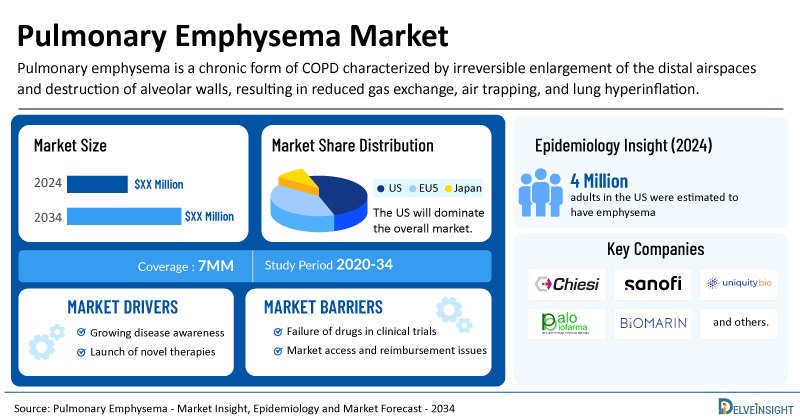
Key Factors Driving the Pulmonary Emphysema Market
-
Rising Prevalence of Smoking and Environmental Pollutants
Tobacco smoking remains the leading cause of pulmonary emphysema globally. Additionally, increasing exposure to air pollution, occupational chemicals, and biomass fuels continues to expand the patient pool, directly contributing to market growth.
-
Growing Awareness and Early Diagnosis
Focused awareness campaigns and improved diagnostic tools—such as high-resolution CT imaging and pulmonary function tests—are leading to earlier detection. Early diagnosis helps patients access treatment sooner, expanding the treated population.
-
Advancements in Bronchodilator and Combination Therapies
The market is witnessing progress in long-acting bronchodilators (LABA, LAMA) and combination inhaled therapies that offer sustained symptom control. These innovations are driving higher adoption rates and improved treatment outcomes.
-
Increasing Adoption of Minimally Invasive Procedures
Techniques such as endobronchial valve therapy and lung volume reduction procedures are gaining momentum due to their ability to improve lung function and quality of life with lower procedural risks. This shift is significantly contributing to market expansion.
-
Growing Elderly Population Susceptible to COPD-related Conditions
As global life expectancy rises, the number of elderly individuals—who are at higher risk of COPD and emphysema—increases. This demographic trend continues to drive sustained demand for emphysema treatments.
-
Strong Research & Development Pipeline
Pharmaceutical companies are focusing on emerging therapies targeting inflammation, protease imbalance, regenerative pathways, and personalized medicine approaches. A robust R&D landscape fuels future market opportunities.
-
Rising Healthcare Expenditure and Access to Treatment
Improved reimbursement policies, better healthcare infrastructure, and increasing patient access to pulmonology services are enabling more individuals to receive appropriate emphysema care, boosting market growth.
DelveInsight's “Pulmonary Emphysema Treatment Market Insight, Epidemiology and Market Forecast – 2034” report delivers an in-depth analysis of pulmonary emphysema epidemiology, market, and clinical development in pulmonary emphysema. In addition to this, the report provides historical and forecasted epidemiology and market data as well as a detailed analysis of the pulmonary emphysema market trends in the United States, EU4 (Germany, France, Italy, and Spain ), and the United Kingdom, and Japan.
The Pulmonary Emphysema Treatment Market Report provides real-world prescription pattern analysis, emerging drugs assessment, market share, and uptake/adoption pattern of individual therapies, as well as historical and forecasted pulmonary emphysema market size from 2020 to 2034 in 7MM. The report also covers current pulmonary emphysema treatment practices/algorithms and unmet medical needs to curate the best opportunities and assess the market’s underlying potential.
Scope of the Pulmonary Emphysema Market | |
|
Study Period |
2020–2034 |
|
Forecast Period |
2025–2034 |
|
Geographies Covered |
US, EU4 (Germany, France, Italy, and Spain) and the UK, and Japan |
|
Pulmonary Emphysema Epidemiology |
Segmented by:
|
|
Pulmonary Emphysema Companies |
|
|
Pulmonary Emphysema Drugs |
|
|
Pulmonary Emphysema Market |
Segmented by:
|
|
Analysis |
|
Pulmonary Emphysema Disease Understanding and Treatment Algorithm
Pulmonary Emphysema Overview and Diagnosis
Pulmonary emphysema is a chronic lung disease under COPD, marked by permanent enlargement of distal airspaces and alveolar wall destruction, leading to impaired gas exchange, air trapping, and hyperinflation. Smoking is the main cause, with α1-antitrypsin deficiency and environmental exposures as other risk factors. It presents with progressive breathlessness, minimal cough, and a “pink puffer” appearance.
Pulmonary Emphysema Diagnosis
It is made through clinical features (progressive dyspnea, minimal cough, barrel chest, decreased breath sounds), spirometry showing airflow obstruction (↓FEV1, ↓FEV1/FVC, ↑TLC, ↑RV, ↓DLCO), and imaging with chest X-ray (hyperinflation, flattened diaphragm) or HRCT (low-attenuation areas, subtype identification). Arterial blood gases show hypoxemia in advanced disease, and α1-antitrypsin testing is done in young or non-smoking patients.
Further details related to country-based variations in diagnosis are provided in the report.
Pulmonary Emphysema Treatment
Pulmonary emphysema treatment aims to relieve symptoms, slow disease progression, and prevent exacerbations. Smoking cessation and avoiding pollutants are the most important measures, supported by influenza, pneumococcal, and COVID-19 vaccinations. Bronchodilators are central short-acting (salbutamol, ipratropium) for quick relief, and long-acting for maintenance, including BEVESPI AEROSPHERE, BREZTRI AEROSPHERE (ICS + LAMA + LABA), TRELEGY ELLIPTA (triple therapy), and beclometasone/formoterol/glycopyrronium bromide (TRIMBOW). Novel therapies include ensifentrine (OHTUVAYRE), which provides both bronchodilation and anti-inflammatory effects, and dupilumab (DUPIXENT) for patients with Type 2 inflammation. Mepolizumab (NUCALA) is also being explored for select patients. Long-term oxygen therapy is vital in hypoxemia, and advanced disease may require bullectomy, lung volume reduction surgery, or transplantation. Exacerbations are treated with short-acting bronchodilators, systemic steroids, and antibiotics, while pulmonary rehabilitation, nutrition, psychological support, and regular follow-up optimize outcomes.
Pulmonary Emphysema Epidemiology
As the market is derived using a patient-based model, the pulmonary emphysema epidemiology chapter in the report provides historical as well as forecasted epidemiology segmented by total diagnosed prevalent cases of COPD, total diagnosed prevalent cases of pulmonary emphysema, age-specific diagnosed prevalent cases of pulmonary emphysema, total treatable cases of pulmonary emphysema in the 7MM covering the United States, EU4 countries (Germany, France, Italy, and Spain), and the United Kingdom, and Japan from 2020 to 2034.
Key findings from Pulmonary Emphysema Epidemiology Forecast
- In 2024, approximately 4.01 million adults in the US were estimated to have emphysema.
- Among the EU4 and the UK, Germany accounted for the highest cases of emphysema with approximately 1.37 million cases, followed by Italy with 0.97 million cases in 2024, whereas the UK accounted for the least cases of emphysema in the same year.
- The highest prevalence of emphysema is observed among individuals aged 55 to 65 years and older, indicating an increased risk of disease with advancing age.
- In Japan, the prevalence of airflow obstruction consistent with COPD, which includes emphysema, ranges between approximately 3.8% and 16.9% depending on the study and population. Large database studies estimate COPD prevalence around 8.6% among those aged 40 and older, with low diagnosis rates despite spirometry testing in health checkups.
Pulmonary Emphysema Drug Analysis
The drug chapter segment of the pulmonary emphysema therapeutics market report encloses a detailed analysis of pulmonary emphysema marketed drugs and late-stage (Phase III and Phase II) Pulmonary Emphysema pipeline drugs. It also deep dives into the pulmonary emphysema pivotal clinical trial details, recent and expected market approvals, patent details, the latest news, and recent deals and collaborations.
Pulmonary Emphysema Marketed Drugs
-
Ensifentrine (OHTUVAYRE): Verona Pharma /Merck
Ensifentrine is a first-in-class, selective dual inhibitor of PDE3 and PDE4, designed to provide both bronchodilatory and nonsteroidal anti-inflammatory effects within a single molecule. In the ENHANCE-1 and ENHANCE-2 trials, ensifentrine achieved its primary endpoints, showing statistically significant and clinically relevant improvements in lung function. A fixed-dose combination of ensifentrine with the LAMA glycopyrrolate is also being developed for maintenance treatment in patients with COPD. Beyond COPD, ensifentrine holds potential therapeutic applications in pulmonary emphysema.
Dupilumab is a first-in-class, fully human monoclonal antibody that targets the IL-4 receptor alpha subunit, thereby inhibiting signaling of both IL-4 and IL-13, key drivers of type 2 inflammation. Through this dual mechanism, it provides broad anti-inflammatory effects across multiple atopic and respiratory diseases. Dupilumab has demonstrated significant and clinically meaningful improvements in lung function and symptom control in clinical trials for asthma and COPD. It is approved for several type 2 inflammatory conditions, and ongoing development explores its potential role in additional indications, including pulmonary emphysema.
Pulmonary Emphysema Emerging Drugs
-
SAR447537: Sanofi
SAR-447537 (formerly INBRX-101) is an investigational recombinant fusion protein being developed by Sanofi for alpha-1 antitrypsin deficiency (AATD), a rare genetic disorder that can cause pulmonary emphysema. Designed as a long-acting AAT-Fc fusion protein, it aims to maintain protective AAT levels in serum and lung tissue with dosing every three to four weeks, unlike current plasma-derived therapies that require weekly infusions. By protecting alveoli and reducing protease-driven tissue damage, SAR-447537 may help slow emphysema progression. It has orphan drug designation and is being studied in the Phase II ElevAATe trial and a long-term open-label extension. Early results show sustained AAT activity and lung penetration, suggesting potential to improve treatment convenience, adherence, and long-term outcomes for AATD-related emphysema.
-
Tanimilast (CHF6001): Chiesi Farmaceutici S.p.A.
CHF6001, also known as Tanimilast, is an anti-inflammatory drug being developed for the treatment of respiratory conditions, including COPD and asthma. Tanimilast functions as a PDE4 inhibitor. By inhibiting PDE4, it prevents the breakdown of cyclic Adenosine Monophosphate (cAMP) within inflammatory cells, leading to reduced inflammation and immune response modulation. This mechanism helps alleviate symptoms and improve lung function in patients with inflammatory respiratory diseases.
|
Comparison of Emerging Drugs Under Development | ||||||
|
Drug Name |
Company |
Highest Phase |
Indication |
RoA |
MoA |
Molecule Type |
|
Tanimilast (CHF6001) |
Chiesi Farmaceutici S.p.A. |
Phase III |
Moderate or severe COPD and chronic bronchitis |
Inhalation |
PDE4 inhibitor |
Small molecule |
|
SAR-447537 |
Sanofi |
Phase II |
Pulmonary emphysema |
IV |
Augmentation therapy with recombinant AAT-Fc to restore protective AAT |
Small molecule |
|
Solrikitug |
Uniquity Bio |
Phase II |
Moderate or severe COPD and chronic bronchitis |
SC |
TSLP inhibitor |
mAb |
|
PBF-680 |
Palobiofarma |
Phase II |
Moderate-to-severe COPD |
Oral |
A1AR antagonist |
Small molecule |
|
BMN-349 |
BioMarin Pharmaceutical |
Phase I |
Pulmonary emphysema |
Oral |
Small-molecule chaperone that reduces Z-AAT polymerization, aids secretion |
Small molecule |
Note: Detailed emerging therapies assessment will be provided in the final report.
Pulmonary Emphysema Market Outlook
Pulmonary emphysema, a major component of COPD, is characterized by progressive lung tissue destruction, chronic airflow limitation, and high morbidity. Current therapies focus on symptom relief and include bronchodilators (LABAs, LAMAs), inhaled corticosteroids (ICS), combination inhalers such as beclometasone/formoterol/glycopyrronium bromide (TRIMBOW), and mucolytics, which improve airflow and reduce exacerbations but do not halt disease progression. Targeted treatments include biologics and small molecules such as dupilumab (DUPIXENT), mepolizumab (NUCALA), and ensifentrine (OHTUVAYRE) for patients with eosinophilic inflammation or frequent exacerbations. For alpha-1 antitrypsin deficiency (AATD)-related emphysema, plasma-derived AAT augmentation therapy remains the standard to slow lung tissue degradation. Emerging pipeline focuses on disease-modifying approaches to restore functional AAT, protect alveoli, and potentially alter disease progression. Key investigational candidates include Solrikitug (Uniquity Bio), PBF-680 (Palobiofarma), Tanimilast/CHF6001 (Chiesi Farmaceutici S.p.A.), long-acting recombinant AAT fusion proteins (SAR-447537), and small-molecule chaperones (BMN-349).
- Among all the 7MM, the US captured the highest pulmonary emphysema treatment market in 2024.
- NUCALA became the second biologic approved for COPD with eosinophilic inflammation, following closely after DUPIXENT’S breakthrough in 2024.
- TRELEGY ELLIPTA and BREZTRI AEROSPHERE continue to drive triple therapy adoption, leveraging once-daily dosing, device convenience, and broad market access.
- OHTUVAYRE by Verona Pharma is anticipated to capture the maximum market share among emerging therapies by 2034.
Pulmonary Emphysema Drugs Uptake
This section focuses on the uptake rate of potential Pulmonary Emphysema drugs expected to be launched in the market during 2025–2034, which depends on the competitive landscape, safety, and efficacy data, along with the order of entry. It is important to understand that the key players evaluating their novel therapies in the pivotal and confirmatory trials should remain vigilant when selecting appropriate comparators to stand the greatest chance of a positive opinion from regulatory bodies, leading to approval, smooth launch, and rapid uptake.
Ensifentrine is the first new inhaled therapy for COPD in over two decades. Approved in June 2024, the drug has demonstrated strong early uptake, reflecting its differentiated profile as both a bronchodilator and anti-inflammatory agent. The rapid adoption underscores physician confidence in its dual mechanism of action and its potential to address unmet needs in COPD management. By leveraging Verona’s pipeline alongside OHTUVAYRE’s momentum, Merck is positioning itself as a leader in next-generation respiratory care, expanding its portfolio beyond oncology and immunology. Ensifentrine provides Merck with a strategic growth engine in chronic lung disease, an area with significant unmet need and long-term potential.
Further detailed analysis of emerging therapies drug uptake in the report…
Pulmonary Emphysema Pipeline Development Activities
The Pulmonary Emphysema Therapeutics Market Report provides insights into different therapeutic candidates in Phase III and Phase II stages. It also analyzes key Pulmonary Emphysema Companies involved in developing targeted therapeutics. The report covers information on collaborations, acquisitions and mergers, licensing, and patent details for pulmonary emphysema emerging therapies.
Latest KOL Views on Pulmonary Emphysema
To keep up with the real-world scenario in current and emerging market trends, we take opinions from Key Industry Leaders working in the domain through primary research to fill the data gaps and validate our secondary research. Industry Experts contacted for insights on the evolving treatment landscape, patient reliance on conventional therapies, patient therapy switching acceptability, and drug uptake along with challenges related to accessibility, including Medical/scientific writers, Professors, and Others.
DelveInsight’s analyst pulmonary emphysema connected with 20+ KOLs to gather insights; however, interviews were conducted with 10+ KOLs in the 7MM. Centers such as Johns Hopkins University, University of Oxford, University of Michigan, and Sarcoma Oncology Center etc., were contacted. Their opinion helps understand and validate current and emerging therapy treatment patterns or pulmonary emphysema market trends.
KOL Views |
|
“Pulmonary emphysema is not just airflow limitation. It is a progressive structural disease that significantly impacts quality of life. Targeted therapies beyond bronchodilators are urgently needed to address alveolar destruction and disease progression.” MD, Johns Hopkins University, USA |
|
“Emphysema is often under-recognized until advanced stages. Early diagnosis using imaging and lung function testing is critical to implementing interventions that preserve lung function and improve survival.” MD, University of Pennsylvania, USA |
Pulmonary Emphysema Qualitative Analysis Report
We perform Qualitative and market Intelligence analysis using various approaches, such as SWOT analysis and Conjoint Analysis. In the SWOT analysis, strengths, weaknesses, opportunities, and threats in terms of gaps in disease diagnosis, patient awareness, physician acceptability, competitive landscape, cost-effectiveness, and geographical accessibility of therapies are provided. Conjoint Analysis analyzes multiple approved and emerging therapies based on relevant attributes such as safety, efficacy, frequency of administration, route of administration, and order of entry. Scoring is given based on these parameters to analyze the effectiveness of therapy.
In efficacy evaluation for pulmonary emphysema, both primary and secondary outcome measures are assessed; for instance, primary endpoints often include reduction in infarct size, improvement in tissue viability, and preservation of organ function, while secondary outcomes may involve biomarkers of oxidative stress, inflammatory response, and overall survival rates. Further, the therapies’ safety is evaluated wherein the acceptability, tolerability, and adverse events are majorly observed, and it sets a clear understanding of the side effects posed by the drug in the trials. In addition, the scoring is also based on the probability of success, and the addressable patient pool for each therapy. According to these parameters, the final weightage score and the ranking of the emerging therapies are decided.
Pulmonary Emphysema Market Access and Reimbursement
Antibiotics are typically prescribed for short durations, often just two weeks, and face reimbursement challenges. Government and private insurers generally use bundled payments for antibiotic treatments, covering the entire course rather than itemizing costs for the drug, administration, and other services. Hospitals receive a fixed amount, so if they manage treatment at a lower cost, they can keep the savings, improving margins. However, this system has led to poor returns for antibiotic developers, resulting in numerous company failures, bankruptcies, and low-value acquisitions in the sector.
The Pulmonary Emphysema Therapeutics Market Report further provides detailed insights on the country-wise accessibility and reimbursement scenarios, cost-effectiveness scenario of approved therapies, programs making accessibility easier and out-of-pocket costs more affordable, insights on patients insured under federal or state government prescription drug programs, etc.
Pulmonary Emphysema Market Access and Reimbursement Key Developments in 2025
|
Region/Country |
Key 2025 Developments |
|
United States |
|
|
Europe (EU-wide) |
|
|
Germany |
|
|
France |
|
|
Italy |
|
|
Spain |
|
|
United Kingdom |
|
|
China |
|
|
Japan |
|
Pulmonary Emphysema Market Report Scope
- The Pulmonary Emphysema Therapeutics Market Report covers a segment of key events, an executive summary, descriptive overview, explaining its causes, signs and symptoms, pathogenesis, and currently available therapies.
- Comprehensive insight has been provided into the epidemiology segments and forecasts pulmonary emphysema, the future growth potential of diagnosis rate, and disease progression along treatment guidelines.
- Additionally, an all-inclusive account of both the current and emerging therapies, along with the elaborative profiles of late-stage and prominent therapies, will have an impact on the current treatment landscape.
- A detailed review of the pulmonary emphysema market, historical and forecasted market size, market share by therapies, detailed assumptions, and rationale behind our approach is included in the report, covering the 7MM drug outreach.
- The Pulmonary Emphysema Therapeutics Market Report provides an edge while developing business strategies, by understanding trends, through SWOT analysis and expert insights/KOL views, patient journey, and treatment preferences that help in shaping and driving the 7MM Pulmonary Emphysema Drugs Market.
Pulmonary Emphysema Market Report Insights
- Patient-based Pulmonary Emphysema Market Forecasting
- Therapeutic Approaches
- Pulmonary Emphysema Pipeline Analysis
- Pulmonary Emphysema Market Size and Trends
- Existing and future Pulmonary Emphysema Market Opportunity
Pulmonary Emphysema Market Report Key Strengths
- 10-Year Pulmonary Emphysema Market Forecast
- 7MM Coverage
- Pulmonary Emphysema Epidemiology Segmentation
- Key Cross Competition
- Conjoint analysis
- Pulmonary Emphysema Drugs Uptake
- Key Pulmonary Emphysema Market Forecast Assumptions
Pulmonary Emphysema Market Report Assessment
- Current Pulmonary Emphysema Treatment Practices
- Pulmonary Emphysema Unmet Needs
- Pulmonary Emphysema Pipeline Drugs Profiles
- Pulmonary Emphysema Drugs Market Attractiveness
- Pulmonary Emphysema Qualitative Analysis (SWOT and Conjoint Analysis)
Key Questions Answered in the Pulmonary Emphysema Market Report
- How does DUPIXENT’s strong efficacy in reducing exacerbations in eosinophilic pulmonary emphysema, combined with its safety profile and biomarker-driven approach, position it ahead of underperforming biologics and therapies like OHTUVAYRE, NUCALA in the evolving pulmonary emphysema treatment landscape?
- Could the upcoming patent expirations of key standard-of-care therapies such as LAMA, LABA, and their combinations trigger accelerated price erosion in the pulmonary emphysema market? As generics begin to enter during the forecast period, how significantly might this affect the market share and profitability of branded drugs?
- Why does triple therapy remain the gold standard for pulmonary emphysema treatment across all severities, and how are BREZTRI and TRELEGY maintaining their leadership in this segment, particularly in reducing all-cause mortality?
- What is the historical and forecasted pulmonary emphysema patient pool/patient burden in the United States, EU4 (Germany, France, Italy, and Spain), the United Kingdom, and Japan?
- Which combination treatment approaches will have a significant impact on the pulmonary emphysema drug treatment market size?
- How would the market drivers, barriers, and future opportunities affect the market dynamics and subsequent analysis of the associated trends?
- What are the current and emerging options for the treatment of pulmonary emphysema?
- How many companies are developing therapies for the treatment of pulmonary emphysema?
- What are the recent novel therapies, targets, mechanisms of action, and technologies developed to overcome the limitations of existing therapies?
- Patient acceptability in terms of preferred treatment options as per real-world scenarios?
- What are the country-specific accessibility issues of expensive, recently approved therapies?
Reasons to Buy the Pulmonary Emphysema Market Report
- The Pulmonary Emphysema Therapeutics Market Report will help in developing business strategies by understanding the latest trends and changing treatment dynamics driving the pulmonary emphysema market.
- Insights on patient burden/disease Pulmonary Emphysema Incidence, evolution in diagnosis, and factors contributing to the change in the epidemiology of the disease during the forecast years.
- Understand the existing market opportunities in varying geographies and the growth potential over the coming years.
- Distribution of historical and current patient share based on real-world prescription data along with reported sales of approved products in the US, EU4 (Germany, France, Italy, and Spain), the United Kingdom, and Japan.
- Identifying strong upcoming players in the Pulmonary Emphysema Drugs Market will help devise strategies to help get ahead of competitors.
- Detailed analysis and ranking of class-wise potential current and emerging therapies under the conjoint analysis section to provide visibility around leading classes.
- Highlights of access and reimbursement policies of approved therapies, barriers to accessibility of expensive off-label therapies, and patient assistance programs.
- To understand Key Opinion Leaders’ perspectives around the accessibility, acceptability, and compliance-related challenges of existing treatment to overcome barriers in the future.
- Detailed insights on the unmet needs of the existing Pulmonary Emphysema Drugs Market so that the upcoming players can strengthen their development and launch strategy.
Stay updated with us for Recent Articles @ New DelveInsight Blogs

