
Radiopharmaceutical CDMO Market Summary
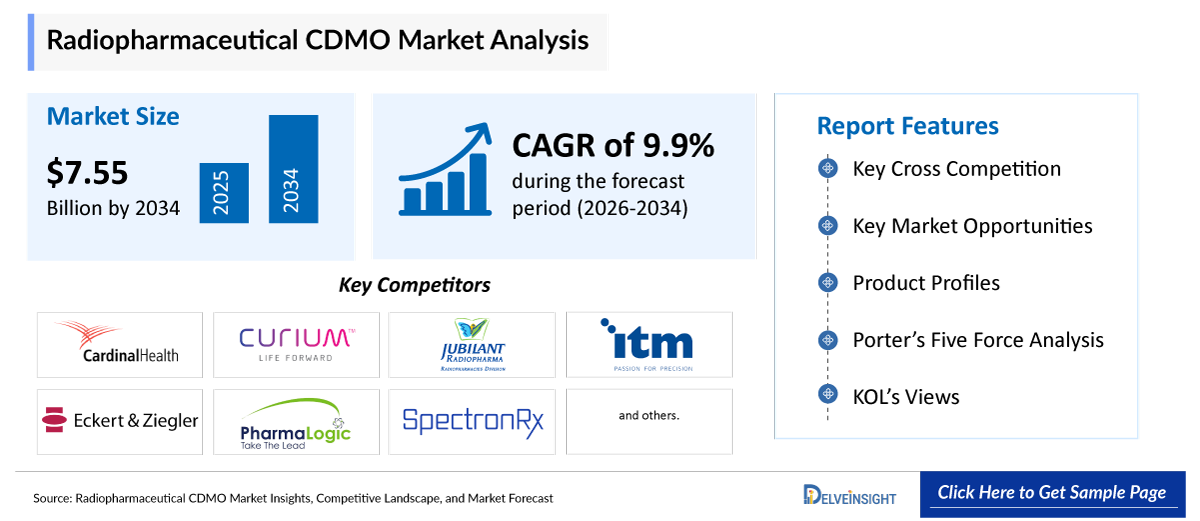
- The Radiopharmaceutical CDMO Market Size is estimated at USD 3.20 billion in 2025 and is projected to reach USD 7.55 billion by 2034. Growth is anchored in the rapid expansion of radioligand therapy and theranostics, rising pharmaceutical outsourcing of complex isotope handling, and major investment in nuclear medicine manufacturing infrastructure.
- The Global Radiopharmaceutical CDMO Market is growing at a CAGR of 9.9% during the forecast period from 2026 to 2034.
Radiopharmaceutical CDMO Market Trends & Insights
- By application, the diagnostic Radiopharmaceuticals segment dominated the Radiopharmaceutical CDMO market with a 62% share in 2025.
- By service type, the contract manufacturing segment dominated the Radiopharmaceutical CDMO market with a 48% share in 2025.
- By radioisotope, the fluorine-18 segment dominated the Radiopharmaceutical CDMO market with a 34% share in 2025.
- By therapeutic area, the oncology segment dominated the Radiopharmaceutical CDMO market with a 71% share in 2025.
- North America dominated the global Radiopharmaceutical CDMO market revenue with a 47% share in 2025, representing the highest regional market share globally.
Request for Unlocking the Sample Page of the Report @ Radiopharmaceutical CDMO Market
Factors Contributing to the Growth of the Radiopharmaceutical CDMO Market
Radiopharmaceutical CDMO Market Drivers
-
Rapid Expansion of Radioligand Therapy and Theranostics
The most powerful driver of the Radiopharmaceutical CDMO market is the rapid clinical and commercial rise of radioligand therapy and theranostics. Targeted radioligand therapies deliver radiation directly to tumor cells while sparing healthy tissue, and their commercial success is now substantial: Novartis' Pluvicto reached USD 1.9 billion in sales in 2025, and Lutathera generated USD 816 million.
These therapies treat prostate cancer, neuroendocrine tumors, and other solid malignancies, and a deep pipeline of beta- and alpha-emitting candidates is advancing through clinical development. Because each dose must be radiolabeled, released, and delivered within a short half-life window, commercial and clinical programs require specialized GMP manufacturing, isotope handling, and time-critical logistics that sponsors rarely possess in-house.
As radioligand therapy moves into earlier treatment lines and new indications, demand for Radiopharmaceutical CDMO capacity expands directly, anchoring market growth through 2034.
-
Rising Global Cancer Burden and Precision Oncology
The growing global cancer burden is expanding demand for precision nuclear medicine and the manufacturing services that support it. The International Agency for Research on Cancer recorded 20 million new cancer cases in 2022 and projects 35 million by 2050, while the incidence of metastatic prostate cancer and neuroendocrine tumors continues to rise.
Radiopharmaceuticals are central to precision oncology, supporting both diagnostic imaging through PET and SPECT and targeted treatment through radioligand therapy, and oncology accounts for the large majority of Radiopharmaceutical CDMO demand. As cancer prevalence increases and theranostic approaches that pair a diagnostic tracer with a matched therapeutic gain adoption, the volume and complexity of Radiopharmaceutical production rise in step.
This sustained clinical demand translates directly into growing requirements for specialized development, manufacturing, and quality services across the forecast period.
-
Increasing Pharmaceutical Outsourcing of Complex Manufacturing
A structural shift toward outsourcing is a central growth engine for the market. Radiopharmaceutical manufacturing is uniquely demanding, requiring radiation-shielded GMP facilities, cyclotron or reactor access, specialized radiochemistry, rapid analytical release, and time-sensitive distribution, all under strict regulatory oversight.
Many pharmaceutical and biotechnology sponsors, particularly the emerging biotech companies that dominate the radioligand pipeline, lack this infrastructure and the capital to build it, so they partner with specialized CDMOs to reduce cost, mitigate capital expenditure, and accelerate time to market. CDMOs provide end-to-end radiolabeling, isotope procurement, GMP manufacturing, fill-finish, quality control, and logistics, allowing sponsors to focus on discovery and clinical development.
As pipelines expand and more programs reach clinical and commercial scale, outsourcing intensity rises, directly enlarging the addressable market for Radiopharmaceutical CDMO services through the forecast period.
-
Accelerating Regulatory Approvals and Label Expansions
A growing wave of regulatory approvals and label expansions is increasing commercial manufacturing demand. In March 2025, the FDA expanded the label of Pluvicto to include earlier, pre-taxane use in metastatic castration-resistant prostate cancer, a change Novartis stated would triple the number of eligible patients, directly increasing required manufacturing volumes.
Diagnostic PSMA imaging agents such as Pylarify, Illuccix, and Locametz, and therapeutic agents anchored by Pluvicto, Lutathera, and Xofigo, continue to expand approved indications across the United States, Europe, and Japan. Each approval and expansion creates durable, recurring demand for compliant GMP production, analytical testing, and reliable supply.
Because most sponsors outsource commercial Radiopharmaceutical manufacturing, this regulatory momentum flows directly to CDMOs with proven capacity and regulatory track records, reinforcing market growth across the forecast period.
-
Investment in Isotope Production and Decentralized Manufacturing
Heavy capital investment in isotope production and decentralized manufacturing is expanding CDMO supply networks and easing critical bottlenecks. The short half-lives of key isotopes require regionally distributed manufacturing, just-in-time release, and precise logistics, and a wave of facility expansion is addressing these constraints.
SpectronRx opened a large actinium-225 labeling plant in Belgium after securing EMA GMP certification, Cardinal Health advanced a cGMP actinium-225 supply chain, and producers including NorthStar Medical Radioisotopes, Eckert & Ziegler, and Niowave expanded isotope capacity, with Niowave breaking ground on a USD 75 million actinium-225 facility. Big Radiopharmaceutical CDMO Companies, including AstraZeneca, Bristol Myers Squibb, Eli Lilly, and Novartis, are securing radioisotope supply and manufacturing capacity.
This investment expands available CDMO capacity, improves supply reliability, and supports the scale-up of next-generation alpha and beta therapies through the forecast period.
-
Stringent Regulatory and Quality Requirements Concentrating Demand
The exceptional regulatory and quality demands of Radiopharmaceutical manufacturing are concentrating demand among compliant, experienced CDMOs. Producers must satisfy stringent good manufacturing practice, radiation-safety, and pharmacovigilance requirements enforced by agencies including the FDA and the European Medicines Agency, and must demonstrate proven inspection records to win sponsor contracts.
The complexity of handling radioactive materials, validating short-half-life processes, and ensuring reliable release and transport raises barriers to entry and rewards specialized expertise. As a result, sponsors preferentially partner with CDMOs that combine isotope access, GMP-qualified facilities, and regulatory depth, consolidating demand among established providers.
This dynamic both sustains pricing and reinforces the strategic value of Radiopharmaceutical CDMOs as essential, trusted partners in the nuclear medicine supply chain across the forecast period.
-
Strong Investor and Big-Pharma Interest in the Radiopharmaceutical Sector
Surging investor and large-pharmaceutical interest is accelerating the build-out of Radiopharmaceutical manufacturing capacity. Industry analysts estimate that Radiopharmaceutical companies attracted USD 900 million in private financings in 2025, with the period spanning 2026 and 2027 viewed as pivotal for the sector.
Major acquisitions underscore the strategic value of manufacturing capability, including Lantheus' agreement to acquire CDMO Evergreen Theragnostics, Curium's acquisition of Nucleis to strengthen PET capabilities, and PharmaLogic's acquisition of a majority stake in Agilera.
Large pharmaceutical companies are vertically integrating by securing isotope supply and contract capacity. This influx of capital and consolidation expands CDMO infrastructure, validates the sector's long-term growth, and channels sustained demand toward providers with scale, technology, and reliable isotope access across the forecast period.
Radiopharmaceutical CDMO Market Restraints
Despite strong momentum, the Radiopharmaceutical CDMO market faces material constraints. The high capital intensity of the business is a significant barrier, as cyclotrons, nuclear reactors, radiation-shielded GMP cleanrooms, and specialized facilities require substantial upfront investment, regulatory validation, and ongoing maintenance that exclude smaller players and slow expansion in emerging economies.
The limited availability and concentrated supply of critical radioisotopes, including molybdenum-99, lutetium-177, and actinium-225, create supply-chain fragility, and shortages can disrupt production and delay programs. The short half-lives of many isotopes impose severe time constraints, requiring just-in-time manufacturing, rapid quality release, and precise logistics, so that headline capacity often overstates real-world output once decay, release windows, and transport are considered.
Complex and evolving regulatory compliance across GMP, radiation safety, and pharmacovigilance lengthens timelines and raises costs, while a shortage of skilled professionals trained in nuclear safety and radiochemistry constrains scale-up. High operational costs, radiation-safety obligations, and the logistical difficulty of time-sensitive, cross-border transport further pressure margins and reliability. Reimbursement and adoption of newer therapies remain uneven across geographies, and dependence on a small number of isotope suppliers concentrates risk.
Together, these capital, supply, regulatory, workforce, and logistical barriers temper the pace of growth, even as the underlying drivers of theranostics expansion, cancer burden, and outsourcing remain firmly intact.
A Radiopharmaceutical Contract Development and Manufacturing Organization (CDMO) is a specialized third-party provider that develops, manufactures, tests, packages, and distributes radioactive drugs used in nuclear medicine for diagnosis and therapy. Because Radiopharmaceuticals contain radioisotopes with short half-lives, require radiation-shielded GMP facilities, and demand precise, time-sensitive logistics, most pharmaceutical and biotechnology sponsors lack the infrastructure to produce them in-house and rely on Radiopharmaceutical CDMOs.
These organizations provide end-to-end services spanning radiolabeling and process development, radioisotope supply and handling, GMP manufacturing, analytical and quality-control testing, fill-finish, packaging, and cold-chain and time-critical distribution. The Radiopharmaceutical CDMO Market is organized by application across diagnostic and therapeutic Radiopharmaceuticals; by radioisotope, including fluorine-18, technetium-99m, gallium-68, lutetium-177, and actinium-225; by source of manufacturing across cyclotrons and nuclear reactors; by scale across preclinical, clinical, and commercial; and by therapeutic area, led by oncology.
Driven by the rise of radioligand therapy and theranostics, accelerating regulatory approvals, and heavy capital investment in isotope production and decentralized manufacturing, Radiopharmaceutical CDMOs have become essential infrastructure underpinning the precision nuclear medicine supply chain.
Radiopharmaceutical CDMO Market Key Growth Drivers
- The rapid clinical and commercial expansion of radioligand therapy and theranostics is driving demand, with Novartis' Pluvicto reaching USD 1.9 billion in sales and Lutathera USD 816 million in 2025.
- The rising global cancer burden is expanding demand for precision nuclear medicine, with the International Agency for Research on Cancer projecting cancer cases to rise from 20 million in 2022 to 35 million by 2050.
- Pharmaceutical and biotechnology sponsors are increasingly outsourcing complex isotope handling, GMP radiochemistry, and time-sensitive logistics to specialized CDMOs to cut cost and accelerate time to market.
- Accelerating regulatory approvals and label expansions, including the March 2025 expansion of Pluvicto that triples the number of eligible patients, are increasing commercial manufacturing demand.
- Heavy capital investment in isotope production and decentralized manufacturing, including new actinium-225 and lutetium-177 capacity, is expanding CDMO supply networks.
- Stringent GMP, radiation-safety, and pharmacovigilance requirements are concentrating demand among compliant CDMOs with proven regulatory track records.
- The convergence of theranostics growth, cancer burden, outsourcing, and infrastructure investment is expected to sustain strong double-digit growth in the market through 2034.
Radiopharmaceutical CDMO Companies
The Radiopharmaceutical CDMO Competitive Landscape is led by the following active providers and isotope suppliers:
- Cardinal Health, Inc.
- Curium Pharma
- Jubilant Radiopharma
- ITM Isotope Technologies Munich SE
- Eckert & Ziegler SE
- PharmaLogic Holdings Corp.
- SpectronRx
- NorthStar Medical Radioisotopes, LLC
- Evergreen Theragnostics, Inc.
- AtomVie Global Radiopharma Inc.
For illustrative purposes, only the top 10 companies are listed in the Table of Contents. The report may include analysis and references to additional companies relevant to the market assessment.
Radiopharmaceutical CDMO Market Size and Forecast
Report Metrics |
Details |
|
2025 Radiopharmaceutical CDMO Market Size | |
|
2034 Projected Radiopharmaceutical CDMO Market Size | |
|
Radiopharmaceutical CDMO Growth Rate (2026-2034) | |
|
Largest Radiopharmaceutical CDMO Market |
North America |
|
Fastest Growing Radiopharmaceutical CDMO Market |
Asia-Pacific |
|
Radiopharmaceutical CDMO Market Structure |
Moderately Concentrated |
Radiopharmaceutical CDMO Market Segment Analysis
The Radiopharmaceutical CDMO Market by Application (Diagnostic Radiopharmaceuticals, Therapeutic Radiopharmaceuticals), Service Type (Contract Manufacturing, Contract Development, Analytical and Quality Control Services, Fill-Finish, Packaging and Logistics), Radioisotope (Fluorine-18, Technetium-99m, Gallium-68, Lutetium-177, Actinium-225, Others), Therapeutic Area (Oncology, Neurology, Cardiology, Others), and Geography (North America, Europe, Asia-Pacific, Rest of World).
-
Radiopharmaceutical CDMO Market Segmentation By Application
Dominant Subsegment: Diagnostic Radiopharmaceuticals. The diagnostic Radiopharmaceuticals category is expected to dominate the market.
Dominant: Diagnostic Radiopharmaceuticals ~ 62%
The diagnostic Radiopharmaceuticals segment accounted for 62% of the Radiopharmaceutical CDMO market in 2025. Diagnostic Radiopharmaceuticals are the leading application because PET and SPECT imaging generate very high, recurring procedure volumes across oncology, cardiology, and neurology, and because short-half-life diagnostic tracers such as fluorine-18 fluorodeoxyglucose must be produced in validated, high-frequency batches with strict regulatory oversight.
The established clinical role of diagnostic imaging, combined with the breadth of approved tracers and the growth of PSMA imaging agents such as Pylarify, Illuccix, and Locametz, sustains large and dependable demand for CDMO manufacturing and quality-control services. Hospitals and nuclear medicine centers increasingly outsource both the manufacturing of these short-lived tracers and associated quality testing to specialized providers with cyclotron access and regional distribution, reinforcing the segment's scale.
While therapeutic Radiopharmaceuticals are the fastest-growing application, propelled by radioligand therapy, the sheer volume, frequency, and regulatory complexity of diagnostic production secure the diagnostic segment's leadership across the forecast period.
-
Radiopharmaceutical CDMO Market Segmentation By Service Type
Dominant Subsegment: Contract Manufacturing. The contract manufacturing category is expected to dominate the market.
Dominant: Contract Manufacturing ~ 48%
The contract manufacturing segment accounted for 48% of the Radiopharmaceutical CDMO market in 2025. Contract manufacturing is the leading service type because it captures the largest and most recurring portion of Radiopharmaceutical outsourcing, spanning routine and large-scale GMP production of both diagnostic and therapeutic products.
Sponsors outsource manufacturing to access radiation-shielded facilities, isotope handling expertise, and compliant production capacity without the prohibitive capital cost of building their own, and this demand recurs with every batch given the short half-lives involved. The segment benefits from the scale-up of commercial radioligand therapies and the high frequency of diagnostic tracer production, both of which require dependable, regulator-inspected manufacturing.
Adjacent services are growing quickly: contract development supports the expanding clinical pipeline, while fill-finish, packaging, and logistics are among the fastest-growing services as therapeutics commercialize and require specialized handling. Nonetheless, the breadth, recurrence, and capital-intensity advantages of outsourced manufacturing keep contract manufacturing the dominant service type across the forecast period.
-
Radiopharmaceutical CDMO Market Segmentation By Radioisotope
Dominant Subsegment: Fluorine-18. The fluorine-18 category is expected to dominate the market.
Dominant: Fluorine-18 ~ 34%
The fluorine-18 segment accounted for 34% of the Radiopharmaceutical CDMO market in 2025. Fluorine-18 is the leading radioisotope because it underpins the most widely used PET diagnostic tracers, including fluorodeoxyglucose and PSMA imaging agents, which are produced in very high volumes across oncology, cardiology, and neurology.
Its favorable half-life supports cyclotron-based production and regional distribution within practical logistics windows, making it the workhorse of decentralized diagnostic manufacturing and a core driver of recurring CDMO demand. The breadth of approved fluorine-18 tracers and the steady growth of PET imaging sustain the segment's leadership.
At the same time, therapeutic isotopes are growing rapidly: lutetium-177 is expanding quickly on the back of commercial radioligand therapies such as Pluvicto and Lutathera, and actinium-225 is attracting heavy investment for next-generation targeted alpha therapy. Technetium-99m remains essential for SPECT imaging, and gallium-68 supports PSMA and neuroendocrine imaging.
While therapeutic isotopes post the fastest growth, the volume and ubiquity of fluorine-18 diagnostics secure its leadership across the forecast period.
-
Radiopharmaceutical CDMO Market Segmentation By Therapeutic Area
Dominant Subsegment: Oncology. The oncology category is expected to dominate the market.
Dominant: Oncology ~ 71%
The oncology segment accounted for 71% of the Radiopharmaceutical CDMO market in 2025. Oncology is overwhelmingly the leading therapeutic area because the majority of Radiopharmaceutical pipeline development and commercial approvals are concentrated in cancer diagnosis and targeted radionuclide therapy.
Radiopharmaceuticals enable precise molecular detection and treatment of malignancies, including prostate cancer, neuroendocrine tumors, and metastatic disease, with strong clinical evidence supporting radioligand therapy for solid tumors. Commercial momentum is substantial, with Pluvicto reaching USD 1.9 billion and Lutathera USD 816 million in 2025, and the FDA's March 2025 expansion of Pluvicto into earlier prostate cancer settings markedly enlarging the treated population.
This concentration drives the bulk of CDMO demand for development, isotope handling, GMP manufacturing, fill-finish, and logistics in oncology programs. Neurology is the fastest-growing therapeutic area as diagnostic and therapeutic applications expand into neurodegenerative disease, while cardiology sustains steady imaging demand. Nonetheless, the depth of the oncology pipeline and the scale of commercial radioligand therapies secure oncology's clear leadership across the forecast period.
Radiopharmaceutical CDMO Market Region Analysis
- Dominant Region: North America
North America accounted for 47% of the global Radiopharmaceutical CDMO market revenue in 2025, representing the highest regional market share globally. The region's dominance reflects a mature nuclear medicine ecosystem, a strong clinical-research base, proximity to major isotope suppliers, and clear FDA regulatory pathways, particularly in the United States. North America hosts the largest concentration of radioligand therapy programs and commercial manufacturing capacity, and sponsors benefit from proximity to isotope producers such as NorthStar Medical Radioisotopes and Cardinal Health and to a dense network of CDMO sites.
The commercial success of therapies such as Pluvicto and Lutathera, combined with a deep clinical pipeline and rising precision-oncology adoption, drives substantial outsourced manufacturing demand. Heavy investment is expanding capacity, including new actinium-225 and PET production facilities, while major pharmaceutical companies are securing domestic isotope supply and contract capacity. Strong reimbursement, regulatory clarity, and proximity to isotope supply anchor the region's continued leadership across the forecast period.
Dominant: North America ~ 47% (Largest)
- Fastest Growing Region: Asia-Pacific
Asia-Pacific is the fastest-growing region in the Radiopharmaceutical CDMO market. The region's elevated CAGR is driven by rising cancer incidence, rapid expansion of nuclear medicine infrastructure, and growing healthcare investment across China, Japan, India, South Korea, and Australia. China is rolling out cyclotron capacity, Japan is pivoting toward theranostics, and India leverages low-cost manufacturing and English-language regulatory filings, and Australia benefits from reactor-based lutetium-177 supply through ANSTO that draws regional clinical trials requiring predictable isotope deliveries.
Government healthcare investment, expanding oncology patient populations, and growing Radiopharmaceutical research activity are accelerating adoption, while regional CDMOs scale GMP capacity and align with global standards. The combination of high disease burden, infrastructure build-out, and isotope supply development positions Asia-Pacific as the principal source of incremental growth over the forecast period.
Radiopharmaceutical CDMO Regional Commentary
- North America
North America accounted for 47% of the global Radiopharmaceutical CDMO market revenue in 2025. The United States dominates on the strength of its nuclear medicine infrastructure, clinical-research base, FDA regulatory clarity, and proximity to isotope suppliers, while heavy investment in actinium-225 and PET manufacturing capacity, and big-pharma moves to secure domestic supply, reinforce its leadership.
- Europe
Europe is a large and advanced regional market, supported by a strong nuclear-research base exemplified by SCK CEN in Belgium, established EMA regulatory frameworks, and growing actinium-225 and lutetium-177 capacity. Capacity ramps such as SpectronRx's Belgian actinium-225 plant and ITM's isotope partnerships reinforce the region's role in supplying both diagnostic and therapeutic Radiopharmaceutical programs across Germany, France, the United Kingdom, Italy, and Spain.
- Asia-Pacific
Asia-Pacific is the fastest-growing region, propelled by rising cancer incidence, rapid nuclear medicine infrastructure build-out, and growing healthcare investment across China, Japan, India, South Korea, and Australia. China's cyclotron rollout, Japan's theranostics pivot, India's low-cost manufacturing, and Australia's reactor-based lutetium-177 supply through ANSTO are accelerating regional CDMO growth and clinical-trial activity.
- Rest of World
The Rest of World region, spanning Latin America, the Middle East, and Africa, is an emerging growth frontier. Expanding nuclear medicine and healthcare infrastructure, rising demand for diagnostic imaging and targeted radionuclide therapy, and efforts to align regulatory frameworks with global GMP standards are gradually broadening access, while sustainable isotope production and international partnerships support the build-out of regional capacity.
Radiopharmaceutical CDMO Market Competitive Landscape
The Radiopharmaceutical CDMO Market is classified as Moderately Concentrated. A group of integrated players with isotope ownership and multi-site reach, including Cardinal Health, Curium, ITM, and Jubilant Radiopharma, secures large contracts and anchors the top tier, while specialized and fast-scaling providers such as PharmaLogic, SpectronRx, NorthStar Medical Radioisotopes, Evergreen Theragnostics, and AtomVie Global Radiopharma compete through isotope access, government-lab tie-ups, and dedicated radioligand therapy capacity, increasing competition in the fastest-growing therapeutic segments.
The Radiopharmaceutical CDMO Competitive Landscape can be evaluated across the following dimensions:
- Market concentration: Moderately concentrated, with integrated, isotope-owning players leading and a fast-growing field of specialized radioligand-therapy providers.
- Leading players: Cardinal Health, Curium, ITM, and Jubilant Radiopharma anchor the top tier through isotope ownership and multi-site networks.
- Geographic reach: Leaders operate global, regionally distributed networks essential for short-half-life isotopes; PharmaLogic's network exceeds 45 sites across four countries supplying over 30 nations.
- Service portfolio strength: Top players offer end-to-end radiolabeling, isotope supply, GMP manufacturing, analytical testing, fill-finish, and logistics.
- Isotope access: Ownership or secured supply of critical isotopes, including the first cGMP actinium-225 supply chain and long-term actinium-225 flow through partnerships, is a decisive advantage.
- Strategic partnerships: Tie-ups with government labs, isotope producers, and biotech sponsors, such as ITM's supply to Alpha-9 Oncology and AtomVie's Ionetix actinium-225 agreement, extend reach.
- M&A activity: Active consolidation, including Lantheus' acquisition of Evergreen Theragnostics, Curium's acquisition of Nucleis, and PharmaLogic's acquisition of a majority stake in Agilera.
- Manufacturing capabilities: Cyclotron and reactor access, radiation-shielded GMP facilities, and automated radiochemistry modules are key competitive moats.
- Innovation focus: Actinium-225 and lutetium-177 scale-up, automated radiochemistry, decentralized production, and sustainable, low-waste isotope manufacturing.
Radiopharmaceutical CDMO Market Recent Developmental Activities
- In 2026, Curium Pharma announced an expansion of its Radiopharmaceutical manufacturing infrastructure to strengthen commercial-scale production for targeted radionuclide therapies and support growing global oncology demand. Strategic significance: Expands commercial therapeutic capacity and reinforces Curium's position as an integrated, isotope-owning leader.
- In 2026, Eckert & Ziegler SE expanded its isotope manufacturing and Radiopharmaceutical service capabilities to support growing clinical and commercial demand for precision oncology and theranostic applications. Strategic significance: Strengthens isotope supply and service breadth across the Radiopharmaceutical value chain.
- In December 2025, AtomVie Global Radiopharma Inc. partnered with Ionetix to secure actinium-225 supply and supplied the first dose of an actinium-225 candidate for Ariceum Therapeutics' Phase 1/2 trial. Strategic significance: Secures critical alpha-isotope supply and demonstrates clinical-stage manufacturing capability for next-generation targeted alpha therapy.
- In June 2025, PharmaLogic Holdings Corp. acquired a majority stake in Norway-based Agilera, one of a small number of CDMOs producing radiotherapeutics at commercial scale, expanding its global Radiopharmaceutical CDMO platform. Strategic significance: Adds commercial therapeutic manufacturing and extends a network exceeding 45 sites across four countries.
- In April 2025, Curium Pharma acquired Nucleis to strengthen its PET Radiopharmaceutical capabilities. Strategic significance: Deepens diagnostic PET capacity and broadens Curium's European manufacturing footprint.
- In April 2025, ITM Isotope Technologies Munich SE supplied actinium-225 to Alpha-9 Oncology under its Actineer program, securing long-term alpha-isotope flow for partner programs. Strategic significance: Reinforces ITM's isotope-supply leadership and supports the targeted alpha therapy pipeline.
- In January 2025, Lantheus Holdings announced a definitive agreement to acquire clinical-stage Radiopharmaceutical CDMO Evergreen Theragnostics, with an upfront payment of USD 250 million and up to USD 752.5 million in milestones. Strategic significance: Adds radioligand therapy manufacturing infrastructure and a revenue-generating contract business to a leading Radiopharmaceutical company.
- In 2025, NorthStar Medical Radioisotopes, LLC, announced investments focused on isotope production capacity expansion and supply-chain optimization to improve reliability for Radiopharmaceutical manufacturers and providers. Strategic significance: Strengthens domestic isotope supply, a critical input for diagnostic and therapeutic Radiopharmaceuticals.
- In 2025, Niowave, Inc., broke ground on a USD 75 million production facility in Lansing, Michigan to expand domestic supply of actinium-225 used in targeted alpha therapy. Strategic significance: Expands scarce alpha-isotope supply and supports the scale-up of next-generation cancer therapies.
- In Q1 2025, SpectronRx opened a 170,000-square-foot actinium-225 labeling plant in Belgium after securing EMA GMP certification, primarily producing actinium-225-based Radiopharmaceuticals. Strategic significance: Adds European alpha-therapy capacity and addresses isotope supply shortages for EMA-backed pipelines.
- In 2024 and 2025, SOFIE Biosciences expanded fluorine-18 production across multiple United States sites and broadened its PET manufacturing and distribution network. Strategic significance: Strengthens decentralized diagnostic tracer supply and supports high-frequency PET imaging demand.
- In October 2024, SpectronRx (with the Belgian Nuclear Research Center) signed a binding agreement to build a European radiolabeling plant at SCK CEN in Mol, focused on actinium-225 Radiopharmaceuticals. Strategic significance: Leverages a leading nuclear-research base to scale scarce alpha-isotope production for European oncology programs.
Radiopharmaceutical CDMO Market Segmentation
Radiopharmaceutical CDMO Market by Application
- Diagnostic Radiopharmaceuticals
- Therapeutic Radiopharmaceuticals
Radiopharmaceutical CDMO Market by Service Type
- Contract Manufacturing
- Contract Development
- Analytical and Quality Control Services
- Fill-Finish
- Packaging and Logistics
Radiopharmaceutical CDMO Market by Radioisotope
- Fluorine-18
- Technetium-99m
- Gallium-68
- Lutetium-177
- Actinium-225
- Others
Radiopharmaceutical CDMO Market by Source of Manufacturing
- Cyclotrons
- Nuclear Reactors
Radiopharmaceutical CDMO Market by Scale of Operation
- Preclinical
- Clinical
- Commercial
Radiopharmaceutical CDMO Market by Therapeutic Area
- Oncology
- Neurology
- Cardiology
- Others
Radiopharmaceutical CDMO Market by Geography
- North America Radiopharmaceutical CDMO Market
- United States Radiopharmaceutical CDMO Market Size in USD million (2023-2034)
- Canada Radiopharmaceutical CDMO Market Size in USD million (2023-2034)
- Mexico Radiopharmaceutical CDMO Market Size in USD million (2023-2034)
- Europe Radiopharmaceutical CDMO Market
- Germany Radiopharmaceutical CDMO Market Size in USD million (2023-2034)
- United Kingdom Radiopharmaceutical CDMO Market Size in USD million (2023-2034)
- France Radiopharmaceutical CDMO Market Size in USD million (2023-2034)
- Italy Radiopharmaceutical CDMO Market Size in USD million (2023-2034)
- Spain Radiopharmaceutical CDMO Market Size in USD million (2023-2034)
- Rest of Europe Radiopharmaceutical CDMO Market Size in USD million (2023-2034)
- Asia-Pacific Radiopharmaceutical CDMO Market
- China Radiopharmaceutical CDMO Market Size in USD million (2023-2034)
- Japan Radiopharmaceutical CDMO Market Size in USD million (2023-2034)
- India Radiopharmaceutical CDMO Market Size in USD million (2023-2034)
- Australia Radiopharmaceutical CDMO Market Size in USD million (2023-2034)
- South Korea Radiopharmaceutical CDMO Market Size in USD million (2023-2034)
- Rest of Asia-Pacific Radiopharmaceutical CDMO Market Size in USD million (2023-2034)
- Rest of the World (RoW) Radiopharmaceutical CDMO Market
- Middle East Radiopharmaceutical CDMO Market Size in USD million (2023-2034)
- Africa Radiopharmaceutical CDMO Market Size in USD million (2023-2034)
- South America Radiopharmaceutical CDMO Market Size in USD million (2023-2034)
Radiopharmaceutical CDMO Market Recent Industry Trends and Milestones (2023-2026)
Category |
Key Developments |
|
Radiopharmaceutical CDMO Market Product Approval |
Regulatory momentum is expanding commercial manufacturing demand. The FDA expanded the label of Novartis' Pluvicto (lutetium Lu 177 vipivotide tetraxetan) to earlier, pre-taxane use in metastatic castration-resistant prostate cancer in March 2025, a change Novartis stated would triple the number of eligible patients. Pluvicto and Lutathera anchor the therapeutic market, while diagnostic PSMA imaging agents Pylarify, Illuccix, and Locametz expand approved indications. Each approval and label expansion creates durable demand for compliant GMP manufacturing, analytical release, and reliable isotope supply, the large majority of which is outsourced to specialized Radiopharmaceutical CDMOs. |
|
Radiopharmaceutical CDMO Market Service Expansion |
CDMOs broadened capacity and capability across the value chain. PharmaLogic opened new PET facilities in Los Angeles, Salt Lake City, and Atlanta and extended a network exceeding 45 sites across four countries supplying over 30 nations. SpectronRx opened a 170,000-square-foot actinium-225 plant in Belgium, SOFIE Biosciences expanded fluorine-18 production across multiple United States sites, and providers scaled fill-finish, packaging, and logistics as therapeutics commercialized. Decentralized, regionally distributed manufacturing expanded to address short-half-life logistics, while automated radiochemistry modules improved throughput and consistency. |
|
Radiopharmaceutical CDMO Market Investment |
Capital and consolidation accelerated sharply. Lantheus agreed to acquire CDMO Evergreen Theragnostics with USD 250 million upfront and up to USD 752.5 million in milestones (January 2025), Curium acquired Nucleis (April 2025), and PharmaLogic acquired a majority stake in Agilera (June 2025). Niowave broke ground on a USD 75 million actinium-225 facility, and Cardinal Health advanced a cGMP actinium-225 supply chain. Industry analysts estimate Radiopharmaceutical companies attracted USD 900 million in private financings in 2025, while AstraZeneca, Bristol Myers Squibb, Eli Lilly, and Novartis moved to secure isotope supply and manufacturing capacity. |
|
Company Strategy |
Cardinal Health, Inc.: Integrated leadership through isotope ownership and the first cGMP actinium-225 supply chain. Curium Pharma: Commercial-scale therapeutic and PET expansion, reinforced by the Nucleis acquisition. ITM Isotope Technologies Munich SE: Isotope-supply leadership through Actineer and long-term actinium-225 agreements. Jubilant Radiopharma: Multi-site diagnostic and therapeutic reach. PharmaLogic Holdings Corp.: Global network expansion and the Agilera acquisition. SpectronRx, NorthStar Medical Radioisotopes, Evergreen Theragnostics, and AtomVie Global Radiopharma: Specialized radioligand-therapy capacity, isotope access, and government-lab partnerships. |
|
Emerging Technologies |
Therapeutic isotopes are the leading edge of innovation, with lutetium-177 scaling on the back of commercial radioligand therapies and actinium-225 attracting heavy investment for targeted alpha therapy, supported by new supply agreements and dedicated facilities. Automated radiochemistry modules, decentralized and regionally distributed production, and just-in-time release address the short-half-life constraint, while AI-driven Radiopharmaceutical development is emerging. Sustainability initiatives, including low-waste cyclotron operation, efficient reactor use, and environmentally friendly packaging, are expanding, and collaborations between CDMOs, academic institutions, and healthcare facilities are accelerating earlier clinical translation of new Radiopharmaceuticals. |
Radiopharmaceutical CDMO Market Startup Funding and Investment Trends
Investment in the Radiopharmaceutical CDMO ecosystem has concentrated on actinium-225 and lutetium-177 capacity, decentralized manufacturing, and dedicated radioligand therapy infrastructure. The following companies illustrate recent funding and investment activity and technology focus.
Company |
Total Funding |
Funding Stage |
Main Offering |
Core Technology |
|
Evergreen Theragnostics, Inc. |
USD 250 million upfront acquisition |
Acquired by Lantheus (2025) |
Radioligand therapy CDMO |
GMP radioligand manufacturing |
|
Nucleus RadioPharma |
Venture-backed |
Growth venture |
End-to-end radiopharma CDMO |
Decentralized GMP manufacturing |
|
Request for unlocking the report of the @ Radiopharmaceutical CDMO Market | ||||
Capital is flowing toward providers that secure scarce isotopes and scale therapeutic manufacturing. Industry analysts estimate that Radiopharmaceutical Companies attracted USD 900 million in private financings in 2025, and Lantheus' acquisition of Evergreen Theragnostics, with USD 250 million upfront and up to USD 752.5 million in milestones, underscores the strategic value of radioligand therapy CDMO infrastructure.
Emerging providers such as Nucleus RadioPharma and AtomVie Global Radiopharma are scaling decentralized GMP and actinium-225 capacity, while isotope specialists including SpectronRx and NorthStar Medical Radioisotopes expand supply of critical radionuclides.
Collectively, these investments signal conviction that isotope access, actinium-225 and lutetium-177 scale-up, and decentralized manufacturing will define the next phase of competitive advantage in the global Radiopharmaceutical CDMO market.
Key Takeaways from the Radiopharmaceutical CDMO Market Report Study
- Market size analysis for the current Radiopharmaceutical CDMO Market Size (2025), and market forecast for 9 years (2026 to 2034).
- Top key product/technology developments, mergers, acquisitions, partnerships, and joint ventures that happened over the last 3 years.
- Key companies dominating the global Radiopharmaceutical CDMO market.
- Various opportunities available for competitors in the Radiopharmaceutical CDMO market space.
- What are the top-performing segments in 2025? How will these segments perform in 2034?
- Which are the top-performing regions and countries in the current Radiopharmaceutical CDMO market scenario?
- Which are the regions and countries where companies should concentrate their opportunities for the Radiopharmaceutical CDMO market growth in the future?
The target audience that can benefit from this Radiopharmaceutical CDMO market report study
- Radiopharmaceutical CDMO product providers
- Research organizations and consulting companies
- Radiopharmaceutical CDMO-related organizations, associations, forums, and other alliances
- Government and corporate offices
- Start-up companies, venture capitalists, and private equity firms
- Distributors and traders dealing in Radiopharmaceutical CDMO
- Various end-users who want to know more about the Radiopharmaceutical CDMO Market and the latest technological developments in the Radiopharmaceutical CDMO market.
Stay updated with us for Recent Articles @ New DelveInsight Blogs

