
RAPA-501 Sales Forecast Summary
Key Factors Driving RAPA-501 Growth
Development in a High-Unmet Medical Need (ALS)
ALS is a rapidly progressive, fatal neurodegenerative disease with very limited effective treatments. Current standards like riluzole, edaravone and sodium phenylbutyrate/taurursodiol modestly slow progression but do not reverse disease course. RAPA-501’s approach — targeting immune-mediated neuroinflammation — addresses a core unmet biological component of ALS pathology.
Ongoing Phase II/III Clinical Trial with Safety and Biological Activity Signals
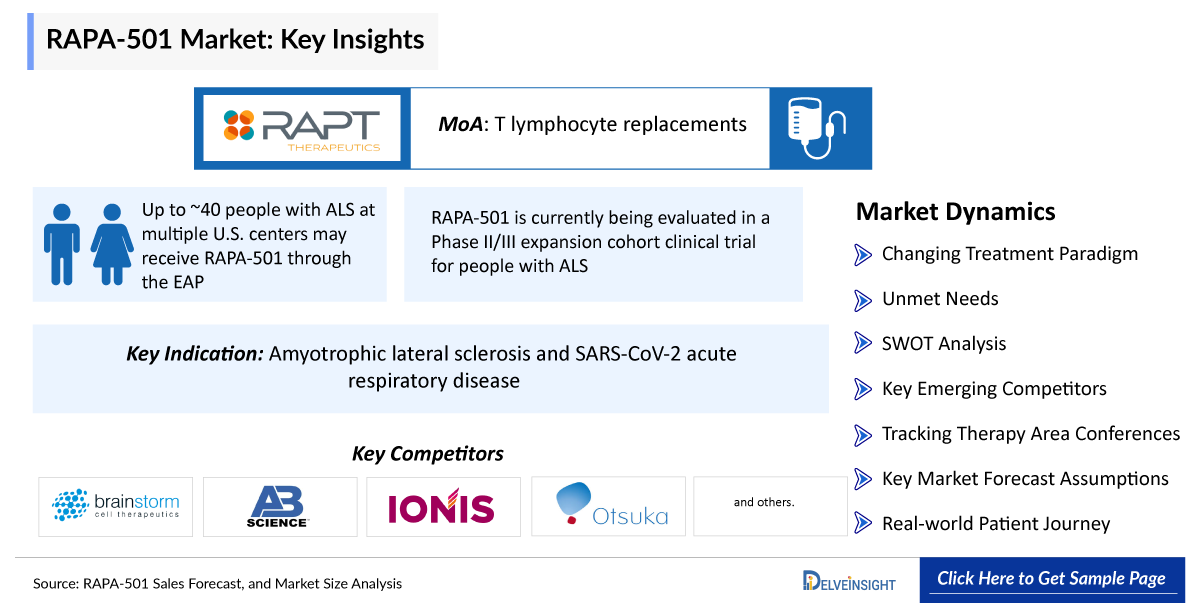
- RAPA-501 is currently being evaluated in a Phase II/III expansion cohort clinical trial for people with ALS (standard-risk participants, moderately early in disease course). This open-label Phase II/III trial is designed to assess feasibility, safety and potential efficacy signals by monitoring functional changes (e.g., ALSFRS-R scores, survival, slow vital capacity).
- Earlier Phase I/II data showed the therapy to be safe, biologically active with diverse anti-inflammatory effects, and exhibiting early trends toward slowing pulmonary function decline — a key marker related to survival in ALS.
Expanded Access Protocol (EAP) Backed by NIH Funding
- RAPA-501 was selected for an Expanded Access Protocol (EAP) under the ACT for ALS framework, supported by a three-year NIH NINDS U01 grant. This EAP allows the therapy to be administered to patients who are otherwise ineligible for clinical trials and provides additional safety, biomarker, and exploratory efficacy data.
- Up to ~40 people with ALS at multiple U.S. centers may receive RAPA-501 through the EAP, collecting outcomes data outside of classical trial constraints.
- The EAP uses AI-driven “virtual controls” rather than placebo control to support evaluation in seriously ill patients.
Rational Biological Mechanism — Targeting T-Cell Regulation
RAPA-501’s cell product expresses regulatory genes (e.g., FOXP3, GATA3) and markers associated with Treg and Th2 anti-inflammatory phenotypes, along with homing molecules like CD103 and ectonucleotidases CD39/CD73 that suppress inflammatory responses in the central nervous system.
This profile supports a mechanistically compelling hypothesis: dampening harmful inflammation and protecting motor neurons could slow disease progression — one of the major therapeutic goals in ALS research.
Support from ALS Research Networks and Non-Profit Funding
RAPA-501’s development is supported by collaborations with groups like the Sean M. Healey & AMG Center for ALS at Massachusetts General Hospital, the NIH, and the NEALS consortium, reflecting strong research community engagement.
RAPA-501 Recent Developments
As of February 2026, trials remain active with enrollment at sites like Mass General, focusing on feasibility in high-risk ALS patients ineligible for other studies; Phase I data confirmed safety and anti-inflammatory activity, with trends toward slower pulmonary decline.
“RAPA-501 Sales Forecast, and Market Size Analysis – 2034” report provides comprehensive insights of RAPA-501 for potential indication like Amyotrophic lateral sclerosis and SARS-CoV-2 acute respiratory disease in the 7MM. A detailed picture of RAPA-501’s existing usage in anticipated entry and performance in potential indications in the 7MM, i.e., the United States, EU4 (Germany, France, Italy, and Spain) and the United Kingdom, and Japan for the study period 2020 –2034 is provided in this report along with a detailed description of the RAPA-501 for potential indications. The RAPA-501 market report provides insights about RAPA-501’s sales forecast, mechanism of action (MoA), dosage and administration, as well as research and development including regulatory milestones, along with other developmental activities. Further, it also consists of historical and current RAPA-501 performance, future market assessments inclusive of the RAPA-501 market forecast analysis for potential indications in the 7MM, SWOT, analysts’ views, comprehensive overview of market competitors, and brief about other emerging therapies in respective indications. It also provides analysis of RAPA-501 sales forecasts, along with factors driving its market.
RAPA-501 Drug Summary
RAPA-501 is an investigational autologous T stem cell therapy developed by Rapa Therapeutics, produced by epigenetic reprogramming of patient-derived CD4+ T-cells using rapamycin (sirolimus) to generate a hybrid regulatory T-cell (TREG)/Th2-like phenotype expressing FOXP3 and GATA3 transcription factors, enriched for CD39, CD73 ectonucleotidases, and CD103 homing markers. Administered intravenously at doses up to 80 × 10^6 cells per infusion following lymphodepletion, it suppresses effector T-cell and microglial inflammation in a T-cell receptor-independent manner, modulates cytokines/chemokines, cross-regulates pathogenic Th1/Th17 responses, and protects neurons/lung tissue, with preclinical evidence of neuroprotection in ALS models. Currently in Phase II/III trials and expanded access for ALS (NCT04220190, NCT06169176), it targets standard-risk patients (ALSFRS-R 34-45, SVC ≥70%, symptom onset ≤24 months), showing Phase I safety across 9 patients, increased TREG markers, and potential to slow progression alongside standard therapies like riluzole or Relyvrio; it previously explored COVID-19 immunomodulation. Adverse events have been manageable, primarily infusion-related. The report provides RAPA-501’s sales, growth barriers and drivers, post usage and approvals in multiple indications.
Scope of the RAPA-501 Market Report
The report provides insights into:
- A comprehensive product overview including the RAPA-501 MoA, description, dosage and administration, research and development activities in potential indication like Amyotrophic lateral sclerosis and SARS-CoV-2 acute respiratory disease.
- Elaborated details on RAPA-501 regulatory milestones and other development activities have been provided in RAPA-501 market report.
- The report also highlights RAPA-501‘s cost estimates and regional variations, reported and estimated sales performance, research and development activities in potential indications across the United States, Europe, and Japan.
- The RAPA-501 market report also covers the patents information, generic entry and impact on cost cut.
- The RAPA-501 market report contains current and forecasted RAPA-501 sales for potential indications till 2034.
- Comprehensive coverage of the late-stage emerging therapies for respective indications.
- The RAPA-501 market report also features the SWOT analysis with analyst views for RAPA-501 in potential indications.
Methodology
The RAPA-501 market report is built using data and information sourced primarily from internal databases, primary and secondary research and in-house analysis by DelveInsight’s team of industry experts. Information and data from the secondary sources have been obtained from various printable and nonprintable sources like search engines, news websites, global regulatory authorities websites, trade journals, white papers, magazines, books, trade associations, industry associations, industry portals and access to available databases.
RAPA-501 Analytical Perspective by DelveInsight
- In-depth RAPA-501 Market Assessment
This RAPA-501 sales market forecast report provides a detailed market assessment of RAPA-501 for potential indication like Amyotrophic lateral sclerosis and SARS-CoV-2 acute respiratory disease in the seven major markets, i.e., the United States, EU4 (Germany, France, Italy, and Spain) and the United Kingdom, and Japan. This segment of the report provides current and forecasted RAPA-501 sales data uptil 2034.
- RAPA-501 Clinical Assessment
The RAPA-501 market report provides the clinical trials information of RAPA-501 for potential indications covering trial interventions, trial conditions, trial status, start and completion dates.
RAPA-501 Competitive Landscape
The report provides Insights on competitors and marketed products within the domain, along with a summary of emerging products and their respective launch dates, posing significant competition in the market.
RAPA-501 Market Potential & Revenue Forecast
- Projected market size for the RAPA-501 and its key indications
- Estimated RAPA-501 sales potential (RAPA-501 peak sales forecasts)
- RAPA-501 Pricing strategies and reimbursement landscape
RAPA-501 Competitive Intelligence
- Number of competing drugs in development (pipeline analysis)
- RAPA-501 Market positioning compared to existing treatments
- RAPA-501 Strengths & weaknesses relative to competitors
RAPA-501 Regulatory & Commercial Milestones
- RAPA-501 Key regulatory approvals & expected launch timelines
- Commercial partnerships, licensing deals, and M&A activity
RAPA-501 Clinical Differentiation
- RAPA-501 Efficacy & safety advantages over existing drugs
- RAPA-501 Unique selling points
RAPA-501 Market Report Highlights
- In the coming years, the RAPA-501 market scenario is set to change due to strong adoption, increased prescriptions and broader uptake in multiple immunological indications; which would expand the size of the market.
- The RAPA-501 companies are developing therapies that focus on novel approaches to treat/improve the disease condition, assess challenges, and seek opportunities that could influence RAPA-501’s dominance.
- Other emerging products for Amyotrophic lateral sclerosis and SARS-CoV-2 acute respiratory disease are expected to give tough market competition to RAPA-501 and launch of late-stage emerging therapies in the near future will significantly impact the market.
- A detailed description of regulatory milestones, and developmental activities, provide the current development scenario of RAPA-501 in potential indications.
- Analyse RAPA-501 cost, pricing trends and market positioning to support strategic decision-making in the immunology landscape.
- Our in-depth analysis of the forecasted RAPA-501 sales data uptil 2034 will support the clients in decision-making process regarding their therapeutic portfolio by identifying the overall scenario of RAPA-501 in potential indications.
Key Questions
- What is the class of therapy, route of administration and mechanism of action of RAPA-501? How strong is RAPA-501’s clinical and commercial performance?
- What is RAPA-501’s clinical trial status in each individual indications such as Amyotrophic lateral sclerosis and SARS-CoV-2 acute respiratory disease and study completion date?
- What are the key collaborations, mergers and acquisitions, licensing and other activities related to the RAPA-501 Manufacturers?
- What are the key designations that have been granted to RAPA-501 for potential indications? How are they going to impact RAPA-501’s penetration in various geographies?
- What is the current and forecasted RAPA-501 market scenario for potential indications? What are the key assumptions behind the forecast?
- What are the current and forecasted sales of RAPA-501 in the seven major countries, including the United States, Europe (Germany, France, Italy, Spain) and the United Kingdom, and Japan?
- What are the other emerging products available and how are these giving competition to RAPA-501 for potential indications?
- Which are the late-stage emerging therapies under development for the treatment of potential indications?
- How cost-effective is RAPA-501? What is the duration of therapy and what are the geographical variations in cost per patient?

