Remote Healthcare Market Summary
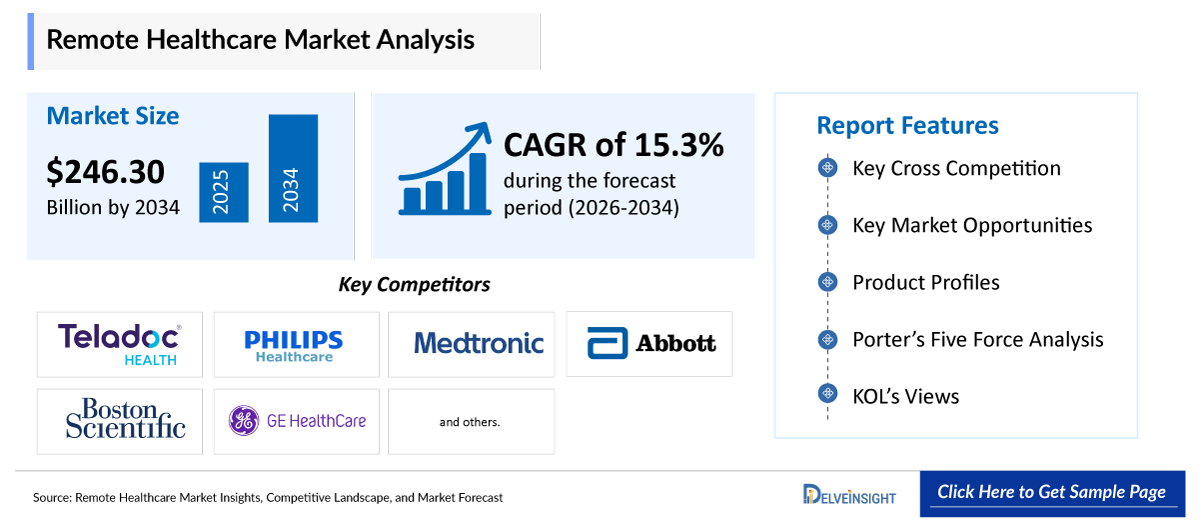
- The Remote Healthcare market is estimated at USD 68.40 billion in 2025 and is projected to reach USD 246.30 billion by 2034. Growth is anchored in the rising global burden of chronic disease, an aging population, physician and nursing shortages, and the accelerating shift of payers and health systems toward cloud-based, AI-enabled connected care.
- The global Remote Healthcare market is growing at a CAGR of 15.3% during the forecast period from 2026 to 2034.
- By component, the hardware segment dominated the Remote Healthcare market with a 44% share in 2025.
- By service type, the telemonitoring segment dominated the Remote Healthcare market with a 41% share in 2025.
- By indication, the cardiovascular diseases segment dominated the Remote Healthcare market with a 34% share in 2025.
- By mode of delivery, the cloud-based segment dominated the Remote Healthcare market with a 52% share in 2025.
- By end-users, the hospitals & health systems segment dominated the Remote Healthcare market with a 53% share in 2025.
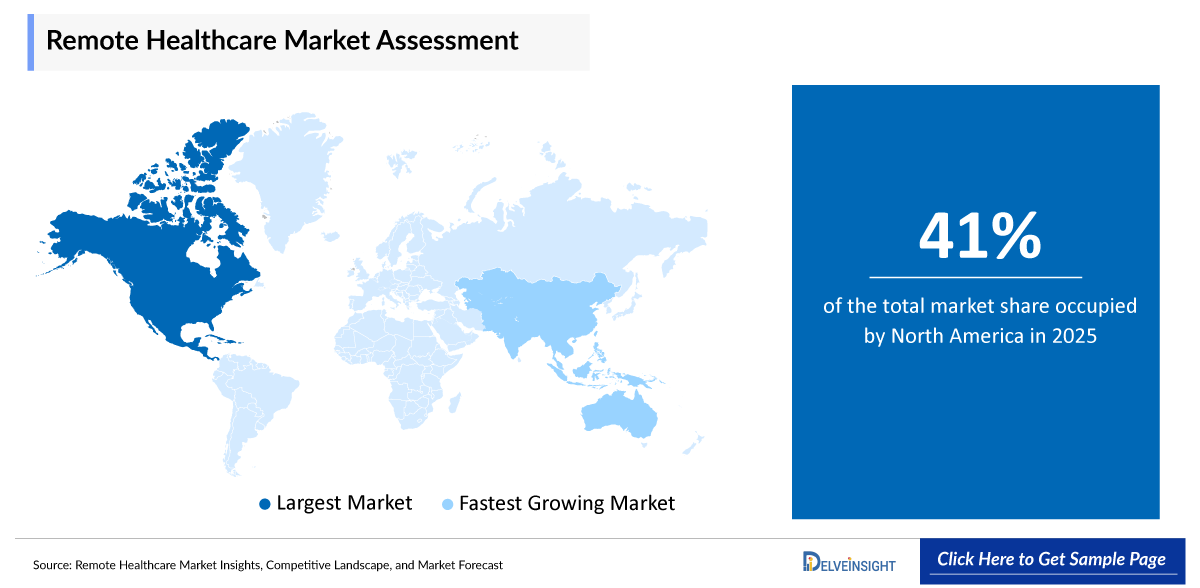
- North America dominated the global Remote Healthcare market revenue with a 41% share in 2025, representing the highest regional market share globally.
Remote healthcare refers to the delivery of medical consultation, diagnosis, monitoring, and treatment support to patients outside traditional clinical settings through connected hardware, software platforms, and clinician-facing services. It spans teleconsultation, telemonitoring, telemedicine, and telepsychiatry, and relies on an ecosystem of wearable sensors, home monitoring devices, secure video and messaging platforms, cloud data infrastructure, and analytics that link patients to hospitals, clinics, and home healthcare providers. Because chronic diseases such as cardiovascular disease, diabetes, respiratory disease, neurological disorders, and cancer require continuous, longitudinal management rather than episodic visits, health systems and payers increasingly rely on remote healthcare platforms to extend clinical oversight into the home, reduce avoidable hospitalizations, and address persistent shortages of physicians and nurses. The market is organized by component across hardware, software, and services; by service type across teleconsultation, telemonitoring, telemedicine, telepsychiatry, and other services; by indication, led by cardiovascular disease, diabetes, respiratory disease, neurological disorders, and cancer; by mode of delivery across cloud-based, on-premise, web-based, and mobile-based platforms; and by end-user across hospitals and health systems, clinics and physician practices, home healthcare providers, and others. Driven by reimbursement parity for virtual care, the proliferation of connected wearables and biosensors, and the integration of artificial intelligence into clinical monitoring workflows, remote healthcare has become foundational infrastructure for value-based, home-centered care delivery.
Remote Healthcare Market Key Growth Drivers
- The rising global burden of chronic disease and an aging population are expanding demand for continuous, longitudinal monitoring, with cardiovascular disease, diabetes, and respiratory disease accounting for the bulk of avoidable hospital admissions.
- A widening global physician and nursing shortage, with the Association of American Medical Colleges projecting a shortfall of up to 180,000 physicians in the United States by 2034, is pushing health systems to extend clinical reach through virtual and remote-monitoring platforms, particularly in rural and underserved areas.
- Reimbursement parity for virtual visits, expanded Medicare and commercial payer coverage of remote patient monitoring and digital mental health codes, and favorable telehealth licensure policies are lowering adoption barriers for providers and patients.
- Rapid proliferation of connected wearables, Bluetooth-enabled biosensors, and mHealth applications is expanding the installed base of patients who can be monitored continuously from home, with tens of millions of remote patient monitoring users now connected globally.
- Integration of artificial intelligence, predictive analytics, and cloud-based data platforms into remote monitoring workflows is improving early detection of clinical deterioration and reducing alert fatigue for care teams.
- Expansion of hospital-at-home and post-acute remote care models is shifting acute and post-acute care volume out of inpatient settings and into the home, supported by health-system and payer investment in connected-care infrastructure.
- Strong investor, payer, employer, and technology-company interest in digital health, evidenced by continued acquisitions and strategic alliances among device makers, platform companies, and health systems, is accelerating consolidation and capability build-out across the market.
Key Companies in Remote Healthcare Market
The competitive landscape is led by the following active device manufacturers:
- Teladoc Health, Inc.
- Koninklijke Philips N.V.
- Medtronic plc
- Abbott Laboratories
- Boston Scientific Corporation
- GE HealthCare Technologies Inc.
- Biofourmis, Inc.
- DexCom, Inc.
- iRhythm Technologies, Inc.
- AliveCor, Inc.
For illustrative purposes, only the top 10 companies are listed in the Table of Contents. The report may include analysis and references to additional companies relevant to the market assessment.
Remote Healthcare Market Size
The following snapshot summarizes the principal report metrics for the Remote Healthcare market.
|
Report Metrics |
Details |
|
2025 Market Size |
USD 68.40 billion |
|
2034 Projected Market Size |
USD 246.30 billion |
|
Growth Rate (2026-2034) |
15.3% CAGR |
|
Largest Market |
North America |
|
Fastest Growing Market |
Asia-Pacific |
|
Market Structure |
Fragmented |
All market values are expressed in USD and represent DelveInsight estimates synthesized from primary and secondary research.
Factors Contributing to the Growth of the Remote Healthcare Market
Market Drivers
Rising Chronic Disease Burden and an Aging Population
The most persistent driver of the Remote Healthcare market is the rising global burden of chronic disease combined with an aging population that requires continuous rather than episodic clinical oversight. Cardiovascular disease, diabetes, chronic obstructive pulmonary disease, and neurological disorders account for the large majority of avoidable hospital admissions, and remote monitoring programs linked to structured care pathways have been shown to meaningfully reduce 30-day readmissions in multi-center studies. As the share of the global population aged 65 and above continues to climb, the volume of patients requiring longitudinal blood pressure, glucose, cardiac rhythm, and respiratory monitoring rises in step, directly expanding demand for connected hardware, monitoring platforms, and the clinical services built around them. Health systems increasingly view remote healthcare not as a pandemic-era convenience but as core infrastructure for managing population health at scale, anchoring durable market growth through 2034.
Physician and Nursing Shortages Expanding Access to Rural and Underserved Care
A widening shortage of physicians and nurses is a central growth engine for remote healthcare adoption. Industry analysts project a shortfall of up to 180,000 physicians in the United States by 2034, with rural counties facing the steepest gaps in access to specialists and primary care. Teleconsultation and telemedicine platforms allow a limited pool of clinicians to serve a much larger and more geographically dispersed patient population, while virtual nursing and remote patient monitoring extend the reach of scarce nursing staff across multiple patients simultaneously. As health systems in North America, Europe, and Asia-Pacific confront persistent workforce constraints, remote healthcare platforms are increasingly deployed as a structural solution rather than a stopgap, sustaining demand for teleconsultation, telemonitoring, and telepsychiatry services across the forecast period.
Reimbursement Parity and Favorable Regulatory and Policy Support
Expanding reimbursement parity for virtual care is directly increasing provider adoption of remote healthcare platforms. Payers increasingly reimburse virtual visits on par with in-person encounters, and newer billing codes covering remote patient monitoring and digital mental health treatment have anchored virtual and connected care firmly within fee schedules in the United States, while comparable reimbursement and licensure reforms are advancing across parts of Europe and Asia-Pacific. Clinics report meaningful incremental annual revenue from enrolling patients in structured remote monitoring programs, creating a direct financial incentive for adoption alongside the clinical benefit. As reimbursement frameworks mature and licensure portability across states and countries improves, the addressable base of providers willing to invest in remote healthcare infrastructure continues to expand.
Proliferation of Connected Wearables, Biosensors, and mHealth Platforms
The rapid proliferation of connected wearables, Bluetooth-enabled biosensors, and mobile health applications is expanding the installed base of patients who can be monitored continuously outside the clinic. Tens of millions of patients globally now use at least one connected remote patient monitoring device, spanning blood pressure cuffs, pulse oximeters, continuous glucose monitors, and ambulatory cardiac patches, and this base continues to grow as device costs fall and smartphone penetration rises. Consumer-grade wearables are increasingly integrated with clinical-grade monitoring platforms, blurring the line between wellness tracking and regulated remote patient monitoring and widening the pool of patients that hardware, software, and services providers can address.
Integration of Artificial Intelligence, Cloud Computing, and Predictive Analytics
Integration of artificial intelligence and cloud-based data infrastructure into remote monitoring workflows is improving the clinical and economic case for remote healthcare. Continuous data streams from wearables and home monitoring devices can overwhelm care teams with alerts, and AI-driven triage and predictive analytics are increasingly deployed to flag clinically meaningful deterioration earlier while reducing alert fatigue. Cloud-based, FHIR-integrated platforms allow monitoring data to flow seamlessly between devices, electronic health records, and care teams, supporting scalable, multi-site deployment. As predictive algorithms demonstrate measurable improvements in outcomes such as blood-pressure control and glycemic management, payers and health systems are more willing to fund the underlying software and analytics infrastructure, reinforcing demand for cloud-based delivery models.
Expansion of Hospital-at-Home and Post-Acute Remote Care Models
The expansion of hospital-at-home and post-acute remote care models is shifting acute and post-acute care volume out of inpatient facilities and into the home, directly enlarging demand for remote healthcare hardware, software, and services. Health systems are deploying continuous vital-sign monitoring, virtual nursing, and command-center models to manage acutely ill patients at home, easing capacity constraints in hospitals while improving patient experience. As regulatory waivers and reimbursement mechanisms supporting hospital-at-home programs mature in the United States and are piloted more broadly internationally, this care model is expected to become a durable, rather than temporary, channel for remote healthcare adoption.
Strong Investor, Payer, and Technology-Company Interest in Digital Health
Sustained investor and strategic interest is accelerating the build-out of remote healthcare capacity. Recent activity includes Teladoc Health's acquisition of Australian virtual-care company Telecare to expand its Asia-Pacific footprint, the merger of remote monitoring specialists CopilotIQ and Biofourmis to create a broader in-home care platform, and continued strategic alliances between device makers such as Medtronic and GE HealthCare to integrate wireless wearable monitoring into hospital care pathways. Large technology and retail platforms are also entering the space, exemplified by Teladoc Health's expanded access through Walmart's Better Care Services. This wave of capital deployment, consolidation, and channel expansion validates the sector's long-term growth trajectory and channels sustained demand toward providers with scale, interoperable technology, and clinical credibility.
Market Restraints
Despite strong momentum, the Remote Healthcare market faces material constraints. Data privacy and cybersecurity concerns are significant, as remote healthcare platforms continuously transmit sensitive patient data across home networks, mobile devices, and cloud infrastructure, exposing providers to breach and compliance risk under frameworks such as HIPAA and GDPR. Uneven broadband and smartphone penetration in rural and low-income areas creates a digital divide that limits adoption among the populations that could benefit most, particularly in parts of Asia-Pacific, Latin America, the Middle East, and Africa.
Reimbursement remains inconsistent across payers, states, and countries, and the potential expiration or narrowing of pandemic-era telehealth flexibilities in some jurisdictions introduces policy uncertainty. Interoperability gaps between devices, monitoring platforms, and electronic health records complicate large-scale deployment, while device accuracy, alert fatigue, and clinical workflow burden on already-stretched care teams can undermine the intended efficiency gains. Cross-border licensure restrictions constrain scaling of teleconsultation and telepsychiatry services internationally, and liability and regulatory complexity around AI-enabled clinical decision support add further friction. Together, these privacy, access, reimbursement, interoperability, and regulatory barriers temper the pace of growth, even as the underlying drivers of chronic disease burden, workforce shortages, and digital infrastructure investment remain firmly intact.
Remote Healthcare Market Segment Analysis
The remote healthcare market by component (hardware, software, services), service type (teleconsultation, telemonitoring, telemedicine, telepsychiatry, others), indication (cardiovascular diseases, diabetes, respiratory diseases, neurological disorders, cancer, others), mode of delivery (cloud-based, on-premise, web-based, mobile-based), end-users (hospitals & health systems, clinics & physician practices, home healthcare providers, others), and Geography (North America, Europe, Asia-Pacific, and Rest of World).
By Component
Dominant Subsegment: Hardware.
The hardware segment accounted for 44% of the Remote Healthcare market in 2025. Hardware leads because remote monitoring depends on a growing installed base of connected devices, including blood pressure monitors, pulse oximeters, continuous glucose monitors, ambulatory cardiac patches, and wearable biosensors, each of which carries a recurring replacement and expansion cycle. Device makers such as Abbott, Medtronic, Boston Scientific, DexCom, and iRhythm Technologies anchor this segment through clinically validated sensors and patches that feed data into monitoring platforms. While software is the fastest-growing component as providers invest in analytics, AI triage, and interoperability layers, and services grow steadily alongside device deployment, the sheer breadth and per-patient cost of connected hardware secures its leadership across the forecast period.
By Service Type
Dominant Subsegment: Telemonitoring.
The telemonitoring segment accounted for 41% of the Remote Healthcare market in 2025. Telemonitoring is the leading service type because it captures the largest and most recurring share of remote healthcare activity, spanning continuous vital-sign, cardiac, and glucose monitoring for patients with chronic conditions. Providers and payers favor telemonitoring because it generates ongoing, billable clinical engagement and measurable reductions in hospital readmissions, unlike single-encounter teleconsultation visits. Teleconsultation remains a large and essential service type for routine and urgent virtual visits, telemedicine supports broader diagnostic and treatment workflows, and telepsychiatry is among the fastest-growing service types as demand for accessible behavioral health care rises. Nonetheless, the recurring, chronic-care-anchored nature of telemonitoring keeps it the dominant service type across the forecast period.
By Indication
Dominant Subsegment: Cardiovascular Diseases.
The cardiovascular diseases segment accounted for 34% of the Remote Healthcare market in 2025. Cardiovascular disease leads because it is the largest single driver of avoidable hospitalization and the indication with the most mature remote monitoring technology base, including ambulatory ECG patches, implantable cardiac monitors, and connected blood-pressure devices from providers such as iRhythm Technologies, Boston Scientific, Medtronic, and Philips. Diabetes is a close and fast-growing category, propelled by continuous glucose monitoring platforms from Abbott and DexCom, while respiratory disease, neurological disorders, and cancer each contribute meaningful and rising demand as remote symptom tracking and post-treatment monitoring expand. The clinical maturity, reimbursement support, and sheer prevalence of cardiovascular disease secure its leadership across the forecast period.
By Mode of Delivery
Dominant Subsegment: Cloud-Based.
The cloud-based segment accounted for 52% of the Remote Healthcare market in 2025. Cloud-based delivery is the leading mode because it enables scalable, multi-site deployment, seamless integration with electronic health records through FHIR-based interoperability, and centralized AI-driven analytics that would be impractical with locally hosted infrastructure. Health systems increasingly prefer cloud-based platforms for their lower upfront capital requirement and ability to support hospital-at-home and virtual nursing programs across many facilities from a single command center. Mobile-based delivery is the fastest-growing mode as patient-facing applications proliferate, web-based access remains important for clinician portals, and on-premise deployment persists mainly among large hospital systems with strict data-residency requirements. The scalability and interoperability advantages of cloud-based platforms keep the segment dominant across the forecast period.
By End-Users
Dominant Subsegment: Hospitals & Health Systems.
The hospitals & health systems segment accounted for 53% of the Remote Healthcare market in 2025. Hospitals and health systems lead as end-users because they possess the capital, clinical staffing, and reimbursement infrastructure to deploy remote healthcare at scale across virtual nursing, hospital-at-home, and post-acute monitoring programs, and because large integrated systems increasingly view remote healthcare as core infrastructure rather than a discrete pilot. Clinics and physician practices are steady adopters of teleconsultation and chronic-care telemonitoring, while home healthcare providers represent the fastest-growing end-user category as post-acute and elder-care organizations expand connected monitoring services. The scale, capital base, and reimbursement leverage of hospitals and health systems secure their leadership across the forecast period.
Remote Healthcare Market Region Analysis
Dominant Region: North America
North America accounted for 41% of the global Remote Healthcare market revenue in 2025, representing the highest regional market share globally. The region's dominance reflects mature reimbursement parity for virtual care, deep penetration of connected wearables and remote patient monitoring devices, and a dense concentration of leading platform and device companies including Teladoc Health, Medtronic, Abbott, Boston Scientific, DexCom, iRhythm Technologies, and AliveCor. The United States anchors regional demand through favorable Medicare and commercial reimbursement for remote patient monitoring and digital mental health services, an expanding hospital-at-home policy framework, and a persistent physician and nursing shortage that pushes health systems toward virtual and remote-monitoring models. Continued consolidation, including strategic alliances between device makers and platform companies, and expanding retail and employer-channel access to virtual care, reinforce the region's continued leadership across the forecast period.
Fastest Growing Region: Asia-Pacific
Asia-Pacific is the fastest-growing region in the Remote Healthcare market. The region's elevated CAGR is driven by large and underserved rural populations, rapid smartphone and mobile-internet penetration, and expanding government investment in digital health infrastructure across China, Japan, India, South Korea, and Australia. China is scaling internet-hospital and mobile telemedicine platforms, Japan is integrating AI-driven remote monitoring for its aging population, India is expanding low-cost teleconsultation and mHealth platforms to extend specialist access into rural areas, and Australia and South Korea are advancing reimbursement frameworks and connected-device adoption. Rising chronic disease prevalence, government digital-health modernization programs, and growing local platform investment position Asia-Pacific as the principal source of incremental growth over the forecast period.
Regional Commentary
North America
North America accounted for 41% of the global Remote Healthcare market revenue in 2025. The United States dominates on the strength of reimbursement parity for virtual care, dense connected-device penetration, and a persistent clinician shortage, while ongoing consolidation among device makers and platform companies, and expanding hospital-at-home policy support, reinforce its leadership.
Europe
Europe is a large and advanced regional market, supported by national digital-health strategies, growing reimbursement for telemedicine across Germany, France, and the United Kingdom, and an established base of connected-care providers including Philips. Strategic partnerships, such as Philips' collaboration with connected-monitoring platform smartQare, reinforce the region's role in scaling both hospital-based and home-based remote monitoring programs across Germany, France, the United Kingdom, Italy, and Spain.
Asia-Pacific
Asia-Pacific is the fastest-growing region, propelled by large underserved rural populations, rapid mobile and smartphone penetration, and expanding government investment in digital health infrastructure across China, Japan, India, South Korea, and Australia. China's internet-hospital rollout, Japan's AI-driven remote monitoring pivot for its aging population, India's low-cost teleconsultation expansion, and rising connected-device adoption in Australia and South Korea are accelerating regional growth.
Rest of World
The Rest of World region, spanning Latin America, the Middle East, and Africa, is an emerging growth frontier. Expanding mobile-network coverage, rising demand for teleconsultation and telemedicine in areas with limited specialist access, and government efforts to modernize healthcare infrastructure are gradually broadening adoption, while international partnerships and donor-funded digital-health programs support the build-out of regional connected-care capacity.
Remote Healthcare Market Competitive Landscape
The Remote Healthcare market is classified as Fragmented. A group of large, diversified medical technology companies with broad connected-device and monitoring portfolios, including Philips, Medtronic, Abbott, Boston Scientific, and GE HealthCare, anchors the hardware side of the market, while dedicated virtual-care and platform specialists such as Teladoc Health and Biofourmis compete on software, services, and clinical program design, and focused device innovators including DexCom, iRhythm Technologies, and AliveCor compete on indication-specific monitoring accuracy and clinical validation.
The competitive landscape can be evaluated across the following dimensions:
- Market concentration: Fragmented, with large diversified medical technology companies competing alongside focused platform and device specialists across hardware, software, and services.
- Leading players: Teladoc Health, Philips, Medtronic, Abbott, and GE HealthCare anchor the top tier through scale, device breadth, and installed clinical base.
- Geographic reach: Leaders operate global, multi-country platforms and distribution networks; Teladoc Health's Solo virtual-care platform is used across more than 4,000 hospitals and health systems worldwide.
- Service portfolio strength: Top players offer end-to-end coverage spanning connected hardware, cloud-based software platforms, teleconsultation, telemonitoring, and clinical support services.
- Clinical validation and regulatory clearance: Regulatory approvals such as iRhythm's Japanese clearance for its Zio ECG system and Abbott's and DexCom's continuous glucose monitoring approvals are decisive competitive advantages.
- Strategic partnerships: Alliances such as Medtronic's expanded strategic collaboration with GE HealthCare on wireless wearable monitoring, and Philips' partnership with smartQare, extend reach and integration depth.
- M&A activity: Active consolidation, including Teladoc Health's acquisition of Australian virtual-care company Telecare and the merger of remote monitoring specialists CopilotIQ and Biofourmis.
- Manufacturing and platform capabilities: Clinically validated sensors, cloud-based interoperable software, and AI-driven analytics engines are key competitive moats.
- Innovation focus: AI-driven predictive monitoring, hospital-at-home enablement, virtual nursing, and consumer-grade wearable integration with clinical-grade platforms.
Remote Healthcare Market Recent Developmental Activities
In 2026, Teladoc Health expanded access to its virtual care services through a collaboration with Walmart's Better Care Services platform, bringing virtual urgent care, dermatology, and nutrition services to a broader consumer base. Strategic significance: Extends Teladoc Health's consumer reach through a major retail channel and diversifies its access points beyond traditional payer and employer contracts.
In January 2026, Medtronic expanded its multiyear global strategic alliance with GE HealthCare to accelerate adoption of next-generation wireless wearable pulse-oximetry and depth-of-anesthesia monitoring technologies across integrated clinical platforms. Strategic significance: Deepens integration between Medtronic's monitoring hardware and GE HealthCare's clinical platforms, broadening access to connected monitoring technology across care settings.
In November 2025, Teladoc Health joined the Collaborative for Healthy Rural America alongside other digital health and consulting organizations to support integrated digital healthcare delivery, data integration, and remote patient management programs in rural communities. Strategic significance: Reinforces Teladoc Health's role in extending virtual and remote-monitoring access to underserved rural populations.
In August 2025, Teladoc Health announced the acquisition of Australian virtual-care company Telecare, expanding its international telehealth and remote patient monitoring footprint across the Asia-Pacific region. Strategic significance: Adds a direct Asia-Pacific commercial presence and accelerates Teladoc Health's international expansion strategy.
In 2025, Biofourmis was selected by AdventHealth to expand hospital-at-home and remote patient monitoring programs, deploying its predictive AI analytics for at-home cardiac and vitals monitoring. Strategic significance: Extends Biofourmis' predictive monitoring platform into a large multi-state health system, reinforcing its position in hospital-at-home care.
In 2025, Biofourmis combined with remote health monitoring company CopilotIQ to create a broader in-home care platform spanning pre-surgical optimization, acute, post-acute, and chronic care management. Strategic significance: Creates a single integrated technology platform for enterprise customers managing patients across the full care continuum.
In 2025, Abbott Laboratories continued to scale its FreeStyle Libre continuous glucose monitoring franchise, sustaining double-digit growth and reinforcing its position as one of the largest connected diabetes-monitoring platforms globally. Strategic significance: Strengthens Abbott's leadership in continuous glucose monitoring, a core pillar of the diabetes remote-monitoring segment.
In April 2025, Philips advanced a strategic partnership with connected-monitoring platform smartQare to extend remote vital-sign monitoring capabilities for hospital and home-based care in Europe. Strategic significance: Strengthens Philips' connected-care portfolio and broadens its remote monitoring footprint across European health systems.
In September 2024, iRhythm Technologies received Japanese regulatory approval for its Zio ECG ambulatory cardiac monitoring system, marking a significant international regulatory milestone for its long-term continuous monitoring platform. Strategic significance: Opens a major new international market for iRhythm's cardiac monitoring technology and validates its platform under a stringent regulatory regime.
In 2024, GE HealthCare continued to expand its remote vital-sign monitoring and command-center offerings supporting hospital-at-home and connected chronic-disease management programs across health systems. Strategic significance: Broadens GE HealthCare's role in enabling health systems to scale remote monitoring beyond the hospital walls.
Remote Healthcare Market Segmentation
Remote Healthcare Market by Component
- Hardware
- Software
- Services
Remote Healthcare Market by Service Type
- Teleconsultation
- Telemonitoring
- Telemedicine
- Telepsychiatry
- Others
Remote Healthcare Market by Indication
- Cardiovascular Diseases
- Diabetes
- Respiratory Diseases
- Neurological Disorders
- Cancer
- Others
Remote Healthcare Market by Mode of Delivery
- Cloud-Based
- On-Premise
- Web-Based
- Mobile-Based
Remote Healthcare Market by End-Users
- Hospitals & Health Systems
- Clinics & Physician Practices
- Home Healthcare Providers
- Others
Remote Healthcare Market by Geography
- North America Remote Healthcare Market
- United States Remote Healthcare Market Size in USD million (2023-2034)
- Canada Remote Healthcare Market Size in USD million (2023-2034)
- Mexico Remote Healthcare Market Size in USD million (2023-2034)
- Europe Remote Healthcare Market
- Germany Remote Healthcare Market Size in USD million (2023-2034)
- United Kingdom Remote Healthcare Market Size in USD million (2023-2034)
- France Remote Healthcare Market Size in USD million (2023-2034)
- Italy Remote Healthcare Market Size in USD million (2023-2034)
- Spain Remote Healthcare Market Size in USD million (2023-2034)
- Rest of Europe Remote Healthcare Market Size in USD million (2023-2034)
- Asia-Pacific Remote Healthcare Market
- China Remote Healthcare Market Size in USD million (2023-2034)
- Japan Remote Healthcare Market Size in USD million (2023-2034)
- India Remote Healthcare Market Size in USD million (2023-2034)
- Australia Remote Healthcare Market Size in USD million (2023-2034)
- South Korea Remote Healthcare Market Size in USD million (2023-2034)
- Rest of Asia-Pacific Remote Healthcare Market Size in USD million (2023-2034)
- Rest of the World (RoW) Remote Healthcare Market
- Middle East Remote Healthcare Market Size in USD million (2023-2034)
- Africa Remote Healthcare Market Size in USD million (2023-2034)
- South America Remote Healthcare Market Size in USD million (2023-2034)
Remote Healthcare Market Recent Industry Trends and Milestones (2023-2026)
|
Category |
Key Developments |
|
Remote Healthcare Market Product Approval |
Reimbursement parity for virtual visits and expanded Medicare and commercial payer coverage of remote patient monitoring and digital mental health codes are anchoring virtual care in fee schedules. iRhythm Technologies received Japanese regulatory approval for its Zio ECG system in September 2024, and continuous glucose monitoring approvals from Abbott and DexCom continue to expand indications. Each approval and reimbursement expansion creates durable demand for connected hardware, cloud-based software, and monitoring services. |
|
Remote Healthcare Market Expansion |
Teladoc Health expanded access through Walmart's Better Care Services platform and joined the Collaborative for Healthy Rural America to widen rural access. Medtronic and GE HealthCare expanded their multiyear strategic alliance on wireless wearable monitoring, Philips advanced its partnership with smartQare, and hospital-at-home and virtual nursing programs scaled across major health systems as providers shifted acute and post-acute volume into the home. |
|
Remote Healthcare Market Investment |
Consolidation accelerated across the sector. Teladoc Health acquired Australian virtual-care company Telecare (August 2025), and remote monitoring specialists CopilotIQ and Biofourmis combined to create a broader in-home care platform (2025). Device makers including Abbott, DexCom, and iRhythm Technologies continued to scale connected-monitoring franchises, while strategic alliances between hardware and platform companies expanded integrated care offerings. |
|
Company Strategy |
Teladoc Health: Retail and rural-access channel expansion alongside international M&A. Philips: Connected-monitoring partnerships extending its European hospital and home-care footprint. Medtronic and GE HealthCare: Deepened wireless wearable monitoring alliance. Abbott and DexCom: Continuous glucose monitoring franchise scale-up. Boston Scientific and iRhythm Technologies: Cardiac monitoring innovation and international regulatory expansion. Biofourmis and AliveCor: AI-driven predictive analytics and consumer-to-clinical monitoring integration. |
|
Emerging Technologies |
AI-driven predictive analytics and early-warning algorithms are the leading edge of innovation, reducing alert fatigue and enabling earlier clinical intervention. Cloud-based, FHIR-integrated platforms, mobile-based patient applications, and virtual nursing command centers are scaling hospital-at-home and post-acute care. Consumer-grade wearables are increasingly integrated with clinical-grade monitoring platforms, and collaborations between device makers, platform companies, and health systems are accelerating adoption of connected chronic-disease management programs. |
Remote Healthcare Market Startup Funding and Investment Trends
Investment in the Remote Healthcare ecosystem has concentrated on AI-driven predictive monitoring, hospital-at-home platforms, and connected chronic-disease management. The following companies illustrate recent funding and investment activity and technology focus.
|
Company |
Total Funding |
Funding Stage |
Main Offering |
Core Technology |
|
Biofourmis, Inc. |
USD 300 million Series D (2022); combined with CopilotIQ (2025) |
Growth / Merger |
AI-powered hospital-at-home and remote patient monitoring |
Predictive AI analytics for continuous home monitoring |
|
Request for unlocking the report of the @ Remote Healthcare Market | ||||
Capital continues to flow toward providers that combine clinically validated monitoring hardware with AI-driven analytics and cloud-based platforms. Teladoc Health's acquisition of Telecare and the CopilotIQ-Biofourmis merger underscore the strategic value of integrated, in-home care infrastructure. Established device makers including Abbott, DexCom, Medtronic, Boston Scientific, and iRhythm Technologies continue to invest in expanding connected-monitoring franchises, while platform specialists such as AliveCor scale AI-enabled cardiac monitoring. Collectively, these investments signal conviction that predictive analytics, hospital-at-home enablement, and cloud-based interoperability will define the next phase of competitive advantage in the global Remote Healthcare market.
Key Takeaways from the Remote Healthcare Market Report Study
- Market size analysis for the current remote healthcare market size (2025), and market forecast for 9 years (2026 to 2034).
- Top key product/technology developments, mergers, acquisitions, partnerships, and joint ventures that happened over the last 3 years.
- Key companies dominating the global remote healthcare market.
- Various opportunities available for competitors in the remote healthcare market space.
- What are the top-performing segments in 2025? How will these segments perform in 2034?
- Which are the top-performing regions and countries in the current remote healthcare market scenario?
- Which are the regions and countries where companies should concentrate their opportunities for remote healthcare market growth in the future?
Target audience who can benefit from this remote healthcare market report study
- Remote healthcare product providers
- Research organizations and consulting companies
- Remote healthcare-related organizations, associations, forums, and other alliances
- Government and corporate offices
- Start-up companies, venture capitalists, and private equity firms
- Distributors and traders dealing in Remote Healthcare
- Various end-users who want to know more about the remote healthcare market and the latest technological developments in the remote healthcare market.

