retinal detachment disorder market
Key Highlights
- The market is expected to increase significantly by 2036.
- The US will grab the highest market share.
- RRD incidence was 868.83 per 100,000 person-years among high myopes versus 22.44 per 100,000 person-years among non-myopes in one large commercially insured cohort.
- Key companies in the active include Alcon; Bausch + Lomb; Carl Zeiss Meditec; Johnson & Johnson Vision; Topcon; NIDEK; IRIDEX; Optos; Santen Pharmaceutical; FCI Ophthalmics; Millennium Surgical; Leica Microsystems; Haag-Streit; Oculus Optikgeräte; Ractigen Therapeutics; Aldeyra Therapeutics; ONL Therapeutics.
DelveInsight's "Retinal Detachment Disorder Market Insights, Epidemiology, and Market Forecast-2036" report delivers an in-depth understanding of the Retinal Detachment Disorder, historical and forecasted epidemiology as well as the Retinal Detachment Disorder market trends in the United States, EU5 (Germany, Spain, Italy, France, and United Kingdom) and Japan.
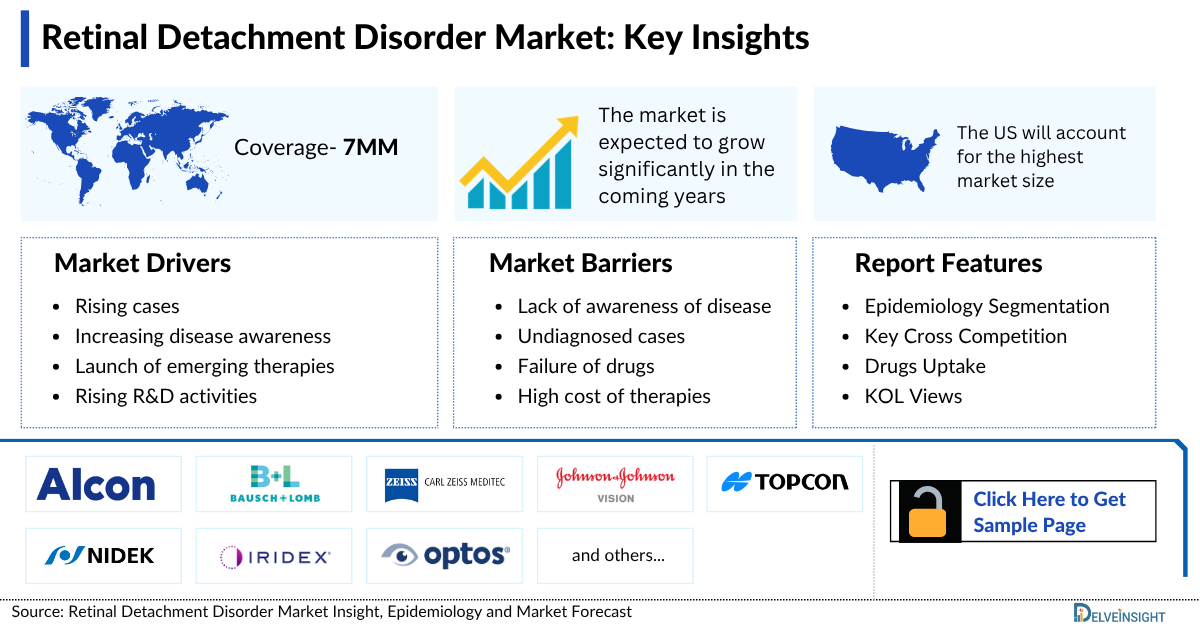
The Retinal Detachment Disorder market report provides current treatment practices, emerging drugs, Retinal Detachment Disorder market share of the individual therapies, current and forecasted Retinal Detachment Disorder market Size from 2022 to 2036 segmented by seven major markets. The Report also covers current Retinal Detachment Disorder treatment practice/algorithm, market drivers, market barriers and unmet medical needs to curate the best of the opportunities and assesses the underlying potential of the Retinal Detachment Disorder market.
Geography Covered
- The United States
- EU5 (Germany, France, Italy, Spain, and the United Kingdom)
- Japan
Study Period: 2022-2036
Key Factors Driving Retinal Detachment Market Growth
- Rising Incidence of Rhegmatogenous Retinal Detachment: Global RRD incidence has been estimated at 12.17 cases per 100,000 people annually, with an increasing temporal trend. A growing patient pool supports demand for retinal imaging, surgical procedures, instruments, and consumables.
- Increasing Prevalence of Myopia and High Myopia: Myopia is a major risk factor for RRD, with risk increasing substantially with greater myopic severity. A U.S. study found RRD incidence in high myopes to be approximately 39 times higher than in non-myopes, supporting demand for retinal monitoring and intervention.
- Aging Population: RRD prevalence peaks around the 60–70-year age range, while population aging increases the number of individuals susceptible to vitreoretinal changes and retinal disorders.
- Growth in Cataract and Intraocular Surgeries: Previous eye surgery, including cataract surgery, is an established risk factor for retinal detachment. Increasing surgical volumes therefore contribute to the population requiring postoperative retinal surveillance and, in some cases, retinal-detachment treatment.
- Advances in Retinal Imaging and Surgical Technologies: OCT, wide-field imaging, improved vitrectomy systems, laser technology, surgical visualization, and advanced instrumentation are expanding diagnostic capabilities and supporting improvements in retinal-detachment management.
Retinal Detachment Disorder Disease Understanding and Treatment Algorithm
Retinal detachment (RD) is a sight-threatening ophthalmic disorder in which the neurosensory retina separates from the underlying retinal pigment epithelium, disrupting retinal function and potentially causing permanent vision loss. It is broadly classified into rhegmatogenous retinal detachment (RRD), caused by a retinal tear or break; tractional retinal detachment (TRD), caused by vitreoretinal traction; and exudative/serous retinal detachment, caused by fluid accumulation without a retinal break. RRD is the most common form and is an ophthalmic emergency requiring prompt assessment and treatment. Major risk factors include increasing age, high myopia, previous cataract or other intraocular surgery, ocular trauma, previous retinal detachment, and retinal disorders such as diabetic retinopathy.
Retinal Detachment Disorder Diagnosis
Diagnosis is primarily clinical and involves a comprehensive dilated retinal examination, including visual acuity, pupillary assessment, visual-field evaluation, intraocular pressure measurement, slit-lamp examination, and indirect ophthalmoscopy with scleral depression to identify retinal breaks and determine the extent of detachment. Optical coherence tomography (OCT) provides high-resolution cross-sectional visualization of the retina and can help confirm neurosensory separation, particularly at the macula. B-scan ultrasonography is particularly useful when vitreous hemorrhage, cataract, or other media opacity prevents direct visualization of the retina. Wide-field fundus photography may also assist with documentation and peripheral retinal assessment.
Retinal Detachment Disorder Treatment
Treatment depends on the type, location, size, and extent of the detachment and whether the macula is attached. Small retinal tears or holes may be treated with laser photocoagulation or cryopexy, while selected uncomplicated detachments may be managed with pneumatic retinopexy. More extensive RRD generally requires surgery, principally pars plana vitrectomy, scleral buckling, or a combination of procedures. Intraocular gas or silicone oil may be used as a tamponade to maintain retinal apposition during healing. PVR, a fibrotic complication that can lead to recurrent detachment, remains a major challenge; current evidence indicates that no pharmacologic adjuvant has yet been established for routine PVR prevention or treatment, leaving surgery as the primary therapeutic approach.
Retinal Detachment Disorder Epidemiology
The Retinal Detachment Disorder epidemiology section provides insights about the historical and current Retinal Detachment Disorder patient pool and forecasted trends for individual seven major countries. It helps to recognize the causes of current and forecasted trends by exploring numerous studies and views of key opinion leaders. This part of the Retinal Detachment Disorder market report also provides the diagnosed patient pool and their trends along with assumptions undertaken.
Key Findings
The disease epidemiology covered in the report provides historical as well as forecasted Retinal Detachment Disorder epidemiology scenario in the 7MM covering the United States, EU5 countries (Germany, Spain, Italy, France, and the United Kingdom), and Japan from 2022 to 2036.
Retinal Detachment Disorder Drug Chapters
The drug chapter segment of the Retinal Detachment Disorder report encloses the detailed analysis of Retinal Detachment Disorder marketed drugs and late-stage (Phase-III and Phase-II) Retinal Detachment Disorder pipeline drugs. It also helps to understand the Retinal Detachment Disorder clinical trial details, expressive pharmacological action, agreements and collaborations, approval and patent details, advantages and disadvantages of each included drug and the latest news and press releases.
Retinal Detachment Disorder Marketed Drugs
The report provides the details of the marketed products/off-label treatments available for Retinal Detachment Disorder treatment.
Retinal Detachment Disorder Emerging Drugs
RAG-1C: Ractigen Therapeutics
RAG-1C is an investigational small activating RNA (saRNA) therapy being developed for the prevention and treatment of proliferative vitreoretinopathy (PVR) following retinal detachment surgery or ocular trauma. It is designed to activate the endogenous p21/CDKN1A gene, thereby promoting cell-cycle arrest and limiting proliferation and myofibroblast transformation. In July 2026, the U.S. FDA cleared Ractigen's IND application, enabling a Phase I study in patients undergoing retinal-detachment surgery who are at high risk of PVR.
ADX-2191 (intravitreal methotrexate): Aldeyra Therapeutics
ADX-2191 is a vitreous-compatible formulation of methotrexate investigated as an adjunct to surgery for PVR associated with retinal detachment. Methotrexate is intended to inhibit cellular proliferation and inflammatory processes involved in PVR membrane formation. Aldeyra's Phase 3 GUARD program previously reported a statistically significant reduction in retinal detachment versus historical control in Part 1, although the overall development history should be distinguished from currently recruiting programs.
Recent Developments in the Retinal Detachment Disorder Market
- In August 2026, Ractigen Therapeutics' RAG-1C program emerged as a notable development in the retinal-detachment/PVR therapeutic landscape after the U.S. FDA cleared its IND application.
Retinal Detachment Disorder Market Outlook
The Retinal Detachment Disorder market outlook of the report helps to build a detailed comprehension of the historic, current, and forecasted Retinal Detachment Disorder market trends by analyzing the impact of current Retinal Detachment Disorder therapies on the market, unmet needs, drivers and barriers, and demand for better technology.
This segment gives a thorough detail of Retinal Detachment Disorder market trend of each marketed drug and late-stage pipeline therapy by evaluating their impact based on the annual cost of therapy, inclusion and exclusion criteria's, mechanism of action, compliance rate, growing need of the market, increasing patient pool, covered patient segment, expected launch year, competition with other therapies, brand value, their impact on the market and view of the key opinion leaders. The calculated Retinal Detachment Disorder market data are presented with relevant tables and graphs to give a clear view of the market at first sight.
According to DelveInsight, the Retinal Detachment Disorder market in 7MM is expected to witness a major change in the study period 2022-2036.
Retinal Detachment Disorder Drugs Uptake
This section focuses on the rate of uptake of the potential Retinal Detachment Disorder drugs recently launched in the Retinal Detachment Disorder market or expected to get launched in the market during the study period 2022-2036. The analysis covers Retinal Detachment Disorder market uptake by drugs; patient uptake by therapies; and sales of each drug.
Retinal Detachment Disorder Drugs Uptake helps in understanding the drugs with the most rapid uptake, reasons behind the maximal use of new drugs, and allow the comparison of the drugs on the basis of Retinal Detachment Disorder market share and size which again will be useful in investigating factors important in market uptake and in making financial and regulatory decisions.
Retinal Detachment Disorder Pipeline Development Activities
The Retinal Detachment Disorder report provides insights into different therapeutic candidates in Phase II, and Phase III stage. It also analyses Retinal Detachment Disorder key players involved in developing targeted therapeutics.
Pipeline Development Activities
The Retinal Detachment Disorder report covers the detailed information of collaborations, acquisition, and merger, licensing, patent details, and other information for Retinal Detachment Disorder emerging therapies.
Reimbursement Scenario in Retinal Detachment Disorder
Approaching reimbursement proactively can have a positive impact both during the late stages of product development and well after product launch. In a report, we take reimbursement into consideration to identify economically attractive indications and market opportunities. When working with finite resources, the ability to select the markets with the fewest reimbursement barriers can be a critical business and price strategy.
KOL- Views
To keep up with current Retinal Detachment Disorder market trends, we take KOLs and SMEs ' opinion working in the Retinal Detachment Disorder domain through primary research to fill the data gaps and validate our secondary research. Their opinion helps to understand and validate current and emerging therapies treatment patterns or Retinal Detachment Disorder market trends. This will support the clients in potential upcoming novel treatment by identifying the overall scenario of the market and the unmet needs.
Competitive Intelligence Analysis
We perform Competitive and Market Intelligence analysis of the Retinal Detachment Disorder Market by using various Competitive Intelligence tools that include - SWOT analysis, PESTLE analysis, Porter's five forces, BCG Matrix, Market entry strategies etc. The inclusion of the analysis entirely depends upon the data availability.
Scope of the Retinal Detachment Disorder Market Report
- The Retinal Detachment Disorder Therapeutics Market Report covers a segment of key events, an executive summary, a descriptive overview, explaining their causes, signs and symptoms, pathogenesis, and currently available treatments.
- Comprehensive insight has been provided into the epidemiology segments and forecasts, the future growth potential of the diagnosis rate, and disease progression along Retinal Detachment Disorder Treatment guidelines.
- Additionally, an all-inclusive account of both the current and emerging treatments, along with the elaborative profiles of late-stage and prominent therapies, will have an impact on the current Retinal Detachment Disorder Treatment landscape.
- A detailed review of the Retinal Detachment Disorder Therapeutics Market, historical and forecasted Retinal Detachment Disorder Treatment Market Size, Retinal Detachment Disorder Drugs Market Share by therapies, detailed assumptions, and rationale behind our approach is included in the report, covering the 7MM drug outreach.
- The Retinal Detachment Disorder Therapeutics Market Report provides an edge while developing business strategies by understanding trends through SWOT analysis and expert insights/KOL views, patient journey, and treatment preferences that help in shaping and driving the 7MM Retinal Detachment Disorder Drugs Market.
Retinal Detachment Disorder Market Report Insights
- Retinal Detachment Disorder Patient Population Forecast
- Retinal Detachment Disorder Therapeutics Market Size
- Retinal Detachment Disorder Pipeline Drugs Analysis
- Retinal Detachment Disorder Market Size and Trends
- Retinal Detachment Disorder Therapeutics Market Opportunity (Current and Forecasted)
Retinal Detachment Disorder Market Report Key Strengths
- Epidemiology-based (Epi-based) Bottom-up Forecasting
- Artificial Intelligence (AI) - enabled Market Research Report
- 11-year forecast
- Retinal Detachment Disorder Market Outlook (North America, Europe, Asia-Pacific)
- Patient Burden Trends (by geography)
- Retinal Detachment Disorder Treatment Addressable Market (TAM)
- Retinal Detachment Disorder Competitive Landscape
- Retinal Detachment Disorder Major Companies Insights
- Retinal Detachment Disorder Price Trends and Analogue Assessment
- Retinal Detachment Disorder Therapies Drug Adoption/Uptake
- Retinal Detachment Disorder Therapies Peak Patient Share Analysis
Retinal Detachment Disorder Market Report Assessment
- Retinal Detachment Disorder Current Treatment Practices
- Retinal Detachment Disorder Unmet Needs
- Retinal Detachment Disorder Clinical Development Analysis
- Retinal Detachment Disorder Emerging Drugs Product Profiles
- Retinal Detachment Disorder Market Attractiveness
- Retinal Detachment Disorder Qualitative Analysis (SWOT and Attribute analysis)
Key Questions Answered in the Retinal Detachment Disorder Treatment Market Report
Retinal Detachment Disorder Therapeutics Market Insights
- What was the Retinal Detachment Disorder Treatment Market Size, the Retinal Detachment Disorder Market Size by therapies, Retinal Detachment Disorder Drugs Market Share (%) distribution in 2025, and what would it look like by 2036? What are the contributing factors for this growth?
- What are the anticipated pricing variations among different geographies for the emerging therapies in the future?
- What can be the future treatment paradigm of Retinal Detachment Disorder?
- What are the disease risks, burdens, and unmet needs of Retinal Detachment Disorder?
- What will be the growth opportunities across the 7MM concerning the patient population with Retinal Detachment Disorder?
- Who is the major future competitor in the market, and how will the competitors affect their market share?
- What are the current options for the treatment of Retinal Detachment Disorder? What are the current guidelines for treating Retinal Detachment Disorder in the US, Europe, and Japan?
Reasons to Buy the Retinal Detachment Disorder Therapeutics Market Report
- The Retinal Detachment Disorder Therapeutics Market Report will help in developing business strategies by understanding the latest trends and changing treatment dynamics driving the Retinal Detachment Disorder Drugs Market.
- Bottom up forecasting builds from the affected population to product forecasts, delivering a robust, data driven approach ideal for new therapies and novel classes.
- Insights on patient burden/disease Retinal Detachment Disorder Prevalence, evolution in diagnosis, and factors contributing to the change in the epidemiology of the disease during the forecast years.
- Understand the existing Retinal Detachment Disorder Drugs Market opportunities in varying geographies and the growth potential over the coming years.
- Identifying strong upcoming players in the Retinal Detachment Disorder Drugs Market will help devise strategies to help get ahead of competitors.
- Detailed analysis, ranking of class-wise potential current, and emerging therapies under the attribute analysis section to provide visibility around leading classes.
- To understand KOLs’ perspectives on the accessibility, acceptability, and compliance-related challenges of existing treatment to overcome barriers in the future.
- Detailed insights on the unmet needs of the existing Retinal Detachment Disorder Drugs Market so that the upcoming players can strengthen their development and launch strategy.
- This Artificial Intelligence (AI) enabled report summarize and simplify complex datasets with in the report into clear, actionable insights for stakeholders, investors, and healthcare providers, enabling faster, data driven decisions.