
RG-6299 Sales Forecast Summary
Key Factors Driving RG-6299 Growth
Large Unmet Medical Need in IgA Nephropathy
IgA nephropathy is the most common form of primary glomerulonephritis worldwide and a major cause of chronic kidney disease and kidney failure.
Key disease burden indicators:
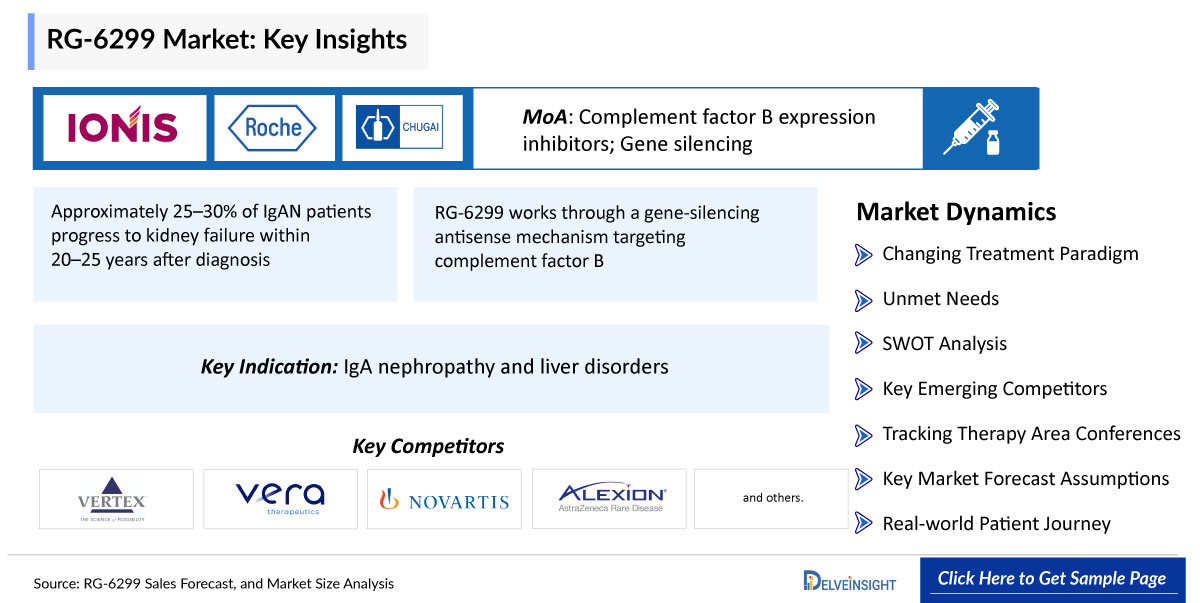
- Approximately 25–30% of IgAN patients progress to kidney failure within 20–25 years after diagnosis.
- The disease often affects young adults, leading to decades of disease management and healthcare costs.
Current treatment options mainly include:
- Blood-pressure control using renin-angiotensin system inhibitors
- Immunosuppressive therapy in selected cases
These treatments do not directly target the complement-driven disease mechanism, leaving a major therapeutic gap that targeted drugs such as RG-6299 aim to address.
Because IgAN is a chronic progressive disease with limited targeted therapies, successful disease-modifying treatments could see strong uptake.
Novel Complement Factor B Targeting Mechanism
RG-6299 works through a gene-silencing antisense mechanism targeting complement factor B, a key enzyme in the alternative complement pathway.
Clinical pharmacology studies showed:
- Up to 69% reduction in plasma complement factor B levels after repeated dosing.
- Parallel reductions in markers of complement activation (Bb protein).
Because complement activation drives kidney inflammation in IgAN, selective inhibition of factor B may provide disease-modifying benefits while preserving the classical immune pathway.
This precision targeting approach is expected to attract physician interest if confirmed in Phase III trials.
Strong Early Clinical Efficacy Data
Clinical studies have demonstrated promising efficacy signals.
In a Phase II study:
- Mean proteinuria reduction of ~44% after 29 weeks of treatment.
- Another study reported a 43% reduction in 24-hour urinary protein excretion with stable kidney function.
Proteinuria reduction is an important surrogate marker in IgAN because it correlates strongly with slower kidney disease progression.
These results provided the basis for advancing the therapy into global Phase III development.
Ongoing Global Phase III Development Program
RG-6299 is currently being evaluated in a large Phase III randomized clinical trial (IMAGINATION study) in patients with IgA nephropathy at high risk of disease progression.
Trial characteristics include:
- Global multicenter design across ~21 countries.
- Evaluation of proteinuria reduction and kidney function (eGFR) outcomes.
Successful Phase III results would enable regulatory submissions and commercial launch, likely toward the late 2020s.
Partnership Between Ionis and Roche
The collaboration between Ionis and Roche significantly strengthens the commercial potential.
Advantages of the partnership include:
- Ionis expertise in antisense RNA technology
- Roche’s global development and commercialization infrastructure
Following positive Phase II data, Roche licensed the drug and advanced it into Phase III trials, highlighting confidence in its clinical potential.
Growing Market for Complement-Targeted Kidney Therapies
Interest in complement pathway inhibitors for kidney diseases is increasing rapidly.
Several new therapies targeting the complement cascade are under development because:
- Complement dysregulation plays a major role in IgAN pathogenesis.
- Targeted therapies could slow kidney decline and delay dialysis or transplant.
This growing therapeutic class could significantly expand the renal disease biologics market over the next decade.
RG-6299 Recent Developments
- In October 2025, Chugai Pharmaceutical announced that it had resolved, at a meeting of the Board of Directors to acquire all shares and stock acquisition rights (hereinafter “Share Acquisition”) of Renalys Pharma (Headquarters: Tokyo, Representative Director: Brian Taylor Slingsby, hereinafter “Renalys Pharma”) and make it a wholly-owned subsidiary of the Company. Renalys Pharma was established for the purpose of developing and commercializing sparsentan (US product name: FILSPARI®), which is being developed mainly for IgA nephropathy in Asia. Through the complete acquisition of Renalys Pharma, Chugai will obtain the exclusive development and commercialization rights for sparsentan in Japan, South Korea, and Taiwan. Chugai currently has sefaxersen (development code: RG6299), a nucleic acid drug as a development project targeting IgA nephropathy. With the addition of sparsentan, Chugai aims to comprehensively address the unmet medical needs by providing multiple treatment options with different mechanisms of action, and will continue to advance its development efforts in the field of IgA nephropathy.
“RG-6299 Sales Forecast, and Market Size Analysis – 2034” report provides comprehensive insights of RG-6299 for potential indication like IgA nephropathy and liver disorders in the 7MM. A detailed picture of RG-6299’s existing usage in anticipated entry and performance in potential indications in the 7MM, i.e., the United States, EU4 (Germany, France, Italy, and Spain) and the United Kingdom, and Japan for the study period 2020 –2034 is provided in this report along with a detailed description of the RG-6299 for potential indications. The RG-6299 market report provides insights about RG-6299’s sales forecast, mechanism of action (MoA), dosage and administration, as well as research and development including regulatory milestones, along with other developmental activities. Further, it also consists of historical and current RG-6299 performance, future market assessments inclusive of the RG-6299 market forecast analysis for potential indications in the 7MM, SWOT, analysts’ views, comprehensive overview of market competitors, and brief about other emerging therapies in respective indications. It also provides analysis of RG-6299 sales forecasts, along with factors driving its market.
RG-6299 Drug Summary
RG-6299 (also known as sefaxersen, IONIS-FB-LRx, or RO7434656) is an investigational antisense oligonucleotide (ASO) developed by Ionis Pharmaceuticals in collaboration with Roche and Chugai, designed to target complement factor B (CFB) mRNA and inhibit the alternative complement pathway by reducing systemic CFB levels, administered subcutaneously every 4 weeks to provide durable suppression of alternative pathway activity while preserving classical pathway function for host defense. It is primarily being evaluated in Phase 2/3 trials for IgA nephropathy (IgAN), with open-label Phase 2 data demonstrating reductions in proteinuria, complement components in blood and urine, and AP functional activity, alongside Phase 1 results supporting monthly dosing and potential benefits in geographic atrophy secondary to AMD; additional exploratory applications include sickle cell disease-related complications. Currently unapproved, ongoing studies like IMAGINATION (NCT05797610) assess its efficacy in reducing IgAN progression over 105 weeks through proteinuria and renal function endpoints, with a favorable pharmacokinetic profile enabling convenient Q4W administration. The report provides RG-6299’s sales, growth barriers and drivers, post usage and approvals in multiple indications.
Scope of the RG-6299 Market Report
The report provides insights into:
- A comprehensive product overview including the RG-6299 MoA, description, dosage and administration, research and development activities in potential indication like IgA nephropathy and liver disorders.
- Elaborated details on RG-6299 regulatory milestones and other development activities have been provided in RG-6299 market report.
- The report also highlights RG-6299‘s cost estimates and regional variations, reported and estimated sales performance, research and development activities in potential indications across the United States, Europe, and Japan.
- The RG-6299 market report also covers the patents information, generic entry and impact on cost cut.
- The RG-6299 market report contains current and forecasted RG-6299 sales for potential indications till 2034.
- Comprehensive coverage of the late-stage emerging therapies for respective indications.
- The RG-6299 market report also features the SWOT analysis with analyst views for RG-6299 in potential indications.
Methodology
The RG-6299 market report is built using data and information sourced primarily from internal databases, primary and secondary research and in-house analysis by DelveInsight’s team of industry experts. Information and data from the secondary sources have been obtained from various printable and nonprintable sources like search engines, news websites, global regulatory authorities websites, trade journals, white papers, magazines, books, trade associations, industry associations, industry portals and access to available databases.
RG-6299 Analytical Perspective by DelveInsight
- In-depth RG-6299 Market Assessment
This RG-6299 sales market forecast report provides a detailed market assessment of RG-6299 for potential indication like IgA nephropathy and liver disorders in the seven major markets, i.e., the United States, EU4 (Germany, France, Italy, and Spain) and the United Kingdom, and Japan. This segment of the report provides current and forecasted RG-6299 sales data uptil 2034.
- RG-6299 Clinical Assessment
The RG-6299 market report provides the clinical trials information of RG-6299 for potential indications covering trial interventions, trial conditions, trial status, start and completion dates.
RG-6299 Competitive Landscape
The report provides Insights on competitors and marketed products within the domain, along with a summary of emerging products and their respective launch dates, posing significant competition in the market.
RG-6299 Market Potential & Revenue Forecast
- Projected market size for the RG-6299 and its key indications
- Estimated RG-6299 sales potential (RG-6299 peak sales forecasts)
- RG-6299 Pricing strategies and reimbursement landscape
RG-6299 Competitive Intelligence
- Number of competing drugs in development (pipeline analysis)
- RG-6299 Market positioning compared to existing treatments
- RG-6299 Strengths & weaknesses relative to competitors
RG-6299 Regulatory & Commercial Milestones
- RG-6299 Key regulatory approvals & expected launch timelines
- Commercial partnerships, licensing deals, and M&A activity
RG-6299 Clinical Differentiation
- RG-6299 Efficacy & safety advantages over existing drugs
- RG-6299 Unique selling points
RG-6299 Market Report Highlights
- In the coming years, the RG-6299 market scenario is set to change due to strong adoption, increased prescriptions and broader uptake in multiple immunological indications; which would expand the size of the market.
- The RG-6299 companies are developing therapies that focus on novel approaches to treat/improve the disease condition, assess challenges, and seek opportunities that could influence RG-6299’s dominance.
- Other emerging products for IgA nephropathy and liver disorders are expected to give tough market competition to RG-6299 and launch of late-stage emerging therapies in the near future will significantly impact the market.
- A detailed description of regulatory milestones, and developmental activities, provide the current development scenario of RG-6299 in potential indications.
- Analyse RG-6299 cost, pricing trends and market positioning to support strategic decision-making in the immunology landscape.
- Our in-depth analysis of the forecasted RG-6299 sales data uptil 2034 will support the clients in decision-making process regarding their therapeutic portfolio by identifying the overall scenario of RG-6299 in potential indications.
Key Questions
- What is the class of therapy, route of administration and mechanism of action of RG-6299? How strong is RG-6299’s clinical and commercial performance?
- What is RG-6299’s clinical trial status in each individual indications such as IgA nephropathy and liver disorders and study completion date?
- What are the key collaborations, mergers and acquisitions, licensing and other activities related to the RG-6299 Manufacturers?
- What are the key designations that have been granted to RG-6299 for potential indications? How are they going to impact RG-6299’s penetration in various geographies?
- What is the current and forecasted RG-6299 market scenario for potential indications? What are the key assumptions behind the forecast?
- What are the current and forecasted sales of RG-6299 in the seven major countries, including the United States, Europe (Germany, France, Italy, Spain) and the United Kingdom, and Japan?
- What are the other emerging products available and how are these giving competition to RG-6299 for potential indications?
- Which are the late-stage emerging therapies under development for the treatment of potential indications?
- How cost-effective is RG-6299? What is the duration of therapy and what are the geographical variations in cost per patient?

