
Risuteganib Sales Forecast Summary
Key Factors Driving Risuteganib Growth
Large and Growing Patient Population in Dry AMD
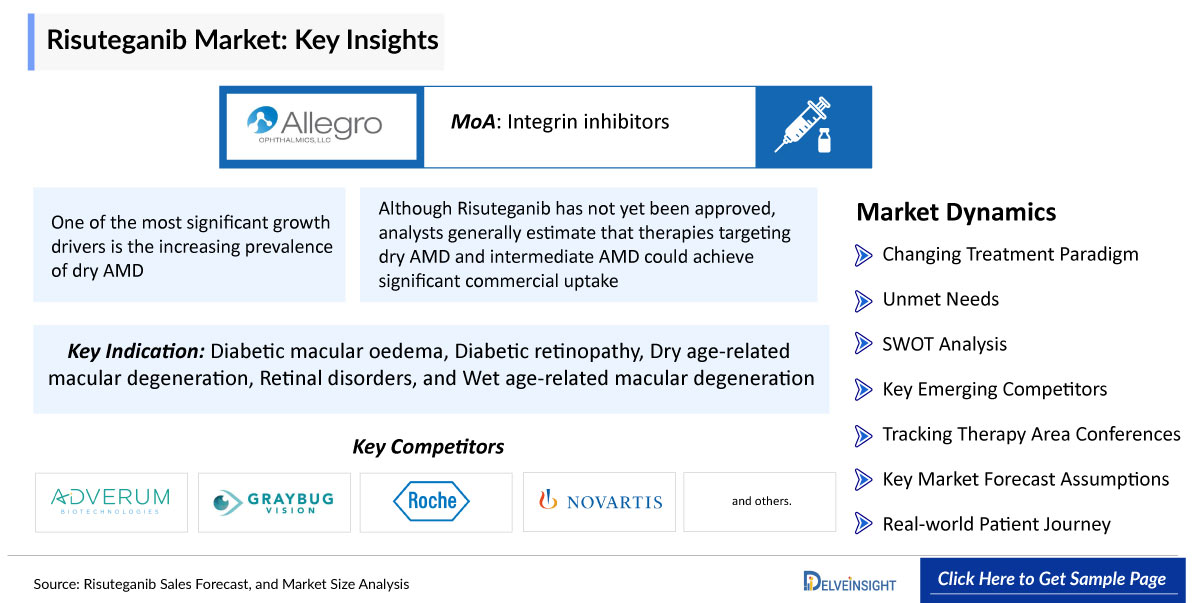
- One of the most significant growth drivers is the increasing prevalence of dry AMD, a leading cause of vision loss in elderly populations. Globally, around 196 million people are affected by age-related macular degeneration, with numbers expected to rise as population age.
- Dry AMD represents the majority of AMD cases but historically has had limited disease-modifying treatment options, creating a large commercial opportunity for emerging therapies like Risuteganib.
- Additionally, intermediate AMD, one of the main target populations for Risuteganib, represents a sizeable market. The intermediate AMD market was valued at about USD 900 million in 2023, with strong growth projected through 2034 as new disease-modifying therapies reach the market.
Novel Mechanism of Action Targeting Integrin Pathways
- Risuteganib offers a differentiated therapeutic approach compared with conventional ophthalmic therapies. It is an intravitreal integrin inhibitor targeting receptors such as αvβ3, αvβ5, α5β1, and αMβ2, which are involved in pathways related to angiogenesis, inflammation, oxidative stress, and vascular leakage.
- By modulating these integrin signaling pathways, the drug may address upstream mechanisms responsible for retinal degeneration rather than only treating downstream symptoms. Preclinical and early clinical data indicate that the therapy may regulate oxidative stress and improve retinal cell survival, which is a key factor in disease progression.
Positive Clinical Trial Data Demonstrating Visual Improvements
Clinical evidence has shown promising functional outcomes for Risuteganib in patients with non-exudative AMD. In a multicenter Phase II randomized clinical trial, the drug demonstrated significant improvements in visual acuity:
- 48% of patients receiving Risuteganib gained ≥8 ETDRS letters, compared with 7% in the sham group.
- 20% of treated patients gained ≥15 letters, whereas none in the control group achieved this level of improvement.
These improvements in best-corrected visual acuity (BCVA) are clinically meaningful because many treatments for dry AMD primarily slow disease progression rather than improve vision.
Expansion Potential Across Multiple Retinal Diseases
Another key growth driver is the potential expansion of Risuteganib beyond dry AMD into other retinal diseases such as:
- Diabetic macular edema (DME)
- Other retinal degenerative conditions linked to oxidative stress and inflammation
Because integrin pathways play a role in multiple ocular diseases, the drug could address a broader therapeutic landscape if clinical trials confirm efficacy across indications.
Such label expansion would substantially increase the total addressable market and improve long-term revenue potential.
Rising Demand for Disease-Modifying Ophthalmic Therapies
- Healthcare systems are increasingly prioritizing therapies that target underlying disease mechanisms rather than symptomatic treatments. Advances in biomarker-based patient selection and imaging diagnostics are also enabling more precise identification of patients likely to benefit from targeted therapies such as Risuteganib.
- At the same time, improvements in specialty ophthalmology clinics and outpatient care delivery are facilitating the adoption of advanced intravitreal therapies.
- These trends are expected to accelerate uptake once new disease-modifying retinal treatments reach the market.
Potential Sales Forecast
Although Risuteganib has not yet been approved, analysts generally estimate that therapies targeting dry AMD and intermediate AMD could achieve significant commercial uptake due to the large patient pool and limited competition.
Based on current epidemiology and market trends:
- The intermediate AMD treatment market exceeded USD 900 million in 2023 and is projected to grow steadily over the next decade.
- If Risuteganib demonstrates strong Phase III efficacy and secures regulatory approval, analysts estimate peak annual sales could reach approximately USD 300–700 million globally, depending on indication expansion and competitive dynamics.
Risuteganib Recent Developments
- In April 2023, the US FDA agreed to a Special Protocol Assessment (SPA) for the Phase IIb/III clinical trial of Risuteganib for intermediate dry AMD. This confirms that the proposed trial design—including endpoints, patient population, and dosage—is sufficient for a future marketing application.
“Risuteganib Sales Forecast, and Market Size Analysis – 2034” report provides comprehensive insights of Risuteganib for potential indication like Diabetic macular oedema, Diabetic retinopathy, Dry age-related macular degeneration, Retinal disorders, and Wet age-related macular degeneration in the 7MM. A detailed picture of Risuteganib’s existing usage in anticipated entry and performance in potential indications in the 7MM, i.e., the United States, EU4 (Germany, France, Italy, and Spain) and the United Kingdom, and Japan for the study period 2020 –2034 is provided in this report along with a detailed description of the Risuteganib for potential indications. The Risuteganib market report provides insights about Risuteganib’s sales forecast, mechanism of action (MoA), dosage and administration, as well as research and development including regulatory milestones, along with other developmental activities. Further, it also consists of historical and current Risuteganib performance, future market assessments inclusive of the Risuteganib market forecast analysis for potential indications in the 7MM, SWOT, analysts’ views, comprehensive overview of market competitors, and brief about other emerging therapies in respective indications. It also provides analysis of Risuteganib sales forecasts, along with factors driving its market.
Risuteganib Drug Summary
Risuteganib (Luminate) is an investigational synthetic oligopeptide developed by Allegro Ophthalmics as a novel integrin modulator and pyruvate dehydrogenase kinase (PDK1) inhibitor, primarily targeting retinal diseases such as non-exudative (dry) age-related macular degeneration (AMD), diabetic macular edema (DME), and diabetic retinopathy. Originally designed to inhibit integrin receptors (e.g., αvβ3, αvβ5, α5β1) involved in angiogenesis, cell adhesion, migration, and inflammation—offering a VEGF-independent pathway—it preferentially binds to the retinal pigment epithelium (RPE), where it protects against oxidative stress, enhances mitochondrial bioenergetics (basal respiration, ATP production, and oxidative phosphorylation), reduces reactive oxygen species, and prevents apoptosis in RPE and photoreceptor cells. Administered via intravitreal injection with a favorable safety profile, long half-life, and low cost compared to anti-VEGF therapies, it has shown promising Phase II results in improving visual acuity and stabilizing retinal function, positioning it as a potential first-in-class therapy for intermediate dry AMD and other retinal degenerations. The report provides Risuteganib’s sales, growth barriers and drivers, post usage and approvals in multiple indications.
Scope of the Risuteganib Market Report
The report provides insights into:
- A comprehensive product overview including the Risuteganib MoA, description, dosage and administration, research and development activities in potential indication like Diabetic macular oedema, Diabetic retinopathy, Dry age-related macular degeneration, Retinal disorders, and Wet age-related macular degeneration.
- Elaborated details on Risuteganib regulatory milestones and other development activities have been provided in Risuteganib market report.
- The report also highlights Risuteganib‘s cost estimates and regional variations, reported and estimated sales performance, research and development activities in potential indications across the United States, Europe, and Japan.
- The Risuteganib market report also covers the patents information, generic entry and impact on cost cut.
- The Risuteganib market report contains current and forecasted Risuteganib sales for potential indications till 2034.
- Comprehensive coverage of the late-stage emerging therapies for respective indications.
- The Risuteganib market report also features the SWOT analysis with analyst views for Risuteganib in potential indications.
Risuteganib Market Report Methodology
The Risuteganib market report is built using data and information sourced primarily from internal databases, primary and secondary research and in-house analysis by DelveInsight’s team of industry experts. Information and data from the secondary sources have been obtained from various printable and nonprintable sources like search engines, news websites, global regulatory authorities websites, trade journals, white papers, magazines, books, trade associations, industry associations, industry portals and access to available databases.
Risuteganib Analytical Perspective by DelveInsight
-
In-depth Risuteganib Market Assessment
This Risuteganib sales market forecast report provides a detailed market assessment of Risuteganib for potential indication like Diabetic macular oedema, Diabetic retinopathy, Dry age-related macular degeneration, Retinal disorders, and Wet age-related macular degeneration in the seven major markets, i.e., the United States, EU4 (Germany, France, Italy, and Spain) and the United Kingdom, and Japan. This segment of the report provides current and forecasted Risuteganib sales data uptil 2034.
-
Risuteganib Clinical Assessment
The Risuteganib market report provides the clinical trials information of Risuteganib for potential indications covering trial interventions, trial conditions, trial status, start and completion dates.
Risuteganib Competitive Landscape
The report provides Insights on competitors and marketed products within the domain, along with a summary of emerging products and their respective launch dates, posing significant competition in the market.
Risuteganib Market Potential & Revenue Forecast
- Projected market size for the Risuteganib and its key indications
- Estimated Risuteganib sales potential (Risuteganib peak sales forecasts)
- Risuteganib Pricing strategies and reimbursement landscape
Risuteganib Competitive Intelligence
- Number of competing drugs in development (pipeline analysis)
- Risuteganib Market positioning compared to existing treatments
- Risuteganib Strengths & weaknesses relative to competitors
Risuteganib Regulatory & Commercial Milestones
- Risuteganib Key regulatory approvals & expected launch timelines
- Commercial partnerships, licensing deals, and M&A activity
Risuteganib Clinical Differentiation
- Risuteganib Efficacy & safety advantages over existing drugs
- Risuteganib Unique selling points
Risuteganib Market Report Highlights
- In the coming years, the Risuteganib market scenario is set to change due to strong adoption, increased prescriptions and broader uptake in multiple immunological indications; which would expand the size of the market.
- The Risuteganib companies are developing therapies that focus on novel approaches to treat/improve the disease condition, assess challenges, and seek opportunities that could influence Risuteganib’s dominance.
- Other emerging products for Diabetic macular oedema, Diabetic retinopathy, Dry age-related macular degeneration, Retinal disorders, and Wet age-related macular degeneration are expected to give tough market competition to Risuteganib and launch of late-stage emerging therapies in the near future will significantly impact the market.
- A detailed description of regulatory milestones, and developmental activities, provide the current development scenario of Risuteganib in potential indications.
- Analyse Risuteganib cost, pricing trends and market positioning to support strategic decision-making in the immunology landscape.
- Our in-depth analysis of the forecasted Risuteganib sales data uptil 2034 will support the clients in decision-making process regarding their therapeutic portfolio by identifying the overall scenario of Risuteganib in potential indications.
Key Questions
- What is the class of therapy, route of administration and mechanism of action of Risuteganib? How strong is Risuteganib’s clinical and commercial performance?
- What is Risuteganib’s clinical trial status in each individual indications such as Diabetic macular oedema, Diabetic retinopathy, Dry age-related macular degeneration, Retinal disorders, and Wet age-related macular degeneration and study completion date?
- What are the key collaborations, mergers and acquisitions, licensing and other activities related to the Risuteganib Manufacturers?
- What are the key designations that have been granted to Risuteganib for potential indications? How are they going to impact Risuteganib’s penetration in various geographies?
- What is the current and forecasted Risuteganib market scenario for potential indications? What are the key assumptions behind the forecast?
- What are the current and forecasted sales of Risuteganib in the seven major countries, including the United States, Europe (Germany, France, Italy, Spain) and the United Kingdom, and Japan?
- What are the other emerging products available and how are these giving competition to Risuteganib for potential indications?
- Which are the late-stage emerging therapies under development for the treatment of potential indications?
- How cost-effective is Risuteganib? What is the duration of therapy and what are the geographical variations in cost per patient?

