
RNS-60 Market Summary
Key Factors Driving RNS-60 Growth
1. Promising Phase II Clinical Results in Acute Ischemic Stroke
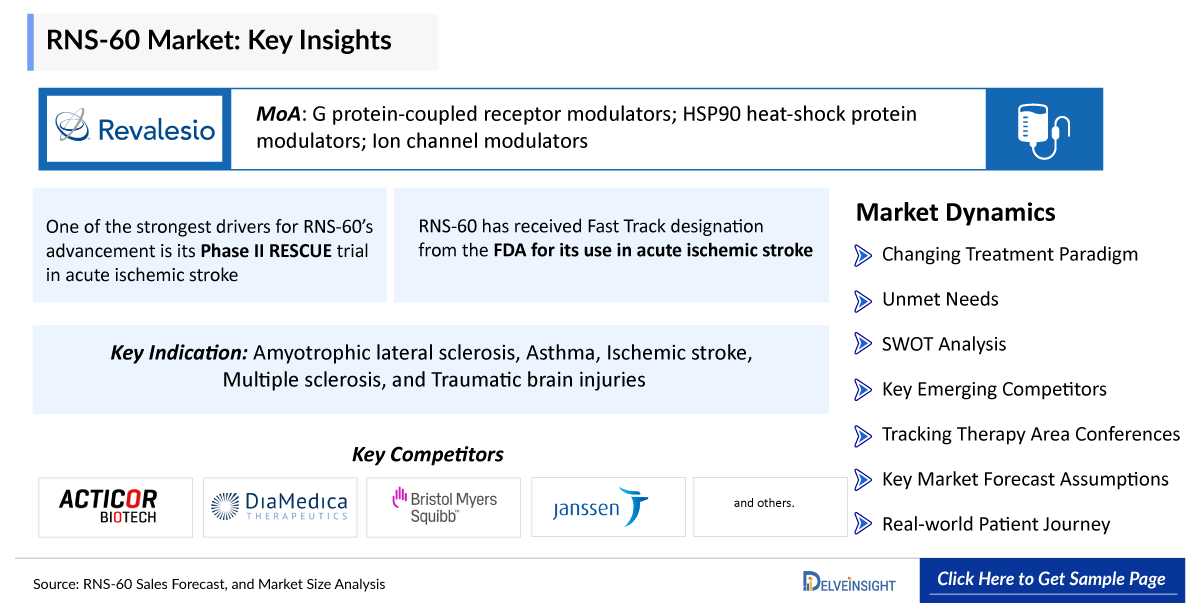
One of the strongest drivers for RNS-60’s advancement is its Phase II RESCUE trial in acute ischemic stroke, which produced proof-of-concept clinical signals:
• Significant reduction in brain infarct growth (nearly 47% at 48 hours with high-dose RNS-60 vs placebo).
• Improved functional outcomes and shorter hospital stays in treated patients, with more patients achieving independence by day 90 compared to placebo.
• The trial showed safety and tolerability comparable to placebo, an important finding for an adjunctive therapy in severe stroke.
• Revalesio has shared these results in peer-reviewed venues and is advancing preparations for the pivotal Phase III RESTORE trial based on this Phase II evidence.
2. Regulatory Momentum: FDA Fast Track Designations
RNS-60 has received Fast Track designation from the US Food and Drug Administration (FDA) for its use in acute ischemic stroke, accelerating development and regulatory engagement.
Fast Track status allows more frequent interactions with the FDA, rolling NDA submission, and eligibility for priority review pathways — all of which can shorten the path toward potential approval.
This designation reflects regulatory recognition of RNS-60’s potential to address an unmet need in stroke care where current standard-of-care focuses primarily on reperfusion rather than tissue protection.
3. Positive Clinical Signals in Chronic Neurological Disease (ALS)
Although the primary focus is currently on stroke, RNS-60 has also shown encouraging results in amyotrophic lateral sclerosis (ALS) clinical studies:
• A post-hoc analysis of a Phase 2 ALS trial indicated that RNS-60 may extend median survival by ~6 months compared to placebo in longer-term follow-up.
• RNS-60 was associated with slower decline in forced vital capacity (FVC) — a key marker of respiratory function critical in ALS outcomes.
4. Novel Mechanism with Broad Neuroprotective and Anti-Inflammatory Potential
RNS-60 represents a first-in-class therapeutic concept — an oxygen-supersaturated saline with physical nanostructures that:
• Supports mitochondrial resilience and cell survival signaling
• Reduces inflammation and tissue damage
• Lacks a conventional chemical pharmacological agent, contributing to a favorable safety and tolerability profile seen across studies to date.
• This multi-modal action, targeting fundamental pathologies like oxidative stress and inflammation common to different brain injuries and neurodegenerative diseases, broadens its potential applicability beyond a single indication.
RNS-60 Recent Developments
In October 2025, Revalesio, a clinical-stage pharmaceutical company pioneering neuroprotective therapies for neurological disorders, announced that data from a post hoc analysis of the RESCUE Phase II clinical trial of its investigational drug RNS60 will be featured as one of two promising drug candidates for the treatment of stroke in an upcoming session at the 17th World Stroke Congress (WSC) 2025 in Barcelona, Spain.
“RNS-60 Sales Forecast, and Market Size Analysis – 2034” report provides comprehensive insights of RNS-60 for potential indication like Amyotrophic lateral sclerosis, Asthma, Ischaemic stroke, Multiple sclerosis, and Traumatic brain injuries in the 7MM. A detailed picture of RNS-60’s existing usage in anticipated entry and performance in potential indications in the 7MM, i.e., the United States, EU4 (Germany, France, Italy, and Spain) and the United Kingdom, and Japan for the study period 2020 –2034 is provided in this report along with a detailed description of the RNS-60 for potential indications. The RNS-60 market report provides insights about RNS-60’s sales forecast, mechanism of action (MoA), dosage and administration, as well as research and development including regulatory milestones, along with other developmental activities. Further, it also consists of historical and current RNS-60 performance, future market assessments inclusive of the RNS-60 market forecast analysis for potential indications in the 7MM, SWOT, analysts’ views, comprehensive overview of market competitors, and brief about other emerging therapies in respective indications. It also provides analysis of RNS-60 sales forecasts, along with factors driving its market.
RNS-60 Drug Summary
RNS-60 is an investigational oxygen-supersaturated saline solution developed by Revalesio, featuring charge-stabilized nanostructures (CSNs) generated via Taylor-Couette-Poiseuille flow under high oxygen concentrations (55±5 ppm), administered intravenously or via inhalation to target mitochondrial dysfunction in neurodegenerative diseases. It enhances mitochondrial function, cellular energy production, and membrane integrity while modulating neuroinflammation in microglia and oligodendrocytes, activating protective pathways like PI3K/Akt for resilience, biogenesis, and anti-inflammatory responses, with preclinical evidence of neuroprotection beyond reperfusion in ischemia. RNS60 has FDA Fast Track designation for acute ischemic stroke based on Phase II RESCUE trial data showing 50% infarct growth reduction in high-dose cohorts, improved 90-day functional independence (72% vs 37% placebo), and benefits in ALS (slower vital capacity decline); it is advancing to Phase III RESTORE for stroke and expanded access for ALS, with potential in Alzheimer's, MS, and Parkinson's. The report provides RNS-60’s sales, growth barriers and drivers, post usage and approvals in multiple indications.
Scope of the RNS-60 Market Report
The report provides insights into:
• A comprehensive product overview including the RNS-60 MoA, description, dosage and administration, research and development activities in potential indication like Amyotrophic lateral sclerosis, Asthma, Ischaemic stroke, Multiple sclerosis, and Traumatic brain injuries.
• Elaborated details on RNS-60 regulatory milestones and other development activities have been provided in RNS-60 market report.
• The report also highlights RNS-60‘s cost estimates and regional variations, reported and estimated sales performance, research and development activities in potential indications across the United States, Europe, and Japan.
• The RNS-60 market report also covers the patents information, generic entry and impact on cost cut.
• The RNS-60 market report contains current and forecasted RNS-60 sales for potential indications till 2034.
• Comprehensive coverage of the late-stage emerging therapies for respective indications.
• The RNS-60 market report also features the SWOT analysis with analyst views for RNS-60 in potential indications.
Methodology
The RNS-60 market report is built using data and information sourced primarily from internal databases, primary and secondary research and in-house analysis by DelveInsight’s team of industry experts. Information and data from the secondary sources have been obtained from various printable and nonprintable sources like search engines, news websites, global regulatory authorities websites, trade journals, white papers, magazines, books, trade associations, industry associations, industry portals and access to available databases.
RNS-60 Analytical Perspective by DelveInsight
• In-depth RNS-60 Market Assessment
This RNS-60 sales market forecast report provides a detailed market assessment of RNS-60 for potential indication like Amyotrophic lateral sclerosis, Asthma, Ischaemic stroke, Multiple sclerosis, and Traumatic brain injuries in the seven major markets, i.e., the United States, EU4 (Germany, France, Italy, and Spain) and the United Kingdom, and Japan. This segment of the report provides current and forecasted RNS-60 sales data uptil 2034.
• RNS-60 Clinical Assessment
The RNS-60 market report provides the clinical trials information of RNS-60 for potential indications covering trial interventions, trial conditions, trial status, start and completion dates.
RNS-60 Competitive Landscape
The report provides Insights on competitors and marketed products within the domain, along with a summary of emerging products and their respective launch dates, posing significant competition in the market.
RNS-60 Market Potential & Revenue Forecast
• Projected market size for the RNS-60 and its key indications
• Estimated RNS-60 sales potential (RNS-60 peak sales forecasts)
• RNS-60 Pricing strategies and reimbursement landscape
RNS-60 Competitive Intelligence
• Number of competing drugs in development (pipeline analysis)
• RNS-60 Market positioning compared to existing treatments
• RNS-60 Strengths & weaknesses relative to competitors
RNS-60 Regulatory & Commercial Milestones
• RNS-60 Key regulatory approvals & expected launch timelines
• Commercial partnerships, licensing deals, and M&A activity
RNS-60 Clinical Differentiation
• RNS-60 Efficacy & safety advantages over existing drugs
• RNS-60 Unique selling points
RNS-60 Market Report Highlights
• In the coming years, the RNS-60 market scenario is set to change due to strong adoption, increased prescriptions and broader uptake in multiple immunological indications; which would expand the size of the market.
• The RNS-60 companies are developing therapies that focus on novel approaches to treat/improve the disease condition, assess challenges, and seek opportunities that could influence RNS-60’s dominance.
• Other emerging products for Amyotrophic lateral sclerosis, Asthma, Ischaemic stroke, Multiple sclerosis, and Traumatic brain injuries are expected to give tough market competition to RNS-60 and launch of late-stage emerging therapies in the near future will significantly impact the market.
• A detailed description of regulatory milestones, and developmental activities, provide the current development scenario of RNS-60 in potential indications.
• Analyse RNS-60 cost, pricing trends and market positioning to support strategic decision-making in the immunology landscape.
• Our in-depth analysis of the forecasted RNS-60 sales data uptil 2034 will support the clients in decision-making process regarding their therapeutic portfolio by identifying the overall scenario of RNS-60 in potential indications.
Key Questions
• What is the class of therapy, route of administration and mechanism of action of RNS-60? How strong is RNS-60’s clinical and commercial performance?
• What is RNS-60’s clinical trial status in each individual indications such as Amyotrophic lateral sclerosis, Asthma, Ischaemic stroke, Multiple sclerosis, and Traumatic brain injuries and study completion date?
• What are the key collaborations, mergers and acquisitions, licensing and other activities related to the RNS-60 Manufacturers?
• What are the key designations that have been granted to RNS-60 for potential indications? How are they going to impact RNS-60’s penetration in various geographies?
• What is the current and forecasted RNS-60 market scenario for potential indications? What are the key assumptions behind the forecast?
• What are the current and forecasted sales of RNS-60 in the seven major countries, including the United States, Europe (Germany, France, Italy, Spain) and the United Kingdom, and Japan?
• What are the other emerging products available and how are these giving competition to RNS-60 for potential indications?
• Which are the late-stage emerging therapies under development for the treatment of potential indications?
• How cost-effective is RNS-60? What is the duration of therapy and what are the geographical variations in cost per patient?

