
Robotic Endoscopy Devices Market Summary
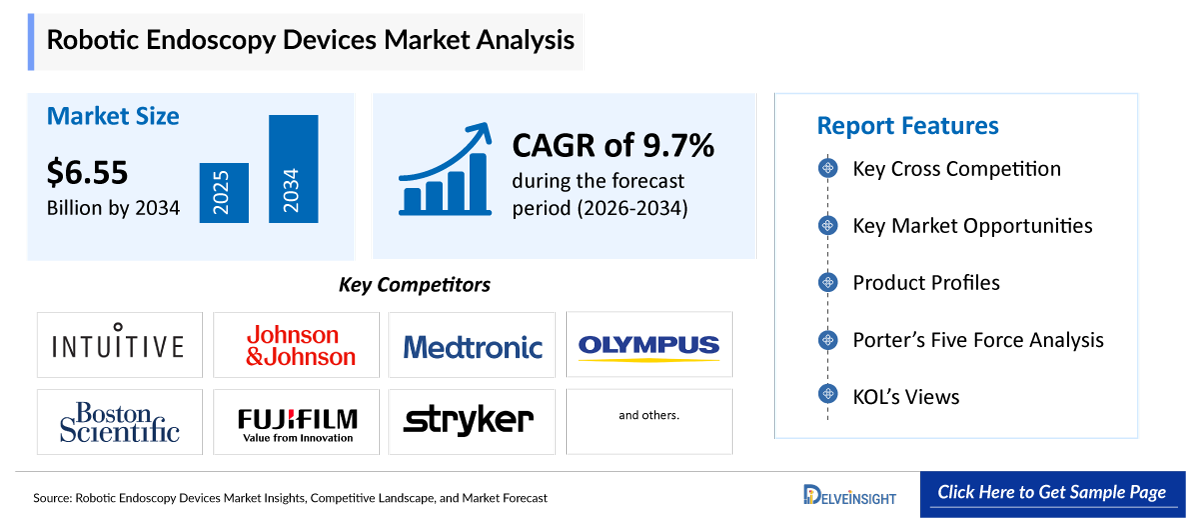
- The Robotic Endoscopy Devices Market is estimated at USD 2.85 billion in 2025 and is projected to reach USD 6.55 billion by 2034. Growth is anchored in the rising preference for minimally invasive procedures, the expansion of robotic bronchoscopy and AI-assisted navigation, and the growing burden of cancer and gastrointestinal disease.
- The Global Robotic Endoscopy Devices Market is growing at a CAGR of 9.7% during the forecast period from 2026 to 2034.
Robotic Endoscopy Devices Market Trends & Insights
- By product type, the therapeutic segment dominated the Robotic Endoscopy Devices market with a 57% share in 2025.
- By application, the laparoscopy segment dominated the Robotic Endoscopy Devices market with a 38% share in 2025.
- By technology, the AI-assisted navigation segment dominated the Robotic Endoscopy Devices market with a 46% share in 2025.
- By end user, the hospitals segment dominated the Robotic Endoscopy Devices market with a 64% share in 2025.
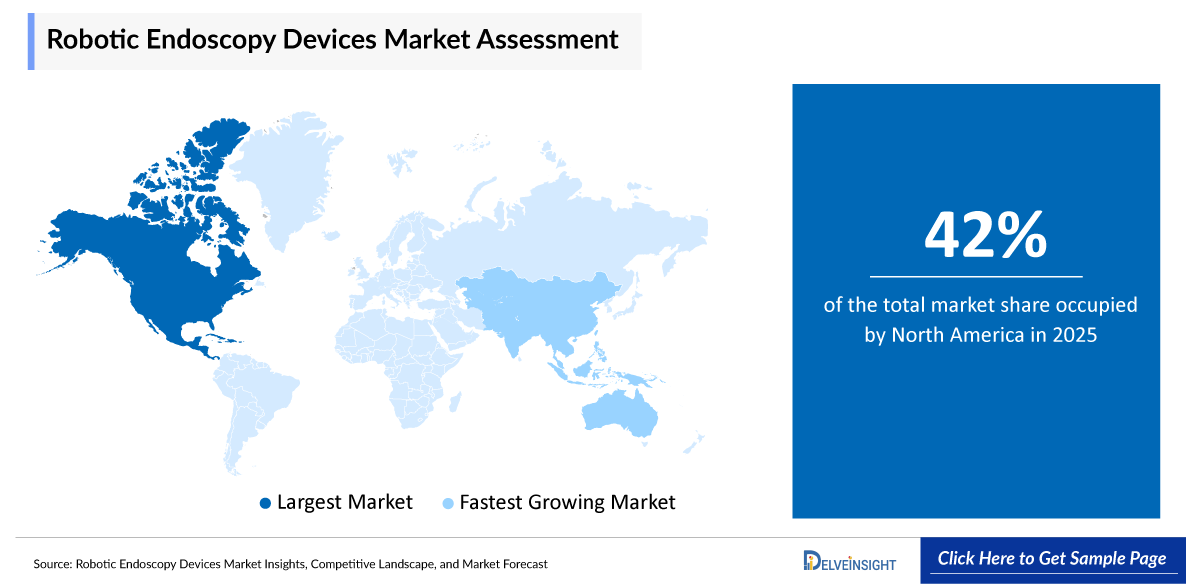
- North America dominated the global Robotic Endoscopy Devices market revenue with a 42% share in 2025, representing the highest regional market share globally.
Request for Unlocking the Sample Page of the Report "Robotic Endoscopy Market"
Factors Contributing to the Growth of the Robotic Endoscopy Devices Market
Robotic Endoscopy Devices Market Drivers
-
Rising Preference for Minimally Invasive Procedures
The most powerful driver of the Robotic Endoscopy Devices market is the rising preference for minimally invasive diagnostic and therapeutic procedures among physicians, patients, and payers. Robotic endoscopy systems deliver high precision, improved dexterity, enhanced three-dimensional visualization, tremor filtration, and ergonomic consoles that reduce surgeon fatigue, enabling longer and more complex cases.
Compared with conventional endoscopy and open surgery, these systems offer shorter recovery times, lower complication rates, and reduced readmissions, which improve clinical outcomes and the economics of care. Outpatient and ambulatory surgical centers benefit from higher throughput and efficiency, while hospitals adopt the platforms to improve accuracy and optimize revenue cycles.
Procedure momentum is strong, with leading robotic platforms reporting double-digit procedure growth. As minimally invasive care becomes the standard expectation across gastrointestinal, respiratory, urological, and soft-tissue interventions, demand for robotic endoscopy expands, anchoring market growth through 2034.
-
Rising Global Burden of Cancer and Gastrointestinal Disease
The growing global burden of cancer and gastrointestinal disease is expanding the volume and complexity of endoscopic procedures. The International Agency for Research on Cancer recorded 20 million new cancer cases in 2022 and projects 35 million by 2050, while colorectal and lung cancers, among the most common malignancies, depend heavily on endoscopic screening, diagnosis, and intervention.
Digestive disorders are also widespread, with a 2023 analysis estimating that over 332 million people are affected in Europe alone. Robotic endoscopy directly addresses this demand by improving access to difficult anatomy, enhancing lesion detection, and enabling precise therapeutic intervention such as endoscopic submucosal dissection.
As cancer incidence rises, populations age, and screening programs expand, the number of diagnostic and therapeutic endoscopic procedures grows, directly increasing demand for robotic platforms across the forecast period.
Robotic Endoscopy Devices Market Restraints
Despite strong momentum, the Robotic Endoscopy Devices market faces material constraints. The high capital cost of robotic systems, along with substantial expenditure on disposables, accessories, service contracts, and facility upgrades, is a significant barrier, particularly for smaller hospitals, ambulatory centers, and providers in lower-resource settings where reimbursement may not fully offset investment.
The complexity of robotic platforms requires specialized training and a learning curve for surgeons and staff, and a shortage of trained operators can slow adoption and utilization. Regulatory and clinical-validation requirements lengthen development timelines and demand rigorous evidence of safety and benefit, while ongoing software and AI updates require continued post-market oversight.
Reimbursement for robotic procedures remains uneven across geographies and indications, constraining the return on investment and limiting access. Supply-chain dependencies and trade measures, including tariffs that major device companies have reported will raise costs, add financial and operational risk. Interoperability between robotic platforms, imaging systems, and hospital IT, along with concerns about data privacy and cybersecurity in connected and cloud-based systems, adds further complexity.
Intense competition and the expiration of core patents pressure margins, even as they spur innovation. Together, these cost, training, regulatory, reimbursement, supply-chain, and integration barriers temper the pace of growth, even as the underlying drivers of minimally invasive demand, disease burden, and AI navigation remain firmly intact.
Robotic Endoscopy Devices Overview
Robotic endoscopy devices are advanced medical systems that combine robotic platforms, high-definition imaging, and AI-assisted navigation to perform minimally invasive diagnostic and therapeutic procedures across gastrointestinal, respiratory, and surgical applications. By pairing precision robotic control with flexible endoscopes, these systems enable physicians to navigate complex anatomy with greater dexterity, stability, and accuracy than conventional endoscopy, while reducing operator fatigue and improving reproducibility.
The category spans diagnostic and therapeutic devices, including robotic endoscopes, imaging and visualization systems, and surgical robots, deployed for colonoscopy, bronchoscopy, laparoscopy, and gastrointestinal endoscopy. Core technologies include AI-assisted navigation and image analysis, electromagnetic and cone-beam CT guidance, flexible and miniaturized robotic endoscopes, and tele-robotic and cloud-connected platforms.
Adoption extends across hospitals, ambulatory surgical centers, and specialized clinics. Over the past several years, robotic bronchoscopy has emerged as a fast-growing segment for reaching peripheral lung nodules, AI-powered polyp and lesion detection has improved diagnostic yield, and major device companies have integrated robotics, imaging, and analytics into connected surgical ecosystems, positioning robotic endoscopy as an increasingly standard tool in modern screening and intervention.
Robotic Endoscopy Devices Market Key Growth Drivers
- The rising preference for minimally invasive procedures is driving adoption, as robotic endoscopy delivers greater precision, dexterity, and stability with shorter recovery times and lower complication rates.
- The growing global burden of cancer and gastrointestinal disease is expanding procedure volumes, with the International Agency for Research on Cancer projecting cancer cases to rise from 20 million in 2022 to 35 million by 2050.
- The rapid expansion of robotic bronchoscopy is improving access to peripheral lung nodules, with AI-assisted platforms lifting diagnostic yield well above conventional bronchoscopy.
- AI-assisted navigation and image analysis are enhancing lesion detection, procedural guidance, and real-time decision support, increasing diagnostic accuracy and clinical confidence.
- Accelerating regulatory clearances and platform launches by leading manufacturers are expanding the installed base across bronchoscopy, GI endoscopy, and soft-tissue surgery.
- Aging populations and rising colorectal and lung cancer screening volumes are increasing demand for robotic diagnostic and therapeutic endoscopy.
- The convergence of minimally invasive demand, disease burden, AI navigation, and platform innovation is expected to sustain strong growth in the market through 2034.
Robotic Endoscopy Devices Companies
- Intuitive Surgical, Inc.
- Johnson & Johnson MedTech
- Medtronic plc
- Olympus Corporation
- Boston Scientific Corporation
- FUJIFILM Holdings Corporation
- Stryker Corporation
- KARL STORZ SE & Co. KG
- Asensus Surgical, Inc.
- CMR Surgical Ltd.
Robotic Endoscopy Devices Market Segment Analysis
The Robotic Endoscopy Devices Market by Product Type (Therapeutic Robotic Endoscopes, Diagnostic Robotic Endoscopes), Application (Laparoscopy, Bronchoscopy, Colonoscopy, Gastrointestinal Endoscopy, Others), Technology (AI-Assisted Navigation, Electromagnetic Navigation, Shape-Sensing Navigation, Cone-Beam CT and Fluoroscopy Guidance, Standard Visualization Systems, Others), End User (Hospitals, Ambulatory Surgical Centers, Specialty Clinics, Others), and Geography (North America, Europe, Asia-Pacific, Rest of World).
-
Robotic Endoscopy Devices Market Segmentation By Product Type
Dominant Subsegment: Therapeutic Robotic Endoscopes. The therapeutic robotic endoscopes category is expected to dominate the market.
Dominant: Therapeutic Robotic Endoscopes ~ 57%
The therapeutic robotic endoscopes segment accounted for 57% of the Robotic Endoscopy Devices market in 2025. Therapeutic robotic endoscopes are the leading product type because they carry the highest clinical and economic value, enabling minimally invasive intervention as well as diagnosis across soft-tissue surgery, gastrointestinal therapy, and lung biopsy.
These systems perform tissue resection, ablation, stenting, polypectomy, and robotic-assisted surgery, commanding premium pricing and generating recurring revenue from instruments, accessories, and disposables. The segment is anchored by high-profile platforms, including Intuitive Surgical's da Vinci 5 for soft-tissue surgery, Medtronic's Hugo robotic-assisted surgery system cleared for urologic procedures, and robotic bronchoscopy systems that biopsy and increasingly treat peripheral lung lesions.
Continuous innovation in AI navigation, energy delivery, and instrumentation deepens therapeutic capability and adoption. Diagnostic robotic endoscopes, including capsule robots and imaging robots, are growing as screening expands, but therapeutic systems retain leadership on the strength of procedure value, recurring consumable revenue, and a deep pipeline of surgical and interventional platforms across the forecast period.
-
Robotic Endoscopy Devices Market Segmentation By Application
Dominant Subsegment: Laparoscopy. The laparoscopy category is expected to dominate the market.
Dominant: Laparoscopy ~ 38%
The laparoscopy segment accounted for 38% of the Robotic Endoscopy Devices market in 2025. Laparoscopy is the leading application because robotic-assisted soft-tissue surgery represents the largest and most established robotic procedure base, spanning urology, gynecology, and general surgery at high volumes in hospitals worldwide.
Robotic platforms deliver superior dexterity, stability, three-dimensional visualization, and ergonomics compared with manual laparoscopy, driving sustained adoption and a growing installed base. The segment is reinforced by a wave of platform competition, including Intuitive Surgical's da Vinci 5, Medtronic's Hugo, Johnson & Johnson's Ottava, and CMR Surgical's Versius Plus, which is expanding access and procedure volumes.
While robotic bronchoscopy is among the fastest-growing applications, propelled by demand to reach peripheral lung nodules, and colonoscopy and gastrointestinal endoscopy expand with screening, the scale, maturity, and procedure value of laparoscopic robotic surgery secure its leadership across the forecast period, supported by recurring instrument and accessory revenue.
-
Robotic Endoscopy Devices Market Segmentation By End User
Dominant Subsegment: Hospitals. The hospitals category is expected to dominate the market.
Dominant: Hospitals ~ 64%
The hospitals segment accounted for 64% of the Robotic Endoscopy Devices market in 2025. Hospitals are the largest end user because they perform the highest volume of complex robotic and endoscopic procedures and have the capital, infrastructure, and specialist staff to acquire and operate premium robotic platforms.
Robotic-assisted surgery, robotic bronchoscopy, and advanced gastrointestinal intervention concentrate in hospitals and academic medical centers, which anchor the installed base for high-value systems from Intuitive Surgical, Medtronic, Johnson & Johnson, and Olympus. Hospital adoption is reinforced by the breadth of procedures, the availability of training and support, and the ability to absorb the high upfront cost of robotic systems and service contracts.
At the same time, ambulatory surgical centers are a fast-growing channel, supported by reimbursement changes that move procedures into outpatient settings and by platforms designed for outpatient workflows, while specialty clinics expand access. Nonetheless, the volume, acuity, and infrastructure of hospitals secure their clear leadership across the forecast period.
Robotic Endoscopy Devices Market Region Analysis
-
Dominant Region: North America
North America accounted for 42% of the global Robotic Endoscopy Devices market revenue in 2025, representing the highest regional market share globally. The region's dominance reflects the world's highest robotic surgery adoption, advanced healthcare infrastructure, strong reimbursement, and the concentration of leading manufacturers, particularly in the United States.
North America hosts the headquarters and primary markets of Intuitive Surgical, Medtronic, Johnson & Johnson MedTech, Boston Scientific, and Stryker, and benefits from a steady cadence of FDA clearances, including Medtronic's Hugo, CMR Surgical's Versius Plus, and Johnson & Johnson's MONARCH QUEST.
The United States leads in robotic bronchoscopy and soft-tissue robotic surgery, with all three FDA-cleared robotic bronchoscopy platforms commercialized in the region. A Medicare reimbursement change effective in 2026 is accelerating the movement of procedures into ambulatory surgical centers, expanding access. Deep clinical expertise, supportive regulation, and strong investment anchor the region's continued leadership across the forecast period.
-
Dominant: North America ~ 42% (Largest)
Fastest Growing Region: Asia-Pacific
Asia-Pacific is the fastest-growing region in the Robotic Endoscopy Devices market. The region's elevated CAGR is driven by a large and aging population, a rising burden of cancer and gastrointestinal disease, expanding healthcare access, and growing investment in robotic surgery across China, Japan, India, South Korea, and Australia.
Governments and hospitals are investing in minimally invasive surgical capacity, and regional and global manufacturers, including Olympus and FUJIFILM, are scaling endoscopy and robotic platforms. Rising screening volumes for colorectal and lung cancer, growing surgical demand, and increasing affordability of robotic systems are accelerating adoption in both urban and expanding healthcare networks.
Local innovation and new lower-cost platforms are broadening access, positioning Asia-Pacific as the principal source of incremental growth over the forecast period.
Robotic Endoscopy Devices Regional Commentary
- North America
North America accounted for 42% of the global Robotic Endoscopy Devices market revenue in 2025. The United States dominates on the strength of the world's highest robotic surgery adoption, a dense base of manufacturers, strong reimbursement, FDA clearance momentum, and the commercialization of all three FDA-cleared robotic bronchoscopy platforms, while Canada contributes through hospital adoption and provincial screening programs.
- Europe
Europe is a large and advanced regional market, led by Germany, the United Kingdom, France, Italy, and Spain. Growth is supported by strong healthcare systems, established surgical infrastructure, and a robust manufacturer base, including KARL STORZ, CMR Surgical, and Olympus Europe, while CE marking and national health-technology assessment shape adoption of new robotic platforms across the region.
- Asia-Pacific
Asia-Pacific is the fastest-growing region, propelled by a large aging population, rising cancer and gastrointestinal disease burden, expanding healthcare access, and growing investment in robotic surgery across China, Japan, India, South Korea, and Australia. Regional endoscopy leaders such as Olympus and FUJIFILM scale platforms, while rising screening volumes and new lower-cost robotic systems broaden access.
- Rest of World
The Rest of World region, spanning Latin America, the Middle East, and Africa, is an emerging growth frontier. A rising burden of cancer and gastrointestinal disease, expanding hospital infrastructure, and growing demand for minimally invasive surgery are increasing adoption, while partnerships, training programs, and telemedicine are gradually extending access to robotic endoscopy across these markets.
Robotic Endoscopy Devices Market Competitive Landscape
The Robotic Endoscopy Devices market is classified as Consolidated. A small group of large medical-device companies controls the majority of revenue, with Intuitive Surgical holding a dominant position in soft-tissue robotic surgery and robotic bronchoscopy, followed by Medtronic, Johnson & Johnson MedTech, Olympus, Boston Scientific, and FUJIFILM across surgery and endoscopy. A growing field of challengers, including CMR Surgical, Asensus Surgical, and emerging players such as Noah Medical and Virtuoso Surgical, is intensifying competition as new platforms reach the market.
The Robotic Endoscopy Devices Competitive Landscape can be evaluated across the following dimensions:
- Market concentration: Consolidated, with Intuitive Surgical dominant and high barriers to entry from capital intensity, clinical evidence, and installed-base lock-in.
- Leading players: Intuitive Surgical, Medtronic, Johnson & Johnson MedTech, Olympus, Boston Scientific, and FUJIFILM anchor the top tier.
- Geographic reach: Leaders operate global commercial and service networks, with rapid expansion programs targeting Asia-Pacific and emerging markets.
- Product portfolio strength: Top players offer integrated portfolios spanning surgical robots, robotic bronchoscopy, endoscopy systems, instruments, and AI software.
- Pipeline strength: Active pipelines in soft-tissue robotics, robotic bronchoscopy, AI navigation, and flexible and miniaturized endoluminal robots.
- Strategic partnerships: Collaborations with computing and imaging providers, such as Johnson & Johnson with NVIDIA and GE HealthCare, and Medtronic with Cosmo Intelligent Medical Devices, extend capability.
- M&A activity: Consolidation continues, including KARL STORZ's acquisition of Asensus Surgical and Johnson & Johnson's acquisition of Auris Health, the basis of MONARCH.
- Manufacturing capabilities: Scale manufacturing of robotic systems, single-use endoscopes, and instruments is a key competitive moat and supply-chain consideration.
- Innovation focus: AI-assisted navigation, robotic bronchoscopy for peripheral lung nodules, energy and instrumentation, and cloud-connected surgical ecosystems.
Robotic Endoscopy Devices Market Recent Developmental Activities
- In December 2025, Medtronic plc, received FDA clearance of the Hugo robotic-assisted surgery system for urologic procedures, its first United States soft-tissue indication and the first large-medtech soft-tissue robot cleared since the da Vinci. Strategic significance: Establishes a major competitor to Intuitive Surgical and expands hospital choice in robotic surgery.
- In December 2025, CMR Surgical Ltd., received FDA 510(k) clearance for its Versius Plus system to perform cholecystectomy and posted nine-figure financing to support United States commercialization. Strategic significance: Adds a modular, portable robotic platform to the United States market and broadens access beyond academic centers.
- In September 2025, Virtuoso Surgical, Inc., received FDA breakthrough device designation for its dual-arm endoscopic surgical robot for endoluminal intervention. Strategic significance: Advances next-generation endoluminal robotics and signals continued innovation in flexible robotic endoscopy.
- In June 2025, Johnson & Johnson MedTech, launched the Polyphonic AI Fund for Surgery in partnership with NVIDIA and Amazon Web Services to develop AI solutions for surgical and endoscopic challenges. Strategic significance: Strengthens the AI ecosystem for connected robotic and endoscopic platforms.
- In March 2025, Johnson & Johnson MedTech, received FDA 510(k) clearance for MONARCH QUEST, an enhanced robotic-assisted bronchoscopy navigation system using AI-powered algorithms, a high-performance computing platform that increases real-time compute by 260%, and integration with the GE HealthCare OEC 3D cone-beam CT imaging system. Strategic significance: Improves accuracy in reaching peripheral lung nodules and advances AI navigation in robotic bronchoscopy.
- In 2025, Intuitive Surgical, Inc., expanded the international rollout of its da Vinci 5 soft-tissue surgical system and continued adoption of its Ion shape-sensing robotic bronchoscopy platform. Strategic significance: Reinforces market leadership across both soft-tissue surgery and robotic bronchoscopy.
- In March 2024, Intuitive Surgical, Inc., received FDA clearance for the da Vinci 5, its most advanced and AI-ready soft-tissue robotic surgical system, designed to support future machine-learning features. Strategic significance: Sets a new performance benchmark and defends Intuitive's leadership amid rising competition.
- In 2024, Medtronic plc (with Cosmo Intelligent Medical Devices), expanded its GI Genius intelligent endoscopy module, the first FDA-cleared AI system for colonoscopy, which supports real-time polyp detection and improved adenoma detection. Strategic significance: Strengthens AI-assisted gastrointestinal endoscopy and supports earlier cancer detection at scale.
- In 2024, KARL STORZ SE & Co. KG, completed its acquisition of Asensus Surgical, adding the Senhance and LUNA digital and performance-guided surgery platforms to its portfolio. Strategic significance: Brings a major endoscopy company into robotic surgery and accelerates digital, performance-guided platforms.
- In March 2023, Noah Medical, received FDA clearance for its Galaxy System for robotic bronchoscopy, which combines electromagnetic navigation with digital tomosynthesis and does not require a pre-procedural CT. Strategic significance: Adds a third FDA-cleared robotic bronchoscopy platform and broadens access to peripheral lung biopsy.
- In 2024 and 2025, Olympus Corporation, advanced its EVIS X1 endoscopy ecosystem and AI-powered cloud endoscopy capabilities for gastrointestinal lesion detection and characterization. Strategic significance: Reinforces leadership in flexible endoscopy and extends AI into routine gastrointestinal procedures.
- In 2024, FUJIFILM Holdings Corporation, expanded its endoscopy portfolio, including CAD EYE AI for colonoscopy polyp detection and characterization and its ELUXEO imaging systems. Strategic significance: Strengthens AI-assisted gastrointestinal endoscopy and broadens FUJIFILM's diagnostic and therapeutic endoscopy range.
Robotic Endoscopy Devices Market Segmentation
Robotic Endoscopy Devices Market by Product Type
- Therapeutic Robotic Endoscopes
- Surgical Robots
- Ablation and Resection Systems
- Stenting and Therapeutic Devices
- Diagnostic Robotic Endoscopes
- Capsule Robots
- Imaging Robots
Robotic Endoscopy Devices Market by Application
- Laparoscopy
- Bronchoscopy
- Colonoscopy
- Gastrointestinal Endoscopy
- Others
Robotic Endoscopy Devices Market by Technology
- AI-Assisted Navigation
- Electromagnetic Navigation
- Shape-Sensing Navigation
- Cone-Beam CT and Fluoroscopy Guidance
- Standard Visualization Systems
- Others
Robotic Endoscopy Devices Market by End User
- Hospitals
- Ambulatory Surgical Centers
- Specialty Clinics
- Others
Robotic Endoscopy Devices Market by Geography
- North America Robotic Endoscopy Devices Market
- United States Robotic Endoscopy Devices Market Size in USD million (2023-2034)
- Canada Robotic Endoscopy Devices Market Size in USD million (2023-2034)
- Mexico Robotic Endoscopy Devices Market Size in USD million (2023-2034)
Europe Robotic Endoscopy Devices Market
- Germany Robotic Endoscopy Devices Market Size in USD million (2023-2034)
- United Kingdom Robotic Endoscopy Devices Market Size in USD million (2023-2034)
- France Robotic Endoscopy Devices Market Size in USD million (2023-2034)
- Italy Robotic Endoscopy Devices Market Size in USD million (2023-2034)
- Spain Robotic Endoscopy Devices Market Size in USD million (2023-2034)
- Rest of Europe Robotic Endoscopy Devices Market Size in USD million (2023-2034)
Asia-Pacific Robotic Endoscopy Devices Market
- China Robotic Endoscopy Devices Market Size in USD million (2023-2034)
- Japan Robotic Endoscopy Devices Market Size in USD million (2023-2034)
- India Robotic Endoscopy Devices Market Size in USD million (2023-2034)
- Australia Robotic Endoscopy Devices Market Size in USD million (2023-2034)
- South Korea Robotic Endoscopy Devices Market Size in USD million (2023-2034)
- Rest of Asia-Pacific Robotic Endoscopy Devices Market Size in USD million (2023-2034)
Rest of the World (RoW) Robotic Endoscopy Devices Market
- Middle East Robotic Endoscopy Devices Market Size in USD million (2023-2034)
- Africa Robotic Endoscopy Devices Market Size in USD million (2023-2034)
- South America Robotic Endoscopy Devices Market Size in USD million (2023-2034)
Robotic Endoscopy Devices Market Recent Industry Trends and Milestones (2023-2026)
|
Category |
Key Developments |
|
Robotic Endoscopy Devices Market Product Approval |
Regulatory momentum accelerated sharply. Intuitive Surgical received FDA clearance for the AI-ready da Vinci 5 (March 2024). Johnson & Johnson MedTech secured FDA 510(k) clearance for MONARCH QUEST robotic-assisted bronchoscopy with AI navigation and cone-beam CT integration (March 2025). Medtronic's Hugo robotic-assisted surgery system was cleared for urologic procedures (December 2025), and CMR Surgical's Versius Plus was cleared for cholecystectomy (December 2025). Noah Medical's Galaxy System earlier joined J&J's MONARCH and Intuitive's Ion as the third FDA-cleared robotic bronchoscopy platform, and AI colonoscopy modules such as GI Genius remain cleared for clinical use. |
|
Robotic Endoscopy Devices Market Product Expansion |
Manufacturers expanded platforms and indications. Multi-purpose robotic systems broadened across urology, gynecology, and general surgery, while robotic bronchoscopy expanded to reach peripheral lung nodules. Olympus advanced its EVIS X1 endoscopy ecosystem and AI cloud endoscopy, and FUJIFILM expanded CAD EYE AI and ELUXEO imaging. A Medicare reimbursement change effective in 2026 is shifting procedures toward ambulatory surgical centers, prompting platforms designed for outpatient workflows. AI polyp and lesion detection, single-use endoscopes, and integration of robotics with imaging and analytics broadened the addressable market across surgery and gastrointestinal and pulmonary endoscopy. |
|
Robotic Endoscopy Devices Market Investment |
Capital and consolidation intensified. CMR Surgical posted nine-figure financing to support United States expansion of Versius Plus, and KARL STORZ acquired Asensus Surgical to enter robotic surgery. Johnson & Johnson launched the Polyphonic AI Fund for Surgery with NVIDIA and Amazon Web Services (June 2025) and expanded edge-AI and digital-twin work with NVIDIA. Medtronic deepened its collaboration with Cosmo Intelligent Medical Devices for AI colonoscopy and expanded its AI and robotics hub in London. Continued venture investment flowed into emerging endoluminal robotics players such as Noah Medical, Virtuoso Surgical, and EndoQuest Robotics. |
|
Company Strategy |
Intuitive Surgical, Inc.: Leadership across soft-tissue robotics (da Vinci 5) and robotic bronchoscopy (Ion shape-sensing). Johnson & Johnson MedTech: MONARCH QUEST robotic bronchoscopy with NVIDIA and GE HealthCare, plus the Ottava surgical robot. Medtronic plc: Hugo robotic surgery and GI Genius AI colonoscopy with Cosmo. Olympus Corporation and FUJIFILM Holdings Corporation: AI-enabled flexible endoscopy ecosystems. Boston Scientific Corporation and Stryker Corporation: Therapeutic endoscopy and surgical platforms. KARL STORZ, CMR Surgical, and Asensus Surgical: Modular, digital, and performance-guided robotic surgery. |
|
Emerging Technologies |
AI-assisted navigation and real-time lesion detection are becoming standard, improving diagnostic yield and procedural guidance. Robotic bronchoscopy platforms combine electromagnetic navigation, shape-sensing, and digital tomosynthesis with cone-beam CT to reach peripheral lung nodules. Flexible, miniaturized, and single-use endoluminal robots, magnetically guided capsule endoscopes, and dual-arm endoluminal systems are advancing. Tele-robotics, augmented and virtual reality, edge-AI computing, digital twins, and cloud-connected surgical ecosystems are extending capability, while hybrid manual-robotic platforms and outpatient-ready systems broaden access across care settings. |
Robotic Endoscopy Devices Market Startup Funding and Investment Trends
Investment in the Robotic Endoscopy Devices ecosystem has concentrated on robotic bronchoscopy, endoluminal and flexible robotics, and AI-assisted navigation. The following companies illustrate recent funding and investment activity and technology focus.
|
Company |
Total Funding |
Funding Stage |
Main Product |
Core Technology |
|
CMR Surgical Ltd. |
USD 1 billion and above |
Late-stage venture |
Versius and Versius Plus |
Modular robotic surgery |
|
Noah Medical |
USD 150 million and above |
Late-stage venture |
Galaxy System |
Robotic bronchoscopy with tomosynthesis |
|
EndoQuest Robotics |
Venture-backed |
Growth venture |
Endoluminal robotic system |
Flexible endoluminal robotics |
|
Virtuoso Surgical, Inc. |
Venture-backed |
Early-stage venture |
Virtuoso system |
Dual-arm endoscopic robotics |
|
Asensus Surgical, Inc. |
Acquired by KARL STORZ |
Public-to-acquired |
Senhance and LUNA |
Digital, performance-guided surgery |
Capital is flowing toward developers that bring robotic precision and AI navigation to endoluminal and minimally invasive procedures. CMR Surgical has raised over USD 1 billion to commercialize its modular Versius platform and expand into the United States, while Noah Medical scales its Galaxy robotic bronchoscopy system.
Emerging players such as EndoQuest Robotics and Virtuoso Surgical advance flexible and dual-arm endoluminal robotics, and the acquisition of Asensus Surgical by KARL STORZ illustrates strong strategic appetite for digital, performance-guided surgery. Collectively, these investments signal conviction that robotic bronchoscopy, endoluminal robotics, and AI-assisted navigation will define the next phase of competitive advantage in the global Robotic Endoscopy Devices market.
Stay updated with us for Recent Articles @ New DelveInsight Blogs

