
Sapanisertib Market Summary
Key Factors Driving Sapanisertib Growth
1. Differentiated dual mTORC1/mTORC2 inhibition may overcome limitations of current mTOR inhibitors:
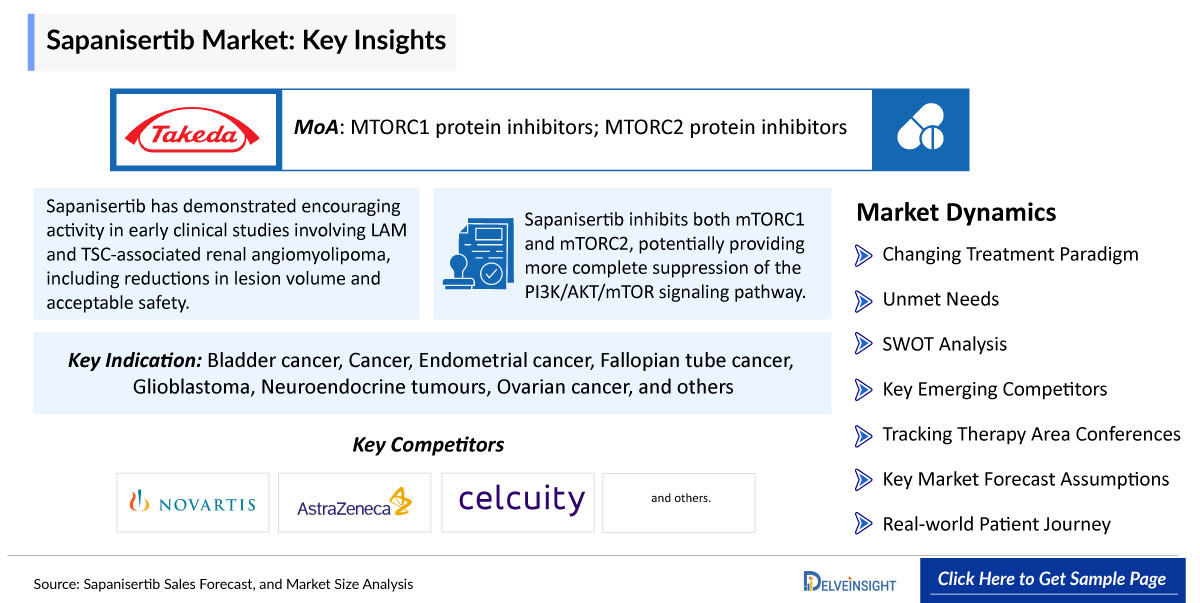
Unlike rapamycin analogs such as sirolimus and everolimus, which primarily inhibit mTORC1, sapanisertib inhibits both mTORC1 and mTORC2, potentially providing more complete suppression of the PI3K/AKT/mTOR signaling pathway. Preclinical studies have shown that dual inhibition may reduce compensatory AKT activation associated with selective mTORC1 blockade, supporting stronger anti-proliferative activity in diseases driven by mTOR dysregulation, including TSC and LAM. Published translational studies in Cancer Discovery and other peer-reviewed journals provide the biological rationale for this approach.
2. Positive early clinical signals in rare mTOR-driven diseases:
Sapanisertib has demonstrated encouraging activity in early clinical studies involving lymphangioleiomyomatosis (LAM) and TSC-associated renal angiomyolipoma, including reductions in lesion volume and acceptable safety. These findings supported continued clinical development and suggest that dual mTOR inhibition could offer an alternative for patients who experience disease progression or intolerance with currently available mTOR inhibitors. Ongoing investigator-sponsored studies continue to evaluate its long-term efficacy and safety.
3. High unmet need in rare diseases with orphan-drug commercial potential:
LAM is a rare progressive lung disease affecting approximately 3–8 women per million worldwide, while TSC affects approximately 1 in 6,000 live births. Current therapies largely stabilize disease rather than producing durable regression, leaving room for therapies with improved efficacy. If future trials demonstrate superior clinical outcomes, sapanisertib could benefit from orphan-drug incentives, premium pricing, and relatively rapid adoption in specialized treatment centers.
4. Potential expansion across multiple mTOR-driven indications:
Beyond LAM and TSC, the mechanism of sapanisertib provides opportunities in additional diseases characterized by aberrant PI3K/AKT/mTOR pathway activation, including selected cancers and genetic disorders. This broad biological applicability increases the program's lifecycle potential and creates opportunities for future label expansion if clinical development is successful. Takeda has previously explored the compound across multiple oncology settings, generating extensive pharmacology and safety experience that may facilitate further development.
5. Oral administration and combination therapy opportunities:
Sapanisertib is administered orally once daily, offering a convenient treatment option for chronic diseases. Its mechanism also supports evaluation in combination with targeted therapies or other pathway inhibitors, particularly where resistance to first-generation mTOR inhibitors develops. Combination strategies remain an active area of translational research and could expand the drug's clinical utility.
6. Commercial outlook remains dependent on successful late-stage development:
Takeda has not disclosed any peak sales estimates or commercial revenue forecasts for sapanisertib, and the drug has not yet entered commercialization. Consequently, there are no official company-endorsed sales projections. Future commercial growth will depend on successful completion of ongoing clinical studies, regulatory approvals, differentiation from established mTOR inhibitors such as everolimus and sirolimus, and demonstration of clinically meaningful advantages in efficacy or durability. Current public disclosures continue to describe sapanisertib as an investigational asset without commercial guidance.
Sapanisertib Recent Developments
In May 2026, Sensei Biotherapeutics today that the first patient was dosed in Study FTH-PIK-101 (NCT07558733), a Phase Ib/II trial of PIKTOR in patients with HR+/HER2- advanced breast cancer. PIKTOR, an investigational, all-oral combination of serabelisib and sapanisertib, is designed to inhibit multiple nodes of the PI3K/AKT/mTOR pathway through PI3K-alpha and dual mTORC1/2 targeting, and became Sensei's lead program after the company acquired Faeth Therapeutics.
“Sapanisertib Sales Forecast, and Market Size Analysis – 2034” report provides comprehensive insights of Sapanisertib for potential indication like Bladder cancer, Cancer, Endometrial cancer, Fallopian tube cancer, Glioblastoma, Neuroendocrine tumours, Ovarian cancer, Peritoneal cancer, Precursor cell lymphoblastic leukaemia-lymphoma, Soft tissue sarcoma, Thyroid cancer, and Urogenital cancer in the 7MM. A detailed picture of Sapanisertib’s existing usage in anticipated entry and performance in potential indications in the 7MM, i.e., the United States, EU4 (Germany, France, Italy, and Spain) and the United Kingdom, and Japan for the study period 2020 –2034 is provided in this report along with a detailed description of the Sapanisertib for potential indications. The Sapanisertib market report provides insights about Sapanisertib’s sales forecast, mechanism of action (MoA), dosage and administration, as well as research and development including regulatory milestones, along with other developmental activities. Further, it also consists of historical and current Sapanisertib performance, future market assessments inclusive of the Sapanisertib market forecast analysis for potential indications in the 7MM, SWOT, analysts’ views, comprehensive overview of market competitors, and brief about other emerging therapies in respective indications. It also provides analysis of Sapanisertib sales forecasts, along with factors driving its market.
Sapanisertib Drug Summary
Sapanisertib is an investigational, orally administered, selective dual inhibitor of the mTORC1 and mTORC2 complexes developed by Takeda for the treatment of various advanced cancers and hematologic malignancies. By inhibiting both mTOR complexes, sapanisertib suppresses the PI3K/AKT/mTOR signaling pathway, reducing tumor cell proliferation, survival, angiogenesis, and metabolic activity while helping to overcome resistance associated with first-generation mTOR inhibitors that target only mTORC1. The drug has been evaluated in multiple Phase I and II clinical trials, both as monotherapy and in combination with targeted therapies, chemotherapy, and endocrine agents, across indications including renal cell carcinoma, endometrial cancer, breast cancer, prostate cancer, and acute leukemias. Although clinical development has demonstrated manageable safety and preliminary antitumor activity, with common adverse events including hyperglycemia, stomatitis, fatigue, nausea, diarrhea, and rash, its development has encountered challenges in demonstrating sufficient efficacy in late-stage studies. Nevertheless, sapanisertib remains an important investigational agent for exploring dual mTOR inhibition as a strategy to overcome resistance and improve outcomes in molecularly selected patient populations. The report provides Sapanisertib’s sales, growth barriers and drivers, post usage and approvals in multiple indications.
Scope of the Sapanisertib Market Report
The report provides insights into:
- A comprehensive product overview including the Sapanisertib MoA, description, dosage and administration, research and development activities in potential indication like Bladder cancer, Cancer, Endometrial cancer, Fallopian tube cancer, Glioblastoma, Neuroendocrine tumours, Ovarian cancer, Peritoneal cancer, Precursor cell lymphoblastic leukaemia-lymphoma, Soft tissue sarcoma, Thyroid cancer, and Urogenital cancer.
- Elaborated details on Sapanisertib regulatory milestones and other development activities have been provided in Sapanisertib market report.
- The report also highlights Sapanisertib‘s cost estimates and regional variations, reported and estimated sales performance, research and development activities in potential indications across the United States, Europe, and Japan.
- The Sapanisertib market report also covers the patents information, generic entry and impact on cost cut.
- The Sapanisertib market report contains current and forecasted Sapanisertib sales for potential indications till 2034.
- Comprehensive coverage of the late-stage emerging therapies for respective indications.
- The Sapanisertib market report also features the SWOT analysis with analyst views for Sapanisertib in potential indications.
Methodology
The Sapanisertib market report is built using data and information sourced primarily from internal databases, primary and secondary research and in-house analysis by DelveInsight’s team of industry experts. Information and data from the secondary sources have been obtained from various printable and nonprintable sources like search engines, news websites, global regulatory authorities websites, trade journals, white papers, magazines, books, trade associations, industry associations, industry portals and access to available databases.
Sapanisertib Analytical Perspective by DelveInsight
- In-depth Sapanisertib Market Assessment
This Sapanisertib sales market forecast report provides a detailed market assessment of Sapanisertib for potential indication like Bladder cancer, Cancer, Endometrial cancer, Fallopian tube cancer, Glioblastoma, Neuroendocrine tumours, Ovarian cancer, Peritoneal cancer, Precursor cell lymphoblastic leukaemia-lymphoma, Soft tissue sarcoma, Thyroid cancer, and Urogenital cancer in the seven major markets, i.e., the United States, EU4 (Germany, France, Italy, and Spain) and the United Kingdom, and Japan. This segment of the report provides current and forecasted Sapanisertib sales data uptil 2034.
- Sapanisertib Clinical Assessment
The Sapanisertib market report provides the clinical trials information of Sapanisertib for potential indications covering trial interventions, trial conditions, trial status, start and completion dates.
Sapanisertib Competitive Landscape
The report provides Insights on competitors and marketed products within the domain, along with a summary of emerging products and their respective launch dates, posing significant competition in the market.
Sapanisertib Market Potential & Revenue Forecast
- Projected market size for the Sapanisertib and its key indications
- Estimated Sapanisertib sales potential (Sapanisertib peak sales forecasts)
- Sapanisertib Pricing strategies and reimbursement landscape
Sapanisertib Competitive Intelligence
- Number of competing drugs in development (pipeline analysis)
- Sapanisertib Market positioning compared to existing treatments
- Sapanisertib Strengths & weaknesses relative to competitors
Sapanisertib Regulatory & Commercial Milestones
- Sapanisertib Key regulatory approvals & expected launch timelines
- Commercial partnerships, licensing deals, and M&A activity
Sapanisertib Clinical Differentiation
- Sapanisertib Efficacy & safety advantages over existing drugs
- Sapanisertib Unique selling points
Sapanisertib Market Report Highlights
- In the coming years, the Sapanisertib market scenario is set to change due to strong adoption, increased prescriptions and broader uptake in multiple immunological indications; which would expand the size of the market.
- The Sapanisertib companies are developing therapies that focus on novel approaches to treat/improve the disease condition, assess challenges, and seek opportunities that could influence Sapanisertib’s dominance.
- Other emerging products for Bladder cancer, Cancer, Endometrial cancer, Fallopian tube cancer, Glioblastoma, Neuroendocrine tumours, Ovarian cancer, Peritoneal cancer, Precursor cell lymphoblastic leukaemia-lymphoma, Soft tissue sarcoma, Thyroid cancer, and Urogenital cancer are expected to give tough market competition to Sapanisertib and launch of late-stage emerging therapies in the near future will significantly impact the market.
- A detailed description of regulatory milestones, and developmental activities, provide the current development scenario of Sapanisertib in potential indications.
- Analyse Sapanisertib cost, pricing trends and market positioning to support strategic decision-making in the immunology landscape.
- Our in-depth analysis of the forecasted Sapanisertib sales data uptil 2034 will support the clients in decision-making process regarding their therapeutic portfolio by identifying the overall scenario of Sapanisertib in potential indications.
Key Questions
- What is the class of therapy, route of administration and mechanism of action of Sapanisertib? How strong is Sapanisertib’s clinical and commercial performance?
- What is Sapanisertib’s clinical trial status in each individual indications such as Bladder cancer, Cancer, Endometrial cancer, Fallopian tube cancer, Glioblastoma, Neuroendocrine tumours, Ovarian cancer, Peritoneal cancer, Precursor cell lymphoblastic leukaemia-lymphoma, Soft tissue sarcoma, Thyroid cancer, and Urogenital cancer and study completion date?
- What are the key collaborations, mergers and acquisitions, licensing and other activities related to the Sapanisertib Manufacturers?
- What are the key designations that have been granted to Sapanisertib for potential indications? How are they going to impact Sapanisertib’s penetration in various geographies?
- What is the current and forecasted Sapanisertib market scenario for potential indications? What are the key assumptions behind the forecast?
- What are the current and forecasted sales of Sapanisertib in the seven major countries, including the United States, Europe (Germany, France, Italy, Spain) and the United Kingdom, and Japan?
- What are the other emerging products available and how are these giving competition to Sapanisertib for potential indications?
- Which are the late-stage emerging therapies under development for the treatment of potential indications?
- How cost-effective is Sapanisertib? What is the duration of therapy and what are the geographical variations in cost per patient?

