
Scar Treatment Market Summary
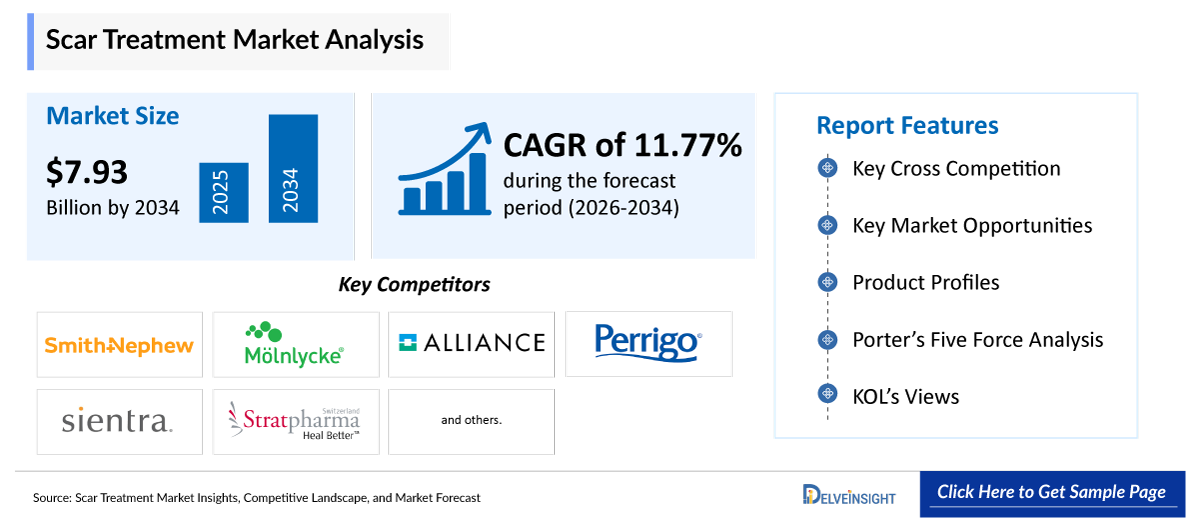
- The Scar Treatment market is estimated at USD 2.92 billion in 2025 and is projected to reach USD 7.93 billion by 2034. Growth is anchored in rising aesthetic and cosmetic awareness, an expanding pool of surgical, traumatic, and burn-related scars, and rapid adoption of minimally invasive laser- and device-based scar-revision technologies.
- The global scar treatment market is growing at a CAGR of 11.77% during the forecast period from 2026 to 2034.
- By product type, the gels, creams, and ointments segment dominated the Scar Treatment market with a 58% share in 2025.
- By treatment type, the topical treatments segment dominated the Scar Treatment market with a 61% share in 2025.
- By scar type, the atrophic scars segment dominated the Scar Treatment market with a 29% share in 2025.
- By distribution channel, the retail pharmacies segment dominated the Scar Treatment market with a 40% share in 2025.
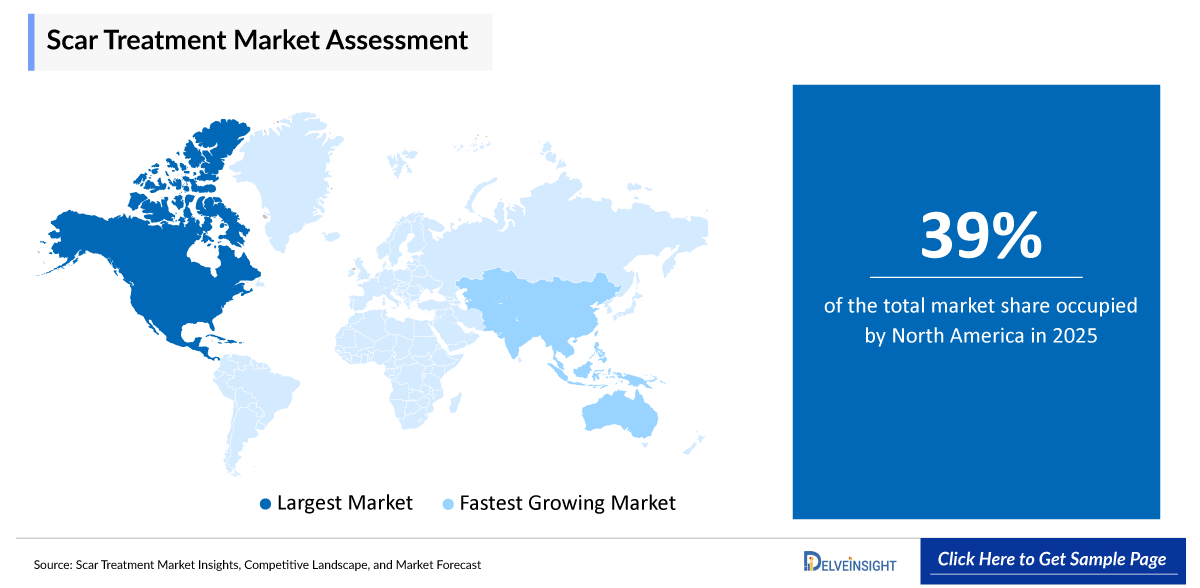
- North America dominated the global scar treatment market revenue with a 39% share in 2025, representing the highest regional market share globally.
Scar treatment refers to the range of topical, procedural, and device-based interventions used to reduce the appearance, texture, and functional impact of scars resulting from surgery, trauma, burns, acne, and other dermatologic conditions. Scars form as a natural consequence of the body's wound-healing cascade, and their type, from flat atrophic depressions and raised hypertrophic or keloid scars to contracture scars and stretch marks, determines the most appropriate treatment pathway. The market spans a broad continuum of products and procedures, including silicone gels, creams, and ointments; silicone sheets and dressings; adhesive scar patches; laser and other energy-based devices; and microneedling systems, delivered through hospital pharmacies, retail pharmacies, online pharmacies and e-commerce, and other specialty channels. Growth is being driven by rising self-consciousness about physical appearance, an expanding volume of surgical procedures and traumatic and burn injuries, increasing prevalence of acne-related scarring, and continuous innovation in fractional laser, radiofrequency microneedling, and regenerative scar-management technologies. As consumers and clinicians increasingly favor early, combination-based scar management over prevention alone, scar treatment has become a well-established and fast-growing category within dermatology, wound care, and medical aesthetics.
Scar Treatment Market Key Growth Drivers
• Rising aesthetic and cosmetic awareness is driving demand, with consumers increasingly seeking early and proactive scar management following surgical, cosmetic, and traumatic wounds.
• The growing incidence of burns, road-traffic accidents, and surgical procedures is expanding the pool of scar patients; the American Burn Association estimates approximately 450,000 burn injuries receive medical treatment annually in the United States alone.
• Rising global prevalence of acne, particularly among adolescents and young adults, is increasing demand for dedicated acne-scar treatments and combination topical-plus-device regimens.
• Technological advancements in fractional laser systems, radiofrequency microneedling, and regenerative, growth-factor-based therapies are improving efficacy and expanding the addressable procedural market.
• Silicone-based gels and sheets remain the internationally recommended first-line therapy for hypertrophic and keloid scars, sustaining high-volume, recurring demand across hospital, retail, and e-commerce channels.
• Expanding e-commerce and direct-to-consumer distribution is broadening access to premium and clinically tested scar-care formulations beyond traditional hospital and retail settings.
• Active M&A and brand consolidation among consumer-health and dermatology majors, including recent transactions involving leading silicone scar-gel brands, is expanding commercial reach and accelerating innovation.
Key Companies in Scar Treatment Market
The competitive landscape is led by the following active manufacturers:
• Smith & Nephew
• Mölnlycke Health Care
• Alliance Pharma
• Perrigo Company
• Sientra
• Stratpharma
• Pacific World Corporation
• Sonoma Pharmaceuticals
• Beiersdorf
• Galderma
Factors Contributing to the Growth of the Scar Treatment Market
Market Drivers
Rising Aesthetic Awareness and Demand for Cosmetic Appearance
The most consistent driver of the Scar Treatment market is the growing consumer focus on skin appearance and self-confidence. Scars from surgery, acne, trauma, and burns carry both physical and psychological burden, and rising exposure to social and professional imagery is prompting patients to seek treatment earlier and more proactively. This shift favors both over-the-counter topical formulations for everyday self-care and clinic-based procedural treatments for more visible or severe scarring. As awareness spreads beyond dermatology clinics into mainstream retail and e-commerce channels, demand for accessible, clinically validated scar-care products continues to widen the addressable market through 2034.
Increasing Incidence of Burns, Trauma, and Surgical Procedures
A structurally expanding pool of scar-forming injuries is sustaining long-term demand. The American Burn Association estimates that approximately 450,000 burn injuries receive medical treatment annually in the United States, while rising volumes of road-traffic accidents and elective and reconstructive surgical procedures continue to generate new scar cases worldwide. Because both prevention (applied immediately after wound closure) and treatment (applied to mature scars) are clinically recommended, each incident can generate demand across multiple product categories, including silicone sheets and dressings, gels, and, for more severe hypertrophic or keloid outcomes, energy-based and injectable interventions.
Market Restraints
Despite strong momentum, the Scar Treatment market faces material constraints. Limited insurance reimbursement for cosmetic and aesthetic scar-revision procedures keeps many premium topical, laser, and injectable treatments largely out-of-pocket, restraining adoption among price-sensitive patients, particularly in emerging economies. Inconsistent patient compliance with long-duration topical regimens, which typically require weeks to months of consistent daily use to demonstrate visible improvement, limits real-world effectiveness and repeat purchase rates for some product categories. The high capital cost of laser and energy-based devices, combined with the need for trained operators and dedicated clinic infrastructure, concentrates procedural volumes among larger dermatology and aesthetic practices and slows adoption in smaller or rural settings. A crowded field of branded, private-label, and counterfeit or low-quality topical products creates pricing pressure and can undermine consumer confidence in unproven formulations. Regulatory classification differences between cosmetic, OTC drug, and medical device pathways across geographies add complexity to product registration and marketing claims. Together, these reimbursement, compliance, capital-intensity, and regulatory barriers temper the pace of growth, even as the underlying drivers of aesthetic demand, rising injury incidence, and technological innovation remain firmly intact.
Scar Treatment Market Segment Analysis
The scar treatment market by product type (gels, creams and ointments, silicone sheets and dressings, scar patches, laser and energy-based devices, microneedling devices, others), treatment type (topical treatments, injectable treatments, energy-based treatments, procedural treatments, others), scar type (atrophic scars, hypertrophic scars, keloid scars, contracture scars, stretch marks, acne scars, others), distribution channel (hospital pharmacies, retail pharmacies, online pharmacies & e-commerce, others), and geography (North America, Europe, Asia-Pacific, and Rest of World).
By Product Type
Dominant Subsegment: Gels, Creams and Ointments.
The gels, creams and ointments segment accounted for 58% of the Scar Treatment market in 2025. This category leads because topical formulations are the most accessible, affordable, and widely recommended first step in scar management, spanning silicone gels, corticosteroid and retinoid-based creams, and OTC herbal or vitamin-based ointments sold across hospital, retail, and online channels. Their ease of self-application, low cost relative to procedural alternatives, and established clinical support for silicone as first-line therapy for hypertrophic and keloid scars sustain very high, recurring purchase volumes. Silicone sheets and dressings and scar patches retain strong clinical demand as fully occlusive alternatives, particularly for post-surgical and burn scars, while laser and energy-based devices and microneedling devices are the fastest-growing categories as clinics and medical spas expand procedural scar-revision offerings. Nonetheless, the breadth, affordability, and everyday accessibility of gels, creams, and ointments secure their leadership across the forecast period.
By Treatment Type
Dominant Subsegment: Topical Treatments.
The topical treatments segment accounted for 61% of the Scar Treatment market in 2025. Topical treatment is the leading modality because it applies to nearly every scar type, requires no specialized clinical setting, and is recommended both for prevention immediately after wound closure and for long-term management of mature scars. Its low barrier to access across hospital pharmacies, retail pharmacies, and e-commerce channels drives high-frequency, repeat purchasing behavior. Energy-based treatments are expanding quickly as fractional laser and radiofrequency microneedling platforms improve outcomes for hypertrophic, keloid, and acne scarring, and injectable treatments, including corticosteroid and dermal-filler-based approaches, are gaining share for raised and atrophic scars, respectively. Procedural treatments, including surgical revision, remain reserved for the most severe or functionally limiting scars. Given the breadth of applicability and the strength of clinical guideline support, topical treatments retain clear leadership through 2034.
Scar Treatment Market Region Analysis
Dominant Region: North America
North America accounted for 39% of the global scar treatment market revenue in 2025, representing the highest regional market share globally. The region's leadership reflects high consumer spending on aesthetic and personal-care products, broad availability of both branded topical scar-care products and advanced laser and energy-based devices, and a dense network of dermatology and medical-aesthetics clinics, particularly in the United States. The presence of well-established consumer brands, high awareness of silicone as first-line scar therapy, strong e-commerce penetration, and continued M&A activity among consumer-health companies consolidating leading scar-care brands reinforce the region's continued dominance across the forecast period.
Fastest Growing Region: Asia-Pacific
Asia-Pacific is the fastest-growing region in the Scar Treatment market, registering a CAGR of approximately 11.2% during the forecast period. The region's elevated growth is driven by rising disposable incomes, expanding healthcare and dermatology-clinic infrastructure, and a large patient population affected by acne, burn injuries, and surgical scarring across China, Japan, India, South Korea, and Australia. China is among the fastest-growing individual markets within the region, supported by rapidly expanding aesthetic-medicine adoption and growing domestic manufacturing of silicone and topical scar-care products. Increasing acceptance of dermatological and aesthetic procedures, expanding retail and e-commerce distribution, and growing awareness of scar-management options are accelerating adoption and positioning Asia-Pacific as the principal source of incremental growth over the forecast period.
Regional Commentary
North America
North America accounted for 39% of the global scar treatment market revenue in 2025. The United States dominates on the strength of high aesthetic and cosmetic spending, dense dermatology and medical-aesthetics infrastructure, and strong retail and e-commerce distribution of branded silicone and topical scar-care products, while ongoing brand consolidation among consumer-health companies reinforces the region's leadership.
Europe
Europe is a large and mature regional market, supported by established dermatology guidelines recommending silicone as first-line scar therapy, strong retail pharmacy networks, and growing adoption of regenerative and biostimulator-based aesthetic treatments across Germany, the United Kingdom, France, Italy, and Spain. Continued clinical evidence generation and new regulatory approvals for injectable and device-based aesthetic therapies are reinforcing the region's role in both preventive and corrective scar management.
Asia-Pacific
Asia-Pacific is the fastest-growing region, propelled by rising disposable incomes, expanding dermatology and aesthetic-clinic infrastructure, and a large population affected by acne, burn injuries, and surgical scarring across China, Japan, India, South Korea, and Australia. Growing acceptance of aesthetic procedures and rapid expansion of retail and e-commerce distribution are accelerating regional adoption of both topical and procedural scar treatments.
Rest of World
The Rest of World region, spanning Latin America, the Middle East, and Africa, is an emerging growth frontier. Rising awareness of aesthetic and dermatological treatment options, expanding private healthcare and medical-aesthetics infrastructure, and growing retail and e-commerce access to branded topical scar-care products are gradually broadening adoption across the region.
Scar Treatment Market Competitive Landscape
The Scar Treatment market is classified as Fragmented. A broad mix of global consumer-health, medical-device, and dermatology companies, including Smith & Nephew, Mölnlycke Health Care, and Alliance Pharma, hold strong positions in silicone-based topical and dressing products, while specialized aesthetic and device-focused players such as Sientra, Stratpharma, Pacific World Corporation, and Sonoma Pharmaceuticals compete through branded silicone gels, wound-care platforms, and clinically differentiated formulations. Global consumer-health majors including Perrigo Company and Beiersdorf leverage extensive retail distribution and private-label manufacturing scale, while dermatology category leader Galderma competes through its broader regenerative aesthetics and dermatological skincare portfolio, increasing competition across both the topical and procedural segments of the market.
The competitive landscape can be evaluated across the following dimensions:
• Market concentration: Fragmented, with no single participant holding a dominant global share and competition spread across consumer-health, medical-device, and dermatology-focused companies.
• Leading players: Smith & Nephew, Mölnlycke Health Care, and Alliance Pharma anchor the top tier through globally recognized silicone-based scar-care and wound-care brands.
• Geographic reach: Leading players operate extensive global retail, hospital, and e-commerce distribution networks spanning North America, Europe, and Asia-Pacific.
• Product portfolio strength: Top players offer end-to-end portfolios spanning silicone gels, sheets and dressings, scar patches, and, for aesthetics-focused competitors, energy-based and injectable procedural options.
• Clinical evidence base: Ownership of published clinical trial data supporting silicone as first-line hypertrophic and keloid scar therapy is a decisive commercial advantage.
• Strategic partnerships: Collaborations with dermatology and medical-aesthetics practices, such as branded in-office partnership programs, extend clinical reach and support premium positioning.
• M&A activity: Active consolidation of established silicone and topical scar-care brands among consumer-health companies continues to reshape category ownership.
• Manufacturing capabilities: Silicone-formulation expertise, GMP-compliant manufacturing, and private-label production scale are key competitive moats.
• Innovation focus: Regenerative and biostimulator-based therapies, next-generation energy-based devices, and combination topical-procedural regimens are shaping the innovation pipeline.
Scar Treatment Market Recent Developmental Activities
In April 2026, Galderma launched ALASTIN Signature Practices, a designation for dermatology, plastic surgery, and medical-aesthetics practices that integrate its regenerative, peri-procedural skincare portfolio into treatment planning. Strategic significance: Deepens clinical integration of peri-procedural and scar-supportive skincare within leading aesthetic practices.
In January 2026, Alliance Pharma completed the sale of its pharmaceutical division to two UK pharmaceutical companies, sharpening its focus as a consumer-health business built around global brands including its Kelo-Cote silicone scar-treatment franchise. Strategic significance: Concentrates resources and management attention on scaling its global scar-care brand portfolio.
Scar Treatment Market Segmentation
Scar Treatment Market by Product Type
• Gels, Creams and Ointments
• Silicone Sheets and Dressings
• Scar Patches
• Laser and Energy-Based Devices
• Microneedling Devices
• Others
Scar Treatment Market by Treatment Type
• Topical Treatments
• Injectable Treatments
• Energy-Based Treatments
• Procedural Treatments
• Others
Scar Treatment Market by Scar Type
• Atrophic Scars
• Hypertrophic Scars
• Keloid Scars
• Contracture Scars
• Stretch Marks
• Acne Scars
• Others
Scar Treatment Market by Distribution Channel
• Hospital Pharmacies
• Retail Pharmacies
• Online Pharmacies & E-Commerce
• Others
Scar Treatment Market by Geography
• North America Scar Treatment Market
▪ United States Scar Treatment Market Size in USD million (2023-2034)
▪ Canada Scar Treatment Market Size in USD million (2023-2034)
▪ Mexico Scar Treatment Market Size in USD million (2023-2034)
• Europe Scar Treatment Market
▪ Germany Scar Treatment Market Size in USD million (2023-2034)
▪ United Kingdom Scar Treatment Market Size in USD million (2023-2034)
▪ France Scar Treatment Market Size in USD million (2023-2034)
▪ Italy Scar Treatment Market Size in USD million (2023-2034)
▪ Spain Scar Treatment Market Size in USD million (2023-2034)
▪ Rest of Europe Scar Treatment Market Size in USD million (2023-2034)
• Asia-Pacific Scar Treatment Market
▪ China Scar Treatment Market Size in USD million (2023-2034)
▪ Japan Scar Treatment Market Size in USD million (2023-2034)
▪ India Scar Treatment Market Size in USD million (2023-2034)
▪ Australia Scar Treatment Market Size in USD million (2023-2034)
▪ South Korea Scar Treatment Market Size in USD million (2023-2034)
▪ Rest of Asia-Pacific Scar Treatment Market Size in USD million (2023-2034)
• Rest of the World (RoW) Scar Treatment Market
▪ Middle East Scar Treatment Market Size in USD million (2023-2034)
▪ Africa Scar Treatment Market Size in USD million (2023-2034)
▪ South America Scar Treatment Market Size in USD million (2023-2034)
Key Takeaways from the Scar Treatment Market Report Study
• Market size analysis for the current Scar Treatment market size (2025), and market forecast for 9 years (2026 to 2034).
• Top key product/technology developments, mergers, acquisitions, partnerships, and joint ventures that happened over the last 3 years.
• Key companies dominating the global scar treatment market.
• Various opportunities available for competitors in the Scar Treatment market space.
• What are the top-performing segments in 2025? How will these segments perform in 2034?
• Which are the top-performing regions and countries in the current Scar Treatment market scenario?
• Which are the regions and countries where companies should concentrate their opportunities for Scar Treatment market growth in the future?
Target audience who can benefit from this Scar Treatment market report study
• Scar Treatment product providers
• Research organizations and consulting companies
• Neurodegenerative disease therapeutics-related organizations, associations, forums, and other alliances
• Government and corporate offices
• Start-up companies, venture capitalists, and private equity firms
• Distributors and traders dealing in Scar Treatment
• Various end-users who want to know more about the Scar Treatment market and the latest technological developments in the Scar Treatment market.