Seasonal Influenza Market
Key Highlights
- Seasonal influenza is an acute viral infection that spreads easily, causing annual epidemics, which peak during the winter in temperate regions.
- Influenza A viruses are the only influenza viruses known to cause flu pandemics. Influenza A virus can spread efficiently among people, and against which people have little or no immunity.
- Antigenic drift is a major evolutionary phenomenon in seasonal influenza, driving the continuous emergence of antigenically distinct viral strains that evade host immunity, thereby sustaining annual outbreaks and challenging long-term vaccine efficacy.
- According to the estimates, the highest market size of seasonal influenza was found in the US and the least was in Spain across the 7MM. The upcoming therapies for seasonal influenza are expected to combat the current unmet needs faced by the patients and add to the overall growth of the seasonal influenza market size.
- Vaccination is the most effective measure for protecting against more severe forms of viral respiratory diseases. Those eligible for vaccination, particularly those at higher risk of severe outcomes, are encouraged to get vaccinated in line with national recommendations.
- The annual influenza vaccine is not 100% effective, it is still the best defense against the flu. The flu vaccination reduces the risk of flu illness from 40–60% among the overall population during seasons when most flu viruses are well-matched to the flu vaccine.
- For people younger than 65 years, Centers for Disease Control and Prevention (CDC) does not recommend any one flu vaccine over another. For adults 65 years and older, there are 3 flu vaccines that are preferentially recommended. These are FLUZONE High-Dose inactivated flu vaccine, FLUBLOK recombinant flu vaccine, and FLUAD adjuvanted inactivated flu vaccine.
- Alongside pharmacological interventions, behavioral management strategies, such as encouraging adherence to hygiene practices and promoting vaccination, are vital for protecting high-risk groups from severe disease.
- The key players in the seasonal influenza include Roche, BioCryst Pharmaceuticals, Seqirus, Moderna, Cocrystal Pharma, Novavax, and others.
- The seasonal influenza pipeline features promising late- and mid-stage therapies (drugs and vaccines) including mRNA-1010, CD388, CC-42344, neumifil, ARCT-2304, and others.
- Emerging treatments may offer more effective management options for seasonal influenza. Growing awareness and improved diagnostic techniques are crucial for early detection and better patient outcomes.
DelveInsight’s “Seasonal Influenza – Market Insights, Epidemiology, and Market Forecast – 2034” report delivers an in-depth understanding of seasonal influenza, historical and forecasted epidemiology as well as seasonal influenza market trends in the United States, EU4 (Germany, France, Italy, and Spain) and the United Kingdom, and Japan.
The seasonal influenza market report provides current treatment practices, emerging drugs, market share of individual therapies, and current and forecasted 7MM seasonal influenza market size from 2020 to 2034. The report also covers current seasonal influenza treatment practices/algorithms and unmet medical needs to curate the best opportunities and assess the market’s potential.
Geography Covered
- The United States
- EU4 (Germany, France, Italy, and Spain) and the United Kingdom
- Japan
|
Study Period |
2020–2034 |
|
Forecast Period |
2025–2034 |
|
Geographies Covered |
US, EU4 (Germany, France, Italy, and Spain) and the UK, and Japan |
|
Seasonal Influenza Epidemiology
|
Segmented by: ● Total Medical Visits Related to Seasonal Influenza ● Total Hospitalized Cases of Seasonal Influenza ● Type-specific Cases of Seasonal Influenza ● Influenza Vaccination Coverage |
|
Seasonal Influenza Key Companies |
· BioCryst Pharmaceuticals · Seqirus · Roche · Moderna · Cidara Therapeutics · Cocrystal Pharma · Pneumagen · Arcturus Therapeutics · Novavax · Sanofi, and others |
|
Seasonal Influenza Key Therapies |
● XOFLUZA ● RAPIVAB ● mRNA-1010 ● CD388 ● CC-42344 ● Neumifil, and others |
|
Seasonal Influenza Market |
Segmented by: · Region · Therapies |
|
Analysis |
· KOL Views · SWOT Analysis · Reimbursement · Conjoint Analysis · Unmet needs |
Seasonal Influenza Understanding and Treatment Algorithm
Seasonal Influenza Overview
Seasonal influenza is an acute viral infection that spreads easily, causing annual epidemics, which peak during the winter in temperate regions. Influenza can affect anyone, but some people, including the very young, the elderly, pregnant women, and those with underlying diseases, obesity, or a weakened immune system, are at higher risk of developing a severe infection, requiring hospitalization, and possibly leading to death. There are four types of influenza viruses: Influenza A, B, C, and D, but only Influenza A and B viruses cause clinically important human diseases and seasonal epidemics. Influenza A viruses cause the most severe clinical disease and are the major cause of seasonal epidemics and pandemics in the human population. Influenza viruses are spread from person to person primarily through large-particle respiratory droplet transmission (e.g., when an infected person coughs or sneezes near a susceptible person). Transmission via large-particle droplets requires close contact between the source and recipient persons because droplets do not remain suspended in the air and generally travel only a short distance (≤1 m) through the air. Uncomplicated influenza is characterized by the abrupt onset of constitutional and respiratory signs and symptoms (e.g., fever, myalgia, headache, malaise, nonproductive cough, sore throat, and rhinitis). Among children, otitis media, nausea, and vomiting are commonly reported with influenza illness. For most persons, uncomplicated influenza illness typically resolves after 3–7 days, although cough and malaise can persist for >2 weeks. However, influenza virus infections can cause primary influenza viral pneumonia; exacerbate underlying medical conditions (e.g., pulmonary or cardiac disease); lead to secondary bacterial pneumonia, sinusitis, or otitis media; or contribute to co-infections with other viral or bacterial pathogens.
Seasonal Influenza
Diagnosis
A diagnosis of influenza is based on clinical presentation and the epidemiological likelihood of infection. Initially, nonspecific symptoms predominate, including fever, chills or frank shaking, headaches, myalgia (muscle pain), malaise (discomfort), and anorexia. Viral culture and reverse transcription PCR (RT-PCR) are the gold standard laboratory tests for influenza. Virus culture is critical for the detailed characterization of novel viruses, surveillance of sensitivity to antiviral drugs, and monitoring of antigenic drift. It is time-consuming, but the length of the test can be reduced if shell-vial co-cultures are used, which detect virus-positive cells by immunostaining before the cytopathic effect. By contrast, RT-PCR, a highly sensitive and specific molecular test, is quick, can be incorporated into multiplex assays, and can be used to subtype viruses. Rapid antigen tests have been developed that are fast, can be run in a physician’s office, and are less expensive.
Further details related to diagnosis are provided in the report…
Seasonal Influenza Treatment
Patients not from a high-risk group can be managed with symptomatic treatment whereas, patients with severe or progressive clinical illness associated with suspected or confirmed influenza virus infection (i.e., clinical syndromes of pneumonia, sepsis, or exacerbation of chronic underlying diseases) can be treated with the antiviral drug. Prophylactic treatment is part of the treatment for influenza. Antiviral medicines play a vital role in controlling influenza by treating the patient’s infection and helping to prevent severe illnesses resulting from flu, including bacterial pneumonia. Several antiviral drugs are available to target the influenza virus, such as oseltamivir (TAMIFLU), zanamivir (RELENZA), peramivir (RAPIVAB), and some others. The best way to reduce the risk of seasonal flu and its potentially serious complications is to get vaccinated every year. Vaccination of people at higher risk of developing serious flu complications is essential to decrease their risk of severe flu illness. Most currently available flu vaccines for prevention from seasonal flu include quadrivalent vaccines, which means they act against the four most common flu virus strains predicted to be circulating—two Influenza A and B strains, respectively.
Further details related to treatment are provided in the report…
Seasonal Influenza Epidemiology
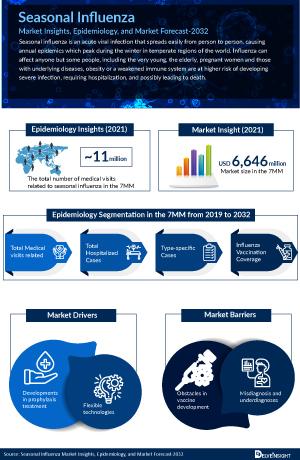
The seasonal influenza epidemiology chapter in the report provides historical as well as forecasted epidemiology segmented by total medical visits related to seasonal influenza, total hospitalized cases of seasonal influenza, type-specific cases of seasonal influenza, and influenza vaccination coverage in the 7MM covering the United States, EU4 (Germany, France, Italy, and Spain), United Kingdom, and Japan from 2020 to 2034.
- As per the CDC (2024) in the US, the overall burden of influenza (flu) for the 2023–2024 flu season was an estimated 40 million flu-related illnesses, 18 million flu-related medical visits, 470,000 flu-related hospitalizations, and 28,000 flu-related deaths.
- As per World Health Organization (WHO) estimates, seasonal influenza viruses cause 3–5 million cases of severe illness and 290,000–650,000 deaths each year, resulting in a severe challenge to public health.
- According to secondary research, seasonal influenza is majorly divided into two types; A and B. Type A influenza accounts for approximately 85% of cases, while Type B influenza makes up the remaining 15%.
- The highest number of total medical visits related to seasonal influenza were accounted for by the US in 2024, which is expected to show a rise in the future.
- According to the estimates, among EU4 and the UK, the total number of medical visits due to seasonal influenza was found highest in Italy, while least was in Spain.
Seasonal Influenza Drug Chapters
The drug chapter segment of the seasonal influenza report encloses a detailed analysis of the marketed and the late, mid, and early stage (Phase III, Phase II, and Phase I/II) pipeline drugs. The marketed drugs segment encloses drugs such as FLUAD QUADRIVALENT, AFLURIA QUADRIVALENT, FLUCELVAX QUADRIVALENT (Seqirus), FLUMIST (AstraZeneca), XOFLUZA (Roche and Shionogi), RAPIVAB (BioCryst Pharmaceuticals), and others. The drug chapter also helps understand the seasonal influenza clinical trial details, expressive pharmacological action, agreements and collaborations, approval and patent details, and the latest news and press releases.
Marketed Drugs
XOFLUZA (baloxavir marboxil): Roche and Shionogi
XOFLUZA is a first-in-class, single-dose oral medicine with an innovative proposed mechanism of action that has demonstrated efficacy in a wide range of influenza viruses, including in vitro activity against oseltamivir-resistant strains and avian strains (H7N9, H5N1) in non-clinical studies. XOFLUZA is the first in a class of antivirals designed to inhibit the cap-dependent endonuclease protein, which is essential for viral replication. In October 2018, Roche announced that the US Food and Drug Administration (FDA) had approved XOFLUZA for the treatment of acute, uncomplicated influenza, or flu, in people 12 years of age and older. In August 2022, Genentech announced that the US FDA approved a supplemental New Drug Application for XOFLUZA to treat acute, uncomplicated influenza in healthy children aged 5 to under 12, showing symptoms for no more than 48 hours. The FDA also approved its use for preventing influenza in the same age group after exposure to an infected person. XOFLUZA is approved in the EU for the treatment of uncomplicated influenza and post-exposure prophylaxis of influenza in children aged one year and above and in adolescents and adults.
- According to a January 2025 presentation, a regulatory submission was filed in Europe in June 2024 to seek approval for XOFLUZA for the treatment of influenza in pediatric patients aged 0 to 1 year.
- According to a January 2025 presentation, a regulatory submission was filed in the US for XOFLUZA targeting influenza transmitted through direct contact, with FDA acceptance of the submission currently pending.
- In September 2024, Roche announced the positive topline results of the Phase III CENTERSTONE study of XOFLUZA showing a reduction in the transmission of influenza viruses.
RAPIVAB (peramivir): BioCryst Pharmaceuticals
RAPIVAB (peramivir) is an antiviral drug with activity against the influenza virus. It is an inhibitor of the influenza virus neuraminidase. RAPIVAB is approved in the United States for the treatment of acute uncomplicated influenza in patients six months and older who have been symptomatic for no more than two days. The efficacy of RAPIVAB is based on clinical trials of naturally occurring influenza in which the predominant influenza infections were influenza A virus and a limited number of patients infected with influenza B virus. It is approved in Japan with the brand name RAPIACTA for the treatment of adults, children, and infants with uncomplicated seasonal influenza and those patients at high risk for complications associated with influenza. RAPIVAB received its initial FDA approval for the treatment of influenza infection in December 2014. This was followed by approval for a pediatric indication in September 2017, and a further expansion in February 2021, allowing use in children six months of age and older.
In September 2024, the HHS awarded us up to a USD 69 million contract for the procurement of up to 95,625 doses over five years of RAPIVAB for the treatment of influenza under the HHS Contract.
|
Key Cross-Marketed Drugs | ||||
|
Product |
Company |
RoA |
MoA |
First FDA Approval |
|
XOFLUZA (baloxavir marboxil) |
Roche and Shionogi
|
Oral |
PCSK9 inhibitors Polymerase inhibitor |
2018 |
|
RAPIVAB (peramivir) |
BioCryst Pharmaceuticals |
IV infusion |
Inhibitor of influenza virus neuraminidase |
2014 |
|
FLUAD QUADRIVALENT |
Seqirus |
Intramuscular (IM) |
Immunostimulants |
2020 |
Note: Detailed list will be provided in the final report.
Emerging Drugs
COVID-influenza combination (CIC) vaccine and Stand-alone influenza vaccine: Novavax
The CIC vaccine combines a stand-alone influenza vaccine and NVX-CoV2373 with the Matrix-M adjuvant into a single injection. The stand-alone influenza vaccine is also an investigational product of Novavax that contains a quadrivalent formulation with four influenza hemagglutinin genes with the Matrix-M adjuvant.
- In December 2024, the company initiated the initial cohort of a Phase III trial comparing the CIC vaccine and stand-alone influenza vaccine to the company’s updated COVID-19 vaccine and a licensed seasonal influenza vaccine comparator in adults aged 65 and older.
- The company is anticipating the initial cohort data by mid-2025 for the CIC vaccine and stand-alone influenza vaccine, and the company is also planning to partner with both vaccine programs to support future clinical development, regulatory filings, and commercialization activities.
- In November 2024, Novavax announced that the US FDA has removed the clinical hold on Novavax's Investigational New Drug (IND) application for its CIC and stand-alone influenza vaccine candidates.
- The US FDA granted Fast Track Designation (FTD) for the recombinant quadrivalent seasonal influenza vaccine candidate in January 2020.
mRNA-1010: Moderna
mRNA-1010 is the first-generation seasonal influenza vaccine candidate that encodes for the hemagglutinin proteins of the strains recommended by the WHO. The company intends to subsequently improve upon the first-generation candidate through the inclusion of additional HA antigens that could provide expanded coverage of co-circulating strains, as well as broadening protection through the addition of another influenza protein, the neuraminidase. Currently, the company is actively recruiting for a Phase III trial (NCT06602024) for the comparison of mRNA-1010 with a licensed influenza vaccine in adults ≥ 50 years of age.
- In September 2024, the company shared the results of an older adult extension study of P303, where mRNA-1010 met all primary immunogenicity endpoints, including superiority for all strains, compared to a licensed enhanced flu vaccine and showed an acceptable reactogenicity profile.
- In February 2023, the company announced interim results from the P301 study of mRNA-1010. The results indicated that mRNA-1010 achieved higher seroconversion rates for A/H3N2 and A/H1N1, as well as superiority on geometric mean titer ratios for A/H3N2 and non-inferiority on geometric mean titer rations for A/H1N1.
CD388: Cidara Therapeutics
Cidara aims to develop CD388, its lead flu DFC, to achieve universal prevention of seasonal and pandemic influenza with a single dose. Drug-Fc conjugates are not vaccines or monoclonal antibodies. Their targeting domains are small molecule antivirals that bind to a highly conserved target on the influenza cell surface, which is essential for viral proliferation and enables universal influenza coverage. These long-acting, bispecific DFCs are designed to directly inhibit viral proliferation while directing immune-mediated clearance of the virus. The two distinct and complementary mechanisms are designed to maximize the antiviral activity of DFCs. CD388 is being developed for universal, season-long flu protection in all patient populations. The company had completed two Phase I studies and one Phase IIa study of CD388, our influenza DFC candidate. These include a randomized, double-blind, dose-escalation Phase I trial (NCT05285137), a Japanese bridging study (NCT05619536), and a Phase IIa trial (NCT05523089) evaluating CD388’s pre-exposure prophylactic activity against influenza. In June 2023, the FDA granted Fast Track designation to CD388 for the prevention of influenza A and B infection in adults who are at high risk of influenza complications due to underlying immunodeficiency and may not mount an adequate response to influenza vaccine or are at high risk of severe influenza despite influenza vaccination, including those for whom vaccines are contraindicated.
- In March 2025, Cidara Therapeutics announced two upcoming presentations at the 38th International Conference on Antiviral Research (ICAR) on CD388 in influenza.
- In September 2024, the company initiated the CD388 Phase IIb NAVIGATE study to further evaluate its efficacy and safety in preventing influenza.
- In April 2024, the Company and Janssen entered into a license and technology transfer agreement, or the Janssen License Agreement, under which the Company reacquired all rights for CD388 from Janssen to develop and commercialize CD388.
|
Product |
Company |
Mechanism of Action |
Phase |
Indication |
ROA |
Molecule Type |
|
COVID-influenza combination (CIC) vaccine |
Novavax |
Immunostimulant |
III |
COVID-19 + seasonal influenza |
IM |
Vaccine |
|
Standalone Influenza vaccine (Quadrivalent vaccine |
Novavax |
Immunostimulant |
III |
Seasonal influenza |
IM |
Vaccine |
|
mRNA-1010 |
Moderna |
Immunostimulant |
III |
Seasonal influenza (Flu) |
IM |
mRNA |
|
CD388 |
Cidara Therapeutics |
Inhibitor of influenza virus neuraminidase |
II |
Influenza |
SC |
Small molecule |
|
CC-42344 |
Cocrystal Pharma |
PB2 Inhibitor |
II |
Seasonal influenza A |
Oral |
Small molecule |
|
Neumifil |
Pneumagen |
Inhibit viral infection by Binding and preventing the entry of viral pathogens |
II |
Influenza |
Intranasal |
Multivalent carbohydrate-binding protein |
|
TIV-HD/ IIV-HD (FLUZONE High-Dose) |
Novavax and Sanofi |
Immunostimulants |
I/II |
COVID-19 + seasonal influenza |
IM |
Vaccine |
|
ARCT-2304 (LUNAR-H5N1)* |
Arcturus Therapeutics/ CSL |
Enhanced expression of haemagglutinin (HA) and neuraminidase (NA) antigens |
I |
Influenza A |
IM |
Self-amplifying mRNA (sa-mRNA) vaccine |
|
* In April 2025, Arcturus Therapeutics announced that the US FDA had granted Fast Track Designation (FTD) ARCT-2304. The Phase I clinical study was initiated in November 2024. | ||||||
Note: Detailed list will be provided in the final report.
Drug Class Insights
PB2 inhibitor
Inhibitors targeting the PB2 subunit of the seasonal influenza virus RNA-dependent RNA polymerase have been developed to disrupt the viral replication cycle. The PB2 protein plays an essential role in the cap-snatching mechanism, wherein the virus cleaves 5′-capped primers from host pre-mRNA to initiate the synthesis of viral mRNA. PB2 inhibitors function by binding to the cap-binding domain of the subunit, thereby preventing the acquisition of host-derived RNA primers and effectively halting viral transcription.
Note: Detailed insights will be provided in the final report.
Seasonal Influenza Market Outlook
Seasonal influenza vaccines are essential in protecting against the most prevalent strains of the virus, with annual updates based on global surveillance data. Vaccines like FLUZONE (inactivated influenza vaccine) and FLUMIST (live attenuated influenza vaccine) stimulate the immune system to produce antibodies that can prevent infection or reduce the severity of illness. These vaccines are crucial in mitigating seasonal flu outbreaks and safeguarding vulnerable populations, such as the elderly and those with chronic health conditions.
Antiviral medications play a vital role in managing seasonal influenza by both treating the infection and reducing the risk of serious complications, such as bacterial pneumonia. When administered promptly, these drugs can lessen the severity of symptoms and typically shorten the duration of illness by about one day. Early treatment is particularly crucial for individuals at high risk of flu-related complications, including the elderly and those with weakened immune systems. At present, some antiviral drugs are recommended for influenza treatment: TAMIFLU, RELENZA, RAPIVAB, and XOFLUZA. TAMIFLU and RELENZA received FDA approval in 1999, followed by newer options introduced after a gap of nearly 15 years.
Over the past few years, improvements in the field of seasonal influenza have been observed though there is still a necessity to have a profound understanding of the disease and its unmet needs. The best way to prevent influenza is to get a flu vaccine yearly. However, the flu viruses constantly change through antigenic drift or antigenic shift, increasing the odds of failure.
Products of companies like Cidara Therapeutics (CD388), Cocrystal Pharma (CC-42344), Moderna (mRNA-1010), and others are in their clinical development stage and are likely to launch during the study period.
- The US accounts for the largest market size of seasonal influenza, in comparison to EU4 and the UK (Germany, France, Italy, the UK, and Spain) and Japan in 2024.
- Among the EU4 and the UK, Germany had the highest market size, while Spain had the lowest market size for seasonal influenza in 2024.
- The emerging landscape for seasonal influenza is having many management options are being evaluated in the pipeline. The expected launch of these therapies may increase the market size of seasonal influenza in the coming years.
Seasonal Influenza Drugs Uptake
This section focuses on the uptake rate of potential drugs expected to be launched in the market during 2025–2034. The landscape of seasonal influenza treatment has experienced a profound transformation with the uptake of novel drugs. These innovative therapies are redefining standards of care. Furthermore, the increased uptake of these transformative drugs is a testament to the unwavering dedication of physicians, professionals, and the entire healthcare community in their tireless pursuit of advancing disease care. This momentous shift in treatment paradigms is a testament to the power of research, collaboration, and human resilience.
Further detailed analysis of emerging therapies drug uptake in the report…
Seasonal Influenza Pipeline Development Activities
The report provides insights into therapeutic candidates in Phase III, Phase II, and Phase I/II. It also analyzes key players involved in developing targeted therapeutics.
Pipeline Development Activities
The report covers information on collaborations, acquisitions and mergers, licensing, and patent details for seasonal influenza emerging therapy.
KOL Views
To keep up with current market trends, we take KOLs and SMEs’ opinions working in the domain through primary research to fill the data gaps and validate our secondary research. Industry Experts were contacted for insights on the seasonal influenza evolving treatment landscape, patient reliance on conventional therapies, patient therapy switching acceptability, and drug uptake, along with challenges related to accessibility, including general practitioners, pulmonologists, and others.
Delveinsight’s analysts connected with 15+ KOLs to gather insights; however, interviews were conducted with 10+ KOLs in the 7MM. Centers such as - University of Barcelona in Spain, Italian National Institute of Health in Italy, University of California in the US, Université de Rennes in France, and others. Their opinion helps understand and validate current and emerging therapy treatment patterns or seasonal influenza market trends. This will support the clients in potential upcoming novel treatments by identifying the overall scenario of the market and the unmet needs.
|
KOL Views |
|
“Influenza can have serious complications in young children, a particularly vulnerable patient population, and there is a demonstrated need for improved vaccines that can mitigate the impact of the flu. Some vaccine candidates have already shown a robust safety profile in adults, and measures to advancing scientific understanding.” |
|
“There continue to be questions about the relative contributions made by the various routes to the spread of influenza, but each will likely play a part depending on the situation. Therefore, policies for infection control and prevention should focus on each of the routes separately. Instead of concentrating on a single individual intervention, non-pharmaceutical interventions can be combined to target the various potential modes of influenza transmission.” |
Qualitative Analysis
We perform Qualitative and market Intelligence analysis using various approaches, such as SWOT analysis and conjoint analysis. In the SWOT analysis, strengths, weaknesses, opportunities, and threats in terms of disease diagnosis, patient awareness, patient burden, competitive landscape, cost-effectiveness, and geographical accessibility of therapies are provided. These pointers are based on the Analyst’s discretion and assessment of the patient burden, cost analysis, and existing and evolving treatment landscape.
Conjoint Analysis analyzes multiple approved and emerging therapies based on relevant attributes such as safety, efficacy, frequency of administration, route of administration, and order of entry. Scoring is given based on these parameters to analyze the effectiveness of therapy.
In efficacy, the trial’s primary and secondary outcome measures are evaluated. Further, the therapies’ safety is evaluated wherein the acceptability, tolerability, and adverse events are majorly observed, and it sets a clear understanding of the side effects posed by the drug in the trials. In addition, the scoring is also based on the probability of success, and the addressable patient pool for each therapy. According to these parameters, the final weightage score and the ranking of the emerging therapies are decided.
Market Access and Reimbursement
Globally, seasonal influenza patient families spend an essential proportion of their household income on seasonal influenza care. Seasonal influenza patients have to face a huge economic burden alone without any healthcare coverage or proper reimbursement policies.
Reimbursement may be referred to as the negotiation of a price between a manufacturer and payer that allows the manufacturer access to the market. It is provided to reduce the high costs and make the essential drugs affordable. Health technology assessment (HTA) plays an important role in reimbursement decision-making and recommending the use of a drug. These recommendations vary widely throughout the seven major markets, even for the same drug. In the US healthcare system, both Public and Private health insurance coverage are included. Also, Medicare and Medicaid are the largest government-funded programs in the US. The major healthcare programs including Medicare, Medicaid, Health Insurance Program (CHIP), and the state and federal health insurance marketplaces are overseen by the Centers for Medicare & Medicaid Services (CMS). Other than these, Pharmacy Benefit Managers (PBMs), and third-party organizations that provide services, and educational programs to aid patients are also present.
The report further provides detailed insights on the country-wise accessibility and reimbursement scenarios, cost-effectiveness scenario of currently used therapies, programs making accessibility easier and out-of-pocket costs more affordable, insights on patients insured under federal or state government prescription drug programs, etc.
Further detailed analysis of emerging therapies drug uptake in the report…
Scope of the Report
- The report covers a segment of key events, an executive summary, and a descriptive overview of seasonal influenza, explaining its causes, signs, symptoms, pathogenesis, and currently used therapies.
- Comprehensive insight into the epidemiology segments and forecasts, disease progression, and treatment guidelines has been provided.
- Additionally, an all-inclusive account of the emerging therapies and the elaborative profiles of different stages and prominent therapies will impact the current treatment landscape.
- A detailed review of the seasonal influenza market, historical and forecasted market size, market share by therapies, detailed assumptions, and rationale behind our approach is included in the report, covering the 7MM drug outreach.
- The report provides an edge while developing business strategies, by understanding trends, through SWOT analysis and expert insights/KOL views, patient journey, and treatment preferences that help shape and drive the 7MM seasonal influenza market.
Seasonal Influenza Report Insights
- Patient population
- Therapeutic approaches
- Seasonal influenza pipeline analysis
- Seasonal influenza market size and trends
- Existing and future market opportunities
Seasonal Influenza Report Key Strengths
- Ten years forecast
- The 7MM coverage
- Seasonal influenza epidemiology segmentation
- Key cross competition
- Drugs uptake and key market forecast assumptions
Seasonal Influenza Report Assessment
- Current treatment practices
- Unmet needs
- Pipeline product profiles
- Market attractiveness
- Qualitative analysis (SWOT analysis and conjoint analysis)
FAQs
- What was the seasonal influenza market size, the market size by therapies, market share (%) distribution in 2024, and what would it look like by 2034? What are the contributing factors for this growth?
- What are the pricing variations among different geographies for approved therapies?
- What can be the future treatment paradigm of seasonal influenza?
- What are the disease risks, burdens, and unmet needs of seasonal influenza? What will be the growth opportunities across the 7MM concerning the patient population with seasonal influenza?
- Who is the major competitor of XOFLUZA in the market and how the competitors will affect their market share?
- What are the current options for the treatment of seasonal influenza? What are the current guidelines for treating seasonal influenza in the US, Europe, and Japan?
- What are the recent novel therapies, targets, mechanisms of action, and technologies being developed to overcome the limitations of existing therapies?
Reasons to Buy
- The report will help develop business strategies by understanding the latest trends and changing treatment dynamics driving the seasonal influenza market.
- Insights on patient burden/disease prevalence, evolution in diagnosis, and factors contributing to the change in the epidemiology of the disease during the forecast years.
- Understand the existing market opportunities in varying geographies and the growth potential over the coming years.
- Distribution of historical and current patient share based on real-world prescription data along with reported sales of approved products in the US, EU4 (Germany, France, Italy, and Spain), the United Kingdom, and Japan.
- Identifying strong upcoming players in the market will help devise strategies to help get ahead of competitors.
- Detailed analysis and ranking of class-wise potential current and emerging therapies under the analyst view section to provide visibility around leading classes.
- Highlights of access and reimbursement policies of current therapies, barriers to accessibility of expensive off-label therapies, and patient assistance programs.
- To understand Key Opinion Leaders’ perspectives around the accessibility, acceptability, and compliance-related challenges of existing treatment to overcome barriers in the future.
- Detailed insights on the unmet needs of the existing market so that the upcoming players can strengthen their development and launch strategy.