Sickle Cell Disease Market
Key Highlights
- As per DelveInsight, the Sickle Cell Disease Market is expected to expand at a healthy growth rate during the forecast period (2023-2032), owing to the launch of new therapies in the market and the rise in the number of cases.
- It is estimated that in the United States, the population of sickle cell disease is approximately 100,000 and is likely to increase in the upcoming years.
- Several major pharma and biotech companies such as Cellectis, Sana Biotechnology, Global Blood Therapeutics, Inc., CSL Behring, Pfizer, Aruvant Sciences, Graphite Bio, Novartis, Agios Pharmaceuticals, Forma Therapeutics, Vertex Pharmaceuticals, Global Blood Therapeutics, Inc., Alfasigma, Novo Nordisk, bluebird bio, ExCellThera, Gamida Cell, KM Biologics/Takeda, Editas Medicine, among others, are actively working in the Sickle Cell Disease Market.
Download the Sample PDF to Get More Insight @ Sickle Cell Disease Market
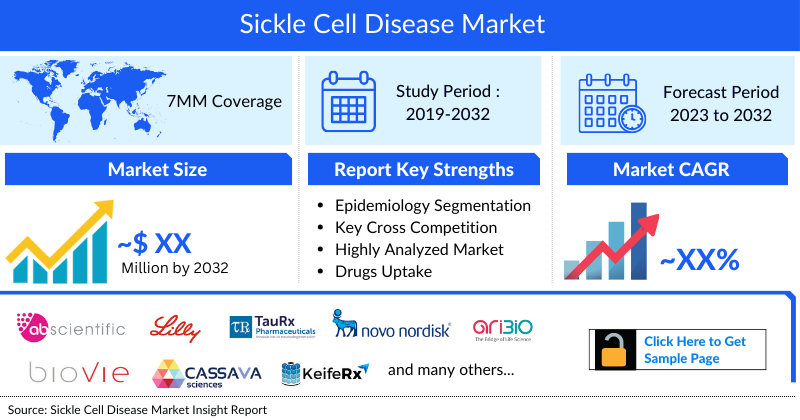
DelveInsight’s “Sickle Cell Disease – Market Insights, Epidemiology, and Market Forecast – 2032” report delivers an in-depth understanding of the Sickle Cell Disease, historical and forecasted epidemiology as well as the Sickle Cell Disease market trends in the United States, EU4 (Germany, France, Italy, and Spain) and the United Kingdom and Japan.
The Sickle Cell Disease market report provides current treatment practices, emerging drugs, the market share of individual therapies, and current and forecasted Sickle Cell Disease market size from 2019 to 2032, segmented by the seven major markets. The report also covers the current Sickle Cell Disease treatment practices/algorithms and unmet medical needs to curate the best of the opportunities and assess the underlying potential of the market.
Geography Covered
- The United States
- EU4 (Germany, France, Italy, and Spain) and the United Kingdom
- Japan
Study period: 2019–2032
Sickle Cell Disease Understanding and Treatment Algorithm
DelveInsight’s Sickle Cell Disease market report gives a thorough understanding of Sickle Cell Disease by including details such as disease definition, symptoms, causes, pathophysiology, diagnosis, and treatment.
Sickle Cell Disease is a group of inherited red blood cell disorders caused by a structural abnormality of hemoglobin called sickle hemoglobin (HbS) which encodes hemoglobin subunit β. HbS is inherited in an autosomal recessive way and can occur due to homozygosity for HbS (HbSS). HbS is functional and soluble when oxygenated, but upon deoxygenation it polymerizes, leading to the generation of deformed red blood cells known as sickled cells and dense erythrocytes. Hence, the sickle cells die early, which causes a constant shortage of red blood cells.
There are several types of Sickle Cell Disease. The specific type of Sickle Cell Disease depends on the genes the person inherited from their parents. The most common types of Sickle Cell Disease include HbSS (commonly called sickle cell anemia and is usually the most severe form of the disease), HbSC (a milder form of Sickle Cell Disease), and HbS beta-thalassemia (a milder form of Sickle Cell Disease).
Symptoms of Sickle Cell Disease may vary from person to person. Some common symptoms and complications include anemia, pain crisis, sickle crisis, acute chest syndrome, stroke, and jaundice.
Sickle cell disease is more common in certain ethnic groups, including:
- People of African descent, including African Americans (among whom 1 in 12 carries a sickle cell gene)
- Hispanic Americans from Central and South America
- People of Middle Eastern, Asian, Indian, and Mediterranean descent
The blocked blood flow through the body in Sickle Cell Disease can lead to serious problems, including stroke, eye problems, infections, and episodes of pain called pain crises.
Sickle cell disease is a lifelong illness. A blood and bone marrow transplant is currently the only cure for sickle cell disease, but there are effective treatments that can reduce symptoms and prolong life.
Sickle Cell Disease Diagnosis
Because sickle cell disease symptoms can begin by four months of age, early diagnosis is critical. All newborns in developed countries like the United States are now tested for the disease. Sickle cell disease can be identified before birth by testing a sample of amniotic fluid or tissue from the placenta. People who carry the sickle cell gene can seek genetic counseling before pregnancy to discuss options.
A new technique used in conjunction with in vitro fertilization, called pre-implantation genetic diagnosis (PGD), enables parents who carry the sickle cell trait to test embryos for the defective gene before implantation and to choose to implant only those embryos free of the sickle cell gene.
The diagnosis requires a complete medical history and physical exam along with a blood test. To confirm the diagnosis, a sample of blood is examined under a microscope to check for large numbers of sickled red blood cells - the hallmark trait of the disease. Further, hemoglobin electrophoresis is a blood test that can determine if a person is a carrier of sickle cell, or has any of the diseases associated with the sickle cell gene.
Sickle Cell Disease Treatment
Management of Sickle Cell Disease is focused on preventing and treating pain episodes and other complications. Prevention strategies include lifestyle behaviors as well as medical screening and interventions to prevent Sickle Cell Disease complications.
The current therapies used to prevent the complications of the disease vary in their effectiveness and are associated with serious risks and tolerability issues. Besides this, Sickle Cell Disease presents with large unmet medical needs, with no disease-modifying treatment. Several drugs are approved for the treatment of Sickle Cell Disease including ADAKVEO, DROXIA, ENDARI, and OXBRYTA.
DROXIA has been the Gold- Standard Treatment for Sickle Cell Disease for decades and is a key therapeutic tool for Sickle Cell Disease approved by the US FDA and EMA. Hydroxycarbamide (alternatively known in some countries as hydroxyurea), a ribonucleotide reductase inhibitor, has multiple physiological effects, including increasing HbF expression which in turn reduces hemoglobin S polymerization and subsequent sickling.
ENDARI was the first new drug for sickle cell patients in nearly two decades and was the first FDA-approved treatment for pediatric as well as adult patients with Sickle Cell Disease. The approval of Emmaus’s ENDARI for treating complications of Sickle Cell Disease in the United States in 2017 marked a significant advancement in Sickle Cell Disease treatment and is expected to pave the way for the development and approval of additional therapies.
ADAKVEO is a P selectin blocker indicated to reduce the frequency of vaso-occlusive crises in adults and pediatric patients aged 16 years and older with sickle cell disease. It is a humanized IgG2 kappa monoclonal antibody that binds to P-selectin and blocks interactions with its ligands, including P-selectin glycoprotein ligand-1. Binding P-selectin on the surface of the activated endothelium and platelets blocks interactions between endothelial cells, platelets, red blood cells, and leukocytes.
In general, about half of the patients go for blood transfusions and exchanges. Although these are also associated with certain complications, like pain during insertions and the development of antibodies to blood types used in transfusions, and can lead to certain high levels of iron in the blood, which can cause organ damage. Thus, Iron chelators are used in the latter case. Bone marrow transplants have equal positive as well as negative attributes. Currently, three therapies modify the disease course of SCA: hydroxycarbamide, erythrocyte transfusion, and hematopoietic stem cell transplantation.
Sickle Cell Disease Epidemiology
The Sickle Cell Disease epidemiology section provides insights into the historical and current Sickle Cell Disease patient pool and forecasted trends for seven individual major countries. It helps recognize the causes of current and forecasted trends by exploring numerous studies and views of key opinion leaders. This part of the Sickle Cell Disease report also provides the diagnosed patient pool, its trends, and assumptions undertaken.
Key findings
According to a study published by Sedrak and Kondamudi (2021), sickle cell anemia is the most common monogenic disorder. The prevalence of the disease is high among the people of Sub-Saharan Africa, South Asia, the Middle East, and the Mediterranean. It is estimated that in the United States, the population of sickle cell disease is approximately 100,000 and is likely to increase. The most common genotype is homozygous hemoglobin SS (HbSS), and common heterozygous conditions are hemoglobin sickle beta zero thalassemias, hemoglobin sickle beta plus thalassemia (hemoglobin sickle beta plus thalassemia), and hemoglobin sickle cell disease (HbSC).
According to the American Society of Hematology (2021), approximately 70,000 to 100,000 Americans have sickle cell disease, the most common form of an inherited blood disorder. This disease, which is present in affected individuals at birth, causes the production of abnormal hemoglobin.
As per Leleu et al. (2021), a cross-sectional observational study including French Sickle Cell Disease patients followed up between 2011 and 2016, estimated that Sickle Cell Disease prevalence in France is between 19,800 and 32,400 patients in 2016. The median age was 31 to 33, significantly less than the median age of 41 in the country’s general population.
According to Kunz et al (2019), results from a national registry in Germany found that most patients had homozygous Sickle Cell Disease (HbSS 75.1%, HbS/β‐thalassemia 13.2%, and HbSC 11.3%). The median age at diagnosis was 1.9 years, most patients were diagnosed when characteristic symptoms occurred. Sepsis and stroke affected 3.2% and 4.2% of patients, respectively. During the first year of observation, 48.3% of patients were admitted to a hospital and 10.1% required intensive care. The study concluded that with an estimated number of at least 2000, the prevalence of Sickle Cell Disease in Germany remains low.
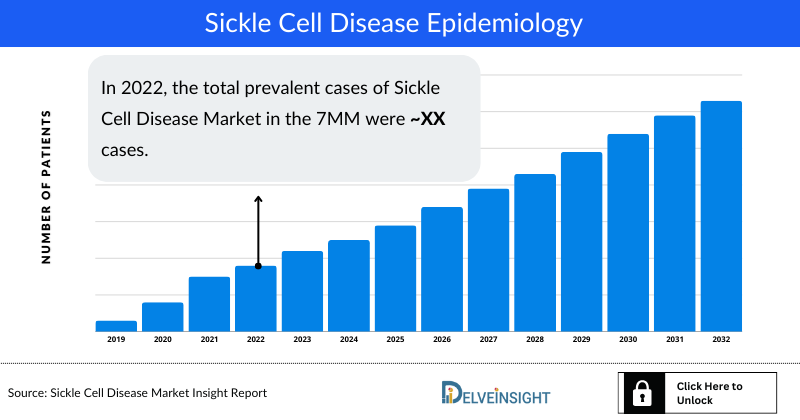
The Sickle Cell Disease epidemiology covered in the report provides historical as well as forecasted epidemiology [segmented as Total Prevalent Cases of Sickle Cell Disease, Diagnosed Prevalent Cases of Sickle Cell Disease, Type-specific Cases of Sickle Cell Disease, and Treated Cases of Sickle Cell Disease] in the 7MM covering the United States, EU4 (Germany, France, Italy, and Spain) and the United Kingdom, and Japan from 2019 to 2032.
Country-wise Sickle Cell Disease Epidemiology
The epidemiology segment also provides the Sickle Cell Disease epidemiology data and findings across the United States, EU4 (Germany, France, Italy, and Spain) and the United Kingdom, and Japan.
Get a more detailed overview of How Sickle Cell Disease Epidemiology will evolve in the upcoming years: Sickle Cell Disease Epidemiology Forecast
Sickle Cell Disease Drug Chapters
The drug chapter segment of the Sickle Cell Disease report encloses a detailed analysis of Sickle Cell Disease marketed drugs and late-stage (Phase III and Phase II) Sickle Cell Disease pipeline drugs. It also helps understand the Sickle Cell Disease clinical trial details, expressive pharmacological action, agreements and collaborations, approval and patent details, advantages and disadvantages of each included drug and the latest news and press releases.
Emerging Sickle Cell Disease drugs
The report details the emerging Sickle Cell Disease therapies under the late and mid-stage of development for Sickle Cell Disease treatment.
Sickle Cell Disease Market Outlook
The Sickle Cell Disease market outlook of the report helps to build a detailed comprehension of the historical, current and forecasted Sickle Cell Disease market trends by analyzing the impact of current therapies on the market, unmet needs, and demand for better technology.
This segment gives a thorough detail of the Sickle Cell Disease market trend of each marketed drug and late-stage pipeline therapy by evaluating their impact based on the annual cost of therapy, inclusion and exclusion criteria, mechanism of action, compliance rate, growing need for the market, increasing patient pool, covered patient segment, expected launch year, competition with other therapies, brand value, their impact on the market and view of the key opinion leaders. The calculated market data are presented with relevant tables and graphs to give a clear view of the market at first sight.
According to DelveInsight, the Sickle Cell Disease market in the 7MM is expected to witness a major change in the study period 2019–2032.
Key findings
This section includes a glimpse of the Sickle Cell Disease market in the 7MM.
The United States: Sickle Cell Disease Market Outlook
This section provides the total Sickle Cell Disease market size and market size by therapies in the United States.
EU4 and the United Kingdom: Sickle Cell Disease Market Outlook
The total Sickle Cell Disease market size and market size by therapies in EU4 (Germany, France, Italy, and Spain) and the United Kingdom are provided in this section.
Japan: Sickle Cell Disease Market Outlook
The total Sickle Cell Disease market size and market size by therapies in Japan are also mentioned.

Sickle Cell Disease Drug Uptake
This section focuses on the rate of uptake of the potential drugs recently launched in the Sickle Cell Disease market or expected to get launched in the market during the study period 2019–2032. The analysis covers the Sickle Cell Disease market uptake by drugs, patient uptake by therapies, and sales of each drug.
This will help in understanding the Sickle Cell Disease drugs with the most rapid uptake and the reasons behind the maximal use of new drugs and allows the comparison of the drugs based on market share and size, which again will be useful in investigating factors important in the market uptake and in making financial and regulatory decisions.
Sickle Cell Disease Pipeline Development Activities
The report provides insights into different therapeutic candidates in Phase II and Phase III stages. It also analyses the Sickle Cell Disease’ key companies involved in developing targeted therapeutics.
Sickle Cell Disease market clinical trial development activities
The report covers detailed information on collaborations, acquisitions, and mergers, licensing patent details, and other information on Sickle Cell Disease emerging therapies.
Sickle Cell Disease Treatment and Therapetuics Market Outlook
While there is no cure for Sickle Cell Disease, various treatment modalities aim to alleviate symptoms and improve patient's quality of life. Sickle Cell Disease remains a complex and challenging condition, necessitating a multidimensional approach to diagnosis, treatment, and ongoing research. Blood transfusions, pain management, and hydroxyurea, a medication that increases fetal hemoglobin production, are commonly used. Bone marrow or stem cell transplantation may be considered in severe cases.
The pharmaceutical landscape for Sickle Cell Disease is witnessing significant advancements, with ongoing research focusing on innovative therapies and potential cures. Gene therapies, such as CRISPR-based technologies, are showing promise in correcting the genetic mutations responsible for Sickle Cell Disease. The market outlook reflects a growing commitment to addressing the unmet medical needs of individuals with Sickle Cell Disease, with increased investment and research initiatives.
Currently, some of the major pharma and biotech giants such as Cellectis, Sana Biotechnology, Global Blood Therapeutics, Inc., CSL Behring, Pfizer, Aruvant Sciences, Graphite Bio, Novartis, Agios Pharmaceuticals, Forma therapeutics, Vertex Pharmaceuticals, Global Blood Therapeutics, Inc., Alfasigma, Novo Nordisk, bluebird bio, ExCellThera, Gamida Cell, KM Biologics/Takeda, Editas Medicine Sickle Cell Disease treatment. As the medical community continues to unravel the complexities of this genetic disorder, there is optimism for improved therapeutic interventions and, ultimately, a brighter future for individuals living with Sickle Cell Disease.
Explore more about the emerging therapies and key companies actively working in the market: Sickle Cell Disease Pipeline Insights
Sickle Cell Disease Reimbursement Scenario
Approaching reimbursement proactively can have a positive impact both during the late stages of product development and well after product launch. In a report, we consider reimbursement to identify economically attractive indications and market opportunities. When working with finite resources, the ability to select the markets with the fewest reimbursement barriers can be a critical business and price strategy.
KOL Views
To keep up with current epidemiology and market trends, we take KOLs and SMEs' opinions working in the Sickle Cell Disease domain through primary research to fill the data gaps and validate our secondary research. Their opinion helps to understand and validate current and emerging therapies and treatment patterns along with Sickle Cell Disease market trends. This will support the clients in potential upcoming novel treatments by identifying the overall scenario of the market and the unmet needs.
Competitive Intelligence Analysis
We perform competitive and market intelligence analysis of the Sickle Cell Disease market by using various competitive intelligence tools that include – SWOT analysis and Market entry strategies, etc. The inclusion of the analysis entirely depends upon the data availability.
Scope of the Report
- Descriptive overview of Sickle Cell Disease, disease overview, patient journeys, treatment algorithms, diagnosis, and currently available therapies.
- Comprehensive insight into the Sickle Cell Disease epidemiology and forecasts in the 7MM.
- An all-inclusive account of both the current and emerging therapies for Sickle Cell Disease, along with the assessment of new therapies, is expected to have an impact on the current treatment landscape.
- Exhaustive analysis of the Sickle Cell Disease market; historical and forecasted covering drug outreach in the 7MM.
- Detailed patient-based market forecasting determines the trends shaping and driving the global Sickle Cell Disease market.
Report Highlights
- In the coming years, the Sickle Cell Disease market is set to change due to the rising awareness of the disease and incremental healthcare spending across the world; which would expand the size of the market to enable drug manufacturers to penetrate more into the market.
- Companies and academics are working to assess challenges and seek opportunities that could influence Sickle Cell Disease R&D. The therapies under development are focused on novel approaches to treat/improve the disease condition.
- Several major Sickle Cell Disease companies are involved in developing therapies to improve the treatment outlook. The launch of emerging therapies will significantly impact the Sickle Cell Disease market.
- A better understanding of Sickle Cell Disease pathogenesis will also contribute to the development of novel therapeutics for Sickle Cell Disease.
- Our in-depth analysis of the Sickle Cell Disease pipeline assets across different stages of development (Phase III and Phase II), emerging trends, and comparative analysis of pipeline products with detailed clinical profiles, key cross-competition, launch date along with product development activities will support the clients in the decision-making process regarding their therapeutic portfolio by identifying the overall scenario of the research and development activities.
Sickle Cell Disease Market Report Insights
- Sickle Cell Disease Patient-Based Market Forecasting
- Sickle Cell Disease Therapeutic approaches
- Sickle Cell Disease Pipeline Analysis
- Sickle Cell Disease market size and trends
- Sickle Cell Disease market opportunities
- Impact of upcoming Sickle Cell Disease Therapies
Sickle Cell Disease Market Report Key Strengths
- 10 years forecast
- The 7MM Coverage
- Sickle Cell Disease Epidemiology Segmentation
- Key cross competition in the Sickle Cell Disease Market
- KOL views
- Sickle Cell Disease drug uptake
Sickle Cell Disease Market Report Assessment
- Current Sickle Cell Disease treatment practices
- Unmet needs
- Sickle Cell Disease pipeline product profiles
- Sickle Cell Disease market attractiveness
Key Questions
Sickle Cell Disease market insights:
- What would be the Sickle Cell Disease market growth till 2032, and what will be the resultant market size in 2032?
- What was the Sickle Cell Disease drug class share (in percentage) distribution in 2019, and how would it look in 2032?
- What would be the Sickle Cell Disease's total market size and market size by therapies across the 7MM during the forecast period (2023–2032)?
- What are the key findings of the market across the 7MM, and which country will have the largest Sickle Cell Disease market size during the forecast period (2023–2032)?
- How would the unmet needs affect the Sickle Cell Disease market dynamics and subsequent analysis of the associated trends?
Sickle Cell Disease Epidemiology Insights:
- What are the disease risk, burden, and regional/ethnic differences of Sickle Cell Disease?
- What is the historical and forecasted Sickle Cell Disease patient pool in the 7MM, and where can one observe the highest patient population and growth opportunities?
- What are the key factors driving the epidemiology trends for seven major markets covering the United States, EU4 (Germany, France, Italy, and Spain) and the United Kingdom, and Japan?
Current Treatment Scenario, Marketed Drugs, and Emerging Therapies
- What are the current treatment guidelines and treatment options, in addition to approved therapies for Sickle Cell Disease in the US, Europe, and Japan?
- What are the key collaborations (Industry–Industry, Industry-Academia), mergers and acquisitions, and licensing activities related to Sickle Cell Disease therapies?
- What are the recent novel therapies, targets, mechanisms of action, and technologies being developed to overcome the limitation of existing therapies?
- What are the clinical studies going on for Sickle Cell Disease and their status, along with the challenges faced?
Reasons to Buy
- The patient-based market forecast analysis will help in developing business strategies by understanding trends shaping and driving the Sickle Cell Disease market.
- Organize sales and marketing efforts by identifying the best opportunities for Sickle Cell Disease in the US, EU4 (Germany, France, Italy, and Spain) and the UK, and Japan.
- Identification of strong upcoming Sickle Cell Disease companies in the market that will help devise strategies that will help in getting ahead of competitors.