
SIMPONI Market Summary
Key Factors Driving SIMPONI Growth
1. Broad Multi-Indication Label Across Large Autoimmune Markets
SIMPONI is approved for:
o Rheumatoid arthritis (RA)
o Psoriatic arthritis (PsA)
o Ankylosing spondylitis (AS)
o Ulcerative colitis (UC)
o Polyarticular juvenile idiopathic arthritis (pJIA) in some markets
The intravenous formulation, SIMPONI ARIA, further expanded use in rheumatology. This broad label enabled penetration across rheumatology and gastroenterology practices and diversified revenue streams.
2. Convenient Once-Monthly Subcutaneous Administration
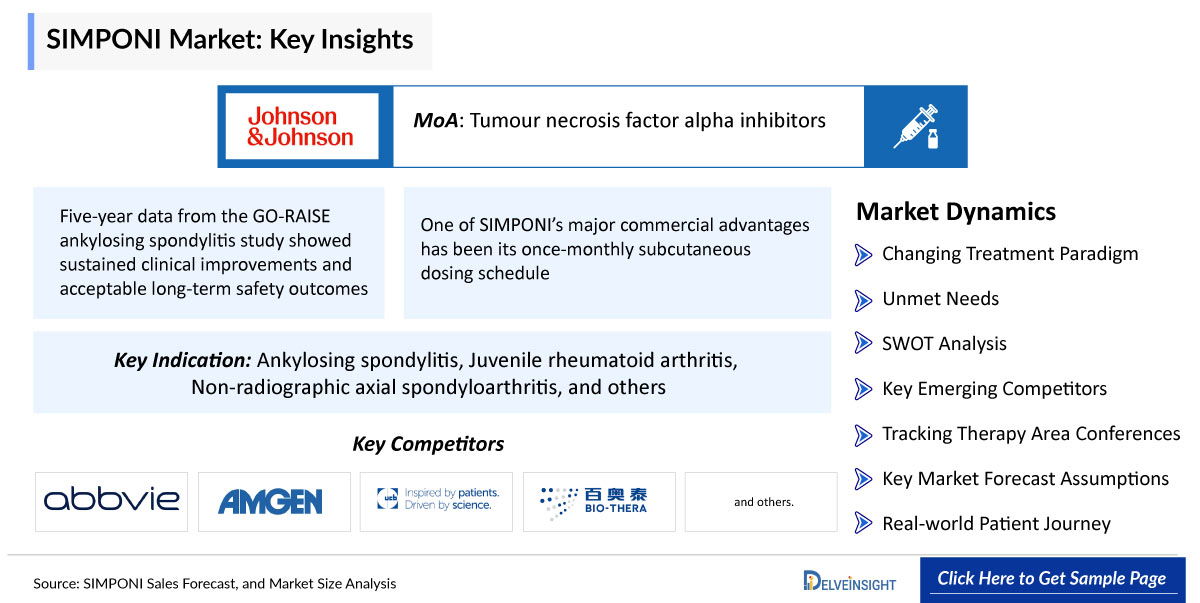
One of SIMPONI’s major commercial advantages has been its once-monthly subcutaneous dosing schedule, which differentiates it from some earlier TNF inhibitors requiring weekly or biweekly administration.
In chronic autoimmune diseases requiring long-term therapy, reduced injection frequency supports:
o Better patient convenience
o Improved adherence
o Greater physician preference for maintenance therapy
This convenience profile has remained an important retention factor in established patients.
3. Strong Long-Term Efficacy and Safety Data
Long-term extension studies published in PUBMED and rheumatology journals demonstrated sustained efficacy across RA, PsA, and AS populations with durable symptom control and inhibition of radiographic progression.
Five-year data from the GO-RAISE ankylosing spondylitis study showed sustained clinical improvements and acceptable long-term safety outcomes. (pubmed.ncbi.nlm.nih.gov)
Such long-term evidence has strengthened physician confidence and supported continued prescribing in chronic inflammatory conditions.
4. Continued Growth of SIMPONI ARIA in Infusion-Based Rheumatology Care
SIMPONI ARIA (intravenous golimumab) became an important lifecycle extension strategy for Johnson & Johnson. The IV formulation appeals to infusion-center rheumatology practices and patients preferring supervised administration.
Clinical studies demonstrated significant improvements in RA disease activity and physical function when combined with methotrexate, helping maintain utilization in established biologic treatment algorithms.
5. Global Expansion and Stable Physician Familiarity in TNF Class
Despite increasing competition from IL-17, IL-23, and JAK inhibitor therapies, TNF inhibitors remain foundational biologics in autoimmune disease management worldwide.
SIMPONI benefits from:
o Extensive physician familiarity
o Established reimbursement pathways
o Long-term real-world experience
o Proven efficacy across multiple inflammatory conditions
This entrenched positioning has helped preserve market share, especially in patients stable on therapy for many years.
SIMPONI Recent Developments
FDA approved Immgolis (golimumab-sldi) as an interchangeable biosimilar biological product to Simponi (golimumab) and Immgolis Intri (golimumab-sldi) as an interchangeable biosimilar biological product to Simponi Aria (golimumab). Immgolis and Immgolis Intri are the first biosimilars approved for Simponi and Simponi Aria, respectively. Immgolis is administered by subcutaneous injection in a single-dose prefilled syringe and Immgolis Intri is administered as an intravenous infusion prepared from a single dose vial.
“SIMPONI Sales Forecast, and Market Size Analysis – 2034” report provides comprehensive insights of SIMPONI for approved indication like Ankylosing spondylitis, Juvenile rheumatoid arthritis, Non-radiographic axial spondyloarthritis, and Psoriatic arthritis; as well as potential indication like Type 1 diabetes mellitus and Hearing disorders in the 7MM. A detailed picture of SIMPONI’s existing usage in approved and anticipated entry and performance in potential indications in the 7MM, i.e., the United States, EU4 (Germany, France, Italy, and Spain) and the United Kingdom, and Japan for the study period 2020 –2034 is provided in this report along with a detailed description of the SIMPONI for approved and potential indications. The SIMPONI market report provides insights about SIMPONI’s sales forecast, mechanism of action (MoA), dosage and administration, as well as research and development including regulatory milestones, along with other developmental activities. Further, it also consists of historical and current SIMPONI performance, future market assessments inclusive of the SIMPONI market forecast analysis for approved and potential indications in the 7MM, SWOT, analysts’ views, comprehensive overview of market competitors, and brief about other emerging therapies in respective indications. It also provides analysis of SIMPONI sales forecasts, along with factors driving its market.
SIMPONI Drug Summary
SIMPONI is a human monoclonal antibody developed by Johnson & Johnson for the treatment of several chronic inflammatory disorders, including rheumatoid arthritis, psoriatic arthritis, ankylosing spondylitis, non-radiographic axial spondyloarthritis, polyarticular juvenile idiopathic arthritis, and moderately to severely active ulcerative colitis. The drug functions as a tumor necrosis factor-alpha (TNF-α) inhibitor, binding to and neutralizing TNF-α, a pro-inflammatory cytokine that plays a central role in immune-mediated inflammation and tissue damage. SIMPONI is administered as a once-monthly subcutaneous injection, while the intravenous formulation, SIMPONI ARIA, is approved for select rheumatologic indications, offering flexible dosing options depending on the disease being treated. Clinical trials across multiple autoimmune conditions have demonstrated its efficacy in reducing inflammation, improving physical function, inducing remission, and slowing disease progression, particularly in patients with inadequate response to conventional therapies. The therapy is generally well tolerated, with common adverse effects including upper respiratory tract infections, injection-site reactions, headache, and elevated liver enzymes, although patients require monitoring for serious infections, tuberculosis reactivation, malignancies, and other risks associated with TNF inhibitor therapy. The report provides SIMPONI’s sales, growth barriers and drivers, post usage and approvals in multiple indications.
Scope of the SIMPONI Market Report
The report provides insights into:
- A comprehensive product overview including the SIMPONI MoA, description, dosage and administration, research and development activities in approved indications like Ankylosing spondylitis, Juvenile rheumatoid arthritis, Non-radiographic axial spondyloarthritis, and Psoriatic arthritis; as well as potential indication like Type 1 diabetes mellitus and Hearing disorders.
- Elaborated details on SIMPONI regulatory milestones and other development activities have been provided in SIMPONI market report.
- The report also highlights SIMPONI‘s cost estimates and regional variations, reported and estimated sales performance, research and development activities in approved and potential indications across the United States, Europe, and Japan.
- The SIMPONI market report also covers the patents information, generic entry and impact on cost cut.
- The SIMPONI market report contains current and forecasted SIMPONI sales for approved and potential indications till 2034.
- Comprehensive coverage of the late-stage emerging therapies for respective indications.
- The SIMPONI market report also features the SWOT analysis with analyst views for SIMPONI in approved and potential indications.
Methodology
The SIMPONI market report is built using data and information sourced primarily from internal databases, primary and secondary research and in-house analysis by DelveInsight’s team of industry experts. Information and data from the secondary sources have been obtained from various printable and nonprintable sources like search engines, news websites, global regulatory authorities websites, trade journals, white papers, magazines, books, trade associations, industry associations, industry portals and access to available databases.
SIMPONI Analytical Perspective by DelveInsight
- In-depth SIMPONI Market Assessment
This SIMPONI sales market forecast report provides a detailed market assessment of SIMPONI for approved indication like Ankylosing spondylitis, Juvenile rheumatoid arthritis, Non-radiographic axial spondyloarthritis, and Psoriatic arthritis; as well as potential indication like Type 1 diabetes mellitus and Hearing disorders in the seven major markets, i.e., the United States, EU4 (Germany, France, Italy, and Spain) and the United Kingdom, and Japan. This segment of the report provides current and forecasted SIMPONI sales data uptil 2034.
- SIMPONI Clinical Assessment
The SIMPONI market report provides the clinical trials information of SIMPONI for approved and potential indications covering trial interventions, trial conditions, trial status, start and completion dates.
SIMPONI Competitive Landscape
The report provides Insights on competitors and marketed products within the domain, along with a summary of emerging products and their respective launch dates, posing significant competition in the market.
SIMPONI Market Potential & Revenue Forecast
- Projected market size for the SIMPONI and its key indications
- Estimated SIMPONI sales potential (SIMPONI peak sales forecasts)
- SIMPONI Pricing strategies and reimbursement landscape
SIMPONI Competitive Intelligence
- Number of competing drugs in development (pipeline analysis)
- SIMPONI Market positioning compared to existing treatments
- SIMPONI Strengths & weaknesses relative to competitors
SIMPONI Regulatory & Commercial Milestones
- SIMPONI Key regulatory approvals & expected launch timelines
- Commercial partnerships, licensing deals, and M&A activity
SIMPONI Clinical Differentiation
- SIMPONI Efficacy & safety advantages over existing drugs
- SIMPONI Unique selling points
SIMPONI Market Report Highlights
- In the coming years, the SIMPONI market scenario is set to change due to strong adoption, increased prescriptions and broader uptake in multiple immunological indications; which would expand the size of the market.
- The SIMPONI companies are developing therapies that focus on novel approaches to treat/improve the disease condition, assess challenges, and seek opportunities that could influence SIMPONI’s dominance.
- Other emerging products for Ankylosing spondylitis, Juvenile rheumatoid arthritis, Non-radiographic axial spondyloarthritis, and Psoriatic arthritis; as well as potential indication like Type 1 diabetes mellitus and Hearing disorders are expected to give tough market competition to SIMPONI and launch of late-stage emerging therapies in the near future will significantly impact the market.
- A detailed description of regulatory milestones, and developmental activities, provide the current development scenario of SIMPONI in approved and potential indications.
- Analyse SIMPONI cost, pricing trends and market positioning to support strategic decision-making in the immunology landscape.
- Our in-depth analysis of the forecasted SIMPONI sales data uptil 2034 will support the clients in decision-making process regarding their therapeutic portfolio by identifying the overall scenario of SIMPONI in approved and potential indications.
Key Questions
- What is the class of therapy, route of administration and mechanism of action of SIMPONI? How strong is SIMPONI’s clinical and commercial performance?
- What is SIMPONI’s clinical trial status in each individual indications such as Ankylosing spondylitis, Juvenile rheumatoid arthritis, Non-radiographic axial spondyloarthritis, and Psoriatic arthritis; as well as potential indication like Type 1 diabetes mellitus and Hearing disorders and study completion date?
- What are the key collaborations, mergers and acquisitions, licensing and other activities related to the SIMPONI Manufacturers?
- What are the key designations that have been granted to SIMPONI for approved and potential indications? How are they going to impact SIMPONI’s penetration in various geographies?
- What is the current and forecasted SIMPONI market scenario for approved and potential indications? What are the key assumptions behind the forecast?
- What are the current and forecasted sales of SIMPONI in the seven major countries, including the United States, Europe (Germany, France, Italy, Spain) and the United Kingdom, and Japan?
- What are the other emerging products available and how are these giving competition to SIMPONI for approved and potential indications?
- Which are the late-stage emerging therapies under development for the treatment of approved and potential indications?
- How cost-effective is SIMPONI? What is the duration of therapy and what are the geographical variations in cost per patient?