
Skin Care Products Market Summary
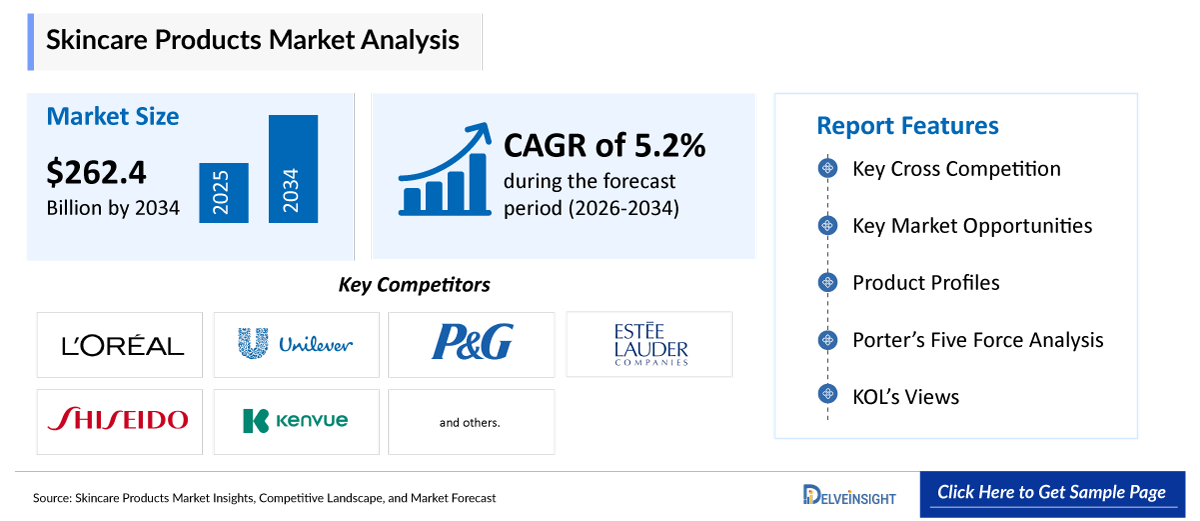
- The Skin Care Products Market Size is estimated at USD 165.9 billion in 2025 and is projected to reach USD 262.4 billion by 2034. Growth is anchored in rising global skin-health awareness, accelerating premiumization and anti-aging demand, expanding e-commerce and direct-to-consumer channels, and heavy new-product investment by the leading beauty conglomerates.
- The Global Skin Care Products Market Size is growing at a CAGR of 5.2% during the forecast period from 2026 to 2034.
Skin Care Products Market Trends & Insights
- By product type, the moisturizers & creams segment dominated the skincare products market with a 32% share in 2025.
- By product formulation, the creams & lotions segment dominated the skincare products market with a 38% share in 2025.
- By skin concern, the wrinkles & fine lines segment dominated the skincare products market with a 29% share in 2025.
- By skin type, the combination skin segment dominated the skincare products market with a 33% share in 2025.
- By consumer age group, the adults segment dominated the skincare products market with a 74% share in 2025.
- By distribution channel, the online/e-commerce segment dominated the skincare products market with a 41% share in 2025.
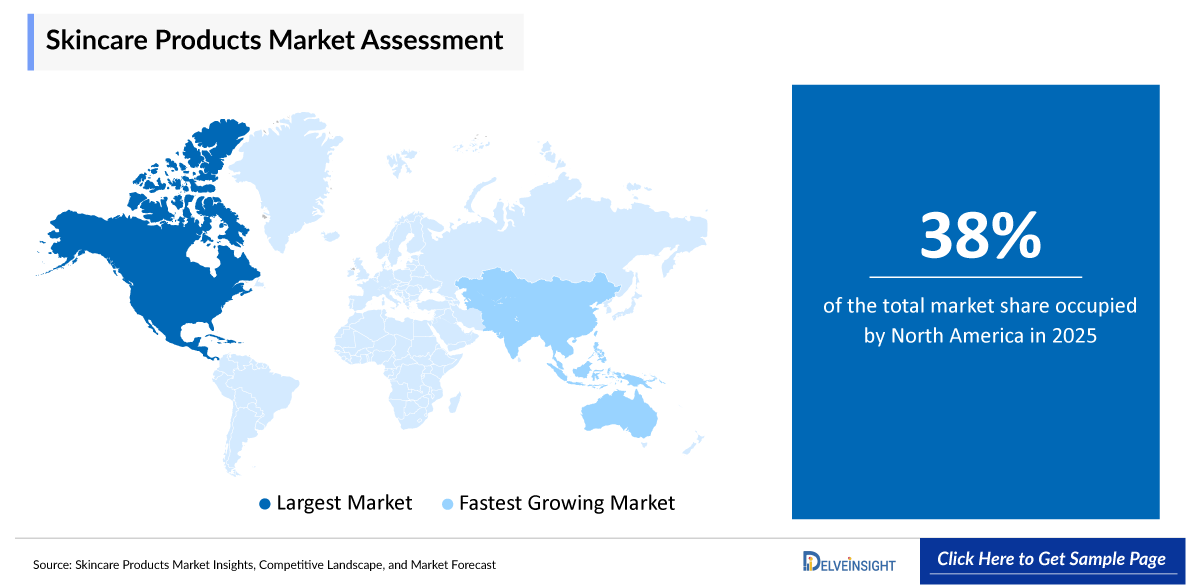
- Asia-Pacific dominated the global skincare products market revenue with a 38% share in 2025, representing the highest regional market share globally.
Skincare Products Market Size
The following snapshot summarizes the principal report metrics for the skincare products market.
|
Report Metrics |
Details |
|
2025 Market Size | |
|
2034 Projected Market Size | |
|
Growth Rate (2026-2034) | |
|
Largest Market |
Asia-Pacific |
|
Fastest Growing Market |
North America |
|
Market Structure |
Fragmented |
All market values are expressed in USD and represent DelveInsight estimates synthesized from primary and secondary research.
Factors Contributing to the Growth of the Skincare Products Market
Skincare Products Market Drivers
-
Rising Global Skin-Health Awareness and Routine Adoption
The most fundamental driver of the skincare products market is the steady, worldwide rise in consumer awareness of skin health and appearance. Consumers across developed and emerging markets are increasingly building multi-step routines spanning cleansing, moisturizing, treatment serums, and sun protection, supported by growing dermatological guidance and social-media-driven education.
This shift has moved skincare from an occasional purchase to a recurring, habitual category, with consumers trading up within routines rather than purchasing single products. As awareness deepens across new demographics, including teenagers and male consumers, the addressable base for skincare manufacturers continues to widen, anchoring durable volume growth through 2034.
-
Premiumization and Anti-Aging Demand
Premiumization is a powerful structural driver, as consumers increasingly trade up to dermatologically tested, clinically backed, and ingredient-transparent formulations. Anti-aging and longevity positioning has gone mainstream, with L'Oréal, the Estée Lauder Companies, and Beiersdorf each debuting longevity-focused launches, and Kenvue's Neutrogena introducing its "Collagen Bank" range aimed at younger, prevention-minded consumers. Premium and "dermaceutical" formulations, featuring actives such as retinoids, peptides, and niacinamide, are commanding higher price points and expanding category value even where unit volumes grow more modestly, particularly across North America and Asia-Pacific's premium urban centers.
-
Expansion of E-Commerce and Direct-to-Consumer Channels
The rapid growth of online and direct-to-consumer channels is reshaping how skincare is discovered, personalized, and purchased. Digital channels enable data-driven product matching, subscription models, and rapid new-product rollout, and brands are increasingly using e-commerce to test and scale innovation before wider retail distribution.
Kenvue reported e-commerce acceleration as a core driver of its Skin Health and Beauty segment growth in 2026, and manufacturers across the competitive set are prioritizing digital-first launches. As online penetration deepens across Asia-Pacific, North America, and emerging markets, e-commerce is expected to remain the fastest-growing distribution channel through the forecast period.
-
Clean Beauty, Microbiome-Friendly, and Natural-Ingredient Trends
Consumer demand for clean-label, natural, and microbiome-friendly formulations continues to reshape product development. Manufacturers are reformulating around mild surfactant systems, fermentation-derived actives, and sustainable sourcing, with Colgate-Palmolive expanding its Palmolive Skin Therapy and Softsoap Dermatologist Tested lines around microbiome-friendly ingredients and L'Oréal advancing its refillable-packaging "#JoinTheRefillMovement" campaign.
As regulatory scrutiny and consumer expectations around ingredient transparency rise, brands that credibly deliver on clean beauty and sustainability commitments are positioned to capture a disproportionate share of premium demand.
-
Growing Male Grooming Adoption
The expansion of skincare into male grooming is opening a substantial incremental consumer base. Rising awareness among male consumers of the benefits of structured skincare routines, including cleansers, moisturizers, and sun protection, is prompting brands to launch dedicated male-focused lines and reformulate existing hero products for broader gender appeal.
This diversification of the historically female-skewed consumer base is expanding total addressable demand and supporting sustained category growth across both mass and premium tiers.
-
AI-Personalized Diagnostics and Biotech-Derived Innovation
Heavy investment in AI-driven personalization and biotech-derived actives is accelerating innovation cycles across the industry. L'Oréal's "Cell BioPrint," a lab-on-a-chip consumer skin-intelligence tool unveiled at CES in January 2025, exemplifies the shift toward data-driven, personalized skincare regimens, while Amorepacific's ONFACE micro-LED mask illustrates growing convergence between skincare and at-home beauty devices.
As diagnostic and device-based innovation matures, manufacturers that combine formulation science with digital personalization are expected to differentiate most effectively and command premium pricing.
-
Active Beauty M&A and Venture Investment
Surging M&A and venture investment activity is reshaping category structure and accelerating capability build-out. L'Oréal signed an agreement in June 2026 to acquire a majority stake in Innovist, a leading Indian personal-care house, while the Estée Lauder Companies acquired the remaining 51% stake in heritage Indian skincare brand Forest Essentials.
Beiersdorf launched a EUR 100 million venture fund in 2026 to back early-stage skincare innovation, alongside a EUR 500 million share buyback programme. This wave of consolidation and venture capital deployment is expanding brand portfolios, broadening geographic reach into high-growth emerging markets, and validating the sector's long-term growth trajectory.
Skin Care Products Overview
Skincare products refer to the broad category of topical products, including cleansers, moisturizers, serums, sunscreens, and exfoliators, formulated to cleanse, hydrate, protect, and treat the skin across a range of concerns and skin types. Because consumer skin concerns, environmental exposure, and skin biology vary widely, manufacturers develop differentiated portfolios spanning product type, formulation, targeted concern, skin type, and consumer age group, distributed through both physical retail and rapidly growing online channels.
The Skin Care Products Market is organized by product type across cleansers and face washes, moisturizers and creams, serums and essences, sunscreens and sun protection, and exfoliators and scrubs; by product formulation across creams and lotions, gels, serums, oils, and balms; by skin concern, led by acne and blemishes, dryness and dehydration, hyperpigmentation and dark spots, and wrinkles and fine lines; by skin type across normal, dry, oily, combination, and sensitive skin; and by consumer age group spanning infants and children, teenagers, and adults.
Driven by rising skin-health awareness, premiumization and dermatologist-backed innovation, the rapid growth of e-commerce and direct-to-consumer channels, and expanding male-grooming adoption, skincare has become one of the largest and most closely watched categories within the global beauty and personal care industry.
Skincare Products Market Key Growth Drivers
- Rising global consciousness around skin health and appearance is driving broad-based category growth, with consumers increasingly investing in multi-step skincare routines across all age groups.
- Accelerating premiumization and anti-aging demand is expanding average spend per consumer, as brands such as L'Oréal, the Estée Lauder Companies, and Beiersdorf scale science-backed longevity and derma-cosmetic launches.
- The rapid expansion of e-commerce and direct-to-consumer channels is broadening market access and enabling personalized, data-driven product discovery, particularly across Asia-Pacific and North America.
- Clean beauty, microbiome-friendly formulation, and natural-ingredient trends are reshaping product development pipelines across mass and premium tiers alike.
- Growing male grooming adoption is opening a fast-expanding new consumer base for cleansers, moisturizers, and sun-protection products.
- Heavy investment in AI-personalized diagnostics and biotech-derived actives, including tools such as L'Oréal's Cell BioPrint, is accelerating innovation cycles and product differentiation.
- Active beauty M&A and venture investment, including Beiersdorf's EUR 100 million venture fund and L'Oréal's agreement to acquire a majority stake in Innovist, is expanding category reach into emerging and adjacent markets.
Major Skincare Products Companies
The Skin Care Products Competitive Landscape is led by the following active manufacturers:
- L'Oréal S.A.
- Unilever PLC
- The Procter & Gamble Company
- The Estée Lauder Companies Inc.
- Shiseido Company, Limited
- Kenvue Inc.
- Beiersdorf AG
- Kao Corporation
- Amorepacific Corporation
- Colgate-Palmolive Company, and others
For illustrative purposes, only the top 10 companies are listed in the Table of Contents. The report may include analysis and references to additional companies relevant to the market assessment.
Skincare Products Market Restraints
Despite strong underlying momentum, the skincare products market faces material constraints. Intense competitive fragmentation, spanning global conglomerates, regional champions, and a growing wave of independent and indie brands, pressures pricing and marketing spend, particularly in mature markets such as North America and Western Europe. Rising input costs for specialty actives, sustainable packaging, and regulatory compliance testing are compressing margins, especially for smaller manufacturers lacking the scale of the leading players.
Regulatory scrutiny of ingredient claims, labeling, and sustainability disclosures is intensifying across the European Union, the United States, and parts of Asia, lengthening product-development timelines and raising compliance costs. Volatile consumer demand, cautious discretionary spending in certain markets, and slowing category growth in China have weighed on results at several leading manufacturers, including Beiersdorf's flagship Nivea brand and elements of P&G's Beauty segment. Counterfeit and grey-market products remain a persistent challenge in several developing markets, undermining brand equity and consumer trust.
Reliance on a small number of dominant retail and e-commerce platforms concentrates channel risk, while shifting consumer preferences and the rapid rise of social-media-driven micro-trends require continuous, capital-intensive innovation. Together, these competitive, cost, regulatory, and channel-concentration pressures temper the pace of growth, even as the underlying drivers of skin-health awareness, premiumization, and e-commerce expansion remain firmly intact.
Skincare Products Market Segment Analysis
The Skincare Products Market product type (cleansers & face washes, moisturizers & creams, serums & essences, sunscreens & sun protection, exfoliators & scrubs, others), product formulation (creams & lotions, gels, serums, oils, balms, others), skin concerns (acne & blemishes, dryness & dehydration, hyperpigmentation & dark spots, wrinkles & fine lines, others), skin type (normal, dry, oily, combination, sensitive), consumer age group (infants & children, teenagers, adults), distribution channel (online/e-commerce, supermarkets & hypermarkets, pharmacies & drugstores, others), and Geography (North America, Europe, Asia-Pacific, and Rest of World).
-
Skin Care Products Market Segmentation By Product Type
Dominant Subsegment: Moisturizers & Creams.
The moisturizers & creams segment accounted for 32% of the skincare products market in 2025. Moisturizers and creams are the leading product type because they address the near-universal, daily consumer need for hydration and barrier support across virtually every skin type and age group, generating the highest purchase frequency and repeat-buy rates of any product category. Hero franchises such as Nivea, Olay, and La Mer's Treatment Lotion illustrate the segment's breadth, spanning mass-market daily moisturizers to ultra-premium anti-aging creams.
The segment benefits from continuous innovation, including peptide- and niacinamide-enriched formulations and barrier-repair technology, that sustains both volume and value growth. While serums and essences are the fastest-growing product type, propelled by targeted anti-aging and brightening claims, the sheer breadth of use-occasions and the foundational role of moisturizers within virtually every skincare routine secure the segment's leadership across the forecast period.
-
Skin Care Products Market Segmentation By Product Formulation
Dominant Subsegment: Creams & Lotions.
The creams & lotions segment accounted for 38% of the skincare products market in 2025. Creams and lotions are the leading formulation because they deliver the broadest functional versatility, spanning daily hydration, targeted treatment, and sun protection, while offering the emollient texture and application ease that consumers across skin types and climates prefer. The format supports high active-ingredient loads and controlled-release delivery, making it the preferred vehicle for premium anti-aging and dermatologist-recommended lines.
Gel and serum formulations are growing quickly, particularly across humid Asia-Pacific markets and among younger, treatment-focused consumers, but the versatility, shelf stability, and broad consumer familiarity of creams and lotions secure the segment's leadership across the forecast period.
-
Skin Care Products Market Segmentation By Skin Concerns
Dominant Subsegment: Wrinkles & Fine Lines.
The wrinkles & fine lines segment accounted for 29% of the skincare products market in 2025. Anti-aging remains the leading skin concern because it commands the highest willingness-to-pay among skincare consumers, driving premiumization across the category and anchoring flagship franchises such as Olay Regenerist, SK-II, and La Mer. Aging populations across North America, Europe, and increasingly Asia-Pacific, combined with growing longevity-focused marketing from L'Oréal, the Estée Lauder Companies, and Beiersdorf, sustain robust demand for retinoid, peptide, and niacinamide-based treatments.
Hyperpigmentation and dark-spot concerns are the fastest-growing category, propelled by strong demand across Asia-Pacific for brightening and even-tone formulations, while acne and blemish concerns sustain steady demand among teenage and young-adult consumers. Nonetheless, the scale of anti-aging spend and product depth secure the wrinkles & fine lines segment's leadership across the forecast period.
-
Skin Care Products Market Segmentation By Skin Type
Dominant Subsegment: Combination Skin.
The combination skin segment accounted for 33% of the skincare products market in 2025. Combination skin is the leading skin-type category because it represents the most commonly self-identified skin type among consumers globally, requiring balanced formulations that hydrate drier zones while controlling oil in the T-zone, a positioning that underpins many best-selling, broad-appeal product lines. Manufacturers increasingly design flagship moisturizers and cleansers to suit combination skin by default, maximizing addressable audience without requiring a full dedicated sub-line.
Sensitive skin is the fastest-growing category, driven by rising diagnosed and self-reported skin sensitivity and the rapid growth of dermatologist-recommended brands such as Cetaphil, CeraVe, and Eucerin, but the breadth of the combination-skin consumer base secures its leadership across the forecast period.
-
Skin Care Products Market Segmentation By Consumer Age Group
Dominant Subsegment: Adults.
The adults segment accounted for 74% of the skincare products market in 2025. Adults are overwhelmingly the leading consumer age group because they command the highest disposable income, the broadest range of skin concerns spanning hydration, anti-aging, and sun protection, and the most established, habitual skincare routines. This group drives the bulk of premium and dermaceutical purchasing, anchoring flagship anti-aging and treatment franchises across the leading manufacturers.
Teenagers represent the fastest-growing age group, fueled by early skincare-routine adoption driven by social media education and dedicated acne-focused launches such as Neutrogena's teen-oriented ranges, while the infants & children segment sustains steady, safety-led demand for gentle cleansers and moisturizers. Nonetheless, the scale and purchasing power of adult consumers secure the segment's clear leadership across the forecast period.
-
Skin Care Products Market Segmentation By Distribution Channel
Dominant Subsegment: Online/E-commerce.
The online/e-commerce segment accounted for 41% of the skincare products market in 2025. Online channels are the leading distribution route because they offer consumers direct access to the widest product assortment, personalized recommendation tools, subscription-based replenishment, and rapid access to new launches, while giving manufacturers rich first-party data to guide product development. Kenvue and other leading players have cited e-commerce acceleration as a core driver of recent skin-health growth, and brands increasingly use digital-first and direct-to-consumer launches to test innovation ahead of wider retail rollout.
Pharmacies and drugstores remain vital for dermatologist-recommended and derma-cosmetic brands such as Cetaphil, CeraVe, and Eucerin, and supermarkets and hypermarkets continue to anchor mass-market volume, but the reach, personalization, and growth trajectory of online and e-commerce channels secure their leadership across the forecast period.
Skincare Products Market Region Analysis
-
Dominant Region: Asia-Pacific
Asia-Pacific accounted for 38% of the global skincare products market revenue in 2025, representing the highest regional market share globally. The region's dominance reflects deep-rooted cultural emphasis on skincare rituals across China, Japan, and South Korea, rapid urbanization, rising disposable incomes, and the global influence of K-beauty and J-beauty innovation trends. Asia-Pacific hosts some of the world's most sophisticated multi-step skincare consumer bases, and homegrown leaders such as Amorepacific and Kao compete alongside global entrants across mass and premium tiers.
Rising demand for brightening, hydration, and anti-pollution formulations, combined with rapid e-commerce and livestream-commerce adoption in China, sustains substantial category growth. Continued urbanization, an expanding middle class, and rising premiumization across India and Southeast Asia anchor the region's continued leadership across the forecast period.
-
Fastest Growing Region: North America
North America is the fastest-growing region in the skincare products market. The region's elevated CAGR is driven by a pronounced consumer shift toward "dermaceuticals" and clinically backed, dermatologist-recommended formulations, rapid adoption of AI-personalized skincare technology, and rising demand for clean-label and hydration-focused products. The United States anchors this growth on the strength of a robust retail and e-commerce infrastructure, a deep bench of derma-cosmetic brands such as CeraVe, Cetaphil, and Neutrogena, and increasing male-grooming adoption.
Growing consumer willingness to invest in premium, science-backed skincare, combined with strong digital-first brand launches and direct-to-consumer growth, positions North America as the principal source of incremental growth among established regions over the forecast period.
Skincare Products Market Regional Commentary
- North America
North America is the fastest-growing region in the global skincare products market. The United States drives regional growth on the strength of its dermaceutical retail infrastructure, strong e-commerce and direct-to-consumer channels, and rising consumer investment in premium, clinically backed skincare, while Canada continues to register robust growth alongside expanding male-grooming and clean-beauty adoption.
- Europe
Europe is a large and mature regional market, anchored by heritage manufacturers such as L'Oréal, Beiersdorf, and Unilever's premium portfolios, alongside established regulatory frameworks under the EU Cosmetics Regulation. Growth is supported by strong derma-cosmetic demand across Germany, France, the United Kingdom, Italy, and Spain, and by continued innovation from Beiersdorf's Nivea and Eucerin franchises and L'Oréal's science-led product pipeline.
- Asia-Pacific
Asia-Pacific is the largest regional market, propelled by deep-rooted skincare culture, rising disposable incomes, and rapid e-commerce and livestream-commerce adoption across China, Japan, India, South Korea, and Australia. China's fast-evolving domestic beauty brands, Japan's derma-cosmetic and J-beauty leadership, India's rapidly expanding middle-class demand, and South Korea's global K-beauty influence continue to anchor regional growth and product innovation.
- Rest of World
The Rest of World region, spanning Latin America, the Middle East, and Africa, is an emerging growth frontier. Rising disposable incomes, expanding modern retail and e-commerce infrastructure, and growing awareness of sun protection and dermatological skincare are gradually broadening access, while international brands increasingly localize formulations and marketing to capture rising demand across these markets.
Skincare Products Market Competitive Landscape
The Skin Care Products Market is classified as Fragmented, with a concentrated group of global leaders. A tier of diversified, multi-brand conglomerates, including L'Oréal, Unilever, the Procter & Gamble Company, and the Estée Lauder Companies, anchors the top tier through global scale, deep R&D investment, and broad distribution, while regionally strong players such as Shiseido, Kao, and Amorepacific compete through cultural relevance, derma-cosmetic depth, and homegrown innovation, and Kenvue, Beiersdorf, and Colgate-Palmolive combine mass-market reach with growing derma-cosmetic and premium portfolios.
The Skin Care Products Competitive Landscape can be evaluated across the following dimensions:
- Market concentration: Fragmented overall, with a small group of diversified global conglomerates capturing a disproportionate share of premium and mass-premium value.
- Leading players: L'Oréal S.A., Unilever PLC, the Procter & Gamble Company, and the Estée Lauder Companies Inc. anchor the top tier through global scale, R&D depth, and multi-brand portfolios.
- Geographic reach: Leaders operate globally distributed manufacturing and distribution networks; regional champions such as Amorepacific, Shiseido, and Kao maintain outsized influence across Asia-Pacific.
- Portfolio strength: Top players offer end-to-end portfolios spanning mass, premium, and dermatologist-recommended tiers, supported by in-house R&D and biotech-derived innovation.
- Innovation access: Ownership of proprietary technology platforms, including L'Oréal's Cell BioPrint and Amorepacific's ONFACE device, is a decisive competitive advantage.
- Strategic partnerships: Tie-ups and minority investments, such as the ex-Unilever Prestige leadership's new beauty-and-wellness venture with Semcap, extend innovation reach beyond core portfolios.
- M&A activity: Active consolidation, including L'Oréal's agreement to acquire a majority stake in Innovist and the Estée Lauder Companies' acquisition of the remaining stake in Forest Essentials.
- Manufacturing capabilities: Global-scale formulation, packaging, and quality-control infrastructure, alongside growing refillable and sustainable packaging capacity, are key competitive moats.
- Innovation focus: AI-personalized diagnostics, biotech-derived actives, microbiome-friendly formulation, and at-home beauty-device convergence.
Skincare Products Market Recent Breakthroughs and Developmental Activities
- In June 2026, L'Oréal S.A. signed an agreement to acquire a majority stake in Innovist, a leading house of personal care brands in India, expanding its reach across the fast-growing Indian skincare market. Strategic significance: Broadens L'Oréal's emerging-market footprint and adds a locally rooted, digitally native personal-care portfolio.
- In 2026, Beiersdorf AG launched a EUR 100 million venture fund to back early-stage skincare innovation, alongside plans to restore momentum to its flagship Nivea brand. Strategic significance: Expands Beiersdorf's access to emerging skincare technology and reinforces its derma-cosmetic growth strategy.
- In 2026, The Estée Lauder Companies Inc. acquired the remaining 51% stake in Indian heritage skincare brand Forest Essentials, building on its existing investment in the company. Strategic significance: Strengthens the Estée Lauder Companies' presence in the high-growth Indian premium skincare market.
- In Q1 2026, Kenvue Inc. reported Skin Health and Beauty net sales growth of 8.4%, driven by Neutrogena's expansion into sun care across select EMEA markets and e-commerce acceleration, ahead of a proposed transaction involving Kimberly-Clark. Strategic significance: Demonstrates the strength of Kenvue's derma-cosmetic portfolio and digital-first growth strategy.
- In March 2026, Kenvue Inc. (Neutrogena, Aveeno, and Rogaine) debuted 20 new research abstracts and clinical skincare innovations at the American Academy of Dermatology Annual Meeting in Denver. Strategic significance: Reinforces Kenvue's dermatologist-backed innovation credentials across hydration, anti-aging, and sun-protection formulations.
- In 2025, Colgate-Palmolive Company expanded its science-led skin-cleansing portfolio globally under the Palmolive Skin Therapy and Softsoap Dermatologist Tested collections, introducing microbiome-friendly formulations for sensitive skin. Strategic significance: Broadens Colgate-Palmolive's presence in dermatologically positioned personal-care skincare beyond its Filorga and Sanex brands.
- In September 2025, Amorepacific Corporation unveiled the ONFACE micro-LED beauty mask through its makeON device brand at IFA 2025, using thousands of ultra-thin LEDs to deliver light therapy for skin texture and elasticity. Strategic significance: Extends Amorepacific's innovation into the fast-growing at-home beauty-device category.
- In January 2025, L'Oréal S.A. unveiled "Cell BioPrint," a lab-on-a-chip consumer skin-intelligence diagnostic tool, at CES, with a pilot planned with a L'Oréal brand in Asia later in the year. Strategic significance: Positions L'Oréal at the forefront of AI-personalized skincare diagnostics and data-driven product development.
- In July 2024, The Procter & Gamble Company separated its Beauty segment's Skin and Personal Care operations into individual Skin Care and Personal Care operating segments, sharpening management focus on its Olay and SK-II franchises. Strategic significance: Strengthens strategic and financial visibility for P&G's core skincare brands.
- In 2025, an ex-Unilever Prestige leadership team partnered with investment firm Semcap to launch a new beauty-and-wellness investment vertical focused on clinically backed skincare, cosmetics, and personalized health solutions. Strategic significance: Signals rising specialist investor interest in clinically differentiated skincare innovation adjacent to the major conglomerates.
Skincare Products Market Segmentation
- Skincare Products Market by Product Type
- Cleansers & Face Washes
- Moisturizers & Creams
- Serums & Essences
- Sunscreens & Sun Protection
- Exfoliators & Scrubs
- Others
- Skincare Products Market by Product Formulation
- Creams & Lotions
- Gels
- Serums
- Oils
- Balms
- Others
- Skincare Products Market by Skin Concerns
- Acne & Blemishes
- Dryness & Dehydration
- Hyperpigmentation & Dark Spots
- Wrinkles & Fine Lines
- Others
- Skincare Products Market by Skin Type
- Normal
- Dry
- Oily
- Combination
- Sensitive
- Skincare Products Market by Consumer Age Group
- Infants & Children
- Teenagers
- Adults
- Skincare Products Market by Distribution Channel
- Online/E-commerce
- Supermarkets & Hypermarkets
- Pharmacies & Drugstores
- Others
Skincare Products Market by Geography
-
North America Skincare Products Market
- United States Skincare Products Market Size in USD million (2023-2034)
- Canada Skincare Products Market Size in USD million (2023-2034)
- Mexico Skincare Products Market Size in USD million (2023-2034)
-
Europe Skincare Products Market
- Germany Skincare Products Market Size in USD million (2023-2034)
- United Kingdom Skincare Products Market Size in USD million (2023-2034)
- France Skincare Products Market Size in USD million (2023-2034)
- Italy Skincare Products Market Size in USD million (2023-2034)
- Spain Skincare Products Market Size in USD million (2023-2034)
- Rest of Europe Skincare Products Market Size in USD million (2023-2034)
-
Asia-Pacific Skincare Products Market
- China Skincare Products Market Size in USD million (2023-2034)
- Japan Skincare Products Market Size in USD million (2023-2034)
- India Skincare Products Market Size in USD million (2023-2034)
- Australia Skincare Products Market Size in USD million (2023-2034)
- South Korea Skincare Products Market Size in USD million (2023-2034)
- Rest of Asia-Pacific Skincare Products Market Size in USD million (2023-2034)
-
Rest of the World (RoW) Skincare Products Market
- Middle East Skincare Products Market Size in USD million (2023-2034)
- Africa Skincare Products Market Size in USD million (2023-2034)
- South America Skincare Products Market Size in USD million (2023-2034)
Skincare Products Market Recent Industry Trends and Milestones (2023-2026)
|
Category |
Key Developments |
|
Skincare Products Market Product Approval |
Product innovation accelerated across the leading houses. L'Oréal unveiled "Cell BioPrint," a lab-on-a-chip consumer skin-intelligence tool, at CES in January 2025, with an Asia pilot planned for later in the year. Kenvue's Neutrogena introduced the "Collagen Bank" range targeting younger, anti-aging-curious consumers, while Neutrogena, Aveeno, and Rogaine unveiled 20 new research abstracts and clinical innovations at the AAD Annual Meeting in March 2026. Amorepacific's beauty-device arm makeON debuted the ONFACE micro-LED mask at IFA 2025. Each launch reinforces premiumization, longevity, and dermatologist-backed positioning across the category. |
|
Skincare Products Market Expansion |
Manufacturers broadened formulation platforms and channel reach. P&G formally separated Skin Care into a standalone operating segment within its Beauty business in July 2024, sharpening investment in Olay and SK-II. Colgate-Palmolive expanded its dermatology-inspired portfolio under Palmolive Skin Therapy and Softsoap Dermatologist Tested, leveraging Filorga and Sanex. Kenvue expanded Neutrogena into sun care across select EMEA markets and launched OGX Pro Growth in North America and EMEA, while e-commerce acceleration lifted Skin Health and Beauty net sales 8.4% in Q1 2026. |
|
Skincare Products Market Investment |
Capital and consolidation accelerated through 2025 and 2026. L'Oréal signed an agreement in June 2026 to acquire a majority stake in Innovist, a leading house of Indian personal-care brands, and continued its #JoinTheRefillMovement sustainable-packaging campaign. The Estée Lauder Companies acquired the remaining 51% stake in Indian heritage skincare brand Forest Essentials, and Beiersdorf launched a EUR 100 million venture fund in 2026 to back early-stage skincare innovation alongside a EUR 500 million share buyback programme. Beauty M&A activity, spanning names such as Olaplex, Wonderbelly, and Forest Essentials, marked one of the busiest starts to a year for the sector. |
|
Company Strategy |
L'Oréal S.A.: Science-led innovation (Cell BioPrint) paired with disciplined bolt-on M&A (Innovist) and sustainability commitments. The Estée Lauder Companies Inc.: Portfolio sharpening through the Forest Essentials acquisition alongside planned divestitures and a multi-year turnaround programme. Beiersdorf AG: Restoring momentum to Nivea while scaling Eucerin and derma-cosmetics through its new venture fund. The Procter & Gamble Company: Standalone Skin Care segment built around Olay and SK-II innovation. Kenvue Inc.: "Our Vue Forward" productivity programme funding Neutrogena, Aveeno, and OGX innovation and e-commerce growth. Kao Corporation, Shiseido Company, Limited, Amorepacific Corporation, Unilever PLC, and Colgate-Palmolive Company: Regional premiumization, derma-cosmetic expansion, and K-beauty/J-beauty led innovation. |
|
Emerging Technologies |
AI-personalized skincare diagnostics, biomarker-driven formulation tools such as Cell BioPrint, and at-home light-therapy devices such as the ONFACE micro-LED mask are moving from novelty to mainstream. Microbiome-friendly formulation, fermentation-derived actives (echoing Pitera-style ferment filtrates), and peptide- and niacinamide-based anti-aging systems are expanding rapidly. Sustainability initiatives, including refillable packaging, low-waste manufacturing, and clean-label reformulation, are broadening across mass and premium tiers alike, while collaborations between brands, dermatologists, and biotech start-ups are accelerating translation of clinical-grade actives into consumer skincare. |
Skincare Products Market Startup Funding and Investment Trends
Investment in the Skincare Products ecosystem has concentrated on AI-personalized diagnostics, biotech-derived actives, microbiome-friendly formulation, and at-home beauty-device convergence. The following companies illustrate recent funding and investment activity and technology focus.
|
Company |
Total Funding |
Funding Stage |
Main Offering |
Core Technology |
|
Kiehl's Naturally Corp. (L'Oréal-backed innovation unit) |
Strategic corporate funding |
Corporate incubation |
Dermatologist-grade skincare CDMO/innovation |
Biotech-derived actives, Cell BioPrint diagnostics |
|
Request for unlocking the report of the @ Skincare Products Market | ||||
Capital is flowing toward brands and platforms that combine formulation science with digital personalization and sustainable manufacturing. Beiersdorf's EUR 100 million venture fund and L'Oréal's agreement to acquire a majority stake in Innovist underscore the strategic value of emerging-market and innovation-stage skincare assets.
Emerging device and diagnostics platforms, echoing L'Oréal's Cell BioPrint and Amorepacific's ONFACE, are scaling AI-personalized and light-therapy technology, while specialist investors such as the newly formed Semcap beauty-and-wellness vertical are targeting clinically backed skincare innovation. Collectively, these investments signal conviction that personalization, biotech-derived actives, and sustainable formulation will define the next phase of competitive advantage in the global skincare products market.
Key Takeaways from the Skincare Products Market Report Study
- Skin Care Products Market size analysis for the current Skincare Market Size (2025), and market forecast for 9 years (2026 to 2034).
- Top key product/technology developments, mergers, acquisitions, partnerships, and joint ventures that happened over the last 3 years.
- Key companies dominating the global Skin Care Products market.
- Various opportunities available for competitors in the skincare products market space.
- What are the top-performing segments in 2025? How will these segments perform in 2034?
- Which are the top-performing regions and countries in the current skincare market scenario?
- Which are the regions and countries where companies should concentrate their opportunities for skincare market growth in the future?
Target audience who can benefit from this Skin Care Products Market Report Study
- Skincare Products product providers
- Research organizations and consulting companies
- Skincare Products-related organizations, associations, forums, and other alliances
- Government and corporate offices
- Start-up companies, venture capitalists, and private equity firms
- Distributors and traders dealing in Skincare Products
- Various end-users who want to know more about the skincare market and the latest technological developments in the skincare market.
Stay updated with us for Recent Articles @ New DelveInsight Blogs

