
SKYSONA Sales Forecast Summary
Key Factors Driving SKYSONA Growth
Market Share Gains and New Patient Starts
- SKYSONA has the distinction of being one of the first gene therapies approved in the US for early, active cerebral adrenoleukodystrophy (CALD), offering a one-time treatment option for a previously untreated patient segment (boys 4–17 years without an available HLA-matched donor for transplant).
- Given the ultra-rare nature of CALD and highly specific eligibility criteria, patient starts are inherently limited; adoption has been concentrated at specialized treatment centers capable of administering gene therapy.
- SKYSONA’s commercial use is further shaped by tightened regulatory criteria that restricts eligible patients to those without alternative stem cell transplant donors, which may affect the pace of new patient starts.
Expansion Across Key Indications
- Cerebral Adrenoleukodystrophy (CALD): SKYSONA is indicated to slow neurological decline in boys aged 4-17 years with early, active CALD — a rare, debilitating, and often fatal neurodegenerative condition caused by mutations in the ABCD1 gene.
- The therapy is a one-time autologous hematopoietic stem cell gene therapy, where a patient’s own stem cells are genetically modified to add functional copies of the ABCD1 gene to help break down very long-chain fatty acids in the brain.
- SKYSONA’s mechanism offers a distinct treatment alternative to allogeneic stem cell transplantation — the previous standard of care that requires a matched donor and carries significant risks.
- There are no broader indications beyond early, active CALD, and label adjustments now focus on safety and refined use due to post-approval findings.
Geographic Expansion
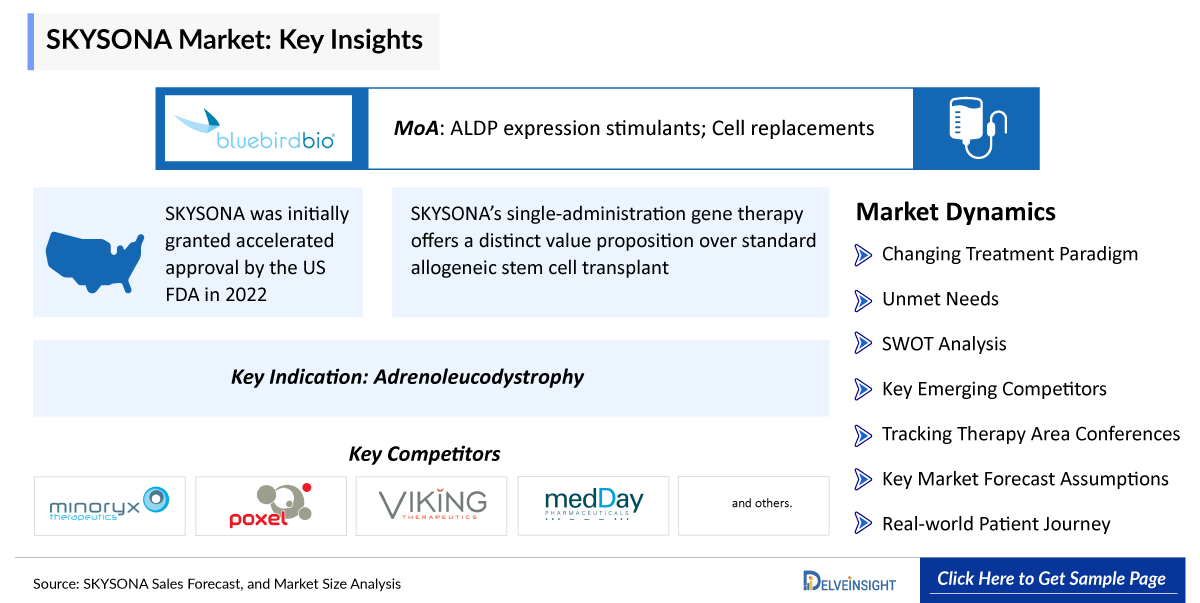
- SKYSONA was initially granted accelerated approval by the US FDA in 2022 and became commercially available through qualified treatment centers in the United States.
- In the European Union, although SKYSONA received a marketing authorization in 2021, the holder withdrew it later for commercial reasons, so there is no current active EU marketing authorization.
- Regulatory and access expansion outside the US remains constrained; broader global launches depend on both regulatory approvals and commercial viability given the drug’s specialized nature and surveillance requirements.
New Indication Approvals
- Since its initial accelerated approval in September 2022, SKYSONA has not gained additional FDA-approved indications beyond slowing neurological progression in early, active CALD, and its indication has been refined following safety data.
- Regulatory actions have focused largely on safety labeling and patient eligibility rather than expansion into other disease types or age groups at this time.
Strong Volume Momentum
- Due to ultra-rare patient populations, SKYSONA’s volume momentum differs from typical chronic therapy trends; adoption hinges on identification of eligible patients via newborn screening and pediatric neurology networks rather than broad prescription growth.
- Real-world treatment numbers remain modest because of limited eligible populations and increased regulatory caution around safety.
- Volume momentum is also influenced by long-term follow-up studies required by regulators to confirm benefits and monitor risks, affecting clinical utilization patterns.
Competitive Differentiation and Market Trends
- SKYSONA’s single-administration gene therapy offers a distinct value proposition over standard allogeneic stem cell transplant, which requires a donor match and carries risks like graft-versus-host disease.
- The drug’s inclusion of functional ABCD1 gene copies targets the underlying genetic cause of CALD, aiming to slow progression rather than only addressing symptoms.
- Broader trends in rare disease care — including expanded newborn screening, precision medicine, and gene therapy adoption — support awareness and earlier diagnosis, potentially increasing the pool of eligible patients over time.
- However, heightened regulatory scrutiny and safety concerns related to hematologic malignancy risk differentiate SKYSONA from some other gene therapies and may influence market confidence and payer decisions.
SKYSONA Recent Developments
- Safety-Related Regulatory Actions (2024–2025): The US FDA has updated SKYSONA’s labeling and indications due to post-approval reports of hematologic malignancies (including myelodysplastic syndrome and acute myeloid leukemia) in treated patients, resulting in tighter access criteria. The therapy is now recommended only for patients without available alternative treatments or suitable HLA-matched stem cell donors.
- Post-Approval Safety Monitoring: The FDA continues to investigate the risk of hematologic malignancy associated with SKYSONA and mandates long-term, prospective safety follow-up studies to assess the incidence and ensure appropriate monitoring protocols.
“SKYSONA Sales Forecast, and Market Size Analysis – 2034” report provides comprehensive insights of SKYSONA for approved indication like Adrenoleucodystrophy in the 7MM. A detailed picture of SKYSONA’s existing usage in anticipated entry and performance in approved indications in the 7MM, i.e., the United States, EU4 (Germany, France, Italy, and Spain) and the United Kingdom, and Japan for the study period 2020 –2034 is provided in this report along with a detailed description of the SKYSONA for approved indications. The SKYSONA market report provides insights about SKYSONA’s sales forecast, mechanism of action (MoA), dosage and administration, as well as research and development including regulatory milestones, along with other developmental activities. Further, it also consists of historical and current SKYSONA performance, future market assessments inclusive of the SKYSONA market forecast analysis for approved indications in the 7MM, SWOT, analysts’ views, comprehensive overview of market competitors, and brief about other emerging therapies in respective indications. It also provides analysis of SKYSONA sales forecasts, along with factors driving its market.
SKYSONA Drug Summary
SKYSONA (Elivaldogene autotemcel) is an autologous hematopoietic stem cell-based gene therapy indicated to slow the progression of neurologic dysfunction in boys aged 4-17 years with early, active cerebral adrenoleukodystrophy (CALD), a severe X-linked genetic disorder caused by ABCD1 gene mutations leading to deficient adrenoleukodystrophy protein (ALDP) and accumulation of very long-chain fatty acids (VLCFAs) that trigger brain inflammation and demyelination. The therapy involves harvesting the patient's own CD34+ hematopoietic stem cells via mobilization and apheresis (target ≥12 × 10^6 cells/kg), transducing them ex vivo with a lentiviral vector (Lenti-D) carrying functional ABCD1 cDNA to express ALDP, followed by myeloablative conditioning and single intravenous infusion of a minimum dose of ≥5.0 × 10^6 CD34+ cells/kg over <60 minutes, without an in-line filter. Post-infusion, the modified stem cells engraft in the bone marrow, differentiate into myeloid cells (e.g., monocytes) that produce and secrete functional ALDP to degrade VLCFAs, cross-correcting affected cells and stabilizing neurologic function as measured by Neurologic Function Score (NFS ≤1 at baseline) and gadolinium-enhanced MRI Loes scores of 0.5-9, particularly in patients lacking an HLA-matched allogeneic donor. The report provides SKYSONA’s sales, growth barriers and drivers, post usage and approvals in multiple indications.
Scope of the SKYSONA Market Report
The report provides insights into:
- A comprehensive product overview including the SKYSONA MoA, description, dosage and administration, research and development activities in approved indication like Adrenoleucodystrophy.
- Elaborated details on SKYSONA regulatory milestones and other development activities have been provided in SKYSONA market report.
- The report also highlights SKYSONA‘s cost estimates and regional variations, reported and estimated sales performance, research and development activities in approved indications across the United States, Europe, and Japan.
- The SKYSONA market report also covers the patents information, generic entry and impact on cost cut.
- The SKYSONA market report contains current and forecasted SKYSONA sales for approved indications till 2034.
- Comprehensive coverage of the late-stage emerging therapies for respective indications.
- The SKYSONA market report also features the SWOT analysis with analyst views for SKYSONA in approved indications.
Methodology
The SKYSONA market report is built using data and information sourced primarily from internal databases, primary and secondary research and in-house analysis by DelveInsight’s team of industry experts. Information and data from the secondary sources have been obtained from various printable and nonprintable sources like search engines, news websites, global regulatory authorities websites, trade journals, white papers, magazines, books, trade associations, industry associations, industry portals and access to available databases.
SKYSONA Analytical Perspective by DelveInsight
In-depth SKYSONA Market Assessment
- This SKYSONA sales market forecast report provides a detailed market assessment of SKYSONA for approved indication like Adrenoleucodystrophy in the seven major markets, i.e., the United States, EU4 (Germany, France, Italy, and Spain) and the United Kingdom, and Japan. This segment of the report provides current and forecasted SKYSONA sales data uptil 2034.
SKYSONA Clinical Assessment
- The SKYSONA market report provides the clinical trials information of SKYSONA for approved indications covering trial interventions, trial conditions, trial status, start and completion dates.
SKYSONA Competitive Landscape
- The report provides Insights on competitors and marketed products within the domain, along with a summary of emerging products and their respective launch dates, posing significant competition in the market.
SKYSONA Market Potential & Revenue Forecast
- Projected market size for the SKYSONA and its key indications
- Estimated SKYSONA sales potential (SKYSONA peak sales forecasts)
- SKYSONA Pricing strategies and reimbursement landscape
SKYSONA Competitive Intelligence
- Number of competing drugs in development (pipeline analysis)
- SKYSONA Market positioning compared to existing treatments
- SKYSONA Strengths & weaknesses relative to competitors
SKYSONA Regulatory & Commercial Milestones
- SKYSONA Key regulatory approvals & expected launch timelines
- Commercial partnerships, licensing deals, and M&A activity
SKYSONA Clinical Differentiation
- SKYSONA Efficacy & safety advantages over existing drugs
- SKYSONA Unique selling points
SKYSONA Market Report Highlights
- In the coming years, the SKYSONA market scenario is set to change due to strong adoption, increased prescriptions and broader uptake in multiple immunological indications; which would expand the size of the market.
- The SKYSONA companies are developing therapies that focus on novel approaches to treat/improve the disease condition, assess challenges, and seek opportunities that could influence SKYSONA’s dominance.
- Other emerging products for Adrenoleucodystrophy are expected to give tough market competition to SKYSONA and launch of late-stage emerging therapies in the near future will significantly impact the market.
- A detailed description of regulatory milestones, and developmental activities, provide the current development scenario of SKYSONA in approved indications.
- Analyse SKYSONA cost, pricing trends and market positioning to support strategic decision-making in the immunology landscape.
- Our in-depth analysis of the forecasted SKYSONA sales data uptil 2034 will support the clients in decision-making process regarding their therapeutic portfolio by identifying the overall scenario of SKYSONA in approved indications.
Key Questions
- What is the class of therapy, route of administration and mechanism of action of SKYSONA? How strong is SKYSONA’s clinical and commercial performance?
- What is SKYSONA’s clinical trial status in each individual indications such as Adrenoleucodystrophy and study completion date?
- What are the key collaborations, mergers and acquisitions, licensing and other activities related to the SKYSONA Manufacturers?
- What are the key designations that have been granted to SKYSONA for approved indications? How are they going to impact SKYSONA’s penetration in various geographies?
- What is the current and forecasted SKYSONA market scenario for approved indications? What are the key assumptions behind the forecast?
- What are the current and forecasted sales of SKYSONA in the seven major countries, including the United States, Europe (Germany, France, Italy, Spain) and the United Kingdom, and Japan?
- What are the other emerging products available and how are these giving competition to SKYSONA for approved indications?
- Which are the late-stage emerging therapies under development for the treatment of approved indications?
- How cost-effective is SKYSONA? What is the duration of therapy and what are the geographical variations in cost per patient?

