
small lymphocytic lymphoma pipeline insight
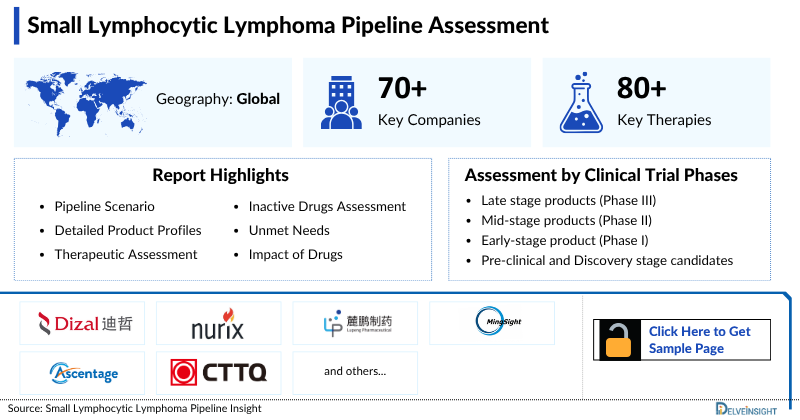
DelveInsight’s, “Small Lymphocytic Lymphoma Pipeline Insight, 2026” report provides comprehensive insights about 70+ companies and 80+ pipeline drugs in Small Lymphocytic Lymphoma pipeline landscape. It covers the pipeline drug profiles, including clinical and nonclinical stage products. It also covers the therapeutics assessment by product type, stage, route of administration, and molecule type. It further highlights the inactive pipeline products in this space.
Geography Covered
- Global coverage
Small Lymphocytic Lymphoma Understanding
Small Lymphocytic Lymphoma Overview
Small Lymphocytic Lymphoma (SLL) is a slow-growing B-cell non-Hodgkin lymphoma characterized by the accumulation of mature, monoclonal B lymphocytes within lymph nodes and other lymphoid tissues. It is the tissue-based counterpart of chronic lymphocytic leukemia (CLL), with the two conditions differing primarily in the degree of lymphocyte involvement in the peripheral blood.
SLL generally follows an indolent clinical course, although some patients may experience disease progression or transformation into a more aggressive lymphoma. The disease commonly presents with painless enlargement of lymph nodes and may remain asymptomatic during its early stages. As SLL advances, patients may develop constitutional symptoms such as fatigue, fever, night sweats, and unexplained weight loss, along with splenomegaly, hepatomegaly, bone marrow involvement, anemia, thrombocytopenia, recurrent infections, and abdominal discomfort.
Small Lymphocytic Lymphoma (SLL) develops through the clonal expansion of mature CD5⁺/CD23⁺ B lymphocytes, driven by genetic alterations and abnormal survival signaling rather than rapid cellular proliferation. Persistent activation of the B-cell receptor (BCR) pathway, involving BTK, SYK, PI3K, and LYN, promotes malignant cell survival and resistance to apoptosis, while the tumor microenvironment further enhances disease progression and immune evasion. Recurrent genetic abnormalities influence prognosis and therapeutic response.
Diagnosis is established through lymph node biopsy with immunophenotypic confirmation by flow cytometry or immunohistochemistry, typically demonstrating CD5⁺ and CD19⁺ B cells. Disease staging is performed using CT or PET/CT imaging and bone marrow assessment, while molecular testing for TP53, IGHV mutation status, and other genomic alterations helps guide prognosis and treatment selection.
Treatment of Small Lymphocytic Lymphoma (SLL) closely follows the management approach for chronic lymphocytic leukemia (CLL), with therapy guided by disease stage, TP53/del (17p) status, patient fitness, and comorbidities. Current first-line treatment has shifted from chemoimmunotherapy to targeted therapies, particularly BTK inhibitors and the BCL2 inhibitor venetoclax, with or without anti-CD20 monoclonal antibodies, based on molecular risk and clinical characteristics. Chemoimmunotherapy remains an option for selected patients, although its use has declined with the availability of more effective targeted agents. For elderly or frail patients, less intensive regimens or single-agent targeted therapies offer durable disease control while maintaining a favorable safety profile.
"Small Lymphocytic Lymphoma Pipeline Insight, 2026" report by DelveInsight outlays comprehensive insights of present scenario and growth prospects across the indication. A detailed picture of the Small Lymphocytic Lymphoma pipeline landscape is provided which includes the disease overview and Small Lymphocytic Lymphoma treatment guidelines. The assessment part of the report embraces, in depth Small Lymphocytic Lymphoma commercial assessment and clinical assessment of the pipeline products under development. In the report, detailed description of the drug is given which includes mechanism of action of the drug, clinical studies, NDA approvals (if any), and product development activities comprising the technology, Small Lymphocytic Lymphoma collaborations, licensing, mergers and acquisition, funding, designations and other product related details.
Small Lymphocytic Lymphoma Pipeline Report Highlights
- The companies and academics are working to assess challenges and seek opportunities that could influence Small Lymphocytic Lymphoma R&D. The therapies under development are focused on novel approaches to treat/improve Small Lymphocytic Lymphoma.
Small Lymphocytic Lymphoma Emerging Drugs Analysis
This segment of the Small Lymphocytic Lymphoma report encloses its detailed analysis of various drugs in different stages of clinical development, including Phase III, II, I, Preclinical and Discovery. It also helps to understand clinical trial details, expressive pharmacological action, agreements and collaborations, and the latest news and press releases.
Small Lymphocytic Lymphoma Emerging Drugs
Birelentinib: Dizal Pharmaceuticals
Birelentinib (DZD8586) is a first-in-class, non-covalent dual inhibitor targeting both LYN and BTK for the treatment of small lymphocytic lymphoma (SLL) and other B-cell malignancies. By blocking both BTK-dependent and BTK-independent B-cell receptor signaling, it is intended to address resistance to existing BTK inhibitors. The therapy exhibits high selectivity for BTK and LYN compared with other TEC family kinases and has demonstrated the ability to penetrate the blood-brain barrier. It is currently being investigated in a Phase III clinical trial for patients with SLL.
NX-5948: Nurix Therapeutics, Inc.
NX-5948 is an oral, investigational targeted protein degrader developed by Nurix Therapeutics, Inc. for the treatment of small lymphocytic lymphoma (SLL) and other B-cell malignancies. It is designed to selectively degrade Bruton's tyrosine kinase (BTK), including both wild-type and mutation-driven forms associated with resistance to covalent BTK inhibitors. NX-5948 is currently being evaluated in Phase III clinical trials in patients with CLL/SLL.
LP-108: Lupeng Pharmaceutical
LP-108 (Lacutoclax) is an investigational, orally administered selective BCL-2 inhibitor being developed for the treatment of relapsed or refractory small lymphocytic lymphoma (SLL) and chronic lymphocytic leukemia (CLL). It is designed to induce apoptosis in malignant B cells while exhibiting relatively weaker inhibition of BCL-XL and BCL-W, which may help improve tolerability. Early clinical findings have demonstrated promising antitumor activity with an acceptable safety profile in CLL/SLL and other B-cell non-Hodgkin lymphomas. LP-108 is currently being evaluated in a Phase II, open-label, multicenter clinical trial in patients with relapsed or refractory CLL/SLL.
MS-553: MingSight Pharmaceutical, Inc
MS-553 is an investigational, oral selective inhibitor of protein kinase C-beta (PKC-β) being developed for the treatment of relapsed or refractory small lymphocytic lymphoma (SLL) and chronic lymphocytic leukemia (CLL). By selectively targeting PKC-β, a key regulator of B-cell receptor signaling, it aims to suppress malignant B-cell proliferation and survival. The therapy is intended to provide a novel treatment option for patients whose disease has progressed after prior therapies, including BTK inhibitors. MS-553 is currently being evaluated in a Phase I/II clinical trial assessing its safety, tolerability, pharmacokinetics, and preliminary antitumor activity in patients with relapsed or refractory CLL/SLL.
APG-3288: Ascentage Pharma Group Inc
APG-3288 is an investigational, oral Bruton's tyrosine kinase (BTK) degrader being developed by Ascentage Pharma Group Inc. for the treatment of relapsed or refractory small lymphocytic lymphoma (SLL) and other B-cell malignancies. Rather than inhibiting BTK activity alone, it is designed to selectively degrade the BTK protein, including resistance-associated mutant forms, with the aim of overcoming limitations of current BTK inhibitors. APG-3288 is being investigated as monotherapy to evaluate its safety, pharmacokinetics, pharmacodynamics, and preliminary antitumor activity in patients with relapsed or refractory hematologic cancers. The therapy is currently in a Phase I, multicenter, open-label clinical trial for patients with relapsed/refractory CLL/SLL and other B-cell malignancies.
Further product details are provided in the report……..
Small Lymphocytic Lymphoma Drug Therapeutic Assessment
This segment of the report provides insights about the different Small Lymphocytic Lymphoma drugs segregated based on following parameters that define the scope of the report, such as:
Major Small Lymphocytic Lymphoma Players in Small Lymphocytic Lymphoma
- There are approx. 70+ key companies which are developing the therapies for Small Lymphocytic Lymphoma. The companies which have their Small Lymphocytic Lymphoma drug candidates in the most advanced stage, i.e. Phase III include, Dizal Pharmaceuticals.
Small Lymphocytic Lymphoma Clinical Trial Phases
DelveInsight’s report covers around 80+ products under different phases of clinical development like
- Late stage products (Phase III)
- Mid-stage products (Phase II)
- Early-stage product (Phase I) along with the details of
- Pre-clinical and Discovery stage candidates
- Discontinued & Inactive candidates
Small Lymphocytic Lymphoma Drug Route of Administration
Small Lymphocytic Lymphoma pipeline report provides the therapeutic assessment of the pipeline drugs by the Route of Administration. Products have been categorized under various ROAs such as
- Oral
- Intravenous
- Subcutaneous
- Parenteral
- Topical
Small Lymphocytic Lymphoma Product Molecule Type
Products have been categorized under various Molecule types such as
- Recombinant fusion proteins
- Small molecule
- Monoclonal antibody
- Peptide
- Polymer
- Gene therapy
Small Lymphocytic Lymphoma Product Type
Drugs have been categorized under various product types like Mono, Combination and Mono/Combination.
Small Lymphocytic Lymphoma Clinical Trial Activities
The Small Lymphocytic Lymphoma Pipeline report provides insights into different Small Lymphocytic Lymphomas clinical Trial within Phase III, II, I, preclinical and discovery stage. It also analyses Small Lymphocytic Lymphoma therapeutic drugs key players involved in developing key drugs.
Small Lymphocytic Lymphoma Pipeline Development Activities
The Small Lymphocytic Lymphoma Clinical Trial Analysis report covers the detailed information of collaborations, acquisition and merger, licensing along with a thorough therapeutic assessment of emerging Small Lymphocytic Lymphoma drugs.
Small Lymphocytic Lymphoma Report Insights
- Small Lymphocytic Lymphoma Pipeline Analysis
- Small Lymphocytic Lymphoma Therapeutic Assessment
- Small Lymphocytic Lymphoma Unmet Needs
- Impact of Small Lymphocytic Lymphoma Drugs
Small Lymphocytic Lymphoma Report Assessment
- Small Lymphocytic Lymphoma Pipeline Product Profiles
- Small Lymphocytic Lymphoma Therapeutic Assessment
- Small Lymphocytic Lymphoma Pipeline Assessment
- Small Lymphocytic Lymphoma Inactive drugs assessment
- Small Lymphocytic Lymphoma Market Unmet Needs
Key Questions Answered in the Small Lymphocytic Lymphoma Pipeline Report
- Current Treatment Scenario and Emerging Therapies:
- How many companies are developing Small Lymphocytic Lymphoma drugs?
- How many Small Lymphocytic Lymphoma drugs are developed by each company?
- How many emerging drugs are in mid-stage, and late-stage of development for the treatment of Small Lymphocytic Lymphoma?
- What are the key collaborations (Industry–Industry, Industry–Academia), Mergers and acquisitions, licensing activities related to the Small Lymphocytic Lymphoma therapeutics?
- What are the recent trends, drug types and novel technologies developed to overcome the limitation of existing therapies?
- What are the clinical studies going on for Small Lymphocytic Lymphoma and their status?
- What are the key designations that have been granted to the emerging drugs?
Small Lymphocytic Lymphoma Key Players
- Dizal Pharmaceuticals
- Nurix Therapeutics, Inc.
- Lupeng Pharmaceutical
- MingSight Pharmaceutical, Inc
- Ascentage Pharma Group Inc.
- Chia Tai Tianqing Pharmaceutical Group Co., Ltd.
- CRISPR Therapeutics AG
- Luminary Therapeutics
- Lomond Therapeutics
- BeOne Medicines
- Ono Pharmaceutical Co., Ltd.
- InnoCare Pharma
- Recursion Pharmaceuticals, Inc.
- Vironexis Biotherapeutics Inc.
- Accutar Biotechnology Inc
- AVM Biotechnology Inc
- Allogene Therapeutics
- Merck & Co.
- Iovance Biotherapeutics
Overactive Bladder Key Products
- Birelentinib
- NX-5948
- LP-108
- MS-553
- APG-3288
- TQB3909
- CTX112
- LMY-922
- ZE50-0134
- BGB-16673
- ONO-4685
- ICP-248
- EXS73565
- VNX-101
- AC676
- AVM0703
- ALLO-501A
- Nemtabrutinib
- IOV-2001