
SOMATULINE Market Summary
Key Factors Driving SOMATULINE Growth
1. Broad Label Across Multiple High-Value Rare Disease Indications
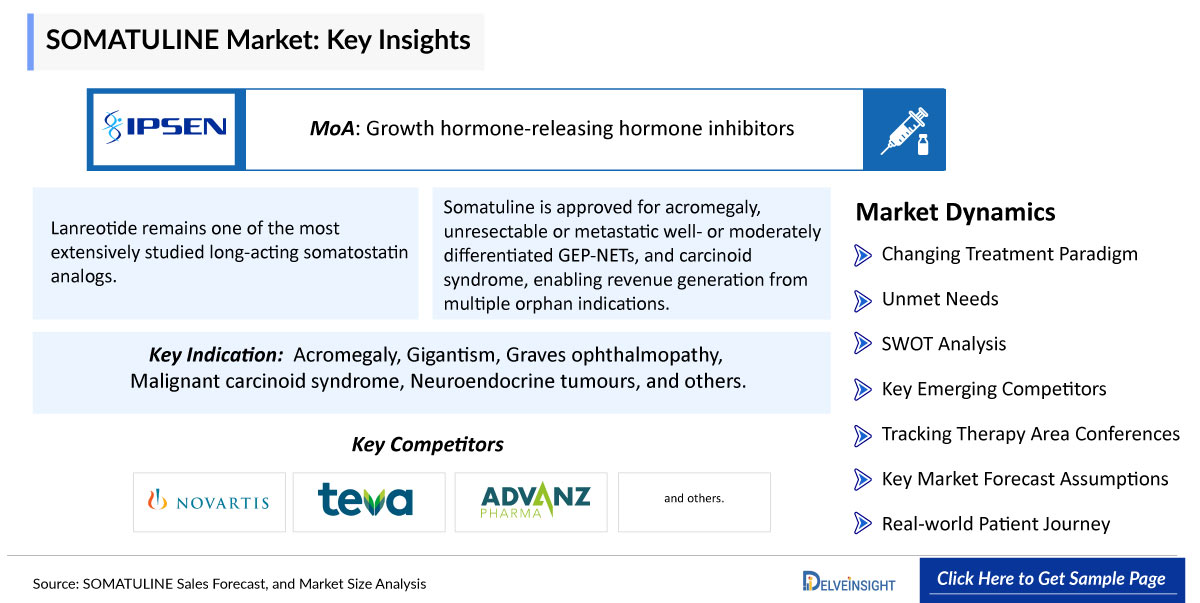
Somatuline is approved for acromegaly, unresectable or metastatic well- or moderately differentiated GEP-NETs, and carcinoid syndrome, enabling revenue generation from multiple orphan indications. The pivotal CLARINET trial demonstrated that lanreotide significantly prolonged progression-free survival (PFS) in patients with metastatic enteropancreatic NETs compared with placebo, establishing it as a standard first-line antiproliferative therapy in international treatment guidelines. Its broad indication base continues to support stable prescribing despite increasing therapeutic competition.
2. Strong Clinical Guideline Support and Long-Term Real-World Experience
Lanreotide remains one of the most extensively studied long-acting somatostatin analogs. It is recommended by major clinical guidelines, including those from the European Society for Medical Oncology (ESMO) and the National Comprehensive Cancer Network (NCCN), for management of functional NETs and hormone control in acromegaly. More than two decades of clinical use have established durable efficacy in suppressing growth hormone (GH) and insulin-like growth factor-1 (IGF-1), controlling hormone-related symptoms, and delaying tumor progression, supporting continued physician confidence and patient retention.
3. Convenient Deep Subcutaneous Administration Supports Patient Preference
Unlike intramuscular formulations of some competing somatostatin analogs, Somatuline is administered as a deep subcutaneous injection in a ready-to-use prefilled syringe. The formulation allows administration by healthcare professionals or, in many regions, by trained patients or caregivers at home. This convenience reduces clinic visits, improves treatment adherence, and remains an important differentiating factor in long-term management of chronic endocrine disorders.
4. Continued Commercial Resilience Despite Generic Competition
Although generic lanreotide products have entered several markets, Somatuline has shown greater resilience than initially anticipated. Ipsen reported 4.3% constant-exchange-rate sales growth for Somatuline in FY2025 and stated that production constraints affecting generic lanreotide suppliers supported stronger-than-expected demand. Consequently, the company expects continued Somatuline growth in 2026, contributing to its overall guidance of more than 13% total company sales growth at constant exchange rates.
5. Growing Incidence and Improved Diagnosis of NETs and Acromegaly
The incidence and prevalence of gastroenteropancreatic neuroendocrine tumors (GEP-NETs) have steadily increased over the past two decades, largely because of improved imaging techniques, earlier diagnosis, and longer patient survival. Similarly, enhanced awareness and biochemical screening have improved diagnosis of acromegaly. Since both diseases require prolonged medical therapy, expanding diagnosed patient populations continue to sustain long-term demand for somatostatin analogs such as Somatuline.
SOMATULINE Recent Developments
Somatuline, also known as lanreotide, has long been developed and marketed for somatostatin-receptor-driven endocrine tumors and acromegaly, with the CLARINET publication showing prolonged progression-free survival in metastatic gastroenteropancreatic neuroendocrine tumors. The FDA label still reflects an established commercial product rather than a newly emerging development asset.
“SOMATULINE Sales Forecast, and Market Size Analysis – 2034” report provides comprehensive insights of SOMATULINE for approved indication like Acromegaly, Gigantism, Graves ophthalmopathy, Malignant carcinoid syndrome, Neuroendocrine tumours, and Pituitary cancer; as well as potential indication like Gastro-oesophageal reflux, Gastrointestinal motility disorders, and Pancreatic cancer in the 7MM. A detailed picture of SOMATULINE’s existing usage in approved and anticipated entry and performance in potential indications in the 7MM, i.e., the United States, EU4 (Germany, France, Italy, and Spain) and the United Kingdom, and Japan for the study period 2020 –2034 is provided in this report along with a detailed description of the SOMATULINE for approved and potential indications. The SOMATULINE market report provides insights about SOMATULINE’s sales forecast, mechanism of action (MoA), dosage and administration, as well as research and development including regulatory milestones, along with other developmental activities. Further, it also consists of historical and current SOMATULINE performance, future market assessments inclusive of the SOMATULINE market forecast analysis for approved and potential indications in the 7MM, SWOT, analysts’ views, comprehensive overview of market competitors, and brief about other emerging therapies in respective indications. It also provides analysis of SOMATULINE sales forecasts, along with factors driving its market.
SOMATULINE Drug Summary
SOMATULINE is a long-acting somatostatin analog approved for the treatment of acromegaly, gastroenteropancreatic neuroendocrine tumors (GEP-NETs), and the symptomatic management of carcinoid syndrome. It is administered as a deep subcutaneous injection in a prefilled syringe, typically every four weeks. Lanreotide binds with high affinity to somatostatin receptor subtypes 2 and 5 (SSTR2 and SSTR5), inhibiting the secretion of growth hormone (GH), insulin-like growth factor-1 (IGF-1), and various gastrointestinal peptides and hormones. Through suppression of the GH–IGF-1 axis, Somatuline is also being investigated as a potential treatment for thyroid eye disease (TED), where elevated IGF-1 signaling contributes to orbital fibroblast activation, inflammation, and tissue expansion. Although small clinical studies have suggested improvements in disease activity and soft-tissue inflammation, Somatuline has not demonstrated sufficient evidence to become a standard therapy for TED, and its use in this indication remains investigational and off-label. The drug has an established safety profile from extensive clinical use in endocrine disorders, with the most common adverse effects including gastrointestinal disturbances, injection-site reactions, and cholelithiasis. The report provides SOMATULINE’s sales, growth barriers and drivers, post usage and approvals in multiple indications.
Scope of the SOMATULINE Market Report
The report provides insights into:
- A comprehensive product overview including the SOMATULINE MoA, description, dosage and administration, research and development activities in approved indications like Acromegaly, Gigantism, Graves ophthalmopathy, Malignant carcinoid syndrome, Neuroendocrine tumours, and Pituitary cancer; as well as potential indication like Gastro-oesophageal reflux, Gastrointestinal motility disorders, and Pancreatic cancer.
- Elaborated details on SOMATULINE regulatory milestones and other development activities have been provided in SOMATULINE market report.
- The report also highlights SOMATULINE‘s cost estimates and regional variations, reported and estimated sales performance, research and development activities in approved and potential indications across the United States, Europe, and Japan.
- The SOMATULINE market report also covers the patents information, generic entry and impact on cost cut.
- The SOMATULINE market report contains current and forecasted SOMATULINE sales for approved and potential indications till 2034.
- Comprehensive coverage of the late-stage emerging therapies for respective indications.
- The SOMATULINE market report also features the SWOT analysis with analyst views for SOMATULINE in approved and potential indications.
Methodology
The SOMATULINE market report is built using data and information sourced primarily from internal databases, primary and secondary research and in-house analysis by DelveInsight’s team of industry experts. Information and data from the secondary sources have been obtained from various printable and nonprintable sources like search engines, news websites, global regulatory authorities websites, trade journals, white papers, magazines, books, trade associations, industry associations, industry portals and access to available databases.
SOMATULINE Analytical Perspective by DelveInsight
- In-depth SOMATULINE Market Assessment
This SOMATULINE sales market forecast report provides a detailed market assessment of SOMATULINE for approved indication like Acromegaly, Gigantism, Graves ophthalmopathy, Malignant carcinoid syndrome, Neuroendocrine tumours, and Pituitary cancer; as well as potential indication like Gastro-oesophageal reflux, Gastrointestinal motility disorders, and Pancreatic cancer in the seven major markets, i.e., the United States, EU4 (Germany, France, Italy, and Spain) and the United Kingdom, and Japan. This segment of the report provides current and forecasted SOMATULINE sales data uptil 2034.
- SOMATULINE Clinical Assessment
The SOMATULINE market report provides the clinical trials information of SOMATULINE for approved and potential indications covering trial interventions, trial conditions, trial status, start and completion dates.
SOMATULINE Competitive Landscape
The report provides Insights on competitors and marketed products within the domain, along with a summary of emerging products and their respective launch dates, posing significant competition in the market.
SOMATULINE Market Potential & Revenue Forecast
- Projected market size for the SOMATULINE and its key indications
- Estimated SOMATULINE sales potential (SOMATULINE peak sales forecasts)
- SOMATULINE Pricing strategies and reimbursement landscape
SOMATULINE Competitive Intelligence
- Number of competing drugs in development (pipeline analysis)
- SOMATULINE Market positioning compared to existing treatments
- SOMATULINE Strengths & weaknesses relative to competitors
SOMATULINE Regulatory & Commercial Milestones
- SOMATULINE Key regulatory approvals & expected launch timelines
- Commercial partnerships, licensing deals, and M&A activity
SOMATULINE Clinical Differentiation
- SOMATULINE Efficacy & safety advantages over existing drugs
- SOMATULINE Unique selling points
SOMATULINE Market Report Highlights
- In the coming years, the SOMATULINE market scenario is set to change due to strong adoption, increased prescriptions and broader uptake in multiple immunological indications; which would expand the size of the market.
- The SOMATULINE companies are developing therapies that focus on novel approaches to treat/improve the disease condition, assess challenges, and seek opportunities that could influence SOMATULINE’s dominance.
- Other emerging products for Acromegaly, Gigantism, Graves ophthalmopathy, Malignant carcinoid syndrome, Neuroendocrine tumours, and Pituitary cancer; as well as potential indication like Gastro-oesophageal reflux, Gastrointestinal motility disorders, and Pancreatic cancer are expected to give tough market competition to SOMATULINE and launch of late-stage emerging therapies in the near future will significantly impact the market.
- A detailed description of regulatory milestones, and developmental activities, provide the current development scenario of SOMATULINE in approved and potential indications.
- Analyse SOMATULINE cost, pricing trends and market positioning to support strategic decision-making in the immunology landscape.
- Our in-depth analysis of the forecasted SOMATULINE sales data uptil 2034 will support the clients in decision-making process regarding their therapeutic portfolio by identifying the overall scenario of SOMATULINE in approved and potential indications.
Key Questions
- What is the class of therapy, route of administration and mechanism of action of SOMATULINE? How strong is SOMATULINE’s clinical and commercial performance?
- What is SOMATULINE’s clinical trial status in each individual indications such as Acromegaly, Gigantism, Graves ophthalmopathy, Malignant carcinoid syndrome, Neuroendocrine tumours, and Pituitary cancer; as well as potential indication like Gastro-oesophageal reflux, Gastrointestinal motility disorders, and Pancreatic cancer and study completion date?
- What are the key collaborations, mergers and acquisitions, licensing and other activities related to the SOMATULINE Manufacturers?
- What are the key designations that have been granted to SOMATULINE for approved and potential indications? How are they going to impact SOMATULINE’s penetration in various geographies?
- What is the current and forecasted SOMATULINE market scenario for approved and potential indications? What are the key assumptions behind the forecast?
- What are the current and forecasted sales of SOMATULINE in the seven major countries, including the United States, Europe (Germany, France, Italy, Spain) and the United Kingdom, and Japan?
- What are the other emerging products available and how are these giving competition to SOMATULINE for approved and potential indications?
- Which are the late-stage emerging therapies under development for the treatment of approved and potential indications?
- How cost-effective is SOMATULINE? What is the duration of therapy and what are the geographical variations in cost per patient?

