stat inhibitors pipeline insight
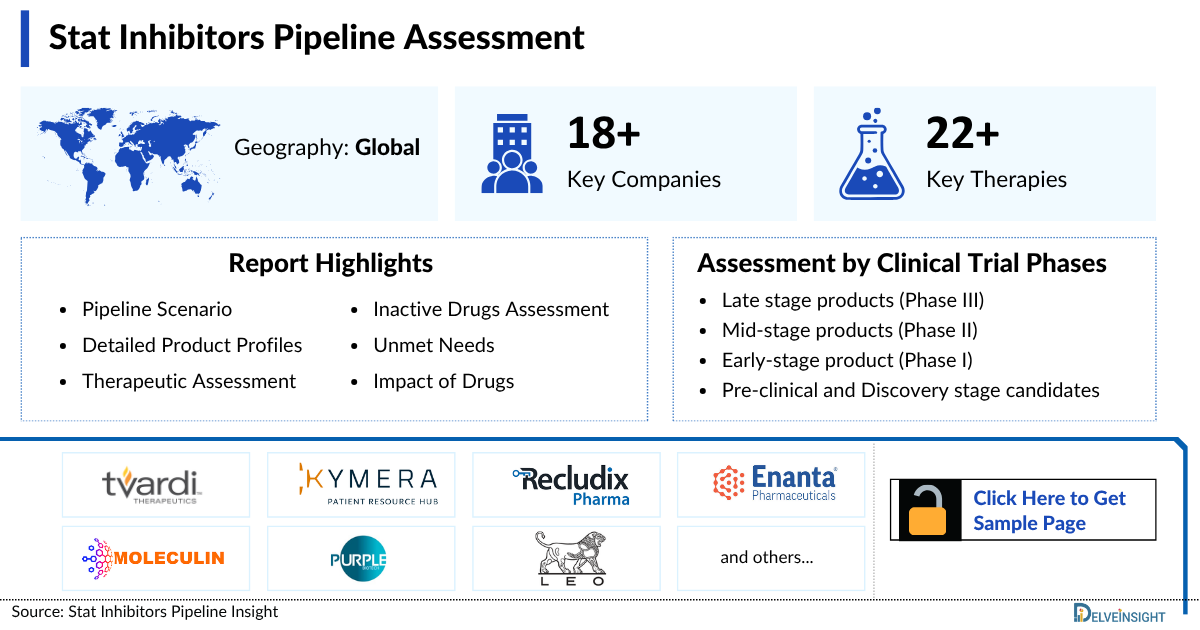
DelveInsight’s, “STAT Inhibitors Pipeline Insight, 2026” report provides comprehensive insights about 18+ companies and 22+ pipeline drugs in STAT Inhibitors pipeline landscape. It covers the pipeline drug profiles, including clinical and nonclinical stage products. It also covers the therapeutics assessment by product type, stage, route of administration, and molecule type. It further highlights the inactive pipeline products in this space.
Geography Covered
- Global coverage
STAT Inhibitors Understanding
STAT Inhibitors Overview
STAT Inhibitors represent a class of chemicals that interfere with the activation and function of Signal Transducer and Activator of Transcription (STAT) proteins. These inhibitors are diverse in structure and mechanism of action, reflecting the complexity of STAT protein regulation. They target various stages in the STAT signaling pathway, from initial activation to nuclear translocation. They include peptidomimetics, small molecules, and oligonucleotides aimed at blocking STAT activity, particularly STAT3 and STAT5, which are often constitutively active in cancer.
Signal Transducer and Activator of Transcription (STAT) proteins are a family of cytoplasmic transcription factors consisting of 7 members. STAT1, STAT2, STAT3, STAT4, STAT5a, STAT5b, and STAT6 each with distinct but sometimes overlapping biological roles. Functionally, STAT1 and STAT2 are central to antiviral defense, STAT3 and STAT5 isoforms regulate cell growth and oncogenesis, while STAT4 and STAT6 orchestrate immune polarization and inflammatory responses. Despite this functional diversity, all STAT proteins share a conserved modular architecture, including an SH2 domain critical for phosphorylation-dependent dimerization, a DNA-binding domain that directs gene specificity, and a transactivation domain that drives transcription.
Functionally STAT2, 4, and 6 regulate immune responses whereas STAT1, 3, and 5 have diverse physiological role. They regulate expression of genes controlling cell cycle (Cyclin D1, D2, and c-Myc), cell survival (Bcl-xL, Bcl-2, Mcl-1), angiogenesis (HIF1α, VEGF) etc. Because of their critical role they are precisely regulated with activation and deactivation cycle of no more than a few hours. Dysregulation at any level, i.e. cytokines, growth factors, tyrosine kinases, negative feedback mechanisms involving STAT pathway, can lead to increase in their activity and contribute to tumorigenesis.
Therapeutic applications of STAT inhibitors are most extensively explored in oncology, where persistent activation of STAT3 and STAT5 drives tumor initiation, progression, and resistance to therapy. In a wide range of solid tumors including breast, prostate, pancreatic, and liver cancers as well as hematologic malignancies such as leukemia, lymphoma, and multiple myeloma, STAT signaling regulates key oncogenic processes like cell proliferation, survival (via anti-apoptotic proteins such as Bcl-2), angiogenesis (through VEGF), and metastasis. Inhibiting STAT activity has been shown to suppress tumor growth, induce apoptosis, and reduce vascularization, thereby limiting tumor expansion. Importantly, STAT inhibitors also enhance the efficacy of existing treatments; for example, combining STAT3 inhibition with tyrosine kinase inhibitors such as Imatinib can overcome drug resistance and improve therapeutic outcomes in certain leukemias. Beyond direct antitumor effects, STAT inhibitors have important roles in modulating the tumor microenvironment and immune response. Aberrant STAT3 signaling contributes to immune evasion by upregulating immunosuppressive cytokines and inhibiting dendritic cell and T-cell activation. By targeting this pathway, STAT inhibitors can restore anti-tumor immunity and enhance responses to immunotherapies. This immunomodulatory potential extends their application to chronic inflammatory and autoimmune diseases, where dysregulated STAT signaling contributes to pathological immune activation. For instance, targeting STAT pathways may help control conditions such as rheumatoid arthritis, inflammatory bowel disease, and psoriasis by reducing pro-inflammatory cytokine production and immune cell overactivation.
"STAT Inhibitors Pipeline Insight, 2026" report by DelveInsight outlays comprehensive insights of present scenario and growth prospects across the indication. A detailed picture of the STAT Inhibitors pipeline landscape is provided which includes the disease overview and STAT Inhibitors treatment guidelines. The assessment part of the report embraces, in depth STAT Inhibitors commercial assessment and clinical assessment of the pipeline products under development. In the report, detailed description of the drug is given which includes mechanism of action of the drug, clinical studies, NDA approvals (if any), and product development activities comprising the technology, STAT Inhibitors collaborations, licensing, mergers and acquisition, funding, designations and other product related details.
STAT Inhibitors Pipeline Report Highlights
The companies and academics are working to assess challenges and seek opportunities that could influence STAT Inhibitors R&D. The therapies under development are focused on novel approaches to treat/improve STAT Inhibitors.
STAT Inhibitors Emerging Drugs Analysis
This segment of the STAT Inhibitors report encloses its detailed analysis of various drugs in different stages of clinical development, including phase II, I, preclinical and Discovery. It also helps to understand clinical trial details, expressive pharmacological action, agreements and collaborations, and the latest news and press releases.
STAT Inhibitors Emerging Drugs
TTI-101: Tvardi Therapeutics
TTI-101 is a first-in-class, orally delivered, small-molecule inhibitor of STAT3 that has been developed as a potential treatment for cancers. It inhibits STAT3 by binding tightly within its Src homology 2 domain, which prevents the recruitment of STAT3 to signaling complexes that contain activated tyrosine kinases, thereby preventing STAT3 activation via phosphorylation on Y705. Binding of TTI-101 to STAT3 also prevents STAT3 homodimerization. TTI-101 has been shown to have limited toxicity in laboratory animals in Good Laboratory Practice toxicology studies. Currently, the drug is being evaluated in the Phase II stage of its development for the treatment of Idiopathic Pulmonary Fibrosis.
KT-621: Kymera Therapeutics, Inc.
KT-621 is an investigational, first-in-class, once daily, oral degrader of STAT6. In preclinical studies, KT-621 demonstrated full inhibition of the IL-4/IL-13 pathway in all relevant human cell contexts with picomolar potency. KT-621 demonstrated deep STAT6 degradation in blood and skin, robust reductions in disease-relevant Type 2 inflammatory biomarkers, meaningful improvements on clinical endpoints and patient-reported outcomes in AD and comorbid asthma and allergic rhinitis, and was well tolerated with a favorable safety profile. Currently, the drug is being evaluated in the Phase II stage of its development for the treatment of Atopic Dermatitis and Asthma.
REX-8756: Recludix Pharma
REX-8756 is an oral, selective STAT6 inhibitor that employs a novel therapeutic approach by targeting STAT6’s SH2 domain a key mediator of protein-protein interactions that was long considered undruggable. In preclinical studies, REX-8756 demonstrated complete and sustained inhibition of STAT6 activity, thereby suppressing IL-4 and IL-13-induced inflammatory biomarkers. REX-8756 has demonstrated potent efficacy in models of asthma, acute lung inflammation and dermatitis, comparable to that of an anti-IL-4/IL-13 antibody combination control. Currently, the drug is being evaluated in the Phase I stage of its development for the treatment of Atopic Dermatitis, COPD and Asthma.
Further product details are provided in the report……..
STAT Inhibitors Drug Therapeutic Assessment
This segment of the report provides insights about the different STAT Inhibitors drugs segregated based on following parameters that define the scope of the report, such as:
Major STAT Inhibitors Players in STAT Inhibitors
There are approx. 18+ key companies which are developing the therapies for STAT Inhibitors. The companies which have their STAT Inhibitors drug candidates in the mid stage, i.e. Phase II include, Tvardi Therapeutics.
STAT Inhibitors Clinical Trial Phases
DelveInsight’s report covers around 22+ products under different phases of clinical development like
- Late stage products (Phase III)
- Mid-stage products (Phase II)
- Early-stage product (Phase I) along with the details of
- Pre-clinical and Discovery stage candidates
- Discontinued & Inactive candidates
STAT Inhibitors Drug Route of Administration
STAT Inhibitors pipeline report provides the therapeutic assessment of the pipeline drugs by the Route of Administration. Products have been categorized under various ROAs such as
- Oral
- Intravenous
- Subcutaneous
- Parenteral
- Topical
STAT Inhibitors Product Molecule Type
Products have been categorized under various Molecule types such as
- Recombinant fusion proteins
- Small molecule
- Monoclonal antibody
- Peptide
- Polymer
- Gene therapy
STAT Inhibitors Product Type
Drugs have been categorized under various product types like Mono, Combination and Mono/Combination.
STAT Inhibitors Clinical Trial Activities
The STAT Inhibitors Pipeline report provides insights into different STAT Inhibitors Clinical Trials within phase II, I, preclinical and discovery stage. It also analyses STAT Inhibitors therapeutic drugs key players involved in developing key drugs.
STAT Inhibitors Pipeline Development Activities
The STAT Inhibitors Clinical Trial Analysis report covers the detailed information of collaborations, acquisition and merger, licensing along with a thorough therapeutic assessment of emerging STAT Inhibitors drugs.
STAT Inhibitors Pipeline Report Insights
- STAT Inhibitors Pipeline Analysis
- STAT Inhibitors Therapeutic Assessment
- STAT Inhibitors Unmet Needs
- Impact of STAT Inhibitors Drugs
STAT Inhibitors Pipeline Report Assessment
- STAT Inhibitors Pipeline Product Profiles
- STAT Inhibitors Therapeutic Assessment
- STAT Inhibitors Pipeline Assessment
- STAT Inhibitors Inactive drugs assessment
- STAT Inhibitors Market Unmet Needs
Key Questions Answered in the STAT Inhibitors Pipeline Report:
- Current Treatment Scenario and Emerging Therapies:
- How many companies are developing STAT Inhibitors drugs?
- How many STAT Inhibitors drugs are developed by each company?
- How many emerging drugs are in mid-stage, and late-stage of development for the treatment of STAT Inhibitors?
- What are the key collaborations (Industry–Industry, Industry–Academia), Mergers and acquisitions, licensing activities related to the STAT Inhibitors therapeutics?
- What are the recent trends, drug types and novel technologies developed to overcome the limitation of existing therapies?
- What are the clinical studies going on for STAT Inhibitors and their status?
- What are the key designations that have been granted to the emerging drugs?
STAT Inhibitors Key Companies
- Tvardi Therapeutics
- Kymera Therapeutics, Inc.
- Recludix Pharma
- Enanta Pharmaceuticals, Inc.
- Moleculin, Inc.
- Purple Biotech
- LEO Pharma A/S
- JW Pharmaceutical
- KAKEN PHARMACEUTICAL CO., LTD.
- C4XD Holdings Limited
STAT Inhibitors Key Products
- TTI-101
- KT-621
- REX-8756
- EPS-3903
- WP1066
- NT219
- STAT6
- JW2286
- KP-723
- Research Program

