Sternal Closure Devices Market Summary
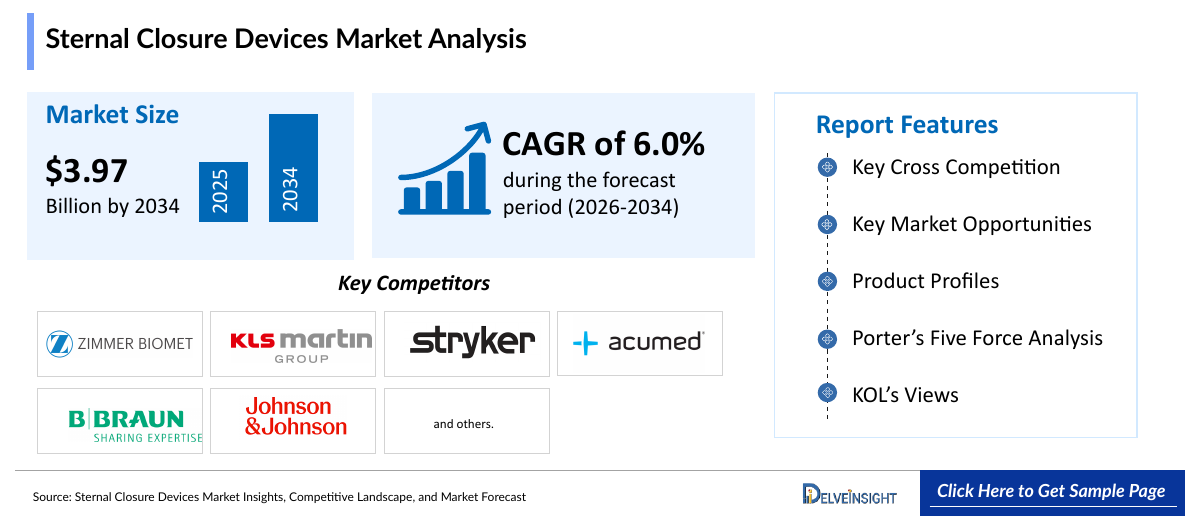
- The Sternal Closure Devices market is estimated at USD 2.35 billion in 2025 and is projected to reach USD 3.97 billion by 2034. Growth is anchored in the rising burden of cardiovascular disease, sustained volumes of sternotomy-based cardiac surgery, and the shift from conventional wire closure toward rigid plate and screw fixation.
- The global Sternal Closure Devices market is growing at a CAGR of 6.0% during the forecast period from 2026 to 2034.
- By product type, the sternal closure wires segment dominated the Sternal Closure Devices market with a 46% share in 2025.
- By application, the cardiology segment dominated the Sternal Closure Devices market with a 74% share in 2025.
- By end-user, the hospitals & clinics segment dominated the Sternal Closure Devices market with a 79% share in 2025.
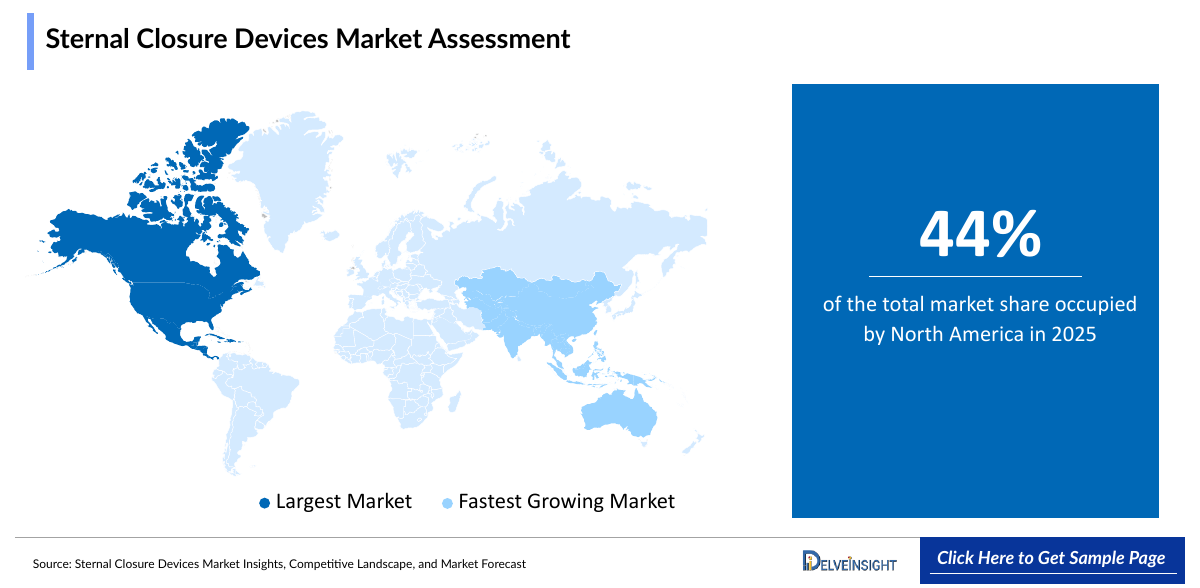
- North America dominated the global Sternal Closure Devices market revenue with a 44% share in 2025, representing the highest regional market share globally.
A sternal closure device is a surgical implant used to re-approximate, stabilize, and fixate the sternum (breastbone) after a median sternotomy or hemisternotomy, and to repair sternal fractures and support chest wall reconstruction. Following open-heart procedures such as coronary artery bypass grafting (CABG) and heart valve surgery, the divided sternum must remain stable to heal; inadequate fixation can lead to sternal dehiscence, non-union, and deep sternal wound infection, which increase mortality, length of stay, and cost. Sternal closure devices include wires, screws, plates, clamps, and cables manufactured from titanium, stainless steel, PEEK, and emerging bioabsorbable materials. The market is organized by product type, spanning sternal closure wires, screws, plates, clamps, and others; by application across cardiology, orthopedics, and respiratory care; by end-user across hospitals and clinics, ambulatory surgical centers, and others; and by geography. Driven by the rising burden of cardiovascular disease, the shift from conventional wire cerclage toward rigid plate fixation, and continuous innovation in low-profile and minimally invasive-compatible implants, sternal closure devices have become a critical component of the cardiothoracic surgical toolkit.
Sternal Closure Devices Market Key Growth Drivers
- The rising global burden of cardiovascular disease, which the World Health Organization identifies as the leading cause of death worldwide, is sustaining high volumes of CABG and valve surgeries that require sternotomy and reliable sternal closure.
- A growing elderly population with comorbidities such as diabetes, obesity, osteoporosis, and chronic obstructive pulmonary disease is increasing the share of high-risk sternotomy patients who benefit from enhanced fixation.
- Surgeons and hospitals are increasingly shifting from conventional stainless steel wire cerclage toward rigid plate and screw fixation to reduce sternal dehiscence, non-union, and deep sternal wound infection.
- Advances in low-profile titanium plates, minimally invasive cardiac surgery-compatible designs, and emerging bioabsorbable and antimicrobial technologies are expanding the use of premium closure systems.
- Product launches and training initiatives, including KLS Martin Group's January 2025 low-profile titanium plating launch and Medtronic's April 2025 partnership with the Society of Thoracic Surgeons, are accelerating adoption of rigid fixation.
- Rising healthcare expenditure, improving reimbursement in developed markets, and expanding cardiac surgery capacity in Asia-Pacific are broadening patient access to sternotomy-based procedures.
- The convergence of cardiovascular disease burden, aging demographics, rigid fixation adoption, and continued implant innovation is expected to sustain steady mid-single-digit growth in the market through 2034.
Key Companies in Sternal Closure Devices Market
The competitive landscape is led by the following active manufacturers:
- Zimmer Biomet
- KLS Martin Group
- Stryker
- Acumed LLC
- Crown Holdco One, Inc.
- B. Braun SE
- JEIL Medical Corporation
- Johnson & Johnson Services, Inc.
- IDEAR S.R.L
- Medtronic
For illustrative purposes, only the top 10 companies are listed in the Table of Contents. The report may include analysis and references to additional companies relevant to the market assessment.
Sternal Closure Devices Market Size
The following snapshot summarizes the principal report metrics for the Sternal Closure Devices market.
|
Report Metrics |
Details |
|
2025 Market Size |
USD 2.35 billion |
|
2034 Projected Market Size |
USD 3.97 billion |
|
Growth Rate (2026-2034) |
6.0% CAGR |
|
Largest Market |
North America |
|
Fastest Growing Market |
Asia-Pacific |
|
Market Structure |
Moderately Concentrated |
All market values are expressed in USD and represent DelveInsight estimates synthesized from primary and secondary research.
Factors Contributing to the Growth of the Sternal Closure Devices Market
Market Drivers
Rising Burden of Cardiovascular Disease and Open-Heart Surgery Volumes
The most important driver of the Sternal Closure Devices market is the persistent global burden of cardiovascular disease. The World Health Organization identifies cardiovascular disease as the leading cause of death worldwide, accounting for more than 17 million deaths annually. A large share of patients with advanced coronary artery disease and valvular disease require open-heart procedures, including coronary artery bypass grafting and valve replacement, that are performed through a median sternotomy. Every sternotomy must be followed by secure sternal re-approximation so that the bone can heal and the patient can recover and mobilize safely. Because sternal closure is a mandatory step of every such procedure, device demand is closely tied to cardiac surgical volumes. As cardiovascular disease prevalence rises, particularly in aging and emerging populations, demand for wires, plates, screws, and clamps expands directly, anchoring market growth through 2034.
Aging Population and High-Risk Patient Profiles
Population aging is expanding the pool of patients who undergo cardiac and thoracic surgery and who carry elevated risk of sternal complications. Older patients and those with diabetes, obesity, osteoporosis, or chronic obstructive pulmonary disease face higher rates of sternal dehiscence, delayed healing, and deep sternal wound infection, complications that prolong hospitalization, require reoperation, and increase mortality and cost. Because these risk factors are increasingly common among cardiac surgery candidates, surgeons are more likely to select enhanced fixation to protect against failure of closure. This demographic shift raises both the volume of procedures and the proportion of cases in which premium, higher-value closure systems are chosen, supporting revenue growth across product types and care settings throughout the forecast period.
Shift from Wire Cerclage Toward Rigid Plate Fixation
A clinical and economic shift from conventional stainless steel wire cerclage toward rigid plate and screw fixation is a central growth engine for the market. Wire closure remains the established standard because of its low cost and familiarity, but it can allow sternal micromotion that contributes to dehiscence, non-union, and infection, particularly in high-risk patients. Rigid fixation systems, such as titanium plates secured with screws, stabilize the sternum more uniformly and are increasingly used in high-risk and complex cases and in minimally invasive cardiac surgery. Published clinical experience with systems such as Zimmer Biomet's SternaLock Blu and SternaLock Blu MICS, including a December 2024 single-center report describing no sternal complications, supports adoption. As hospitals weigh the cost of complications against the price of the implant, rigid fixation continues to gain share and lift average selling prices.
Technological Advances in Materials and Implant Design
Continuous innovation in materials and implant design is expanding clinical options and sustaining demand. Manufacturers are introducing low-profile titanium plating systems, anatomically contoured plates, locking screw constructs, and implants designed specifically for hemisternotomy and minimally invasive approaches. Titanium, stainless steel, and PEEK are being refined for strength, biocompatibility, and imaging compatibility, while bioabsorbable and antimicrobial-coated devices are emerging to address infection risk and avoid secondary removal. KLS Martin Group's January 2025 commercial launch of a new low-profile titanium plating system for high-risk sternal closure in Europe and North America illustrates the pace of innovation. These advances improve surgeon confidence, support premium pricing, and encourage conversion from wires to advanced systems through the forecast period.
Rising Healthcare Expenditure and Favorable Reimbursement
Rising healthcare expenditure and improving reimbursement in developed markets are supporting the use of advanced closure technologies. Deep sternal wound infection and sternal dehiscence are among the most serious and costly complications of cardiac surgery, and hospitals increasingly recognize that preventing them can offset the higher upfront price of rigid fixation systems through shorter stays and fewer reoperations. Hospital quality programs and surgical-site infection reduction initiatives reinforce this focus. In emerging economies, growing public and private healthcare investment, expanding insurance coverage, and new cardiac centers are widening access to open-heart surgery. Together, higher spending, outcome-focused purchasing, and broader access are expanding the revenue pool for sternal closure devices across the forecast period.
Product Approvals, Surgeon Training, and Clinical Evidence
Regulatory clearances, surgeon education, and growing clinical evidence are strengthening adoption. Sternal closure systems generally reach the market through regulatory pathways such as FDA 510(k) clearance, and manufacturers have continued to secure clearances for plate and fixation systems, including Stryker's Sternal Plate Systems approved in March 2019. Industry education is also scaling: Zimmer Biomet updated its surgical training programs in March 2025 to reduce the risk of sternal non-union in high-risk cardiothoracic surgery, and Medtronic partnered with the Society of Thoracic Surgeons in April 2025 to standardize median sternotomy closure protocols using advanced rigid fixation across 500 US teaching hospitals. Training, guidelines, and published outcomes lower the barriers to adoption and encourage broader use of advanced closure systems.
Expanding Cardiac Surgery Capacity in Emerging Markets
Expanding cardiac surgery capacity in emerging markets is opening new demand. Countries including China, India, Japan, South Korea, and Australia are investing in cardiac centers, training surgeons, and broadening access to CABG and valve surgery, while middle-income countries are steadily increasing procedure volumes. Regional manufacturers, including Korea-based JEIL Medical Corporation, are widening the availability of cost-effective closure systems, and global leaders are extending distribution networks and training in these regions. As procedure volumes scale and surgeons gain experience with advanced systems, demand is expected to shift gradually from basic wires toward plates and screws, making Asia-Pacific and other emerging regions a principal source of incremental growth over the forecast period.
Market Restraints
Despite steady momentum, the Sternal Closure Devices market faces material constraints. The higher cost of rigid plate and screw systems relative to conventional wires is a significant barrier, particularly in price-sensitive and emerging markets and in hospitals operating under tight budgets and group purchasing pressure. Procedural risks, including infection, sternal dehiscence, and non-union, can persist even with advanced devices and may deter some institutions from changing established practice. The growing use of minimally invasive and transcatheter approaches, such as transcatheter valve replacement and percutaneous coronary intervention, can reduce the number of open-heart procedures that require sternotomy. A shortage of surgeons trained in advanced rigid fixation techniques, the learning curve for new implants, and the need for specialized instrumentation constrain adoption. Reimbursement often does not distinguish between wire and rigid fixation, limiting the financial incentive to upgrade, while stringent and evolving regulatory requirements, such as the EU Medical Device Regulation and FDA premarket review, lengthen development timelines and raise compliance costs. Variations in clinical evidence and surgeon preference, together with pricing pressure from hospital purchasing organizations, further temper growth, even as the underlying drivers of cardiovascular disease burden, aging, and rigid fixation adoption remain intact.
Sternal Closure Devices Market Segment Analysis
The Sternal Closure Devices Market is segmented by product type (sternal closure wires, sternal closure screws, sternal closure plates, sternal closure clamps, and others), application (cardiology, orthopedics, and respiratory), end-user (hospitals & clinics, ambulatory surgical centers, and others), and geography (North America, Europe, Asia-Pacific, Rest of World).
By Product Type
Dominant Subsegment: Sternal Closure Wires.
The sternal closure wires segment accounted for 46% of the Sternal Closure Devices market in 2025. Sternal closure wires are the leading product type because stainless steel wire cerclage remains the long-established, most widely used method of closing the sternum after median sternotomy. Wires are inexpensive, familiar to virtually every cardiac surgeon, quick to apply, and compatible with standard operating room workflows, which sustains very high, recurring volumes across hospitals of every size and in price-sensitive markets. Their low cost relative to rigid systems also makes them the default choice in routine, lower-risk CABG and valve procedures. While sternal closure plates and screws are the fastest-growing product types as surgeons adopt rigid fixation for high-risk patients and minimally invasive cases, and clamps and other devices serve specific niches, the sheer procedure volume, affordability, and clinical familiarity of wires secure the segment's leadership across the forecast period.
By Application
Dominant Subsegment: Cardiology.
The cardiology segment accounted for 74% of the Sternal Closure Devices market in 2025. Cardiology is the leading application because the great majority of sternal closures follow median sternotomy performed for cardiac surgery, principally coronary artery bypass grafting, heart valve repair and replacement, and aortic procedures. The high and recurring volume of these operations, driven by the global burden of coronary and valvular disease, creates a large and dependable base of demand for closure devices. Cardiac surgeons also face the greatest clinical consequences of sternal complications, including deep sternal wound infection and mediastinitis, which strengthens interest in rigid fixation for high-risk patients. Orthopedics, covering sternal fracture fixation and chest wall reconstruction after trauma, and respiratory applications, spanning thoracic surgery, represent smaller but steadily growing uses. Nonetheless, the scale and recurrence of cardiac surgery secure cardiology's leadership across the forecast period.
By End-User
Dominant Subsegment: Hospitals & Clinics.
The hospitals & clinics segment accounted for 79% of the Sternal Closure Devices market in 2025. Hospitals and clinics are the leading end-user because sternotomy-based cardiac and thoracic surgery requires complex infrastructure, including cardiac operating rooms, perfusion services, intensive care units, and specialized surgical teams, which is concentrated in tertiary and large hospitals. These institutions perform the large majority of open-heart procedures, negotiate supply contracts with manufacturers, and make the purchasing decisions for closure devices, including premium rigid fixation systems. Hospital quality programs focused on reducing surgical-site infection further support spending on advanced closure. Ambulatory surgical centers, which mainly serve lower-acuity procedures, and other settings such as specialty cardiac centers, trauma centers, and research institutes account for smaller shares. Nonetheless, the concentration of cardiac surgery in hospitals secures the segment's leadership across the forecast period.
Sternal Closure Devices Market Region Analysis
Dominant Region: North America
North America accounted for 44% of the global Sternal Closure Devices market revenue in 2025, representing the highest regional market share globally. The region's dominance reflects a high burden of cardiovascular disease, large volumes of CABG and valve surgery, advanced hospital infrastructure, favorable reimbursement, and early adoption of rigid sternal fixation, particularly in the United States. North America is home to leading manufacturers including Zimmer Biomet, Stryker, Medtronic, and Johnson & Johnson, which maintain extensive surgeon training programs and distribution networks. Initiatives such as Medtronic's April 2025 partnership with the Society of Thoracic Surgeons to standardize sternotomy closure protocols in 500 US teaching hospitals reinforce advanced-fixation adoption. Strong clinical evidence generation, quality programs targeting surgical-site infection, and established FDA regulatory pathways anchor the region's continued leadership across the forecast period.
Fastest Growing Region: Asia-Pacific
Asia-Pacific is the fastest-growing region in the Sternal Closure Devices market. The region's elevated CAGR is driven by a rising burden of cardiovascular disease, an aging population, expanding cardiac surgery capacity, and growing healthcare investment across China, Japan, India, South Korea, and Australia. China and India are adding cardiac centers and surgeon training capacity, Japan has a mature, aging patient base, South Korea hosts domestic manufacturers such as JEIL Medical Corporation, and Australia offers advanced clinical infrastructure. Rising insurance coverage and increasing procedure volumes are accelerating the transition from basic wires toward rigid fixation systems, while global manufacturers expand local distribution and training. The combination of disease burden, infrastructure build-out, and rising adoption positions Asia-Pacific as the principal source of incremental growth over the forecast period.
Regional Commentary
North America
North America accounted for 44% of the global Sternal Closure Devices market revenue in 2025. The United States dominates on the strength of its cardiac surgery volumes, advanced hospital infrastructure, favorable reimbursement, and the presence of leading manufacturers, while rigid fixation adoption, surgeon training initiatives, and quality programs targeting surgical-site infection reinforce its leadership.
Europe
Europe is a large and advanced regional market, supported by established cardiac surgery programs, broad health coverage, and a strong medical-device manufacturing base, including Germany-based KLS Martin Group and B. Braun SE. The EU Medical Device Regulation sets rigorous clinical-evidence and quality requirements that favor established manufacturers. Demand across Germany, France, the United Kingdom, Italy, and Spain is supported by high cardiac surgery volumes, an aging population, and growing adoption of rigid plate fixation in high-risk patients.
Asia-Pacific
Asia-Pacific is the fastest-growing region, propelled by a rising cardiovascular disease burden, expanding cardiac surgery capacity, and growing healthcare investment across China, Japan, India, South Korea, and Australia. Cardiac center build-out in China and India, an aging patient base in Japan, domestic manufacturing in South Korea, and advanced clinical infrastructure in Australia are accelerating regional demand and the transition toward rigid fixation.
Rest of World
The Rest of World region, spanning Latin America, the Middle East, and Africa, is an emerging growth frontier. Expanding cardiac surgery programs and healthcare infrastructure, rising cardiovascular disease prevalence, and efforts to broaden access to open-heart surgery are gradually increasing demand for sternal closure devices, while international partnerships and distributor networks support the build-out of regional supply.
Sternal Closure Devices Market Competitive Landscape
The Sternal Closure Devices market is classified as Moderately Concentrated. A group of diversified orthopedic and medical technology leaders with broad portfolios and global distribution, including Zimmer Biomet, KLS Martin Group, Johnson & Johnson Services, Stryker, and Medtronic, anchors the top tier, while specialized and regional manufacturers such as Acumed, B. Braun, JEIL Medical Corporation, IDEAR S.R.L., and Crown Holdco One compete through focused sternal fixation portfolios, price positioning, and regional strength, intensifying competition in rigid plate fixation.
The competitive landscape can be evaluated across the following dimensions:
- Market concentration: Moderately concentrated, with a few diversified medical technology leaders holding a large share and a field of specialized and regional manufacturers competing in plates, screws, and clamps.
- Leading players: Zimmer Biomet, KLS Martin Group, Johnson & Johnson Services, Stryker, and Medtronic anchor the top tier through broad portfolios, surgeon relationships, and global distribution.
- Geographic reach: Leaders operate global distribution and training networks, while regional players such as JEIL Medical Corporation and IDEAR S.R.L. compete on local presence and price.
- Product portfolio strength: Top players offer wires, cables, plates, screws, and clamps, together with dedicated instrumentation, to serve routine and high-risk sternal closure.
- Materials and design: Titanium, stainless steel, and PEEK implants, low-profile and anatomically contoured plates, and minimally invasive-compatible designs are decisive differentiators.
- Strategic partnerships: Collaboration with professional societies and teaching hospitals, such as Medtronic's April 2025 partnership with the Society of Thoracic Surgeons, extends clinical influence and standardizes practice.
- M&A activity: Portfolio consolidation, notably Zimmer Biomet's USD 250 million acquisition of A&E Medical Corporation in December 2020, has broadened leaders' sternal closure offerings.
- Manufacturing capabilities: Precision machining of titanium and stainless steel implants, quality systems compliant with FDA and EU MDR requirements, and sterile supply logistics are key competitive moats.
- Innovation focus: Rigid plate fixation for high-risk patients, hemisternotomy and minimally invasive solutions, and bioabsorbable and antimicrobial technologies.
Sternal Closure Devices Market Recent Developmental Activities
In April 2025, Medtronic initiated an educational partnership with the Society of Thoracic Surgeons to standardize median sternotomy closure protocols using advanced rigid fixation in 500 US teaching hospitals. Strategic significance: Extends clinical influence and promotes best-practice adoption of rigid sternal fixation in leading cardiac surgery centers.
In March 2025, Zimmer Biomet updated its surgical training programs, focusing on reducing the risk of sternal non-union in high-risk cardiothoracic surgeries. Strategic significance: Reinforces Zimmer Biomet's position in rigid fixation and supports adoption of its sternal closure portfolio among high-risk patients.
In January 2025, KLS Martin Group announced the commercial launch of its newest low-profile titanium plating system, designed for high-risk sternal closure in European and North American markets. Strategic significance: Strengthens KLS Martin's rigid fixation portfolio and broadens its offering in two of the largest regional markets.
In December 2024, Zimmer Biomet (SternaLock Blu systems) was featured in a peer-reviewed first report on rigid plate fixation for sternal closure after minimally invasive cardiac surgery, in which no sternal complications were reported in the studied cohort. Strategic significance: Adds clinical evidence supporting rigid plate fixation in minimally invasive cardiac surgery, although the report is a single-center retrospective analysis.
Sternal Closure Devices Market Segmentation
Sternal Closure Devices Market by Product Type
- Sternal Closure Wires
- Sternal Closure Screws
- Sternal Closure Plates
- Sternal Closure Clamps
- Others
Sternal Closure Devices Market by Application
- Cardiology
- Orthopedics
- Respiratory
Sternal Closure Devices Market by End-User
- Hospitals & Clinics
- Ambulatory Surgical Centers
- Others
Sternal Closure Devices Market by Geography
- North America Sternal Closure Devices Market
- United States Sternal Closure Devices Market Size in USD million (2023-2034)
- Canada Sternal Closure Devices Market Size in USD million (2023-2034)
- Mexico Sternal Closure Devices Market Size in USD million (2023-2034)
- Europe Sternal Closure Devices Market
- Germany Sternal Closure Devices Market Size in USD million (2023-2034)
- United Kingdom Sternal Closure Devices Market Size in USD million (2023-2034)
- France Sternal Closure Devices Market Size in USD million (2023-2034)
- Italy Sternal Closure Devices Market Size in USD million (2023-2034)
- Spain Sternal Closure Devices Market Size in USD million (2023-2034)
- Rest of Europe Sternal Closure Devices Market Size in USD million (2023-2034)
- Asia-Pacific Sternal Closure Devices Market
- China Sternal Closure Devices Market Size in USD million (2023-2034)
- Japan Sternal Closure Devices Market Size in USD million (2023-2034)
- India Sternal Closure Devices Market Size in USD million (2023-2034)
- Australia Sternal Closure Devices Market Size in USD million (2023-2034)
- South Korea Sternal Closure Devices Market Size in USD million (2023-2034)
- Rest of Asia-Pacific Sternal Closure Devices Market Size in USD million (2023-2034)
- Rest of the World (RoW) Sternal Closure Devices Market
- Middle East Sternal Closure Devices Market Size in USD million (2023-2034)
- Africa Sternal Closure Devices Market Size in USD million (2023-2034)
- South America Sternal Closure Devices Market Size in USD million (2023-2034)
Sternal Closure Devices Market Recent Industry Trends and Milestones (2023-2026)
|
Category |
Key Developments |
|
Sternal Closure Devices Market Product Approval |
Regulatory clearances and clinical validation are shaping product adoption. Sternal closure systems are generally brought to market through regulatory pathways such as FDA 510(k) clearance, and manufacturers continue to expand plate and fixation offerings, including Stryker's Sternal Plate Systems, approved by the U.S. FDA in March 2019 for sternal fixation and closure after sternotomy or sternum fracture. Zimmer Biomet's SternaLock Blu and SternaLock Blu MICS titanium plating systems, described in a December 2024 peer-reviewed report, extend rigid fixation into minimally invasive cardiac surgery. Each clearance and body of clinical evidence supports broader use of advanced closure devices alongside conventional wires and cables. |
|
Sternal Closure Devices Market Product Launch and Training |
Manufacturers broadened portfolios and surgeon education. KLS Martin Group commercially launched a new low-profile titanium plating system for high-risk sternal closure in Europe and North America in January 2025, Zimmer Biomet updated its surgical training programs in March 2025 to reduce sternal non-union risk, and Medtronic partnered with the Society of Thoracic Surgeons in April 2025 to standardize rigid fixation closure protocols across 500 US teaching hospitals. Providers are also developing designs for hemisternotomy and minimally invasive approaches, while training and instrumentation support help surgeons transition from wires to plates and screws. |
|
Sternal Closure Devices Market Investment and M&A |
Capital deployment has focused on portfolio expansion and clinical education rather than large-scale consolidation. Zimmer Biomet's December 2020 acquisition of A&E Medical Corporation, valued at USD 250 million (USD 150 million in cash with the remaining USD 100 million by the end of 2021), added sutures, cables, and sternal fixation systems and remains a defining transaction. Leading orthopedic and medical technology companies continue to invest in research and development, surgeon training programs, and clinical evidence generation, while regional manufacturers continue to build distribution in Asia-Pacific and Europe. |
|
Company Strategy |
Zimmer Biomet: Rigid fixation leadership through SternaLock Blu plating systems and the A&E Medical acquisition. KLS Martin Group: Low-profile titanium plating systems for high-risk closure. Stryker: Sternal plate systems for fixation and closure after sternotomy. Medtronic: Clinical education and protocol standardization with the Society of Thoracic Surgeons. Johnson & Johnson Services, Inc.: Broad orthopedic and trauma portfolio through its medical technology business. Acumed LLC, B. Braun SE, JEIL Medical Corporation, IDEAR S.R.L., and Crown Holdco One, Inc.: Complementary fixation and surgical portfolios, regional strength, and competitive positioning. |
|
Emerging Technologies |
Innovation is centered on rigid plate fixation, with low-profile titanium and PEEK implants, anatomically contoured plates, and locking screw constructs improving stability for high-risk patients. Designs for hemisternotomy and minimally invasive cardiac surgery are emerging, alongside bioabsorbable and antimicrobial-coated devices intended to lower infection risk and avoid secondary removal. Patient-specific devices tailored to individual anatomy are gaining interest, and digital tools, including imaging-based planning and AI-supported risk stratification to identify high-risk patients, are expected to support device selection. Collaborations among manufacturers, surgical societies, and teaching hospitals are accelerating clinical evidence generation and standardization of closure practice. |
Sternal Closure Devices Market Startup Funding and Investment Trends
Investment in the Sternal Closure Devices ecosystem has concentrated on portfolio expansion, rigid fixation technologies, and surgeon education. The following examples illustrate recent investment activity and technology focus.
|
Company |
Total Funding |
Funding Stage |
Main Offering |
Core Technology |
|
Zimmer Biomet / A&E Medical Corporation |
USD 250 million acquisition |
Acquired by Zimmer Biomet (2020) |
Sternal closure devices |
Cable and rigid fixation systems |
|
Emerging Specialty Closure Providers |
Not publicly disclosed |
Private |
Specialty sternal closure systems |
Low-profile rigid fixation designs |
|
Request for unlocking the report of the @ Sternal Closure Devices Market | ||||
Capital is flowing toward portfolio expansion, clinical evidence, and surgeon education rather than speculative new entrants. Zimmer Biomet's USD 250 million acquisition of A&E Medical Corporation underscores the strategic value of a broad sternal closure portfolio, while leaders including KLS Martin Group, Medtronic, and Stryker continue to invest in rigid fixation, training, and regulatory clearances. Emerging and regional providers are positioned to compete through price, targeted designs, and regional distribution. Collectively, these investments signal conviction that rigid plate fixation, minimally invasive-compatible implants, and bioabsorbable and antimicrobial technologies will define the next phase of competitive advantage in the global Sternal Closure Devices market.
Key Takeaways from the Sternal Closure Devices Market Report Study
- Market size analysis for the current sternal closure devices market size (2025), and market forecast for 9 years (2026 to 2034).
- Top key product/technology developments, mergers, acquisitions, partnerships, and joint ventures that happened over the last 3 years.
- Key companies dominating the global sternal closure devices market.
- Various opportunities available for competitors in the sternal closure devices market space.
- What are the top-performing segments in 2025? How will these segments perform in 2034?
- Which are the top-performing regions and countries in the current sternal closure devices market scenario?
- Which are the regions and countries where companies should concentrate their opportunities for sternal closure devices market growth in the future?
Target audience who can benefit from this sternal closure devices market report study
- Sternal Closure Devices product providers
- Research organizations and consulting companies
- Sternal Closure Devices-related organizations, associations, forums, and other alliances
- Government and corporate offices
- Start-up companies, venture capitalists, and private equity firms
- Distributors and traders dealing in sternal closure devices
- Various end-users who want to know more about the sternal closure devices market and the latest technological developments in the sternal closure devices market.