
Structural Heart Devices Market Summary
- The Structural Heart Devices market is estimated at USD 12.94 billion in 2025 and is projected to reach USD 30.62 billion by 2034. Growth is anchored in the rising global burden of valvular and structural heart disease, rapid adoption of transcatheter repair and replacement technologies, and continued expansion of minimally invasive interventional cardiology infrastructure.
- The global Structural Heart Devices market is growing at a CAGR of 10.08% during the forecast period from 2026 to 2034.
- By product type, the replacement device segment dominated the Structural Heart Devices market with a 63% share in 2025.
- By application, the atrial septal defect segment dominated the Structural Heart Devices market with a 29% share in 2025.
- By end-user, the hospital segment dominated the Structural Heart Devices market with a 45% share in 2025.
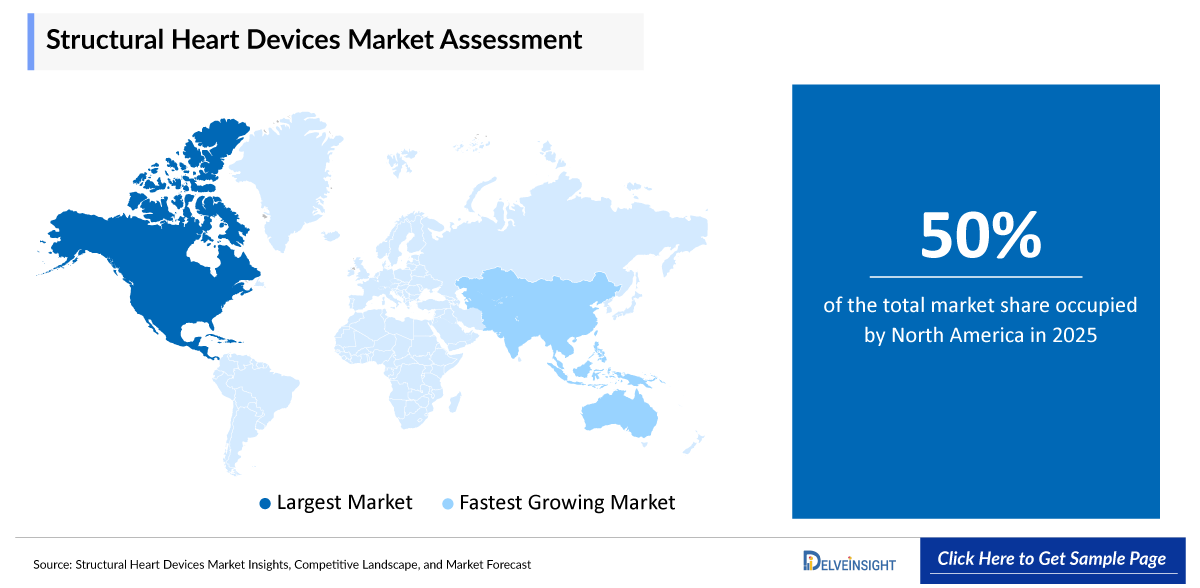
- North America dominated the global Structural Heart Devices market revenue with a 50% share in 2025, representing the highest regional market share globally.
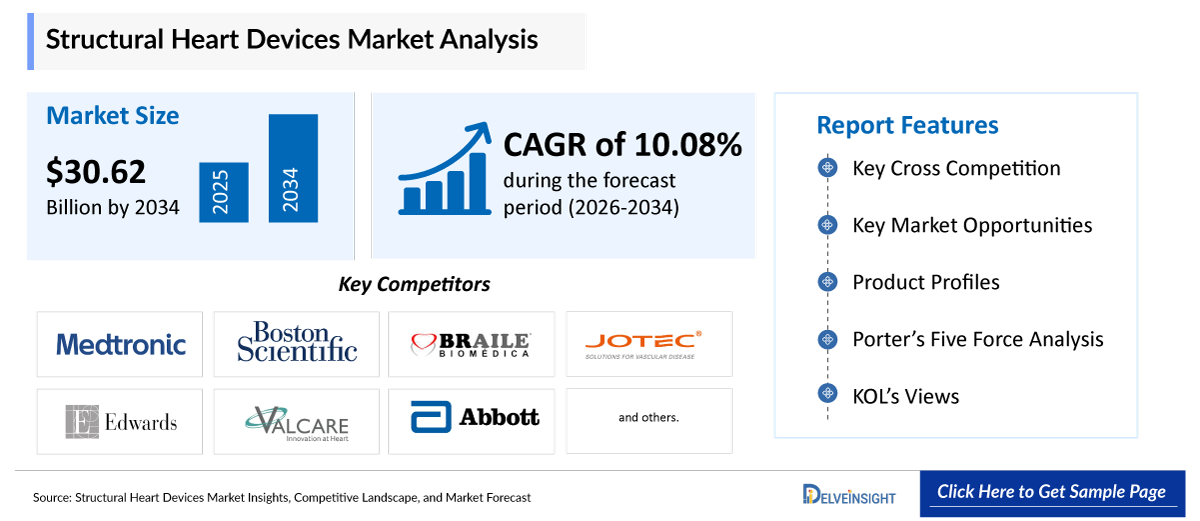
A structural heart device is a specialized medical technology designed to diagnose, repair, or replace abnormalities in the heart's structure, including its valves, chambers, walls, and associated vessels. Because structural heart disease encompasses both congenital defects, such as atrial septal defect, ventricular septal defect, and patent foramen ovale, and acquired valvular disorders, such as aortic valve stenosis and mitral regurgitation, treatment increasingly relies on catheter-based repair devices, including occluders, annuloplasty devices, and valvuloplasty devices, alongside surgical and transcatheter replacement devices, including mechanical and tissue heart valves. These technologies offer minimally invasive alternatives to open-heart surgery, reducing surgical trauma, shortening hospital stays, and expanding treatment access to elderly and high-risk patients who are often poor candidates for conventional surgery. The market is organized by product type across repair devices, including occluders, annuloplasty devices, valvuloplasty devices, and others, and replacement devices, including mechanical heart valves and tissue heart valves; by application across atrial septal defect, aortic valve stenosis, patent foramen ovale, ventricular septal defects, mitral regurgitation, and others; and by end-user across hospitals, ambulatory surgical centers, and others. Driven by the rising prevalence of cardiovascular and valvular disorders, continuous technological advancement in transcatheter platforms, and the accelerating global shift toward minimally invasive cardiac interventions, structural heart devices have become a cornerstone of modern interventional cardiology.
Structural Heart Devices Market Key Growth Drivers
- The rising global prevalence of cardiovascular and valvular disorders, including aortic stenosis, mitral regurgitation, and congenital heart defects, is expanding the patient pool eligible for structural heart interventions.
- Aortic valve stenosis has emerged as the most common valvular pathology worldwide, affecting an estimated 9 million people, while mitral regurgitation affects nearly 24 million people globally, sustaining durable long-term demand.
- Continuous technological advancement, including next-generation transcatheter heart valves, minimally invasive mitral and tricuspid repair systems, and improved annuloplasty platforms, is broadening eligible patient anatomies and improving procedural outcomes.
- Growing demand for minimally invasive cardiac interventions is accelerating adoption, as catheter-based procedures offer reduced surgical trauma, shorter hospital stays, and faster recovery relative to open-heart surgery.
- Regulatory approvals and label expansions, including Edwards Lifesciences' April 2025 CE Mark for the SAPIEN M3 transcatheter mitral valve replacement system and Abbott's continued TriClip clinical evidence generation, are widening the treatable patient population.
- Heavy capital investment and active M&A activity, including Boston Scientific's acquisition of Baylis Medical and Artivion's 2026 acquisition of Endospan, are expanding structural heart device portfolios and manufacturing capacity.
- An aging global population and rising rates of hypertension, obesity, and diabetes are increasing the incidence of degenerative valvular disease, sustaining long-term structural heart device demand through 2034.
Key Companies in Structural Heart Devices Market
The competitive landscape is led by the following active device manufacturers:
- Medtronic
- Boston Scientific Corporation
- Braile Biomedica
- JOTEC GmbH
- Edwards Life Sciences Corporation
- Valcare Medical
- W. L. Gore & Associates, Inc.
- Abbott Laboratories
- Cardiovascular Systems, Inc.
- XELTIS BV
For illustrative purposes, only the top 10 companies are listed in the Table of Contents. The report may include analysis and references to additional companies relevant to the market assessment.
Structural Heart Devices Market Size
The following snapshot summarizes the principal report metrics for the structural heart devices market.
|
Report Metrics |
Details |
|
2025 Market Size |
USD 12.94 billion |
|
2034 Projected Market Size |
USD 30.62 billion |
|
Growth Rate (2026-2034) |
10.08% CAGR |
|
Largest Market |
North America |
|
Fastest Growing Market |
Asia-Pacific |
|
Market Structure |
Moderately Consolidated |
All market values are expressed in USD and represent DelveInsight estimates synthesized from primary and secondary research.
Factors Contributing to the Growth of the Structural Heart Devices Market
Market Drivers
Rising Prevalence of Cardiovascular and Valvular Disorders
The most powerful driver of the Structural Heart Devices market is the rising global burden of valvular and structural heart disease. Aortic valve stenosis has become the most common valvular pathology worldwide, affecting an estimated 9 million people, while mitral regurgitation affects nearly 24 million people globally, and aortic regurgitation continues to rise alongside diastolic hypertension. Congenital heart defects, including atrial septal defect, ventricular septal defect, and patent foramen ovale, remain among the most common birth anomalies diagnosed worldwide, with congenital heart defects affecting nearly 1% of all births in the United States, or roughly 40,000 babies each year, and about one in four of these infants requiring immediate intervention. In the United States alone, more than 5 million people are diagnosed with heart valve disease annually, with over 25,000 associated deaths. Because these conditions frequently progress to heart failure, arrhythmias, or pulmonary hypertension if untreated, they create a large and durable population requiring repair or replacement devices, anchoring market growth through 2034.
Technological Advancements in Transcatheter Platforms
Continuous innovation in device design and interventional technique has been pivotal in expanding the scope and safety of structural heart procedures. Next-generation transcatheter heart valves, minimally invasive mitral and tricuspid repair systems, and left atrial appendage closure devices are being engineered for improved durability, precision, and patient outcomes. Complementary advances in real-time imaging, 3D echocardiography, and AI-enabled procedural guidance have further enhanced accuracy and physician confidence. Newer TAVR systems are now designed to treat a wider range of patient anatomies, including bicuspid valves, while restorative and bioresorbable polymer valve platforms, such as those in development by Xeltis, aim to evolve into living tissue over time. These advancements are broadening treatment applicability and reinforcing market growth.
Growing Demand for Minimally Invasive Cardiac Interventions
There is a clear global shift toward minimally invasive treatment options due to their advantages over traditional open-heart surgery. Catheter-based procedures using structural heart devices offer reduced surgical trauma, shorter hospital stays, lower infection risk, and quicker recovery, making them particularly attractive for elderly patients and those with multiple comorbidities. The rapid clinical adoption of transcatheter aortic valve replacement reflects this growing preference, with TAVR now considered standard care across many high-risk and intermediate-risk patient groups, while transcatheter mitral and tricuspid repair and replacement platforms are following a similar adoption curve.
Regulatory Approvals and Expanding Clinical Indications
A steady wave of regulatory approvals and label expansions is increasing procedural volumes and commercial demand. In April 2025, Edwards Lifesciences' SAPIEN M3 mitral valve replacement system received CE Mark approval for patients with moderate-to-severe or severe mitral regurgitation who are not candidates for surgery or transcatheter edge-to-edge repair. In March 2025, Abbott reported two-year TRILUMINATE Pivotal trial results demonstrating durable improvement in tricuspid regurgitation with its TriClip system. Each approval and expanded indication broadens the treatable patient population and creates durable, recurring demand for compliant, high-volume device manufacturing.
Investment, M&A Activity, and Portfolio Expansion
Heavy capital investment and active consolidation are expanding structural heart device portfolios and manufacturing capacity. Boston Scientific acquired Baylis Medical to strengthen its structural heart and transseptal access portfolio, while Artivion, the parent of JOTEC GmbH, completed its USD 135 million acquisition of Endospan Ltd. in May 2026 to expand its aortic arch and structural repair platform. Valcare Medical, which has raised more than USD 44 million to date, advanced its AMEND transcatheter mitral annuloplasty system through an Early Feasibility Study, including the first U.S. transseptal implantation in February 2026. This sustained investment expands available manufacturing capacity, deepens clinical evidence, and supports the scale-up of next-generation repair and replacement platforms through the forecast period.
Aging Population and Rising Cardiovascular Risk Factors
The aging of the global population, combined with rising rates of hypertension, obesity, and diabetes, is expanding the pool of patients presenting with degenerative valvular and structural heart conditions. In the United Kingdom, heart valve disease affects 11.29% of individuals aged 65 and older, while in Australia, more than 500,000 individuals were diagnosed with heart valve disease in 2024, with an additional estimated 250,000 cases remaining undiagnosed. As life expectancy continues to rise worldwide, the incidence of age-related valvular degeneration is expected to increase correspondingly, sustaining long-term demand for both repair and replacement structural heart devices.
Market Restraints
Despite strong momentum, the Structural Heart Devices market faces material constraints. Frequent product failures and recalls undermine physician confidence, disrupt treatment adoption, and create financial and reputational challenges for manufacturers, with device malfunctions or durability issues often necessitating product withdrawals that delay procedures and raise patient-safety concerns. Stringent regulatory requirements for product approval, including extensive clinical trials, long evaluation timelines, and rigorous safety assessments, slow innovation and create significant barriers to entry for new players. The high capital intensity of developing and manufacturing transcatheter platforms, combined with the need for specialized hybrid operating rooms, catheterization labs, and highly trained interventional cardiologists, constrains adoption in emerging economies and lower-resourced healthcare systems. Reimbursement variability across geographies, alongside the logistical and cost pressures introduced by tariffs on imported medical devices and components, further tempers near-term growth, even as the underlying drivers of rising disease prevalence, technological innovation, and minimally invasive adoption remain firmly intact.
Structural Heart Devices Market Segment Analysis
The Structural Heart Devices by Market by Product Type (Repair Device [Occluders, Annuloplasty Devices, Valvuloplasty Devices, and Others] and Replacement Device [Mechanical Heart Valves and Tissue Heart Valves]), Application (Atrial Septal Defect, Aortic Valve Stenosis, Patent Foramen Ovale, Ventricular Septal Defects, Mitral Regurgitation, and Others), End-User (Hospital, Ambulatory Surgical Centers, and Others), and Geography (North America, Europe, Asia-Pacific, and Rest of World).
By Product Type
Dominant Subsegment: Replacement Device.
Dominant: Replacement Device ~ 63%
The replacement device segment accounted for approximately 63% of the Structural Heart Devices market in 2025. Replacement devices, spanning surgical and transcatheter mechanical and tissue heart valves, lead the market because transcatheter aortic valve replacement has become standard care across high-risk, intermediate-risk, and increasingly low-risk patients with severe aortic valve stenosis. Tissue heart valves dominate replacement volumes given their favorable hemodynamic profile and lower long-term anticoagulation burden relative to mechanical valves, while mechanical heart valves, championed by durable platforms such as On-X, remain the standard for younger patients requiring extended device longevity. The breadth of approved transcatheter valve platforms from Edwards Lifesciences, Medtronic, Abbott, and Boston Scientific, combined with continuous innovation extending TAVR to bicuspid and lower-risk anatomies, sustains great and dependable demand for replacement devices. While repair devices, particularly annuloplasty systems, are the fastest-growing product category, propelled by the expansion of transcatheter mitral and tricuspid repair, the sheer procedural volume and clinical maturity of valve replacement secure the segment's leadership across the forecast period.
By Application
Dominant: Atrial Septal Defect ~ 29%
The atrial septal defect segment accounted for approximately 29% of the Structural Heart Devices market in 2025. Atrial septal defect repair leads the application segment because ASDs are among the most common congenital heart defects diagnosed worldwide, and left untreated, they can progress to pulmonary hypertension, arrhythmias, and heart failure, creating consistent, recurring treatment demand. The rapid adoption of minimally invasive occluder devices has transformed ASD management, allowing physicians to close defects through catheter-based intervention rather than open-heart surgery, reducing procedural risk and recovery time while improving long-term outcomes. Ongoing innovation in occluder design, improved intraprocedural imaging, and expanding awareness and early detection are further driving adoption. While aortic valve stenosis represents the largest single valvular disease burden globally, with an estimated 9 million people affected, and mitral regurgitation is the fastest-growing application on the back of expanding transcatheter repair adoption, the high incidence and established treatment pathway for atrial septal defect secure its leadership across the forecast period.
By End-User
Dominant: Hospitals ~ 45%
The hospital segment accounted for approximately 45% of the Structural Heart Devices market in 2025. Hospitals dominate the end-user landscape because they remain the central hub for diagnosing, treating, and managing complex cardiovascular conditions. Structural heart procedures such as transcatheter aortic valve replacement, mitral and tricuspid repair, annuloplasty, and septal defect closure require advanced infrastructure, specialized equipment, and highly skilled cardiologists and surgeons- resources concentrated almost exclusively in hospital settings. Hospitals are increasingly investing in state-of-the-art hybrid operating rooms, catheterization laboratories, and advanced imaging systems, enabling higher-precision, image-guided therapies, while comprehensive post-operative care and multi-disciplinary heart teams strengthen their role as the preferred treatment centers. Ambulatory surgical centers are gaining share as select lower-risk structural procedures migrate to outpatient settings, but the complexity and risk profile of most structural heart interventions keep hospitals firmly in the lead across the forecast period.
Structural Heart Devices Market Region Analysis
Dominant Region: North America
North America accounted for approximately 50% of the global Structural Heart Devices market revenue in 2025, representing the highest regional market share globally. The region's dominance reflects a mature interventional cardiology ecosystem, a strong clinical-research base, and a favorable regulatory environment supported by frequent FDA product approvals and new device launches from leading manufacturers. Congenital heart defects affect nearly 1% of all births in the United States, impacting approximately 40,000 babies each year, while more than 5 million Americans are diagnosed with heart valve disease annually, with over 25,000 associated deaths, underscoring persistent clinical need. North America hosts the largest concentration of hybrid operating rooms, catheterization labs, and skilled structural heart programs, and sponsors benefit from proximity to leading manufacturers, including Medtronic, Edwards Lifesciences, Abbott, and Boston Scientific. Strong reimbursement frameworks, regulatory clarity, and continued capacity investment anchor the region's continued leadership across the forecast period.
Fastest Growing Region: Asia-Pacific
Asia-Pacific is the fastest-growing region in the Structural Heart Devices market. The region's elevated CAGR is driven by rising cardiovascular and valvular disease prevalence, rapid expansion of interventional cardiology infrastructure, and growing healthcare investment across China, Japan, India, South Korea, and Australia. A growing elderly population, combined with lifestyle-related risk factors such as diabetes, hypertension, and obesity, is significantly increasing the incidence of structural heart conditions. Leading manufacturers are expanding their regional presence, partnering with local distributors, and pursuing regulatory approvals to accelerate market entry, while regional players such as Microport, Meril Life Sciences, and Venus Medtech scale local manufacturing capacity. The combination of high disease burden, infrastructure build-out, and improving physician training positions Asia-Pacific as the principal source of incremental growth over the forecast period.
Regional Commentary
North America
North America accounted for approximately 50% of the global Structural Heart Devices market revenue in 2025. The United States dominates on the strength of its interventional cardiology infrastructure, clinical-research base, FDA regulatory clarity, and the concentrated presence of leading device manufacturers, while continued investment in hybrid operating rooms and catheterization capacity reinforces its leadership.
Europe
Europe is a large and advanced regional market, supported by established CE Mark regulatory pathways, strong government-backed reimbursement in Germany, France, and the United Kingdom, and a leading role in clinical research and trial activity for next-generation mitral and tricuspid repair systems. Capacity investments by JOTEC GmbH, Braile Biomedica's European distribution partners, and continued transcatheter innovation reinforce the region's role in both diagnostic and therapeutic structural heart programs.
Asia-Pacific
Asia-Pacific is the fastest-growing region, propelled by rising cardiovascular and valvular disease incidence, rapid infrastructure build-out, and growing healthcare investment across China, Japan, India, South Korea, and Australia. Expanding TAVR and septal defect closure adoption, combined with growing local manufacturing capacity from regional players, is accelerating regional structural heart device growth.
Rest of World
The Rest of World region, spanning Latin America, the Middle East, and Africa, is an emerging growth frontier. Expanding cardiac care infrastructure, rising demand for minimally invasive valve therapy, and efforts to align regulatory frameworks with global standards are gradually broadening access, while international partnerships support the build-out of regional interventional cardiology capacity.
Structural Heart Devices Market Competitive Landscape
The Structural Heart Devices market is classified as Moderately Consolidated. A group of global leaders with broad product portfolios and deep clinical evidence, including Medtronic, Edwards Lifesciences, Abbott, and Boston Scientific, anchors the top tier through robust transcatheter valve, repair, and occluder platforms, while specialized and fast-scaling providers such as Valcare Medical, XELTIS BV, JOTEC GmbH, Braile Biomedica, W. L. Gore & Associates, and Cardiovascular Systems compete through focused technologies, niche clinical indications, and regional manufacturing strength, increasing competition across the fastest-growing repair segments.
The competitive landscape can be evaluated across the following dimensions:
- Market concentration: Moderately consolidated, with a handful of global leaders dominating through robust product portfolios and a fast-growing field of specialized transcatheter repair providers.
- Leading players: Medtronic, Edwards Lifesciences, Abbott, and Boston Scientific anchor the top tier through broad transcatheter valve and repair portfolios and continuous clinical evidence generation.
- Geographic reach: Leaders operate global, multi-country manufacturing and distribution networks essential for supplying hospitals and cardiac centers worldwide.
- Service portfolio strength: Top players offer end-to-end repair and replacement portfolios spanning occluders, annuloplasty and valvuloplasty devices, and mechanical and tissue heart valves.
- Clinical evidence: Ownership of long-term clinical trial data, including Abbott's TRILUMINATE Pivotal trial and Edwards Lifesciences' pivotal mitral and tricuspid programs, is a decisive competitive advantage.
- Strategic partnerships: Collaborations with hospital networks, research institutions, and investigator sites, such as Valcare Medical's work with Banner - University Medical Center, extend clinical reach.
- M&A activity: Active consolidation, including Boston Scientific's acquisition of Baylis Medical and Artivion's 2026 acquisition of Endospan, is expanding structural heart portfolios.
- Manufacturing capabilities: Advanced polymer, nitinol, and pericardial tissue engineering, alongside precision transcatheter delivery systems, are key competitive moats.
- Innovation focus: Transcatheter mitral and tricuspid repair and replacement, next-generation annuloplasty devices, restorative and bioresorbable valve platforms, and AI-enabled procedural guidance.
Structural Heart Devices Market Recent Developmental Activities
In May 2026, Artivion, Inc., the parent company of JOTEC GmbH, completed its acquisition of Endospan Ltd. for an upfront net purchase price of USD 135 million, adding the NEXUS Aortic Arch System to its structural and aortic repair portfolio.
In February 2026, Valcare Medical, Inc., announced the successful first U.S. transseptal implantation of its AMEND Transcatheter Mitral Valve Repair Annuloplasty System as part of its ongoing Early Feasibility Study.
In January 2026, XELTIS BV published early clinical outcomes from two trials of its restorative pulmonary valve conduit, showing sustained functionality as the bioabsorbable polymer scaffold is colonized by the patient's own tissue.
In April 2025, Edwards Lifesciences Corporation announced that its SAPIEN M3 transcatheter mitral valve replacement system received CE Mark approval for patients with moderate-to-severe or severe mitral regurgitation unsuitable for surgery or transcatheter edge-to-edge repair.
In March 2025, Abbott Laboratories announced new two-year results from its TRILUMINATE Pivotal trial, showing that the TriClip transcatheter edge-to-edge repair system provides significant and lasting improvement in tricuspid regurgitation.
In March 2025, Valcare Medical, Inc., received FDA approval of an investigational device exemption to commence an Early Feasibility Study of its AMEND Trans-Septal System in patients with functional mitral regurgitation.
In 2025, Boston Scientific Corporation advanced its Watchman FLX Pro left atrial appendage closure platform through continued regulatory clearance and commercial rollout.
In 2024 and 2025, Medtronic secured approvals and expanded commercial availability for its Evolut FX transcatheter aortic valve replacement system, improving deliverability and commissural alignment.
In 2024, Abbott Laboratories introduced the Amplatzer Talisman PFO Occluder in global markets, broadening its structural heart occluder portfolio.
In 2024, Boston Scientific Corporation acquired Baylis Medical to strengthen its structural heart and transseptal access portfolio.
Structural Heart Devices Market Segmentation
Structural Heart Devices Market by Product Type
- Repair Device
- Occluders
- Annuloplasty Devices
- Valvuloplasty Devices
- Others
- Replacement Device
- Mechanical Heart Valves
- Tissue Heart Valves
Structural Heart Devices Market by Application
- Atrial Septal Defect
- Aortic Valve Stenosis
- Patent Foramen Ovale
- Ventricular Septal Defects
- Mitral Regurgitation
- Others
Structural Heart Devices Market by End-User
- Hospital
- Ambulatory Surgical Centers
- Others
Structural Heart Devices Market by Geography
- North America Structural Heart Devices Market
- United States Structural Heart Devices Market Size in USD million (2023-2034)
- Canada Structural Heart Devices Market Size in USD million (2023-2034)
- Mexico Structural Heart Devices Market Size in USD million (2023-2034)
- Europe Structural Heart Devices Market
- Germany Structural Heart Devices Market Size in USD million (2023-2034)
- United Kingdom Structural Heart Devices Market Size in USD million (2023-2034)
- France Structural Heart Devices Market Size in USD million (2023-2034)
- Italy Structural Heart Devices Market Size in USD million (2023-2034)
- Spain Structural Heart Devices Market Size in USD million (2023-2034)
- Rest of Europe Structural Heart Devices Market Size in USD million (2023-2034)
- Asia-Pacific Structural Heart Devices Market
- China Structural Heart Devices Market Size in USD million (2023-2034)
- Japan Structural Heart Devices Market Size in USD million (2023-2034)
- India Structural Heart Devices Market Size in USD million (2023-2034)
- Australia Structural Heart Devices Market Size in USD million (2023-2034)
- South Korea Structural Heart Devices Market Size in USD million (2023-2034)
- Rest of Asia-Pacific Structural Heart Devices Market Size in USD million (2023-2034)
- Rest of the World (RoW) Structural Heart Devices Market
- Middle East Structural Heart Devices Market Size in USD million (2023-2034)
- Africa Structural Heart Devices Market Size in USD million (2023-2034)
- South America Structural Heart Devices Market Size in USD million (2023-2034)
Structural Heart Devices Market Recent Industry Trends and Milestones (2023-2026)
|
Category |
Key Developments |
|
Structural Heart Devices Market Product Approval |
Edwards Lifesciences launched the SAPIEN 3 Ultra RESILIA transcatheter heart valve platform, designed for enhanced durability and minimally invasive aortic valve replacement; Abbott introduced the Amplatzer Talisman PFO Occluder in global markets, broadening its occluder portfolio; Medtronic secured approvals for the Evolut FX TAVR system, improving deliverability and commissural alignment. |
|
Structural Heart Devices Market Expansion |
Boston Scientific advanced its Watchman FLX Pro left atrial appendage closure platform through FDA clearance; Edwards Lifesciences received CE Mark approval for its SAPIEN M3 transcatheter mitral valve replacement system in April 2025; Abbott secured continued FDA support for its TriClip transcatheter edge-to-edge repair system for tricuspid regurgitation. |
|
Structural Heart Devices Market Investment |
Abbott partnered with cardiovascular care networks to expand access to transcatheter interventions; Medtronic collaborated with hospital networks across Europe and Asia-Pacific to accelerate TAVR adoption; Valcare Medical worked with investigator sites, including Banner - University Medical Center, to advance its AMEND transcatheter mitral annuloplasty program. |
|
Company Strategy |
Boston Scientific acquired Baylis Medical to strengthen its structural heart and transseptal access portfolio; Artivion, the parent of JOTEC GmbH, completed its acquisition of Endospan Ltd. in May 2026, expanding its aortic arch and structural repair portfolio; Edwards Lifesciences pursued targeted acquisitions to strengthen its mitral and tricuspid repair pipeline. |
|
Emerging Technologies |
Leading companies are prioritizing R&D investment to improve device durability, expand indications toward younger and lower-risk patients, and broaden minimally invasive treatment options across repair and replacement portfolios. |
Structural Heart Devices Market Startup Funding and Investment Trends
Investment in the Structural Heart Devices ecosystem has concentrated on transcatheter mitral and tricuspid annuloplasty, restorative valve platforms, and next-generation occluder technology. The following companies illustrate recent funding and investment activity and technology focus.
|
Company |
Total Funding |
Funding Stage |
Main Offering |
Core Technology |
|
Millipede, Inc. |
USD 90+ million |
Early Commercial |
IRIS Transcatheter Annuloplasty Ring |
Percutaneous mitral annuloplasty implant for functional mitral regurgitation |
|
Request for unlocking the report of the @ Structural Heart Devices Market | ||||
Capital continues to flow toward providers that advance clinically validated, minimally invasive repair and replacement platforms. Millipede's IRIS Transcatheter Annuloplasty Ring and Valcare Medical's AMEND system underscore sustained investor conviction in transcatheter mitral repair, while established leaders including Medtronic, Edwards Lifesciences, Abbott, and Boston Scientific continue to reinvest in R&D and pursue targeted acquisitions, such as Boston Scientific's purchase of Baylis Medical and Artivion's acquisition of Endospan. Collectively, these investments signal conviction that transcatheter innovation, restorative device technology, and expanding minimally invasive indications will define the next phase of competitive advantage in the global Structural Heart Devices market.
Key Takeaways from the Structural Heart Devices Market Report Study
- Market size analysis for the current structural heart devices market size (2025), and market forecast for 9 years (2026 to 2034).
- Top key product/technology developments, mergers, acquisitions, partnerships, and joint ventures that happened over the last 3 years.
- Key companies dominating the global structural heart devices market.
- Various opportunities available for competitors in the structural heart devices market space.
- What are the top-performing segments in 2025? How will these segments perform in 2034?
- Which are the top-performing regions and countries in the current structural heart devices market scenario?
- Which are the regions and countries where companies should concentrate their opportunities for structural heart devices market growth in the future?
Target audience who can benefit from this structural heart devices market report study
- Structural heart devices product providers
- Research organizations and consulting companies
- Structural heart devices-related organizations, associations, forums, and other alliances.
- Government and corporate offices
- Start-up companies, venture capitalists, and private equity firms
- Distributors and traders dealing in structural heart devices
- Various end-users who want to know more about the structural heart devices market and the latest technological developments in the structural heart devices market.

