
Surgical Instruments Market Summary
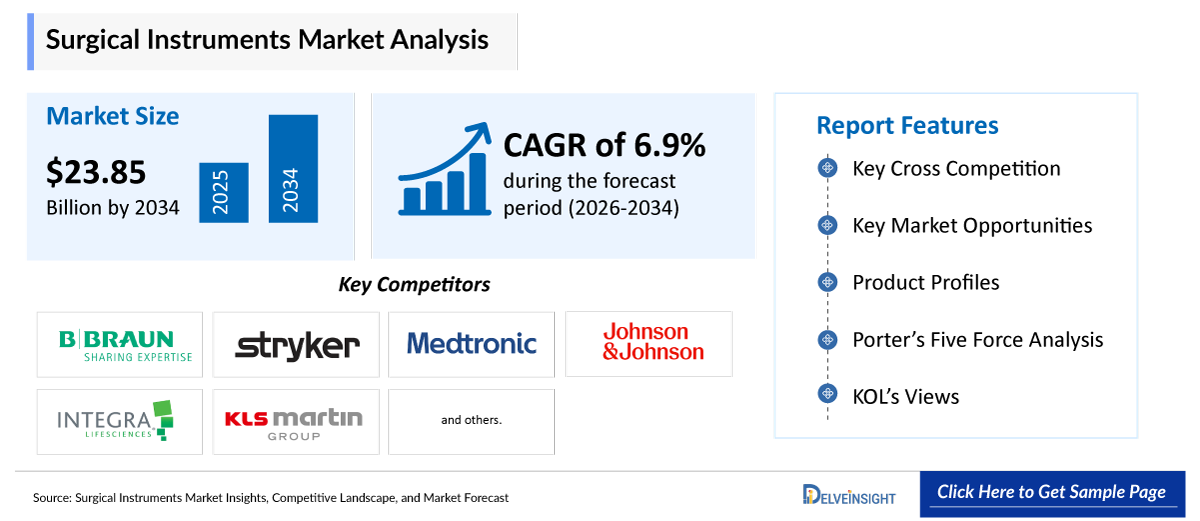
- The Surgical Instruments market size is estimated at USD 13.10 billion in 2025 and is projected to reach USD 23.85 billion by 2034. Growth is anchored in rising global surgical procedure volumes, expanding adoption of minimally invasive and robotic-assisted surgery, and the rapid growth of ambulatory surgical infrastructure.
- The global surgical instruments market is growing at a CAGR of 6.9% during the forecast period from 2026 to 2034.
- By product type, the handheld surgical instruments segment dominated the Surgical Instruments market with a 27% share in 2025.
- By instrument type, the reusable surgical instruments segment dominated the Surgical Instruments market with a 58% share in 2025.
- By application, the general surgery segment dominated the Surgical Instruments market with a 34% share in 2025.
- By end-user, the hospitals segment dominated the Surgical Instruments market with a 61% share in 2025.
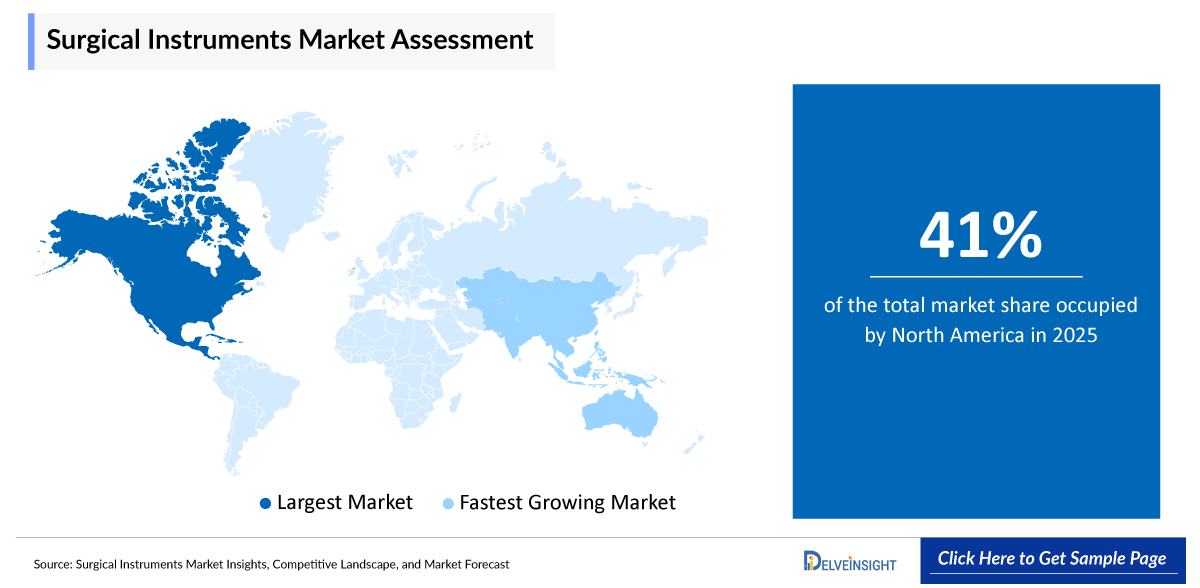
- North America dominated the global surgical instruments market revenue with a 41% share in 2025, representing the highest regional market share globally.
A surgical instrument is a specialized tool or device designed to perform specific actions during a surgical procedure, including cutting, dissecting, grasping, retracting, suturing, clamping, and providing access for viewing internal tissue. Surgical instruments span handheld instruments such as forceps, scissors, scalpels, and retractors; electrosurgical instruments that use electrical energy to cut and coagulate tissue; suturing instruments including needle holders and staplers; cutting instruments; powered instruments driven by electricity, battery, compressed air, or ultrasound; and endoscopic and minimally invasive instruments used in laparoscopic and robotic-assisted procedures. Instruments are further differentiated by instrument type across reusable, disposable, and single-use categories, and are deployed across general surgery, cardiovascular surgery, orthopedic surgery, neurosurgery, and other specialties in hospitals, ambulatory surgical centers, and diagnostic and surgical centers. Driven by rising global surgical volumes, the shift toward minimally invasive and robotic-assisted procedures, heightened infection-control standards, and sustained investment by leading manufacturers in instrument innovation and manufacturing capacity, surgical instruments have become foundational infrastructure underpinning safe and effective surgical care worldwide.
Surgical Instruments Market Key Growth Drivers
- Rising global surgical procedure volumes, with more than 320 million surgical procedures performed worldwide each year and surgical instruments utilized in nearly every intervention, are driving sustained baseline demand.
- Growing adoption of minimally invasive and robotic-assisted surgery, exemplified by Stryker's Mako and Zimmer Biomet's ROSA robotic systems both receiving 2024 FDA approvals for shoulder reconstruction with limited commercial launches in 2025, is expanding demand for specialized endoscopic and powered instrumentation.
- The rapid expansion of ambulatory surgical centers, which offer lower-cost, higher-throughput outpatient procedures, is broadening the customer base for single-use and disposable instrument sets.
- The rising global burden of chronic disease and an aging population is increasing surgical volumes across cardiovascular, orthopedic, general, and neurosurgical specialties.
- Heightened infection-control standards and hospital-acquired-infection prevention protocols are accelerating the shift toward single-use and disposable instruments alongside advanced sterilization and reprocessing systems.
- Active portfolio expansion and M&A among leading manufacturers, including Zimmer Biomet's 2025 acquisition of Monogram Technologies and Integra LifeSciences' acquisition of Acclarent from Ethicon, are expanding instrument portfolios and technological capability.
- Expanding healthcare infrastructure investment and rising surgical capacity in emerging markets across Asia-Pacific and Latin America is broadening market access for both reusable and disposable instrument lines.
Key Companies in Surgical Instruments Market
The competitive landscape is led by the following active manufacturers:
- B. Braun Melsungen AG
- Stryker Corporation
- Medtronic plc
- Johnson & Johnson (Ethicon)
- Integra LifeSciences Corporation
- KLS Martin Group
- Teleflex Incorporated
- STERIS Corporation
- Zimmer Biomet Holdings, Inc.
- Sklar Corporation, and others
For illustrative purposes, only the top 10 companies are listed in the Table of Contents. The report may include analysis and references to additional companies relevant to the market assessment.
Surgical Instruments Market Size
The following snapshot summarizes the principal report metrics for the Surgical Instruments market.
|
Report Metrics |
Details |
|
2025 Market Size |
USD 13.10 billion |
|
2034 Projected Market Size |
USD 23.85 billion |
|
Growth Rate (2026-2034) |
6.9% CAGR |
|
Largest Market |
North America |
|
Fastest Growing Market |
Asia-Pacific |
|
Market Structure |
Moderately Fragmented |
All market values are expressed in USD and represent DelveInsight estimates synthesized from primary and secondary research.
Factors Contributing to the Growth of the Surgical Instruments Market
Surgical Instruments Market Drivers
- Rising Global Surgical Procedure Volumes: The most fundamental driver of the Surgical Instruments market is the sheer, sustained volume of surgical procedures performed globally, exceeding 320 million operations annually, with surgical instruments used in nearly every intervention. General surgery, cardiovascular surgery, orthopedic surgery, and neurosurgery each generate recurring, high-frequency demand for handheld, cutting, suturing, and powered instruments. As global surgical volumes continue to climb alongside population growth and expanding access to surgical care, baseline instrument demand across both reusable and single-use categories rises in direct proportion, anchoring market growth through 2034.
- Growing Adoption of Minimally Invasive and Robotic-Assisted Surgery: The rapid clinical adoption of minimally invasive and robotic-assisted surgical techniques is reshaping instrument demand toward specialized endoscopic, laparoscopic, and powered platforms. Stryker's Mako and Zimmer Biomet's ROSA robotic systems both received FDA approval for shoulder reconstruction applications in 2024 and began limited commercial launches in 2025, while Medtronic continues to expand its Hugo robotic-assisted surgery platform across general surgery and urology. These robotic platforms rely on companion endoscopic and minimally invasive instrument sets, and as robotic-assisted procedures expand into new anatomical applications, demand for compatible, high-precision surgical instrumentation grows correspondingly across the forecast period.
- Expansion of Ambulatory Surgical Centers: The rapid proliferation of ambulatory surgical centers is broadening the customer base for surgical instruments beyond traditional hospital settings. ASCs offer lower-cost, higher-throughput outpatient procedures across ophthalmology, orthopedics, and general surgery, and their emphasis on procedural efficiency and rapid turnover favors single-use and disposable instrument sets that eliminate reprocessing downtime. As payers and health systems continue to shift eligible procedures toward outpatient settings to reduce costs, ambulatory surgical centers are becoming an increasingly important and fast-growing channel for surgical instrument manufacturers.
- Rising Chronic Disease Burden and Aging Population: The growing global burden of chronic disease and an aging population are expanding the pool of patients requiring surgical intervention. Rising rates of cardiovascular disease, osteoarthritis, cancer, and other age-related conditions are driving higher surgical volumes across cardiovascular surgery, orthopedic surgery, and general surgery. As life expectancy increases and healthcare systems expand surgical capacity to address this demand, the volume and complexity of procedures requiring specialized surgical instrumentation continue to rise, sustaining instrument demand across the forecast period.
- Heightened Infection-Control Standards Favoring Single-Use Instruments: Stringent infection-control standards and growing awareness of hospital-acquired infections are accelerating the shift toward single-use and disposable surgical instruments in applicable procedures. Regulatory bodies and hospital infection-control committees increasingly favor single-use devices where reprocessing risk is elevated, while advanced sterilization and instrument-tracking systems support compliance for reusable instrument sets. This dual dynamic, rising single-use adoption alongside investment in sterilization infrastructure for reusable instruments, is expanding the addressable market across both instrument-type categories.
- Active Portfolio Expansion and M&A Among Leading Manufacturers: Strategic M&A and portfolio realignment among major manufacturers are expanding instrument capabilities and reshaping competitive dynamics. Zimmer Biomet's 2025 acquisition of Monogram Technologies added an AI-navigated robotic surgical instrumentation platform for total knee arthroplasty, Integra LifeSciences acquired ENT instrument maker Acclarent from Ethicon, and Stryker completed the acquisition of Guard Medical to strengthen its surgical wound-care and instrument portfolio. This wave of consolidation and capability expansion is broadening product breadth and accelerating the introduction of next-generation surgical instruments.
- Growing Healthcare Infrastructure Investment in Emerging Markets: Expanding healthcare infrastructure investment across Asia-Pacific, Latin America, and the Middle East is broadening market access for surgical instrument manufacturers. Rising government healthcare spending, growing hospital and ambulatory surgical center construction, and increasing surgical training capacity in China, India, and Southeast Asia are expanding the base of facilities equipped to perform complex surgical procedures. As these markets mature, demand for both cost-effective reusable instruments and premium single-use and powered instruments is expected to accelerate, positioning emerging markets as a key source of incremental growth through 2034.
Surgical Instruments Market Restraints
Despite strong underlying demand, the Surgical Instruments market faces material constraints. Reimbursement pressure and cost-containment initiatives by hospitals and group purchasing organizations are compressing instrument pricing, particularly for commoditized handheld and disposable products, while the high upfront cost of advanced robotic and powered instrument platforms limits adoption among smaller and resource-constrained facilities. Stringent regulatory approval pathways, including FDA 510(k) clearance and the European Union's Medical Device Regulation, lengthen product development timelines and raise compliance costs, particularly for novel powered and robotic-compatible instruments. The complexity and cost of reprocessing reusable instruments, including sterilization validation, instrument tracking, and infection-control compliance, create operational burdens for hospitals and favor higher-cost single-use alternatives in some settings, pressuring overall margins. Volatile raw material costs, particularly for surgical-grade stainless steel and specialized polymers, and global supply chain disruptions affect manufacturing costs and instrument availability. Intensifying price competition from low-cost regional manufacturers, particularly across Asia, is compressing margins in commoditized instrument categories, while a shortage of skilled sterile processing and biomedical technicians constrains hospital reprocessing capacity in several markets. Together, these reimbursement, regulatory, supply chain, and workforce barriers temper the pace of growth, even as the underlying drivers of rising surgical volumes, minimally invasive adoption, and infrastructure investment remain firmly intact.
Surgical Instruments Market Segment Analysis
The surgical instruments market by product type (handheld surgical instruments, electrosurgical instruments, surgical suturing instruments, surgical cutting instruments, powered surgical instruments, endoscopic & minimally invasive instruments, and other surgical instruments), instrument type (reusable surgical instruments, disposable surgical instruments, and single-use surgical instruments), application (general surgery, cardiovascular surgery, orthopedic surgery, neurosurgery, and others), end-users (hospitals, ambulatory surgical centers, diagnostic & surgical centers, and others), and geography (North America, Europe, Asia-Pacific, and Rest of World).
By Product Type
Dominant Subsegment: Handheld Surgical Instruments.
The handheld surgical instruments segment accounted for 27% of the Surgical Instruments market in 2025. Handheld surgical instruments, including forceps, scissors, scalpels, clamps, and retractors, remain the leading product type because they are foundational to virtually every surgical procedure across every specialty, generating the highest recurring procurement volume of any instrument category. Their broad utility, low per-unit cost relative to powered and robotic instruments, and compatibility with both reusable and disposable instrument-type strategies sustain their dominant position across hospitals, ambulatory surgical centers, and diagnostic and surgical centers. While powered surgical instruments and endoscopic and minimally invasive instruments are growing rapidly on the back of robotic-assisted and minimally invasive procedure adoption, the sheer breadth, ubiquity, and procedural necessity of handheld instruments secure their leadership across the forecast period.
By Instrument Type
Dominant Subsegment: Reusable Surgical Instruments.
The reusable surgical instruments segment accounted for 58% of the Surgical Instruments market in 2025. Reusable surgical instruments are the leading instrument type because they offer significant long-term cost advantages for hospitals and surgical centers performing high volumes of procedures, and because well-established sterilization and reprocessing infrastructure supports their continued use across most surgical specialties. Reusable instruments also generate less medical waste than single-use alternatives, aligning with sustainability initiatives increasingly prioritized by health systems. Disposable and single-use surgical instruments are growing quickly, driven by heightened infection-control standards, the convenience they offer ambulatory surgical centers, and their use in specialized minimally invasive procedures, but the entrenched economics and infrastructure supporting reusable instruments secure their leadership across the forecast period.
By Application
Dominant Subsegment: General Surgery.
The general surgery segment accounted for 34% of the Surgical Instruments market in 2025. General surgery is the leading application because it encompasses the broadest and most frequently performed range of surgical procedures, including abdominal, gastrointestinal, hernia repair, and soft-tissue procedures, each requiring extensive use of handheld, cutting, and suturing instruments. The universal presence of general surgery departments across virtually every hospital and surgical center, combined with steady procedure growth driven by rising chronic disease prevalence, sustains large and dependable instrument demand. While orthopedic surgery and cardiovascular surgery are growing rapidly on the back of an aging population and rising cardiovascular disease incidence, the sheer volume and breadth of general surgery procedures secure the segment's leadership across the forecast period.
By End-Users
Dominant Subsegment: Hospitals.
The hospitals segment accounted for 61% of the Surgical Instruments market in 2025. Hospitals are the leading end-user because they perform the largest volume and broadest range of surgical procedures globally, spanning routine and complex cases across every surgical specialty, and maintain the capital infrastructure required for both reusable instrument reprocessing and advanced powered and robotic instrument platforms. Hospitals' established procurement relationships with leading manufacturers and their role as primary sites for complex and emergency surgery sustain large, recurring instrument demand. Ambulatory surgical centers are the fastest-growing end-user as procedure volumes shift toward outpatient settings, but the scale and procedural breadth of hospital-based surgery secure hospitals' leadership across the forecast period.
Surgical Instruments Market Region Analysis
Dominant Region: North America
North America accounted for 41% of the global surgical instruments market revenue in 2025, representing the highest regional market share globally. The region's dominance reflects a mature, high-volume healthcare system, extensive ambulatory surgical center infrastructure, strong reimbursement frameworks, and early adoption of minimally invasive and robotic-assisted surgical technologies, particularly in the United States. North America hosts the largest concentration of major surgical instrument manufacturers, including Stryker, Medtronic, Zimmer Biomet, Integra LifeSciences, and Teleflex, and sponsors benefit from proximity to advanced manufacturing and R&D infrastructure. Heavy investment in robotic-assisted surgery platforms, rising surgical procedure volumes tied to an aging population and chronic disease burden, and continued expansion of ambulatory surgical capacity drive substantial instrument demand. Strong reimbursement, regulatory clarity from the FDA, and a dense network of hospitals and surgical centers anchor the region's continued leadership across the forecast period.
Fastest Growing Region: Asia-Pacific
Asia-Pacific is the fastest-growing region in the Surgical Instruments market. The region's elevated CAGR is driven by rising surgical procedure volumes, rapid expansion of hospital and ambulatory surgical infrastructure, and growing healthcare investment across China, Japan, India, South Korea, and Australia. China is expanding hospital surgical capacity and domestic instrument manufacturing, Japan is advancing minimally invasive and robotic-assisted surgical adoption, India leverages low-cost manufacturing and a rapidly growing base of accredited surgical facilities, and government healthcare investment across the region is expanding access to surgical care. The combination of rising disease burden, infrastructure build-out, and growing domestic manufacturing capability positions Asia-Pacific as the principal source of incremental growth over the forecast period.
Surgical Instruments Market Regional Commentary
North America
North America accounted for 41% of the global surgical instruments market revenue in 2025. The United States dominates on the strength of its high-volume healthcare system, extensive ambulatory surgical center network, strong reimbursement frameworks, and early adoption of robotic-assisted and minimally invasive surgical technologies, while the concentration of leading manufacturers headquartered in the region reinforces its leadership.
Europe
Europe is a large and advanced regional market, supported by a strong base of established manufacturers including B. Braun, KLS Martin, and STERIS's European operations, harmonized regulatory frameworks under the EU Medical Device Regulation, and well-developed hospital infrastructure across Germany, France, the United Kingdom, Italy, and Spain. Growing adoption of minimally invasive surgery and sustained investment in sterilization and reprocessing infrastructure reinforce the region's role in both instrument manufacturing and consumption.
Asia-Pacific
Asia-Pacific is the fastest-growing region, propelled by rising surgical procedure volumes, rapid hospital and ambulatory surgical infrastructure build-out, and growing healthcare investment across China, Japan, India, South Korea, and Australia. China's expanding domestic manufacturing base, Japan's robotic-assisted surgery adoption, and India's growing accredited hospital network are accelerating regional instrument demand and manufacturing capacity.
Rest of World
The Rest of World region, spanning Latin America, the Middle East, and Africa, is an emerging growth frontier. Expanding hospital and surgical infrastructure, rising surgical procedure volumes, and efforts to align regulatory frameworks with global standards are gradually broadening access, while growing medical tourism and international partnerships support the build-out of regional surgical capacity.
Surgical Instruments Market Competitive Landscape
The Surgical Instruments market is classified as Moderately Fragmented. A group of large, diversified medical technology players with broad instrument portfolios and global manufacturing footprints, including Stryker, Medtronic, Johnson & Johnson (Ethicon), Zimmer Biomet, and B. Braun, anchors the top tier through scale, brand recognition, and integrated product ecosystems, while specialized and regionally focused providers such as KLS Martin Group, Integra LifeSciences, Teleflex, STERIS, and Sklar Corporation compete through focused specialty portfolios, sterilization and reprocessing expertise, and dedicated customer relationships, sustaining competitive intensity across product categories.
The competitive landscape can be evaluated across the following dimensions:
- Market concentration: Moderately fragmented, with large diversified players leading and a broad field of specialized instrument manufacturers competing across niche categories.
- Leading players: Stryker, Medtronic, Johnson & Johnson (Ethicon), Zimmer Biomet, and B. Braun anchor the top tier through scale, portfolio breadth, and global manufacturing reach.
- Geographic reach: Leaders operate global manufacturing and distribution networks; B. Braun alone maintains production facilities and offices across more than 60 countries.
- Product portfolio strength: Top players offer end-to-end instrument portfolios spanning handheld, electrosurgical, suturing, cutting, powered, and endoscopic instruments alongside sterilization and reprocessing solutions.
- Technology and innovation focus: Robotic-assisted and powered instrumentation, AI-navigated surgical platforms, and single-use instrument innovation are decisive competitive advantages.
- Strategic partnerships: Tie-ups between instrument manufacturers, robotic platform developers, and health systems, such as Zimmer Biomet's integration of Monogram's mBOS platform, extend technological reach.
- M&A activity: Active consolidation, including Zimmer Biomet's acquisition of Monogram Technologies, Integra LifeSciences' acquisition of Acclarent, and Teleflex's divestiture of its Acute Care, Interventional Urology, and OEM businesses.
- Manufacturing capabilities: Advanced surgical-grade metallurgy, precision machining, and automated production lines are key competitive moats, particularly for reusable instrument manufacturers.
- Innovation focus: Robotic and AI-navigated instrumentation, single-use instrument expansion, ergonomic design, and sustainable, low-waste manufacturing.
Surgical Instruments Market Recent Developmental Activities
- In 2026, B. Braun Melsungen AG expanded its Aesculap surgical instrument manufacturing capacity in Germany to support growing global demand for reusable and single-use instrument sets. Strategic significance: Strengthens B. Braun's global manufacturing footprint and reinforces its position as an integrated surgical instrument and sterilization solutions provider.
- In 2025, Stryker Corporation launched Steri-Shield 8, a next-generation operating room personal protection system, and completed the acquisition of Guard Medical, Inc., strengthening its surgical wound-care and instrument reprocessing offerings. Strategic significance: Expands Stryker's Instruments division portfolio and reinforces its focus on the surgical wound care market.
- In October 2025, Zimmer Biomet Holdings, Inc. acquired Monogram Technologies for approximately USD 177 million upfront plus milestone-based contingent value rights through 2030, adding the mBOS AI-navigated, CT-based robotic surgical instrumentation platform for total knee arthroplasty. Strategic significance: Strengthens Zimmer Biomet's robotic and powered surgical instrument capabilities and reinforces its position in AI-navigated surgical robotics.
- In December 2025, Teleflex Incorporated announced definitive agreements to divest its Acute Care, Interventional Urology, and OEM businesses for a combined USD 2.03 billion, sharpening its focus on Vascular Access, Interventional, and Surgical instrument businesses. Strategic significance: Streamlines Teleflex's portfolio toward higher-growth surgical and interventional instrument segments.
- In 2025, Integra LifeSciences Corporation completed the acquisition of Acclarent, Inc. from Ethicon, Inc., a Johnson & Johnson MedTech company, for USD 275 million in cash at closing plus additional regulatory milestone payments, adding ENT surgical instruments and technologies. Strategic significance: Establishes Integra as a leading provider of ENT surgical instrumentation and broadens its specialty surgical portfolio.
- In 2025, Johnson & Johnson (Ethicon) divested its Acclarent ENT instruments business to Integra LifeSciences while continuing to expand its core suturing, stapling, and energy-device instrument portfolio. Strategic significance: Sharpens Ethicon's focus on its core general surgery and wound closure instrument franchises.
- In 2025, STERIS Corporation continued integration and expansion of the surgical instrumentation, laparoscopic instrumentation, and sterilization container assets acquired from Becton, Dickinson and Company, broadening its consumable surgical instrument portfolio. Strategic significance: Strengthens STERIS's position across the operating room and sterile processing department.
- In 2025, KLS Martin Group expanded its portfolio of patient-specific surgical instruments and cranio-maxillofacial instrument sets, broadening its footprint in specialized surgical disciplines. Strategic significance: Reinforces KLS Martin's position in precision surgical instrumentation for specialized surgical procedures.
- In September 2025, Sklar Corporation relocated and expanded its West Chester, Pennsylvania operations to increase manufacturing and distribution capacity for its surgical instrument product lines. Strategic significance: Expands Sklar's domestic manufacturing and distribution capacity for reusable surgical instruments.
- In 2025, Medtronic plc advanced its Hugo robotic-assisted surgery platform and expanded its portfolio of powered and energy-based surgical instruments across general surgery and urology applications. Strategic significance: Strengthens Medtronic's position in robotic-assisted and powered surgical instrumentation.
Surgical Instruments Market Segmentation
Surgical Instruments Market by Product Type
Handheld Surgical Instruments
Electrosurgical Instruments
Surgical Suturing Instruments
Surgical Cutting Instruments
Powered Surgical Instruments
Endoscopic & Minimally Invasive Instruments
Other Surgical Instruments
Surgical Instruments Market by Instrument Type
Reusable Surgical Instruments
Disposable Surgical Instruments
Single-use Surgical Instruments
Surgical Instruments Market by Application
General Surgery
Cardiovascular Surgery
Orthopedic Surgery
Neurosurgery
Others
Surgical Instruments Market by End-Users
Hospitals
Ambulatory Surgical Centers
Diagnostic & Surgical Centers
Others
Surgical Instruments Market by Geography
North America Surgical Instruments Market
United States Surgical Instruments Market Size in USD million (2023-2034)
Canada Surgical Instruments Market Size in USD million (2023-2034)
Mexico Surgical Instruments Market Size in USD million (2023-2034)
Europe Surgical Instruments Market
Germany Surgical Instruments Market Size in USD million (2023-2034)
United Kingdom Surgical Instruments Market Size in USD million (2023-2034)
France Surgical Instruments Market Size in USD million (2023-2034)
Italy Surgical Instruments Market Size in USD million (2023-2034)
Spain Surgical Instruments Market Size in USD million (2023-2034)
Rest of Europe Surgical Instruments Market Size in USD million (2023-2034)
Asia-Pacific Surgical Instruments Market
China Surgical Instruments Market Size in USD million (2023-2034)
Japan Surgical Instruments Market Size in USD million (2023-2034)
India Surgical Instruments Market Size in USD million (2023-2034)
Australia Surgical Instruments Market Size in USD million (2023-2034)
South Korea Surgical Instruments Market Size in USD million (2023-2034)
Rest of Asia-Pacific Surgical Instruments Market Size in USD million (2023-2034)
Rest of the World (RoW) Surgical Instruments Market
Middle East Surgical Instruments Market Size in USD million (2023-2034)
Africa Surgical Instruments Market Size in USD million (2023-2034)
South America Surgical Instruments Market Size in USD million (2023-2034)
Surgical Instruments Market Recent Industry Trends and Milestones (2023-2026):
|
Category |
Key Developments |
|
Surgical Instruments Market Product Approval |
Regulatory clearances continue to expand instrument capability. Stryker's Mako and Zimmer Biomet's ROSA robotic systems both received FDA approval for shoulder reconstruction applications in 2024, with limited commercial launches in 2025. Zimmer Biomet's mBOS robotic platform, added through the Monogram Technologies acquisition, received FDA 510(k) clearance for total knee arthroplasty. Each new clearance creates durable demand for compatible instrument sets and reinforces the shift toward robotic-assisted and AI-navigated surgical instrumentation. |
|
Surgical Instruments Market Expansion |
Manufacturers broadened capacity across the value chain. B. Braun expanded Aesculap manufacturing capacity in Germany, Sklar Corporation relocated and expanded its Pennsylvania operations, and STERIS continued integrating surgical instrumentation and sterilization container assets acquired from Becton, Dickinson and Company. Growth of ambulatory surgical centers accelerated demand for single-use instrument sets, while hospitals expanded investment in automated instrument tracking and reprocessing systems. |
|
Surgical Instruments Market Investment |
Capital and consolidation activity accelerated. Zimmer Biomet acquired Monogram Technologies for approximately USD 177 million upfront plus milestone payments (October 2025), Integra LifeSciences acquired Acclarent from Ethicon for USD 275 million (2025), and Teleflex announced the divestiture of its Acute Care, Interventional Urology, and OEM businesses for a combined USD 2.03 billion (December 2025). Stryker completed the acquisition of Guard Medical to strengthen its surgical wound-care portfolio. |
|
Company Strategy |
Stryker Corporation: Portfolio expansion through the Guard Medical acquisition and Steri-Shield 8 launch, reinforcing its Instruments division. Zimmer Biomet Holdings, Inc.: Robotic and AI-navigated instrumentation expansion through the Monogram Technologies acquisition. Medtronic plc: Continued build-out of the Hugo robotic-assisted surgery platform. Johnson & Johnson (Ethicon) and Integra LifeSciences Corporation: Portfolio realignment through the Acclarent divestiture and acquisition. Teleflex Incorporated: Portfolio streamlining toward Vascular Access, Interventional, and Surgical businesses. B. Braun Melsungen AG, KLS Martin Group, STERIS Corporation, and Sklar Corporation: Manufacturing capacity expansion and specialty portfolio strengthening. |
|
Emerging Technologies |
Robotic-assisted and AI-navigated surgical instrumentation are the leading edge of innovation, with platforms such as Mako, ROSA, Hugo, and mBOS expanding into new anatomical applications. Single-use instrument innovation, ergonomic design, and advanced instrument-tracking systems using RFID and barcode technology are addressing infection-control and reprocessing efficiency demands. Sustainability initiatives, including low-waste manufacturing and reduced-plastic packaging, are expanding, and collaborations between manufacturers, hospitals, and academic institutions are accelerating the clinical translation of next-generation surgical instruments. |
Surgical Instruments Market Startup Funding and Investment Trends
Investment in the Surgical Instruments ecosystem has concentrated on robotic and AI-navigated instrumentation, single-use instrument innovation, and specialty instrument portfolio expansion. The following companies illustrate recent funding and investment activity and technology focus.
|
Company |
Total Funding |
Funding Stage |
Main Offering |
Core Technology |
|
Monogram Technologies |
USD 177 million upfront |
Acquired by Zimmer Biomet (2025) |
Robotic knee surgery instrumentation |
AI-navigated robotic platform (mBOS) |
|
Request for unlocking the report of the @ Surgical Instruments Market Insights | ||||
Capital is flowing toward providers that secure robotic and AI-navigated surgical technology and expand specialty instrument portfolios. Zimmer Biomet's acquisition of Monogram Technologies for approximately USD 177 million upfront, with up to USD 12.37 per share in milestone-based contingent value rights through 2030, underscores the strategic value of robotic surgical instrumentation, while Integra LifeSciences' USD 275 million acquisition of Acclarent reflects continued consolidation around specialty instrument categories. Emerging providers and established manufacturers alike are scaling single-use instrument production, robotic-compatible instrument sets, and advanced sterilization and instrument-tracking technology. Collectively, these investments signal conviction that robotic-assisted surgery, single-use instrument innovation, and specialty portfolio depth will define the next phase of competitive advantage in the global surgical instruments market.
Key Takeaways from the Surgical Instruments Market Report Study
- Market size analysis for the current surgical instruments market size (2025), and market forecast for 9 years (2026 to 2034).
- Top key product/technology developments, mergers, acquisitions, partnerships, and joint ventures that happened over the last 3 years.
- Key companies dominating the global surgical instruments market.
- Various opportunities available for competitors in the surgical instruments market space.
- What are the top-performing segments in 2025? How will these segments perform in 2034?
- Which are the top-performing regions and countries in the current surgical instruments market scenario?
- Which are the regions and countries where companies should concentrate their opportunities for surgical instruments market growth in the future?
Target audience who can benefit from this surgical instruments market report study
- Surgical Instruments product providers
- Research organizations and consulting companies
- Neurodegenerative disease therapeutics-related organizations, associations, forums, and other alliances
- Government and corporate offices
- Start-up companies, venture capitalists, and private equity firms
- Distributors and traders dealing in surgical instruments
- Various end-users who want to know more about the Surgical Instruments market and the latest technological developments in the surgical instruments market.

