
Surgical Sutures Market Summary
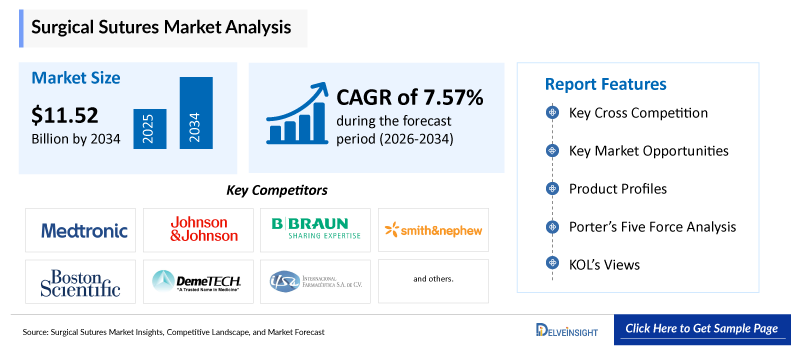
- The Surgical Sutures Market is estimated at USD 6.03 billion in 2025 and is projected to reach USD 11.52 billion by 2034. Growth is anchored by the rising global volume of surgical procedures, increasing prevalence of chronic wounds and traumatic injuries, expanding adoption of minimally invasive and robotic-assisted surgeries requiring advanced wound closure solutions, and continuous product innovation, including antimicrobial, absorbable, and barbed sutures, supported by expanding healthcare infrastructure and improving access to surgical care worldwide.
- The Global Surgical Sutures Market is growing at a CAGR of 7.57% during the forecast period from 2026 to 2034.
Surgical Sutures Market Trends & Insights
- By product type, the suture threads segment dominated the Surgical Sutures market with a 79% share in 2025.
- By suture type, the synthetic sutures segment dominated the Surgical Sutures market with an 85% share in 2025.
- By suture filament, the multifilament segment dominated the Surgical Sutures market with a 52% share in 2025.
- By application, the general surgery segment dominated the Surgical Sutures market with a 34% share in 2025.
- By end-user, the hospitals segment dominated the Surgical Sutures market with a 68% share in 2025.
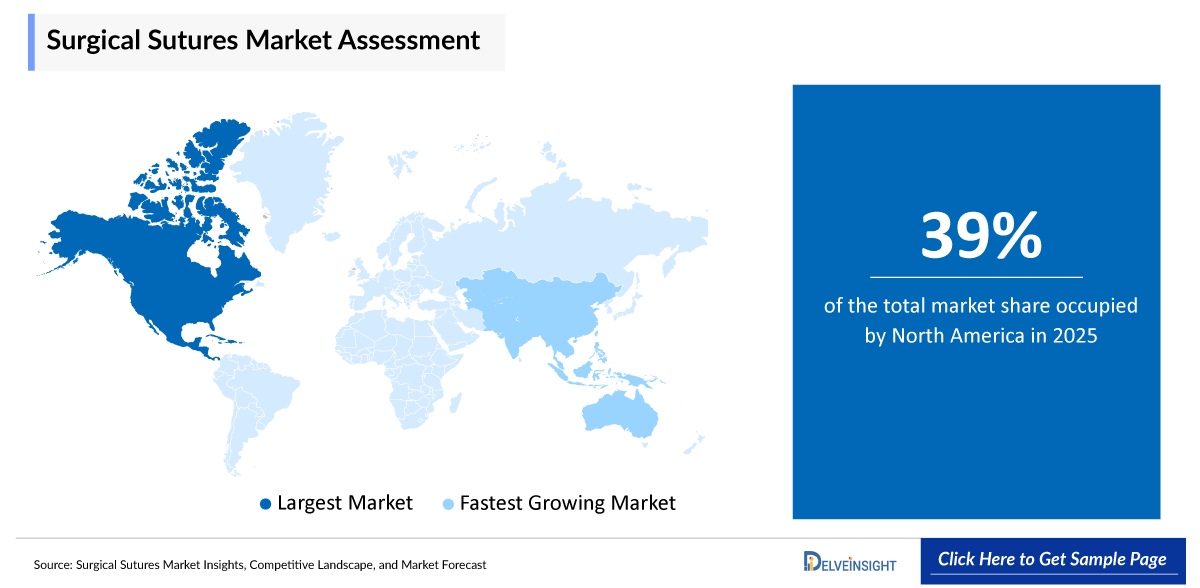
- North America dominated the global Surgical Sutures market revenue with a 39% share in 2025, representing the highest regional market share globally.
Request to unlock the Sample Page of the "Surgical Sutures Market"
Surgical Sutures Market Size
The following snapshot summarizes the principal report metrics for the Surgical Sutures market.
|
Report Metrics |
Details |
|
2025 Market Size | |
|
2034 Projected Market Size | |
|
Growth Rate (2026-2034) | |
|
Largest Market |
North America |
|
Fastest Growing Market |
Asia-Pacific |
|
Market Structure |
Moderately Consolidated |
All market values are expressed in USD and represent DelveInsight estimates synthesized from primary and secondary research.
Factors Contributing to the Growth of the Surgical Sutures Market
Surgical Sutures Market Drivers
-
Rising Global Volume of Surgical Procedures
The most direct driver of the Surgical Sutures market is the sustained growth in surgical procedure volumes worldwide. In the United States alone, roughly 600,000 knee replacement procedures and approximately 200,000 coronary artery bypass graft procedures are performed each year, and comparable volumes of hip replacement, hernia repair, hysterectomy, and cosmetic surgery add substantially to suture demand.
Every incision, from open cardiac surgery to outpatient dermatologic procedures, requires reliable wound closure, and sutures remain the most widely used closure modality across specialties. As global healthcare access expands and elective and emergency surgical volumes rise in both developed and emerging markets, the recurring, per-procedure nature of suture consumption anchors durable, high-frequency demand across the forecast period.
-
Growing Burden of Chronic and Cardiovascular Disease
The rising global burden of chronic disease, particularly cardiovascular disease, is expanding the pool of patients requiring surgical intervention. The World Health Organization attributes 17.9 million deaths in 2019 to cardiovascular disease, underscoring its position as the leading driver of major surgical referral. Diabetes, obesity, and other lifestyle-related conditions further elevate rates of orthopedic, vascular, and general surgery.
As chronic disease prevalence continues to climb, particularly in rapidly urbanizing economies, the resulting growth in bypass, vascular, and reconstructive procedures translates directly into sustained suture demand across cardiovascular and general surgery applications.
-
Expanding Geriatric Population and Age-Related Surgical Needs
The rapidly aging global population is a structural growth engine for the market. Older patients experience substantially higher rates of osteoarthritis, cardiovascular disease, and degenerative conditions that require surgical correction, driving elevated volumes of joint replacement, cardiac, and general surgical procedures.
As life expectancy rises and the proportion of the population over 65 continues to grow across North America, Europe, and increasingly Asia-Pacific, the base of age-related surgical candidates expands correspondingly, reinforcing long-term, demographically anchored demand for Surgical Sutures through 2034.
-
Technological Advancements in Suture Materials and Coatings
Continuous innovation in suture materials and coatings is broadening clinical adoption and supporting premium pricing. Antibacterial, triclosan-coated sutures are now recommended by the CDC, the WHO, and the American College of Surgeons and Surgical Infection Society as a measure to reduce surgical site infection, and manufacturers including Ethicon and Meril Life Sciences have expanded antimicrobial-coated absorbable suture lines in response.
Advances in polymer science have also improved knot security, tensile strength retention, and predictable absorption profiles, allowing synthetic sutures to progressively displace natural materials such as silk and catgut across most surgical applications.
-
Rapid Adoption of Barbed, Knotless Suture Technology
The growing clinical preference for barbed, knotless sutures is reshaping wound closure practice. Barbed sutures distribute tension evenly along the wound line without the need for surgical knots, reducing operative time, knot-related complications, and tissue strangulation risk.
Adoption is accelerating fastest in cosmetic, orthopedic, and gynecological procedures, where efficient closure and improved cosmetic outcomes are prioritized, and academic research continues to refine barb geometry and bioresorbable barbed-suture fabrication techniques. As barbed technology matures and gains further specialty-specific clinical validation, it is expected to be the fastest-growing suture filament segment through the forecast period.
-
Growth of Minimally Invasive and Robot-Assisted Surgery
The continued shift toward minimally invasive and robot-assisted surgical techniques is increasing demand for fine-gauge, high-performance sutures engineered for small-incision handling and robotic instrument compatibility.
As laparoscopic and robotic platforms expand into general, gynecological, and cardiovascular surgery, sponsors and hospitals increasingly specify sutures optimized for reduced tissue trauma and precise robotic-arm manipulation, supporting incremental value growth even where procedure-level suture consumption is lower than in open surgery.
-
Expansion of Ambulatory Surgical Centers and Outpatient Procedures
The rapid growth of ambulatory surgical centers and outpatient procedure volumes, particularly across the United States, China, and India, is broadening and decentralizing the demand base for Surgical Sutures. Outpatient settings favor efficient, easy-to-handle closure products, and the specialized, lower-wait-time environment of ambulatory centers is expanding utilization of both standard and advanced suture products, reinforcing the end-user diversification of the market across the forecast period.
Surgical Sutures Market Restraints
Despite steady momentum, the Surgical Sutures market faces material constraints. The global shift toward alternative wound closure technologies, including surgical staples, tissue adhesives, and mechanical closure devices, is displacing sutures in select applications where speed and ease of use are prioritized over the tensile strength and versatility of thread-based closure. Pricing pressure from a highly fragmented base of regional and low-cost manufacturers, particularly across India, Turkey, and China, is compressing margins for global brands.
Stringent regulatory requirements for medical device approval, sterilization validation, and biocompatibility testing lengthen product development timelines and raise costs, particularly for antimicrobial and bioresorbable innovations. The high cost of antimicrobial and barbed sutures relative to conventional products limits accessibility in price-sensitive healthcare systems, while reimbursement structures in several emerging markets remain uneven.
Additionally, the risk of surgical site infection and suture-related complications continues to draw clinical and regulatory scrutiny, and antimicrobial resistance concerns pose a long-term challenge to antibacterial-coated suture technology. Together, these competitive, pricing, regulatory, and access barriers temper the pace of growth even as the underlying drivers of rising surgical volumes and product innovation remain firmly intact.
A surgical suture is a sterile medical device, typically a threaded needle-and-filament system, used by surgeons and clinicians to approximate and hold together tissue, close surgical incisions, and ligate blood vessels following surgery, trauma, or injury. Sutures are foundational to wound closure across virtually every surgical discipline and remain the benchmark against which newer closure technologies, including staples, adhesives, and mechanical closure devices, are measured.
The market is organized by product type across suturing devices and suture threads, the latter split into absorbable and non-absorbable materials; by suture type across natural fibers such as silk and catgut and synthetic polymers such as polyglactin, polydioxanone, and polypropylene; by suture filament across monofilament, multifilament, and barbed constructions; by application, led by general surgery, cardiovascular surgery, orthopedic surgery, ophthalmic surgery, and gynecological surgery; and by end-user across hospitals, specialty clinics, and ambulatory surgical centers.
Driven by rising surgical volumes, an aging population, the shift toward minimally invasive and outpatient procedures, and continuous advances in antimicrobial coatings and barbed wound-closure technology, Surgical Sutures remain essential, high-volume infrastructure underpinning modern operative care.
Surgical Sutures Market Key Growth Drivers
- The rising global volume of surgical procedures is driving demand, with roughly 600,000 knee replacements and about 200,000 coronary artery bypass graft procedures performed annually in the United States alone.
- The rising global burden of chronic and cardiovascular disease is expanding demand for surgical intervention, with the WHO attributing 17.9 million deaths in 2019 to cardiovascular disease, the leading cause of surgical referral worldwide.
- An expanding geriatric population is increasing the incidence of hip and knee replacement, hernia repair, and cardiovascular procedures that rely heavily on suture-based wound closure.
- Continuous technological advancement, including antibacterial triclosan-coated sutures now recommended by the CDC, WHO, and the American College of Surgeons and Surgical Infection Society for reducing surgical site infection, is broadening premium-suture adoption.
- Rapid adoption of barbed, knotless suture technology is reducing operative time and knot-related complications across cosmetic, orthopedic, and gynecological procedures.
- The shift toward minimally invasive and robot-assisted surgery is increasing demand for fine-gauge, high-tensile-strength synthetic sutures engineered for small-incision handling.
- The expansion of ambulatory surgical centers and outpatient procedure volumes, particularly across the United States, China, and India, is broadening the distributed demand base for Surgical Sutures.
- The convergence of rising surgical volumes, an aging population, minimally invasive adoption, and antimicrobial and barbed suture innovation is expected to sustain steady growth in the market through 2034.
Surgical Sutures Companies
The Surgical Sutures Competitive Landscape is led by the following active players:
- Johnson & Johnson (Ethicon)
- Medtronic PLC
- B. Braun Melsungen AG
- Smith & Nephew
- Boston Scientific Corporation
- DemeTECH Corporation
- Internacional Farmacéutica S.A. de C.V.
- Meril Life Sciences Pvt. Ltd.
- Teleflex Incorporated
- Lotus Surgicals
For illustrative purposes, only the top 10 companies are listed in the Table of Contents. The report may include analysis and references to additional companies relevant to the market assessment.
Surgical Sutures Market Segment Analysis
The Surgical Sutures Product Type (Suturing Devices, Suture Threads [Absorbable and Non-Absorbable]), Suture Type (Natural and Synthetic), Suture Filament (Monofilament, Multifilament, and Barbed), Application (General Surgery, Cardiovascular Surgery, Orthopedic Surgery, Ophthalmic Surgery, Gynecological Surgery, and Others), End-User (Hospitals, Specialty Clinics, Ambulatory Surgical Centers, and Others), and Geography (North America, Europe, Asia-Pacific, and Rest of the World).
-
Surgical Sutures Market Segmentation By Product Type
Dominant Subsegment: Suture Threads. The suture threads category is expected to dominate the market.
Dominant: Amyloid Biomarkers ~ 79%
The suture threads segment accounted for 79% of the Surgical Sutures market in 2025, with absorbable suture threads accounting for the majority of this share at approximately 60%. Suture threads are the leading product type because they are the direct, consumable component of virtually every surgical closure, purchased and replaced with every procedure, while suturing devices such as needle holders and suturing instruments are durable capital equipment purchased far less frequently.
Within suture threads, absorbable materials such as polyglactin, polydioxanone, and poliglecaprone lead because they eliminate the need for suture removal, reduce follow-up visits, and are increasingly preferred for internal tissue approximation across general, gynecological, and orthopedic surgery. Non-absorbable threads, including polypropylene, polyester, and nylon, remain essential for cardiovascular, ophthalmic, and skin closure applications requiring long-term tensile strength.
As global surgical volumes rise and absorbable-material innovation continues, the suture threads segment is set to retain its clear leadership across the forecast period.
-
Surgical Sutures Market Segmentation By Suture Type
Dominant Subsegment: Synthetic. The synthetic category is expected to dominate the market.
Dominant: Synthetic ~ 85%
The synthetic segment accounted for 85% of the Surgical Sutures market in 2025. Synthetic sutures, manufactured from engineered polymers such as polyglactin, polydioxanone, polypropylene, and nylon, are the leading suture type because they offer predictable, manufacturer-controlled tensile strength retention and absorption profiles, lower rates of tissue reaction, and greater consistency in batch-to-batch quality compared with natural materials.
Natural sutures, including silk and catgut, continue to be used in specific applications and cost-sensitive markets, valued for their handling characteristics and knot security, but face declining share as hospitals and surgeons prioritize the standardized performance and lower infection risk associated with synthetic alternatives. The continued expansion of antimicrobial-coated and barbed synthetic product lines further reinforces the segment's leadership across the forecast period.
-
Surgical Sutures Market Segmentation By Suture Filament
Dominant Subsegment: Multifilament. The multifilament category is expected to dominate the market.
Dominant: Multifilament ~ 52%
The multifilament segment accounted for 52% of the Surgical Sutures market in 2025. Multifilament, or braided, sutures are the leading filament type because their braided construction provides superior flexibility, pliability, and knot security, making them the preferred choice for a broad range of general, gynecological, and soft-tissue procedures where secure, easily manipulated closure is required. Monofilament sutures, valued for their smooth passage through tissue and lower infection-harboring surface area, remain the standard for cardiovascular, ophthalmic, and skin closure applications. .
Barbed sutures, while currently the smallest filament category, are the fastest-growing segment as knotless, tension-distributing closure gains adoption in cosmetic, orthopedic, and minimally invasive procedures. The combination of established multifilament versatility and accelerating barbed-suture innovation is expected to shape competitive dynamics within the segment across the forecast period.
-
Surgical Sutures Market Segmentation By Application
Dominant Subsegment: General Surgery. The general surgery category is expected to dominate the market.
Dominant: General Surgery ~ 34%
The general surgery segment accounted for 34% of the Surgical Sutures market in 2025. General surgery is the leading application because it encompasses the broadest and highest-volume range of procedures, including abdominal, hernia repair, and soft-tissue surgeries, performed across virtually every hospital and surgical center worldwide, generating consistent, recurring suture demand.
Cardiovascular surgery represents a significant and technically demanding segment requiring high-tensile, non-absorbable monofilament sutures for vascular anastomosis, while orthopedic surgery is expanding on the back of rising joint replacement volumes among an aging population.
Ophthalmic surgery requires ultra-fine, specialized sutures for precision closure, and gynecological surgery is a steady contributor supported by rising minimally invasive procedure volumes. While cardiovascular and orthopedic applications are growing quickly, the sheer breadth and frequency of general surgical procedures secure the segment's leadership across the forecast period.
-
Surgical Sutures Market Segmentation By End-User
Dominant Subsegment: Hospitals. The hospitals category is expected to dominate the market.
Dominant: Hospitals ~ 68%
The hospitals segment accounted for 68% of the Surgical Sutures market in 2025. Hospitals remain the leading end-user because they perform the overwhelming majority of complex, high-acuity, and emergency surgical procedures, maintain the largest and most diverse surgical caseloads, and hold the purchasing scale to standardize across full suture product portfolios, from routine general-surgery threads to specialized cardiovascular and ophthalmic products.
Ambulatory surgical centers are the fastest-growing end-user as outpatient procedure volumes rise and payers and patients favor lower-cost, lower-wait-time settings for eligible elective procedures. Specialty clinics, particularly in ophthalmology, dermatology, and gynecology, sustain steady, application-specific demand. As hospitals continue to anchor the largest and most complex share of global surgical volume, the segment is expected to retain its clear leadership across the forecast period.
Surgical Sutures Market Region Analysis
- Dominant Region: North America
- Dominant: North America ~ 39% (Largest)
North America accounted for 39% of the global Surgical Sutures market revenue in 2025, representing the highest regional market share globally. The region's dominance reflects its high volume of complex surgical procedures, well-established hospital and ambulatory surgical infrastructure, strong reimbursement environment, and the concentrated presence of leading manufacturers, including Johnson & Johnson, Medtronic, Boston Scientific, DemeTECH, and Teleflex.
The United States drives the bulk of regional demand, supported by high rates of cardiovascular, orthopedic, and general surgery and rapid adoption of advanced antimicrobial and barbed suture technologies. Continued growth in ambulatory surgical center volumes and sustained innovation investment by domestically headquartered manufacturers reinforce the region's continued leadership across the forecast period.
Fastest Growing Region: Asia-Pacific
Asia-Pacific is the fastest-growing region in the Surgical Sutures market. The region's elevated CAGR is driven by rising surgical procedure volumes across China and India, expanding hospital and specialty clinic infrastructure, growing healthcare investment, and the increasing presence of low-cost, high-volume regional manufacturers.
China's large and aging population is driving sustained growth in general, orthopedic, and cardiovascular surgery, while India's combination of rising domestic surgical volumes, a large base of specialty clinics, and a deep manufacturing ecosystem anchored by companies such as Meril Life Sciences and Lotus Surgicals supports both regional demand and export-oriented production. Growing medical tourism across the region, particularly in India, Thailand, and South Korea, further accelerates procedure volumes and suture consumption.
Surgical Sutures Regional Commentary
- North America
North America's leadership is anchored by the United States, supported by a mature hospital and ambulatory surgical infrastructure, favorable reimbursement, and the world's highest concentration of leading suture manufacturers and R&D investment. Canada and Mexico contribute steadily growing, complementary demand, with Mexico additionally serving as a manufacturing base through companies such as Internacional Farmacéutica.
- Europe
Europe is a large and technologically advanced regional market, supported by an established medical device regulatory framework, strong hospital infrastructure, and the presence of major manufacturers including B. Braun Melsungen AG. Germany, the United Kingdom, France, Italy, and Spain anchor regional demand, with Germany's Aesculap division-led surgical instrumentation and suture manufacturing base reinforcing the region's competitive depth.
- Asia-Pacific
Asia-Pacific is expanding rapidly, propelled by rising surgical volumes, growing healthcare infrastructure investment, and an expanding domestic manufacturing base across China, Japan, India, South Korea, and Australia. India in particular combines strong domestic demand growth with a deep base of specialized suture manufacturers, including Meril Life Sciences and Lotus Surgicals, that increasingly compete on both cost and technology in global export markets.
- Rest of World
The Rest of World region, spanning Latin America, the Middle East, and Africa, is an emerging growth frontier for Surgical Sutures. Expanding hospital and surgical infrastructure, rising healthcare investment, and growing surgical procedure volumes are gradually broadening access, while regional manufacturing hubs such as Internacional Farmacéutica in Mexico support both local supply and nearshoring of production for the broader Americas market.
Surgical Sutures Market Competitive Landscape
The Surgical Sutures market is classified as Moderately Consolidated. Johnson & Johnson, along with Medtronic, B. Braun Melsungen AG, Smith & Nephew, and Boston Scientific, anchor the top tier through broad product portfolios, global manufacturing scale, and deep hospital distribution relationships, while specialized and fast-scaling manufacturers such as DemeTECH Corporation, Meril Life Sciences, Teleflex Incorporated, Internacional Farmacéutica, and Lotus Surgicals compete through cost efficiency, regional manufacturing depth, and targeted product innovation, increasing competition across both developed and emerging markets.
The Surgical Sutures Competitive Landscape can be evaluated across the following dimensions:
- Market concentration: Moderately consolidated, with large multinational medtech companies leading and a broad, fragmented field of regional and specialized suture manufacturers.
- Leading players: Johnson & Johnson (Ethicon), Medtronic PLC, B. Braun Melsungen AG, Smith & Nephew, and Boston Scientific Corporation anchor the top tier through global scale and product breadth.
- Geographic reach: Leading players operate global manufacturing and distribution networks; DemeTECH Corporation alone distributes to more than 100 countries from its Miami, Florida manufacturing base.
- Product portfolio strength: Top players offer end-to-end portfolios spanning absorbable and non-absorbable threads, monofilament, multifilament, and barbed constructions, and antimicrobial-coated variants.
- Technology and coatings: Ownership of proprietary antimicrobial coatings and barbed suture platforms, including Ethicon's Plus Antibacterial Technology and Meril's triclosan-coated MITSU AB line, is a decisive competitive advantage.
- Strategic partnerships and divestitures: Active portfolio realignment, including Teleflex Incorporated's divestiture of its Medical OEM fiber and suture manufacturing business, is reshaping supplier relationships across the value chain.
- Manufacturing capabilities: Vertically integrated resin-to-fiber-to-suture manufacturing, sterilization validation, and custom suture configuration capacity are key competitive moats.
- Innovation focus: Antimicrobial coatings, barbed and knotless suture technology, bioresorbable polymer development, and suture products optimized for robotic and minimally invasive surgery.
Surgical Sutures Market Recent Developmental Activities
- In December 2025, Teleflex Incorporated announced definitive agreements to divest its Teleflex Medical OEM business, which manufactures surgical fibers and sutures, to Montagu and Kohlberg in a carve-out transaction valued at approximately USD 1.5 billion, alongside a separate USD 530 million sale of its acute care and interventional urology businesses, with closing expected in the second half of 2026. Strategic significance: Reshapes the competitive supplier base for contract-manufactured surgical fibers and sutures and signals continued portfolio realignment among diversified medtech suppliers.
- In 2025 and 2026, Johnson & Johnson (Ethicon) continued to expand its wound closure and surgical portfolio, reinforced by growing clinical endorsement of triclosan-coated antibacterial suture technology by the CDC, WHO, and the American College of Surgeons and Surgical Infection Society as a recommended measure for surgical site infection prevention. Strategic significance: Strengthens Ethicon's antimicrobial suture leadership and reinforces guideline-backed clinical demand for coated wound closure products.
- In 2025, Meril Life Sciences Pvt. Ltd. expanded its MITSU AB triclosan-coated, antibacterial braided synthetic absorbable suture line, broadening its endosurgery wound closure portfolio for global markets. Strategic significance: Extends Meril's antimicrobial and barbed suture offering and strengthens its competitive position across Asia-Pacific and export markets.
- In 2025, DemeTECH Corporation continued expanding its custom suture manufacturing capacity at its Miami Lakes, Florida facility, broadening distribution of its absorbable and non-absorbable suture portfolio to more than 100 countries. Strategic significance: Strengthens DemeTECH's position as a scaled, cost-competitive alternative to multinational suture manufacturers.
- In 2025, B. Braun Melsungen AG continued to expand its Aesculap surgical suture and wound-care education footprint across Asia-Pacific, building on its January 2024 opening of a Wound, Ostomy, and Continence Learning Center in Thailand. Strategic significance: Deepens B. Braun's clinical training infrastructure and reinforces demand for its surgical suture portfolio across the region.
- In 2024 and 2025, KitoTech Medical expanded its distribution partnership with Corza Medical for its non-invasive microMend wound closure devices, an adjacent innovation to traditional barbed and non-absorbable suture technology. Strategic significance: Illustrates continued competitive and technological pressure on conventional suture products from mechanical and non-invasive closure alternatives.
- In 2025, Smith & Nephew continued to invest in its advanced wound management and surgical closure portfolio as part of its broader medical technology strategy. Strategic significance: Sustains Smith & Nephew's competitive presence in orthopedic and general surgical wound closure.
- In 2025, Boston Scientific Corporation continued to invest in its suturing and suture-capturing device portfolio, including its Capio SLIM suture capturing system, as part of its broader interventional and surgical device strategy. Strategic significance: Reinforces Boston Scientific's presence in specialized suture-based tissue fixation applications.
- In 2025, Internacional Farmacéutica S.A. de C.V. continued to expand its manufacturing and export capacity from its Mexico manufacturing base, supporting growing demand across the Americas. Strategic significance: Strengthens regional nearshoring supply for the North American and Latin American Surgical Sutures market.
- In 2025, Lotus Surgicals continued to expand its absorbable and non-absorbable suture manufacturing capacity and international distribution footprint from its India manufacturing base. Strategic significance: Reinforces India's position as a growing, cost-competitive global manufacturing hub for Surgical Sutures.
Surgical Sutures Market Segmentation
Surgical Sutures Market by Product Type
- Suturing Devices
- Suture Threads
- Absorbable
- Non-Absorbable
Surgical Sutures Market by Suture Type
- Natural
- Synthetic
Surgical Sutures Market by Suture Filament
- Monofilament
- Multifilament
- Barbed
Surgical Sutures Market by Application
- General Surgery
- Cardiovascular Surgery
- Orthopedic Surgery
- Ophthalmic Surgery
- Gynecological Surgery
- Others
Surgical Sutures Market by End-User
- Hospitals
- Specialty Clinics
- Ambulatory Surgical Centers
- Others
Surgical Sutures Market by Geography
- North America Surgical Sutures Market
- United States Surgical Sutures Market Size in USD million (2023-2034)
- Canada Surgical Sutures Market Size in USD million (2023-2034)
- Mexico Surgical Sutures Market Size in USD million (2023-2034)
- Europe Surgical Sutures Market
- Germany Surgical Sutures Market Size in USD million (2023-2034)
- United Kingdom Surgical Sutures Market Size in USD million (2023-2034)
- France Surgical Sutures Market Size in USD million (2023-2034)
- Italy Surgical Sutures Market Size in USD million (2023-2034)
- Spain Surgical Sutures Market Size in USD million (2023-2034)
- Rest of Europe Surgical Sutures Market Size in USD million (2023-2034)
- Asia-Pacific Surgical Sutures Market
- China Surgical Sutures Market Size in USD million (2023-2034)
- Japan Surgical Sutures Market Size in USD million (2023-2034)
- India Surgical Sutures Market Size in USD million (2023-2034)
- Australia Surgical Sutures Market Size in USD million (2023-2034)
- South Korea Surgical Sutures Market Size in USD million (2023-2034)
- Rest of Asia-Pacific Surgical Sutures Market Size in USD million (2023-2034)
- Rest of the World (RoW) Surgical Sutures Market
- Middle East Surgical Sutures Market Size in USD million (2023-2034)
- Africa Surgical Sutures Market Size in USD million (2023-2034)
- South America Surgical Sutures Market Size in USD million (2023-2034)
Surgical Sutures Market Recent Industry Trends and Milestones (2023-2026)
|
Category |
Key Developments |
|
Surgical Sutures Market Product Approval |
Suturion SutureTOOL (Jan 2025/2026): Received U.S. FDA clearance for this first-of-its-kind device that aims to optimize precise, standardized abdominal wall closures. SutureTech RapidFix (Sep 2025): The FDA cleared the All-Suture Dual Anchor System to streamline soft-tissue-to-bone fixation in orthopedic procedures. |
|
Surgical Sutures Market Launch |
MMI Robotic Suture: Launched globally by Medical Microinstruments, Inc. (MMI), this is the world's first suture purpose-built for the Symani Surgical System, tailored for delicate microsurgeries. Corza Medical Onatec Ophthalmic Sutures: Unveiled at the American Academy of Ophthalmology, this expanded portfolio features nearly 130 next-generation ophthalmic and oculoplastic sutures with high-tempered stainless steel needles designed to reduce tissue trauma. |
|
Surgical Sutures Market Investment |
Teleflex Incorporated is divesting its Teleflex Medical OEM division to private equity firms Montagu and Kohlberg in a $1.5 billion carve-out transaction. The sale establishes the OEM unit (which develops custom-engineered surgical fibers, sutures, and catheters) as an independent global contract manufacturer. |
|
Company Strategy |
Johnson & Johnson (Ethicon): Antimicrobial and barbed suture portfolio leadership through STRATAFIX and Antibacterial Technology. Medtronic PLC: Continued integration of suturing technology within its broader surgical portfolio. B. Braun Melsungen AG: Aesculap-led suture manufacturing and expanded clinical education footprint. Smith & Nephew and Boston Scientific Corporation: Continued investment in wound closure and suture-capturing device portfolios. DemeTECH Corporation, Meril Life Sciences, Internacional Farmacéutica, and Lotus Surgicals: Cost-competitive, regionally anchored manufacturing scale-up. Teleflex Incorporated: Divestiture of its Medical OEM surgical fiber and suture manufacturing business to focus its core portfolio. |
|
Emerging Technologies |
Barbed, knotless suture technology is the leading edge of innovation, with bioresorbable barb geometries advancing through academic and industry research. Antimicrobial coatings continue to gain guideline-backed clinical support, while manufacturers explore sutures optimized for robotic and minimally invasive surgical platforms. Adjacent non-invasive and mechanical wound closure technologies are emerging as both competitive alternatives and complementary innovation pathways alongside traditional suture products. |
Surgical Sutures Market Startup Funding and Investment Trends
Investment and portfolio activity in the Surgical Sutures ecosystem has concentrated on manufacturing capacity, antimicrobial and barbed product innovation, and strategic divestiture of non-core suture manufacturing assets. The following activity illustrates recent investment and technology focus.
Company |
Total Funding |
Funding Stage |
Main Offering |
Core Technology |
|
Teleflex Medical OEM (Teleflex Incorporated) |
USD 1.5 billion divestiture |
Carve-out sale (2026) |
Surgical fibers and sutures manufacturing |
Vertically integrated fiber-to-suture extrusion |
|
KitoTech Medical |
Distribution partnership with Corza Medical |
Growth |
Non-invasive microMend wound closure |
Force-modulating microstaple wound closure |
|
Request for unlocking the report of the @ Surgical Sutures Market | ||||
Capital and strategic activity are flowing toward providers that combine manufacturing scale with differentiated coating and filament technology. Teleflex Incorporated's approximately USD 1.5 billion divestiture of its Medical OEM surgical fiber and suture manufacturing business underscores the strategic value of vertically integrated suture production capacity, while KitoTech Medical's distribution partnership with Corza Medical reflects continued innovation pressure from adjacent, non-invasive wound closure technologies. Regionally anchored manufacturers, including DemeTECH Corporation, Meril Life Sciences, Internacional Farmacéutica, and Lotus Surgicals, continue to expand capacity to compete on cost and export reach. Collectively, this activity signals conviction that manufacturing scale, antimicrobial and barbed technology, and diversified regional supply will define the next phase of competitive advantage in the global Surgical Sutures market.
Key Takeaways from the Surgical Sutures Market Report Study
- Market size analysis for the current Surgical Sutures market size (2025), and market forecast for 9 years (2026 to 2034).
- Top key product/technology developments, mergers, acquisitions, partnerships, and joint ventures that happened over the last 3 years.
- Key companies dominating the global Surgical Sutures market.
- Various opportunities available for competitors in the Surgical Sutures market space.
- What are the top-performing segments in 2025? How will these segments perform in 2034?
- Which are the top-performing regions and countries in the current Surgical Sutures market scenario?
- Which are the regions and countries where companies should concentrate their opportunities for Surgical Sutures market growth in the future?
Target audience who can benefit from this Surgical Sutures market report study
- Surgical Sutures product providers
- Research organizations and consulting companies
- Surgical Sutures-related organizations, associations, forums, and other alliances
- Government and corporate offices
- Start-up companies, venture capitalists, and private equity firms
- Distributors and traders dealing in Surgical Sutures
- Various end-users who want to know more about the Surgical Sutures market and the latest technological developments in the Surgical Sutures market.
Stay updated with us for Recent Articles @ New DelveInsight Blogs

