TCR-Therapy Pipeline Summary
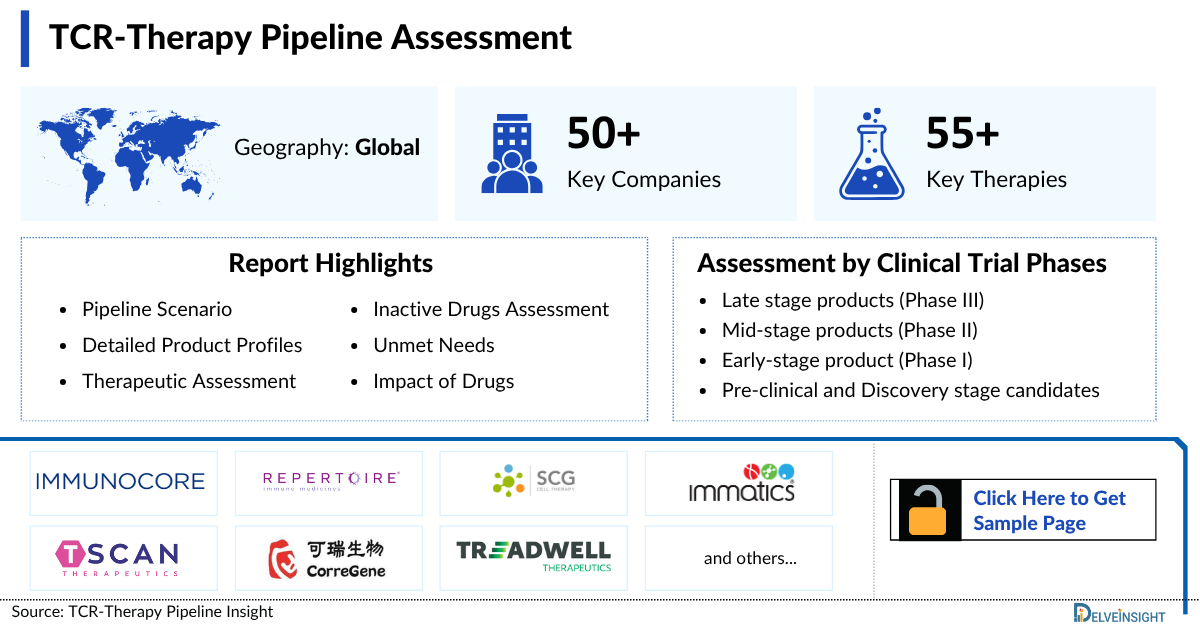
DelveInsight’s, “TCR Therapy Pipeline Insight, 2026” report provides comprehensive insights about 50+ companies and 55+ pipeline drugs in TCR Therapy pipeline landscape. It covers the pipeline drug profiles, including clinical and nonclinical stage products. It also covers the therapeutics assessment by product type, stage, route of administration, and molecule type. It further highlights the inactive pipeline products in this space.
Geography Covered
- Global coverage
TCR Therapy Disease Understanding
TCR Therapy Overview
The T-cell receptor (TCR) is a molecule found on the surface of T cells, or T lymphocytes, that is responsible for recognizing fragments of antigen as peptides bound to major histocompatibility complex (MHC) molecules. The binding between TCR and antigen peptides is of relatively low affinity and is degenerate, that is, many TCRs recognize the same antigen peptide and many antigen peptides are recognized by the same TCR. The TCR is composed of two different protein chains (that is, it is a heterodimer). In humans, in 95% of T cells the TCR consists of an alpha (a) chain and a beta (ß) chain (encoded by TRA and TRB, respectively), whereas in 5% of T cells the TCR consists of gamma and delta (?/d) chains (encoded by TRG and TRD, respectively). This ratio changes during ontogeny and in diseased states (such as leukemia). It also differs between species. Orthologues of the 4 loci have been mapped in various species. Each locus can produce a variety of polypeptides with constant and variable regions.
The TCR is a disulfide-linked membrane-anchored heterodimeric protein normally consisting of the highly variable alpha (a) and beta (ß) chains expressed as part of a complex with the invariant CD3 chain molecules. T cells expressing this receptor are referred to as a:ß (or aß) T cells, though a minority of T cells express an alternate receptor, formed by variable gamma (?) and delta (d) chains, referred as ?d T cells. Each chain is composed of two extracellular domains: Variable (V) region and a Constant (C) region, both of Immunoglobulin superfamily (IgSF) domain forming antiparallel ß-sheets. The Constant region is proximal to the cell membrane, followed by a transmembrane region and a short cytoplasmic tail, while the Variable region binds to the peptide/MHC complex. The TCR is a heterodimer of one a and one ß chain, or one ? and one d chain, which are disulphide-linked. Each TCR chain is composed of a constant and a variable domain, followed by a membrane-spanning region and a short cytosolic tail.
The TCR receptor complex is an octomeric complex of variable TCR receptor a and ß chains with three dimeric signaling modules CD3d/e, CD3?/e and CD247 ?/? or ?/?. Ionizable residues in the transmembrane domain of each subunit form a polar network of interactions that hold the complex together. Since the cytoplasmic tail of the TCR is extremely short, making it unlikely to participate in signaling, these signaling molecules are vital in propagating the signal from the triggered TCR into the cell.
The essential function of the TCR complex is to identify specific bound antigen and elicit a distinct and critical response. The signal transduction mechanism by which a T cell elicits this response upon contact with its unique antigen is termed T-cell activation (just as phototransduction is the term given to the signal transduction event by which photoreceptors elicits vision upon exposure to photons). There are myriad molecules involved in the complex biochemical process (called trans-membrane signaling) by which T-cell activation occurs. The most common mechanism for activation and regulation of molecules beneath the lipid bilayer is via reversible tyrosine phosphorylation by protein kinase/phosphatase.
"TCR Therapy Pipeline Insight, 2026" report by DelveInsight outlays comprehensive insights of present scenario and growth prospects across the indication. A detailed picture of the TCR Therapy pipeline landscape is provided which includes the disease overview and TCR Therapy treatment guidelines. The assessment part of the report embraces, in depth TCR Therapy commercial assessment and clinical assessment of the pipeline products under development. In the report, detailed description of the drug is given which includes mechanism of action of the drug, clinical studies, NDA approvals (if any), and product development activities comprising the technology, TCR Therapy collaborations, licensing, mergers and acquisition, funding, designations and other product related details.
TCR Therapy Pipeline Report Highlights
The companies and academics are working to assess challenges and seek opportunities that could influence TCR Therapy R&D. The therapies under development are focused on novel approaches to treat/improve TCR Therapy.
TCR Therapy Emerging Drugs Chapters
This segment of the TCR Therapy report encloses its detailed analysis of various drugs in different stages of clinical development, including phase III, II, II/III I, preclinical and Discovery. It also helps to understand clinical trial details, expressive pharmacological action, agreements and collaborations, and the latest news and press releases.
TCR Therapy Emerging Drugs
IMC F106C: Immunocore
Brenetafusp (IMC-F106C; formerly Renetafusp) is a first-in-class PRAME × CD3 ImmTAC (Immune Mobilizing Monoclonal T-cell Receptor Against Cancer) bispecific T-cell engager being developed by Immunocore for advanced cutaneous melanoma and other PRAME-expressing solid tumors in HLA-A*02:01-positive patients. Updated Phase I/II results presented at the 2024 ASCO Annual Meeting demonstrated encouraging antitumor activity in heavily pretreated advanced melanoma, with a 56% disease control rate (11% partial response and 44% stable disease), increasing to 58% in PRAME-positive tumors, along with a median progression-free survival of 4.2 months and circulating tumor DNA (ctDNA) molecular responses in 42% of PRAME-positive patients. The therapy also demonstrated a manageable safety profile, with predominantly low-grade cytokine release syndrome and rash, supporting its feasibility for outpatient administration. Based on these encouraging findings, Immunocore initiated the global Phase III PRISM-MEL-301 (NCT06112314) trial evaluating brenetafusp in combination with nivolumab versus standard nivolumab-based therapy as first-line treatment for unresectable Stage III/IV cutaneous melanoma, marking the first Phase III evaluation of a PRAME-targeted therapy in melanoma.
Pemvidutide: Altimmune
Pemvidutide (proposed INN, formerly known as ALT-801) is a novel, investigational, peptide-based GLP-1/glucagon dual receptor agonist in development for the treatment of obesity and NASH. Activation of the GLP-1 and glucagon receptors is believed to mimic the complementary effects of diet and exercise on weight loss, with GLP-1 suppressing appetite and glucagon increasing energy expenditure. By combining GLP-1 and glucagon activity in a single peptide, pemvidutide has the potential to achieve weight loss comparable to bariatric surgery. Pemvidutide also has been shown to increase the breakdown of fat and its mobilization within the liver, which may have beneficial effects on insulin resistance, a common problem in people with obesity. Pemvidutide incorporates the EuPortTM domain, a proprietary technology that increases its serum half-life for weekly dosing while slowing the entry of pemvidutide into the bloodstream, which may improve its tolerability. In a Phase I clinical study, pemvidutide demonstrated striking reductions in body weight, liver fat and serum lipids. Currently the drug is in Phase II stage of its development for the treatment of Alcoholic liver disorder, Alcoholism, MASH, and Obesity.
TSC-100: TScan Therapeutics
TSC-100 is HA-1 and HA-2 specific TCR-T candidates directed at eliminating native blood cells, including residual cancer cells, in target-positive and HLA-A*02:01-positive patients undergoing HCT. The TSC-100 and TSC-101 TCRs were identified using ReceptorScan from hundreds of millions of CD8+T cells. The therapies is designed to elicit an anti-tumor response in patients by targeting HA-1 or HA-2 minor antigens, which are present on malignant and normal blood cells of patients but not on any of the new, donor-derived blood cells. We believe that donor T cells engineered to express an HA-1 or HA-2 specific TCR will generate an anti-tumor effect in patients, leading to a reduction in relapse rates and an increase in long-term survival. Currently the drug is in Phase I stage of its development for the treatment of Cancer.
Further product details are provided in the report...
TCR Therapy Therapeutic Assessment
This segment of the report provides insights about the different TCR Therapy drugs segregated based on following parameters that define the scope of the report, such as:
Major Players in TCR Therapy
There are approx. 50+ key companies which are developing the therapies for TCR Therapy. The companies which have their TCR Therapy drug candidates in the most advanced stage, i.e. Phase III include, Immunocore.
TCR Therapy Pipeline Drug Phases
DelveInsight’s report covers around 55+ products under different phases of clinical development like
- Late stage products (Phase III)
- Mid-stage products (Phase II)
- Early-stage product (Phase I) along with the details of
- Pre-clinical and Discovery stage candidates
- Discontinued & Inactive candidates
TCR Therapy Drugs Route of Administration
TCR Therapy pipeline report provides the therapeutic assessment of the pipeline drugs by the Route of Administration. Products have been categorized under various ROAs such as
- Intravenous
- Subcutaneous
- Oral
- Intramuscular
TCR Therapy Drugs Molecule Type
Products have been categorized under various Molecule types such as
- Monoclonal antibody
- Small molecule
- Peptide
TCR Therapy Pipeline Product Type
- Drugs have been categorized under various product types like Mono, Combination and Mono/Combination.
TCR Therapy Pipeline Development Activities
The TCR Therapy Pipeline report provides insights into different therapeutic candidates in phase II, I, preclinical and discovery stage. It also analyses TCR Therapy therapeutic drugs key players involved in developing key drugs.
TCR Therapy Clinical Trials and Development Activities
The TCR Therapy clinical trial analysis report covers the detailed information of collaborations, acquisition and merger, licensing along with a thorough therapeutic assessment of emerging TCR Therapy drugs.
TCR Therapy Pipeline Report Insights
- TCR Therapy Pipeline Analysis
- TCR Therapy Therapeutic Assessment
- TCR Therapy Unmet Needs
- Impact of TCR Therapy Drugs
TCR Therapy Pipeline Report Assessment
- TCR Therapy Pipeline Product Profiles
- TCR Therapy Therapeutic Assessment
- TCR Therapy Pipeline Assessment
- Inactive TCR Therapy drugs assessment
- TCR Therapy Unmet Needs
Key Questions Answered in the TCR Therapy Pipeline Report:
Current Treatment Scenario and Emerging Therapies:
- How many companies are developing TCR Therapy drugs?
- How many TCR Therapy drugs are developed by each company?
- How many emerging drugs are in mid-stage, and late-stage of development for the treatment of TCR Therapy?
- What are the key collaborations (Industry–Industry, Industry–Academia), Mergers and acquisitions, licensing activities related to the TCR Therapy therapeutics?
- What are the recent trends, drug types and novel technologies developed to overcome the limitation of existing therapies?
- What are the clinical studies going on for TCR Therapy and their status?
- What are the key designations that have been granted to the emerging drugs?
Key TCR Therapy Companies
- Immunocore
- Guangdong Xiangxue Precision Medical Technology
- Altimmune
- Immatics
- TScan Therapeutics
- SCG Cell Therapy
- Treadwell Therapeutics
- Adaptimmune
- Immatics N.V.
Key TCR Therapy Pipeline Products
- IMC F106C
- TAEST 16001
- ALT-801
- IMA 201
- TSC-100
- SCG 162
- TCR-BASED CELL THERAPY
- IMC-P115C
- Off-the-shelf TCR therapy Research Program
- IMA-203