
Telerehabilitation Market Summary
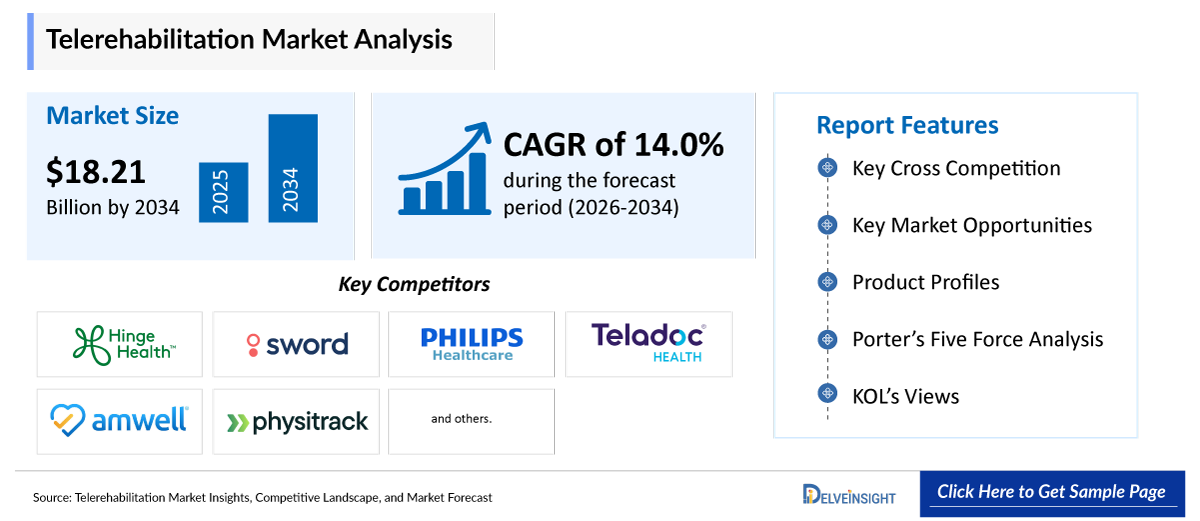
• The global telerehabilitation market was valued at USD 5.60 billion in 2025 and is projected to reach USD 18.21 billion by 2034.
• The market is expected to expand at a CAGR of 14.0% during the forecast period 2026-2034, supported by the rising geriatric population, the growing burden of chronic and musculoskeletal conditions, the demand for accessible and cost-effective home-based care, and continuous technological advancement.
• By component, the software segment dominated the telerehabilitation market with a 48% share in 2025.
• By application, the physical therapy segment dominated the telerehabilitation market with a 38% share in 2025.
• By mode of delivery, the cloud-based segment dominated the telerehabilitation market with a 65% share in 2025.
• By end-user, the hospitals and clinics segment dominated the telerehabilitation market with a 42% share in 2025.
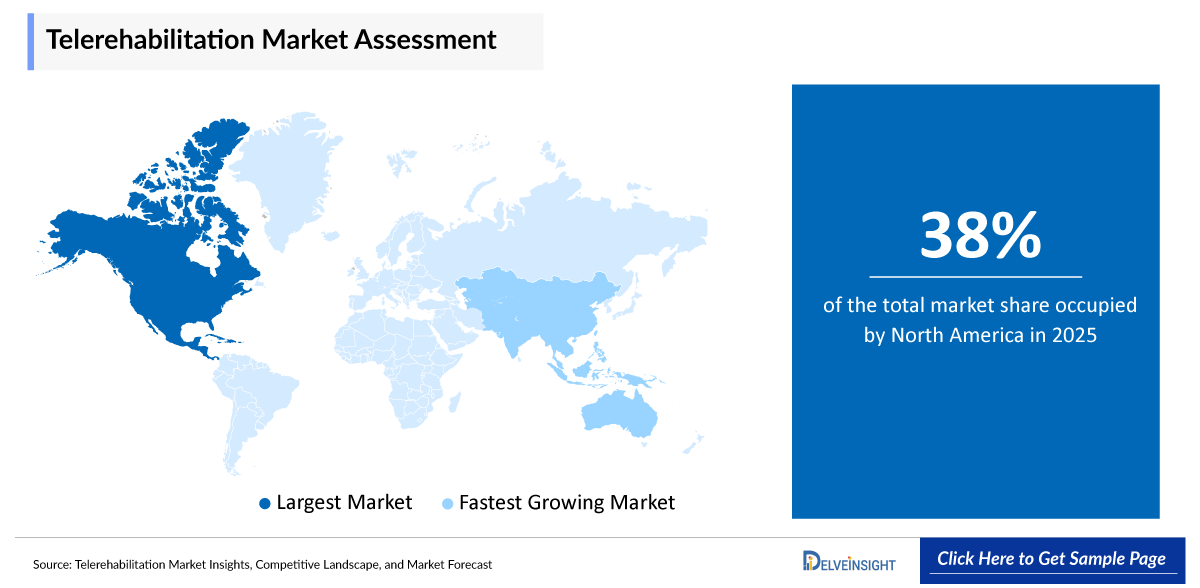
• North America accounted for the largest share of the telerehabilitation market at 38% in 2025, while Asia-Pacific is anticipated to register the fastest growth through 2034.
Telerehabilitation, also termed e-rehabilitation, is the delivery of rehabilitation services through telecommunication networks and the internet, allowing clinicians to remotely assess, treat, and monitor patients undergoing physical, occupational, speech, cardiac, neurological, and other therapies. By eliminating the need to visit a clinic or hospital and enabling access to rehabilitation from the comfort of the home, telerehabilitation overcomes the geographical and access barriers that limit conventional care and supports continuous, cost-effective therapy for people with disabilities, chronic conditions, and rehabilitation needs. The market is organized by the component supplied, the application or therapy delivered, the mode of delivery, and the setting of care. By component, it spans the software platforms that deliver and manage remote therapy, the services that constitute the therapy itself, and the hardware, including wearable sensors, cameras, and virtual reality systems, that supports it. By application, it spans physical, occupational, and speech therapy and the cardiac, neurological, and other rehabilitation programs delivered remotely. By mode of delivery, it spans cloud-based, on-premises, and web-based platforms, and by end-user it spans hospitals and clinics, home care settings, and rehabilitation centers. The market is driven by the aging of the population, the rising burden of chronic and musculoskeletal disease, the demand for accessible and cost-effective care, the advance of artificial intelligence, wearables, and immersive technologies, and the normalization of virtual care.
Telerehabilitation Market Key Growth Drivers
• The rising geriatric population, with the World Health Organization reporting that the number of people aged 60 and older was 1 billion in 2019 and is projected to reach 1.4 billion by 2030 and 2.1 billion by 2050, increasing the demand for rehabilitation.
• The growing burden of chronic and musculoskeletal conditions, with the Centers for Disease Control and Prevention reporting that 6 in 10 American adults have a chronic disease and 4 in 10 have two or more, is driving demand for rehabilitation services.
• The rising demand for accessible, convenient, and cost-effective home-based care that eliminates travel, overcomes geographical barriers, and enables continuous therapy.
• Continuous technological advancement, including artificial-intelligence-driven analytics, wearable sensors, motion capture, virtual and augmented reality, and cloud-based platforms that improve the reliability, engagement, and efficiency of remote therapy.
• The shortage of rehabilitation professionals and the gaps in access to rehabilitation in rural, remote, and underserved areas, which telerehabilitation helps to address.
• Expanding reimbursement and regulatory support, including the extension of telehealth flexibilities in the United States and digital health reimbursement pathways in Europe, which improve access and adoption.
• The normalization of telehealth and virtual care following the acceleration of remote care delivery, which has made remote rehabilitation a familiar and accepted option for patients and providers.
Key Companies in Telerehabilitation Market
The competitive landscape is led by the following active manufacturers:
• Hinge Health, Inc.
• SWORD Health
• Koninklijke Philips N.V.
• Teladoc Health, Inc.
• American Well Corporation (Amwell)
• Physitrack PLC
• Zimmer Biomet Holdings, Inc.
• DarioHealth Corp.
• Included Health, Inc.
• MedBridge
Factors Contributing to the Growth of the Telerehabilitation Market
Market Drivers
Rising Geriatric Population
The foundational driver of the telerehabilitation market is the aging of the global population, because older adults are the principal consumers of rehabilitation and the growth of the elderly population directly expands the demand for the therapies that telerehabilitation delivers. The World Health Organization reports that the number of people aged 60 and older was 1 billion in 2019 and is projected to reach 1.4 billion by 2030 and 2.1 billion by 2050, and this demographic shift is a powerful driver of demand, since aging often results in a decline in physical and cognitive abilities, leading to a higher risk of falls, injuries, and chronic conditions that require rehabilitation. Older adults undergoing recovery from stroke, joint replacement, cardiac events, and the progression of chronic and neurological conditions require sustained rehabilitation, and they benefit particularly from the home-based delivery that telerehabilitation provides, since mobility limitations, the burden of travel, and the risk of exposure make attending a clinic difficult. The concentration of rehabilitation need in the growing older population, and the suitability of remote delivery for this group, make demographic aging a central and durable driver. Because the aging of the population is large, predictable, and effectively irreversible, and because it concentrates rehabilitation demand in the population best served by home-based care, this driver provides the most durable foundation for market growth.
Growing Burden of Chronic and Musculoskeletal Conditions
The rising burden of chronic and musculoskeletal conditions is a powerful driver of the telerehabilitation market because these conditions generate a very great and sustained demand for the rehabilitation that telerehabilitation delivers, and their prevalence is rising. The Centers for Disease Control and Prevention reports that 6 in 10 American adults have a chronic disease and 4 in 10 have two or more, and the musculoskeletal conditions that are among the most common and costly, including back and joint pain and the consequences of injury and surgery, generate an enormous demand for physical therapy and rehabilitation. Musculoskeletal conditions are a leading cost driver for employers, and the burden of stroke, cardiac disease, neurological conditions, and the developmental and other conditions requiring rehabilitation adds further to the demand. These conditions frequently require sustained, repeated therapy over weeks and months, and the convenience, continuity, and lower cost of remote delivery make telerehabilitation an attractive means of providing it, particularly for the chronic conditions that require long-term management. The rising prevalence of these conditions, driven by aging, lifestyle, and the growing survival of acute events, expands the demand. Because chronic and musculoskeletal conditions are common, costly, rising, and well suited to remote rehabilitation, this driver is a central and durable contributor to market growth.
Market Restraints
Despite strong demand and rapid technological advances, the telerehabilitation market faces several material constraints. The most significant is the concern over data privacy and security, since telerehabilitation generates and transmits sensitive patient health information, and ensuring encrypted communication, secure storage, and compliance with the local and international data protection laws that govern health information presents a substantial hurdle to providers, while patient concern over the privacy of their information can create resistance to adoption, and the continuous investment in cybersecurity and privacy that addresses these concerns adds to operating costs. A second constraint is the uncertainty and variability of reimbursement, since although reimbursement for telehealth and telerehabilitation has expanded, it remains variable across payers and jurisdictions and subject to change, and the dependence of the market upon the continuation and extension of telehealth reimbursement flexibilities creates uncertainty that can constrain investment and adoption. A third constraint is the limitation of remote assessment, since some aspects of rehabilitation, particularly the hands-on physical assessment and manual therapy that conventional rehabilitation provides, cannot be fully replicated remotely, and the absence of physical presence limits the applicability of telerehabilitation for certain conditions and interventions and can affect the accuracy of assessment. A fourth constraint is the barrier of technology access and digital literacy, since telerehabilitation depends upon patients having access to devices, connectivity, and the ability to use them, and the limited access to technology and broadband and the lower digital literacy of some populations, particularly among the elderly who are among the principal users, can limit adoption. Additional constraints include the fragmentation of the provider landscape, the challenge of demonstrating outcomes and value, and the regulatory complexity of delivering care across jurisdictions. Together, these privacy, reimbursement, clinical, and access factors ensure that growth, while strong, proceeds against genuine constraints.
Telerehabilitation Market Segment Analysis
The global telerehabilitation market is segmented by component (software, services, and hardware), by application (physical therapy, occupational therapy, speech therapy, cardiac rehabilitation, neurological rehabilitation, and others), by mode of delivery (cloud-based, on-premise, and web-based), by end-user (hospitals and clinics, home care settings, rehabilitation centers, and others), and by geography (North America, Europe, Asia-Pacific, and the Rest of the World).
By Component
Dominant Subsegment: Software.
The software segment accounted for a 48% share of the telerehabilitation market in 2025. The software segment dominates the component structure because the software platform is the core of telerehabilitation, the medium through which remote therapy is delivered, managed, and monitored, and its central role, together with the growing need for improved access, convenience, and personalized treatment, sustains its leading position. Telerehabilitation software encompasses the platforms that connect clinicians and patients, deliver and prescribe exercise and therapy programs, capture and analyze data from sensors and cameras, apply artificial intelligence to personalize therapy and track progress, and integrate with health records; the widespread adoption of these platforms among healthcare providers, together with the advance of sophisticated rehabilitation software, has made software the largest component. The scalability and recurring-revenue economics of software, and its role as the platform upon which telerehabilitation services are delivered, reinforce its dominance. The services segment constitutes a substantial component, encompassing the therapy sessions and clinical services delivered through the platforms, and it is a large and growing component driven by the rising number of service providers and the demand for multiple-session, program-based rehabilitation. The hardware segment, encompassing the wearable sensors, cameras, motion-capture systems, and virtual reality devices that support remote therapy, constitutes the third component and the fastest-growing, driven by the advance of sensor and immersive technologies. The software segment is expected to retain its leading share throughout the forecast period.
By Application
Dominant Subsegment: Physical Therapy.
The physical therapy segment accounted for a 38% share of the telerehabilitation market in 2025. Physical therapy dominates the application structure because musculoskeletal and movement conditions are the most common indications for rehabilitation and the most amenable to remote delivery, and the very large volume of physical therapy, driven by the prevalence of injuries, accidents, disability, and the consequences of surgery and chronic disease, anchors the market. Physical therapy, addressing the musculoskeletal and movement impairments that arise from injury, surgery, arthritis, back and joint conditions, and the recovery from stroke and other events, is the largest and most established application of telerehabilitation, and the digital musculoskeletal programs that dominate the commercial market are a form of remote physical therapy, delivering exercise therapy and movement rehabilitation through software, sensors, and clinician support. The suitability of physical therapy for remote delivery, through the guidance and monitoring of exercise and movement, and the enormous demand created by the prevalence of musculoskeletal conditions, sustain the leading position of the segment. Occupational therapy constitutes a substantial second application, addressing the activities of daily living, and speech therapy a further application, addressing the speech, language, and swallowing disorders well suited to remote delivery. Cardiac rehabilitation, neurological rehabilitation, and other applications, including pulmonary and cognitive rehabilitation, complete the structure, several of them growing rapidly as remote delivery extends into new therapeutic areas. The physical therapy segment is expected to retain its leading share throughout the forecast period.
Telerehabilitation Market Region Analysis
Dominant Region: North America
North America accounted for a 38% share of the global telerehabilitation market in 2025. The region is expected to account for the largest share of the global market, driven by its advanced healthcare infrastructure, favorable policy and reimbursement initiatives for telehealth, the rapid adoption of virtual care, the high prevalence of chronic and musculoskeletal conditions, and the presence of leading digital rehabilitation companies. The United States is the largest and most advanced market for telerehabilitation, and the increasing shift toward virtual consultation, supported by the regulatory reforms and the expansion of Medicare telehealth flexibilities that have enhanced access to telehealth services, has accelerated adoption. The region combines a high prevalence of the chronic and musculoskeletal conditions that require rehabilitation, with the Centers for Disease Control and Prevention reporting that 6 in 10 adults have a chronic disease, with a large and well-funded digital health sector, the strong embrace of digital musculoskeletal programs by employers and health plans addressing a leading cost driver, and the presence and commercial strength of the leading telerehabilitation and digital musculoskeletal companies, several of them based in the region. The region leads in the funding, innovation, and commercialization of telerehabilitation, and it is the principal market in which the leading platforms are launched and scaled. The region is expected to retain its leading position throughout the forecast period.
Fastest Growing Region: Asia-Pacific
Asia-Pacific is projected to register the fastest compound annual growth rate in the telerehabilitation market through 2034. The region is emerging as the principal growth engine of the market, propelled by very large and aging populations, a rising burden of chronic and musculoskeletal disease, increasing demand for physical, occupational, and speech therapy, rising investment in healthcare digitization, and growing rural healthcare accessibility needs across China, Japan, India, and the wider region. The region combines the largest populations in the world with rapidly aging societies, a rising burden of chronic and musculoskeletal conditions that require rehabilitation, and large rural and underserved populations for whom the access that telerehabilitation provides is particularly valuable; the combination of rising demand and expanding digital infrastructure is driving rapid growth. Rising investment in healthcare digitization, the growth of hospitals and rehabilitation centers, technological advancement, and government initiatives to promote healthy lifestyles and expand healthcare access all support the market, and the large rural populations of the major economies create substantial demand for the remote access that telerehabilitation provides. Japan combines a very high geriatric population with technological readiness and strong demand for home-based rehabilitation, China combines a very large population with rising investment in healthcare digitization and rural access, and India combines a very large population with a rapidly expanding digital health sector. Regional growth is expected to exceed the global average across every segment. Source: World Health Organization.
Regional Commentary
North America
North America leads on value and adoption, holding a 38% share in 2025. The region combines advanced healthcare infrastructure, favorable telehealth policy and reimbursement, rapid adoption of virtual care, a high prevalence of chronic and musculoskeletal conditions, and the presence of the leading digital rehabilitation companies. The expansion of Medicare telehealth flexibilities and the strong embrace of digital musculoskeletal programs by employers and health plans have accelerated adoption, and the region leads in the funding, innovation, and commercialization of telerehabilitation. Near-term dynamics are shaped by the consolidation of the digital musculoskeletal sector, the integration of virtual and in-person care, and the evolution of telehealth reimbursement.
Europe
Europe is a large and advanced market, supported by well-developed healthcare systems, a rapidly aging population, growing awareness of telerehabilitation, and, notably, digital health reimbursement pathways, including Germany’s framework for the reimbursement of approved digital health applications, with Germany, the United Kingdom, and France among the principal markets. The region combines a substantial and aging population with a strong preference among aging populations for home-based care and with supportive public healthcare and reimbursement, and it hosts distinctive digital rehabilitation innovators. The pace of adoption is shaped by national reimbursement and health-system digitalization, and the region sustains a competitive market served by both global and regional participants.
Asia-Pacific
Asia-Pacific is the fastest-growing region, propelled by very large and aging populations, a rising burden of chronic and musculoskeletal disease, rising investment in healthcare digitization, and growing rural healthcare accessibility needs across China, Japan, India, and the wider region. Japan combines a very high geriatric population with technological readiness and demand for home-based rehabilitation, China combines a very large population with rising healthcare digitization and rural access needs, and India combines a very large population with a rapidly expanding digital health sector. The large rural and underserved populations create substantial demand for remote access. Growth exceeds the global average across every segment.
Rest of World
The Rest of the World comprises the Middle East, Africa, and South America. The burden of chronic and musculoskeletal disease is high and rising across all three, and the access advantages of telerehabilitation are particularly valuable where rehabilitation services and specialists are scarce. The Gulf states combine high healthcare investment with the digitization of care, and the larger Latin American markets, particularly Brazil, support growing digital health sectors and telerehabilitation adoption, together representing steady growth. Much of Africa faces severe shortages of rehabilitation services and infrastructure, so telerehabilitation, particularly through accessible mobile and web-based delivery, offers substantial potential to extend access, concentrated for now in the larger urban and private markets. Regional growth will be driven by the rising disease burden, expanding digital infrastructure and healthcare access, and the access advantages of remote rehabilitation.
Telerehabilitation Market Competitive Landscape
The global telerehabilitation market is classified as Fragmented, though rapidly consolidating. The market comprises a large number of digital musculoskeletal and telerehabilitation platform companies, a group of well-funded venture-backed and newly public leaders, and established health technology and device companies, and it is undergoing active consolidation as the sector matures from a phase of growth toward defensible, platform-scale incumbents. Competition centers upon clinical outcomes and evidence, the breadth of the therapeutic and condition portfolio, the technology platform and its use of sensors and artificial intelligence, the employer and health-plan relationships that constitute the principal route to market, reimbursement, and scale. The competitive landscape is evaluated across the following dimensions:
• Market concentration: Fragmented, comprising a large number of digital musculoskeletal and telerehabilitation platform companies alongside a group of well-funded leaders and established health technology and device companies, and rapidly consolidating as the sector matures toward defensible, platform-scale incumbents, exemplified by the consolidation of the digital musculoskeletal space.
• Leading players: The digital musculoskeletal leaders Hinge Health and SWORD Health lead the high-value employer and health-plan market, Physitrack and MedBridge serve the clinician and provider market, Koninklijke Philips, Teladoc Health, and American Well bring health technology and telehealth scale, and Zimmer Biomet, DarioHealth, Included Health, and a large number of specialized providers participate across the therapeutic areas.
• Geographic reach: The leading platforms operate at national and increasingly international scale, exemplified by the transatlantic reach of the consolidating digital musculoskeletal leaders across the United States and Europe, while the health technology companies maintain global reach and a large number of regional and specialized providers serve local markets.
• Product portfolio strength: Competitive advantage rests upon clinical outcomes and evidence, the breadth of the therapeutic and condition portfolio spanning musculoskeletal, pelvic, cardiac, and other programs, the technology platform and its use of sensors, motion capture, and artificial intelligence, and the integration of virtual and in-person care, with the leaders differentiating through clinical validity, breadth, and platform scale.
• Pipeline strength: Development is concentrated in artificial-intelligence-driven personalization and movement analysis, the expansion of the therapeutic portfolio into new conditions such as pelvic and pulmonary rehabilitation, the integration of wearable sensors and immersive technologies, the addition of in-person and hybrid care, and the demonstration of clinical and economic outcomes.
• Strategic partnerships: Collaboration is central, spanning partnerships between telehealth platforms and digital musculoskeletal providers to offer employers integrated virtual care, exemplified by the alliances of a leading telehealth company with the digital musculoskeletal leaders, and partnerships with employers, health plans, and health systems that constitute the principal routes to market.
• M&A activity: Acquisition and consolidation are the defining competitive dynamic, as the sector matures and the leaders acquire capability, geography, and reimbursement access, exemplified by the transatlantic consolidation of the digital musculoskeletal space, the acquisition of surgical and pulmonary rehabilitation capability, and the acquisition of movement-analysis and digital therapy technology.
• Innovation focus: Innovation is shifting toward artificial-intelligence-driven movement analysis and personalization, camera-based and sensor-based assessment, the integration of virtual and in-person care, the expansion into new therapeutic areas, immersive virtual and augmented reality therapy, and the demonstration of clinical and economic value that value-based contracting requires.
• Regulatory standing: Regulatory and reimbursement standing is a decisive competitive factor, since the reimbursement of digital rehabilitation, through telehealth coverage in the United States and digital health application pathways such as Germany’s in Europe, determines access to markets, and compliance with the data protection regulations governing health information is essential, so that reimbursement access and regulatory compliance are significant sources of competitive advantage.
Telerehabilitation Market Recent Developmental Activities
In January 2026, SWORD Health acquired the Munich-based digital musculoskeletal company Kaia Health in a deal valued at USD 285 million, folding Kaia’s camera-based motion analysis into its sensor-led model and securing, through Kaia’s approvals, a reimbursement position in Germany’s digital health application pathway. Strategic significance: the acquisition exemplified the transatlantic consolidation of the digital musculoskeletal space, the maturation of the sector from growth toward defensible platform-scale incumbents, and the strategic value of reimbursement access and complementary technology.
Telerehabilitation Market Segmentation
Telerehabilitation Market Assessment by Component
• Software
• Services
• Hardware
Telerehabilitation Market Assessment by Application
• Physical Therapy
• Occupational Therapy
• Speech Therapy
• Cardiac Rehabilitation
• Neurological Rehabilitation
• Others
Telerehabilitation Market Assessment by Mode of Delivery
• Cloud-Based
• On-Premise
• Web-Based
Telerehabilitation Market Assessment by End-User
• Hospitals and Clinics
• Home Care Settings
• Rehabilitation Centers
• Others
Telerehabilitation Market Assessment by Geography
• North America
▪ United States Telerehabilitation Market Size in USD million (2023-2034)
▪ Canada Telerehabilitation Market Size in USD million (2023-2034)
▪ Mexico Telerehabilitation Market Size in USD million (2023-2034)
• Europe
▪ France Telerehabilitation Market Size in USD million (2023-2034)
▪ Germany Telerehabilitation Market Size in USD million (2023-2034)
▪ United Kingdom Telerehabilitation Market Size in USD million (2023-2034)
▪ Italy Telerehabilitation Market Size in USD million (2023-2034)
▪ Spain Telerehabilitation Market Size in USD million (2023-2034)
▪ Rest of Europe Telerehabilitation Market Size in USD million (2023-2034)
• Asia-Pacific
▪ China Telerehabilitation Market Size in USD million (2023-2034)
▪ Japan Telerehabilitation Market Size in USD million (2023-2034)
▪ India Telerehabilitation Market Size in USD million (2023-2034)
▪ Australia Telerehabilitation Market Size in USD million (2023-2034)
▪ South Korea Telerehabilitation Market Size in USD million (2023-2034)
▪ Rest of Asia-Pacific Telerehabilitation Market Size in USD million (2023-2034)
• Rest of the World
▪ Middle East Telerehabilitation Market Size in USD million (2023-2034)
▪ Africa Telerehabilitation Market Size in USD million (2023-2034)
▪ South America Telerehabilitation Market Size in USD million (2023-2034)
Key Takeaways from the Telerehabilitation Market Report Study
• Market size analysis for the current Telerehabilitation market size (2025), and market forecast for 9 years (2026 to 2034).
• Top key product/technology developments, mergers, acquisitions, partnerships, and joint ventures that happened over the last 3 years.
• Key companies dominating the global Telerehabilitation market.
• Various opportunities available for competitors in the Telerehabilitation market space.
• What are the top-performing segments in 2025? How will these segments perform in 2034?
• Which are the top-performing regions and countries in the current Telerehabilitation market scenario?
• Which are the regions and countries where companies should concentrate their opportunities for Telerehabilitation market growth in the future?
Target audience that can benefit from this Telerehabilitation market report study
• Telerehabilitation product providers
• Research organizations and consulting companies
• Telerehabilitation -related organizations, associations, forums, and other alliances
• Government and corporate offices
• Start-up companies, venture capitalists, and private equity firms
• Distributors and traders dealing in Telerehabilitation
• Various end-users who want to know more about the Telerehabilitation market and the latest technological developments in the Telerehabilitation market.

