
Tendinopathy Epidemiology Summary
Tendinopathy Insights and Trends
- Tendinopathy is a common overuse tendon disorder characterized by activity-related pain, reduced function, and degenerative changes such as collagen disorganization and matrix breakdown. It commonly affects the Achilles, patellar, rotator cuff, and lateral elbow tendons and is primarily caused by failed tendon healing resulting from repetitive mechanical loading.
- A large real-world cohort study reported a 12-month prevalence of tendon rupture and tendinopathy of 3.4% among patients with atherosclerotic cardiovascular disease and 1.9% in the overall population.
- Acute rupture of the Achilles tendon is one of the most common tendon injuries in the adult population, with incidences ranging between 7-40 per 100,000 person-years.
- Older adults and athletes are particularly susceptible to tendinopathy, which can, in turn, increase the risk of tendon rupture.
Tendinopathy Epidemiology Forecast in the 7MM
- 2025 Total Incidence Cases of Tendinopathy: ~XX
- 2036 Projected Incidence Cases of Tendinopathy: ~XX
- Tendinopathy Growth Rate (2026–2036): XX% CAGR
DelveInsight's ‘Tendinopathy – Epidemiology Forecast – 2036’ report delivers an in-depth understanding of the Tendinopathy, historical and forecasted epidemiology, in the United States, EU4 (Germany, Spain, Italy, and France), and the United Kingdom, and Japan.
|
Study Period |
2022–2036 |
|
Historical Year |
2022–2025 |
|
Forecast Period |
2026–2036 |
|
Base Year |
2026 |
|
Geographies Covered |
|
|
Tendinopathy Epidemiology CAGR (Forecast period) |
XX% (2026–2036) |
|
Tendinopathy Epidemiology Segmentation Analysis |
Patient Burden Assessment
|
Tendinopathy Understanding and Diagnosis Algorithm
Tendinopathy Overview
Tendinopathy is a group of tendon disorders characterized by pain, functional limitation, and tendon degeneration, most often caused by repetitive mechanical overload and failed healing rather than acute inflammation. It commonly affects Achilles, patellar, rotator cuff, and lateral elbow tendons (tennis elbow) and is associated with sports and occupational overuse. The condition involves collagen disorganization and impaired tendon repair, leading to a predominantly degenerative, chronic course with persistent symptoms and reduced function.
Further details are provided in the report.
Tendinopathy Diagnosis
Diagnosis of tendinopathy is primarily clinical, based on a detailed history of activity-related pain, typically worsened by repetitive loading or overuse, along with localized tenderness and functional impairment on physical examination. Pain is often reproducible with resisted movements or stretching of the involved tendon, supporting the diagnosis.
Imaging is used to confirm and assess severity, with ultrasound commonly identifying tendon thickening, hypoechogenicity, and neovascularization, while MRI provides a detailed evaluation of tendon degeneration, partial tears, and associated soft tissue changes, particularly in chronic or refractory cases. In most cases, diagnosis does not require laboratory testing, as tendinopathy is a non-systemic, degenerative condition, but investigations may be used to exclude inflammatory arthropathies or alternative causes of tendinopathy when clinically indicated.
Further details are provided in the report.
Tendinopathy Epidemiology
Key Findings from Tendinopathy Epidemiological Analysis and Forecast
- Tendinopathy is most frequently observed in physically active individuals and those exposed to repetitive mechanical loading, including athletes and manual labor populations, where it represents a major cause of overuse-related musculoskeletal injury.
- The condition is strongly associated with age-related tendon degeneration and cumulative mechanical stress, with increased occurrence in middle-aged and older adults, reflecting progressive decline in tendon repair capacity and structural integrity.
- As per secondary research, approximately 4.0% of Achilles tendinopathy patients progressed to rupture, highest in 50–59 years (4.3%) and 40–49 years (3.9%), significantly higher than in 20–39 and 60–69.
- Epidemiological data indicate that 898 per 100,000 individuals in the United States are diagnosed with Achilles tendinopathy, with the highest incidence observed in those aged 50–59 years, followed by the 40–49 year age group; both groups exhibit substantially higher rates than individuals aged 20–39 and 60–69 years.
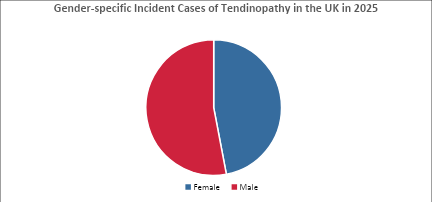
- Overall, tendinopathy is slightly more common in males than in females. The difference is modest and mainly influenced by activity level and occupational load rather than sex alone.
Scope of the Report
- The report covers a segment of a descriptive overview of tendinopathy, explaining its causes, signs and symptoms, and pathogenesis.
- Comprehensive insight has been provided into the epidemiology segments and forecasts, the future growth potential of the diagnosis rate, and disease progression.
Report Insights
Tendinopathy Patient Population Forecast
Report Key Strengths
- Epidemiology‑based (Epi‑based) Bottom‑up Forecasting
- 11-year Forecast
- Patient Burden Trends (by geography)
FAQs
- What are the disease risks, burdens, and unmet needs of Tendinopathy? What will be the growth opportunities across the 7MM concerning the patient population with Tendinopathy?
- What is the historical and forecasted Tendinopathy patient pool in the US, EU4 (Germany, France, Italy, and Spain), the UK, and Japan?
Reasons to Buy
- Insights on patient burden/disease prevalence, evolution in diagnosis, and factors contributing to the change in the epidemiology of the disease during the forecast years.
- To understand key opinion leaders’ perspectives on the diagnostic challenges to overcome barriers in the future.
- Detailed insights into various factors hampering disease diagnosis and other existing diagnostic challenges.