Testicular Cancer Pipeline
DelveInsight’s, “Testicular Cancer Pipeline Insight, 2026” report provides comprehensive insights about 4+ companies and 4+ pipeline drugs in Testicular Cancer pipeline landscape. It covers the pipeline drug profiles, including clinical and nonclinical stage products. It also covers the therapeutics assessment by product type, stage, route of administration, and molecule type. It further highlights the inactive pipeline products in this space.
Geography Covered
- Global coverage
Testicular Cancer Understanding
Testicular Cancer Overview
Testicular cancer is a disease in which malignant (cancer) cells form in the tissues of one or both testicles. The testicles are 2 egg-shaped glands located inside the scrotum (a sack of loose skin that lies directly below the penis). The testicles are held within the scrotum by the spermatic cord, which also contains the vas deferens and vessels and nerves of the testicles. Almost all testicular cancers start in the germ cells. The two main types of testicular germ cell tumors are seminomas and nonseminomas. These 2 types grow and spread differently and are treated differently. Non-seminomas tend to grow and spread more quickly than seminomas. Seminomas are more sensitive to radiation. A testicular tumor that contains both seminoma and non-seminoma cells is treated as a non-seminoma. The stages that are used for testicular cancer are: Stage 0, Stage I, Stage II,and Stage III.
Germ-cell tumors are observed to develop secondary to a tumorigenic event in utero that leads to intratubular germ-cell neoplasia. Intratubular germ-cell neoplasia is derived from gonocytes that have failed to differentiate into spermatogonia. These cells do not attain invasive potential until after hormonal changes occur during puberty. Seminomas consist of transformed germ cells that are blocked in their differentiation. Embryonal carcinoma cells resemble undifferentiated stem cells, and their gene expression is similar to those of stem cells and intratubular germ-cell neoplasms. Choriocarcinomas and yolk-sac tumors have extraembryonic differentiation, and teratomas have somatic differentiation.
Several genetic loci that confer a predisposition to testicular cancer have been identified. The variant with the highest impact was detected at 12q21, the genes encoding the proteins involved in KITLG–KIT signaling. The development of intratubular germ-cell neoplasia may involve aberrantly activated KITLG–KIT in utero, which induces arrest of embryonic germ cells at the gonocyte stage; subsequently, overexpression of embryonic transcription factors such as NANOG, sex-determining-region Y–box 17 (SOX17), and octamer-binding transcription factor 3–4 (OCT3/4, also known as POU domain, class 5, transcription factor 1 [POU5F1]) leading to suppression of apoptosis, increased proliferation, and accumulation of mutations in gonocytes.
Treatment of testicular cancer requires cooperative evaluation by urologists, medical oncologists, and radiation oncologists. Expert radiologic evaluation during surveillance is mandatory to detect recurrent disease. Careful pathologic evaluation is needed to describe different components of seminomatous and non-seminomatous germ cell tumors or GCNIS within specimens. Multidisciplinary discussions and planning result in the optimization of treatment, which results in an excellent prognosis for testicular cancer patients within all risk categories.
High doses of chemotherapy are given to kill cancer cells. Healthy cells, including blood-forming cells, are also destroyed by the cancer treatment. Stem cell transplant is a treatment to replace the blood-forming cells. Stem cells (immature blood cells) are removed from the blood or bone marrow of the patient or a donor and are frozen and stored. After the patient completes chemotherapy, the stored stem cells are thawed and given back to the patient through an infusion. These reinfused stem cells grow into (and restore) the body's blood cells. Prompt diagnosis and treatment are crucial since testicular malignancy has excellent cure rates due to high chemo-sensitivity with modern cisplatin-based chemotherapy, radio-sensitivity, and surgical excision with orchiectomy or retroperitoneal lymph node dissection. Different types of treatments are available for patients with testicular cancer. Some treatments are standard (the currently used treatment), and some are being tested in clinical trials.
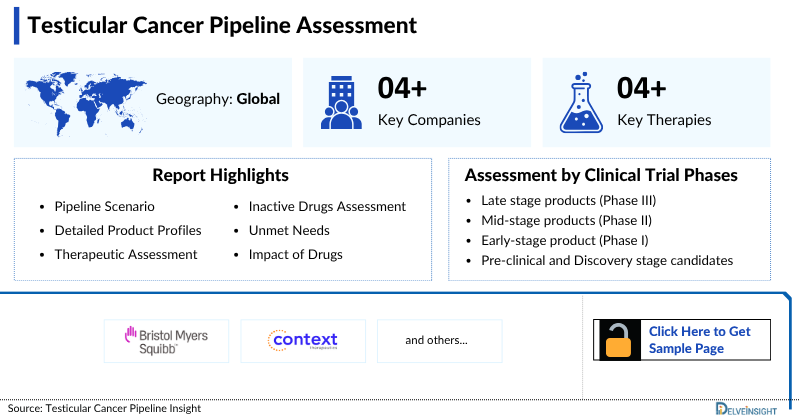
"Testicular Cancer Pipeline Insight, 2026" report by DelveInsight outlays comprehensive insights of present scenario and growth prospects across the indication. A detailed picture of theTesticular Cancer pipeline landscape is provided which includes the disease overview andTesticular Cancer treatment guidelines. The assessment part of the report embraces, in depthTesticular Cancer commercial assessment and clinical assessment of the pipeline products under development. In the report, detailed description of the drug is given which includes mechanism of action of the drug, clinical studies, NDA approvals (if any), and product development activities comprising the technology,Testicular Cancer collaborations, licensing, mergers and acquisition, funding, designations and other product related details.
Testicular Cancer Pipeline Report Highlights
The Testicular Cancer companies and academics are working to assess challenges and seek opportunities that could influence Testicular Cancer R&D. The therapies under development are focused on novel approaches to treat/improve Testicular Cancer.
Testicular Cancer Emerging Drugs Analysis
This segment of the Testicular Cancer report encloses its detailed analysis of various drugs in different stages of clinical development, including phase II, I, preclinical and Discovery. It also helps to understand clinical trial details, expressive pharmacological action, agreements and collaborations, and the latest news and press releases.
Testicular Cancer Emerging Drugs
Nivolumab: Bristol-Myers Squibb
Nivolumab (Opdivo, Opdyta) is a human IgG4 anti-PD-1 monoclonal antibody. Opdivo is formulated as solution and concentrate solution for intravenous and subcutaneous route of administration. Nivolumab is indicated for the treatment of unresectable melanoma. Currently the drug is in Phase II stage of Clinical trial evaluation for the treatment of Testicular cancer.
Further product details are provided in the report……..
Testicular Cancer Drug Therapeutic Assessment
This segment of the report provides insights about the different Testicular Cancer drugs segregated based on following parameters that define the scope of the report, such as:
Major Testicular Cancer Players in Testicular Cancer
There are approx. 4+ key companies which are developing the therapies for Testicular Cancer. The companies which have their Testicular Cancer drug candidates in the most advanced stage, i.e. Phase II include, Bristol-Myers Squibb
Testicular Cancer Clinical Trial Phases
DelveInsight’s report covers around 4+ products under different phases of clinical development like
- Late stage products (Phase III)
- Mid-stage products (Phase II)
- Early-stage product (Phase I) along with the details of
- Pre-clinical and Discovery stage candidates
- Discontinued & Inactive candidates
Testicular Cancer Drug Route of Administration
Testicular Cancer pipeline report provides the therapeutic assessment of the pipeline drugs by the Route of Administration. Products have been categorized under various ROAs such as
- Oral
- Intravenous
- Subcutaneous
- Parenteral
- Topical
Testicular Cancer Product Molecule Type
Products have been categorized under various Molecule types such as
- Recombinant fusion proteins
- Small molecule
- Monoclonal antibody
- Peptide
- Polymer
- Gene therapy
Testicular Cancer Product Type
Drugs have been categorized under various product types like Mono, Combination and Mono/Combination.
Testicular Cancer Clinical Trial Activities
The Testicular Cancer pipeline report provides insights into different Testicular Cancer clinical trials within phase II, I, preclinical and discovery stage. It also analyses Testicular Cancer therapeutic drugs key players involved in developing key drugs.
Testicular Cancer Pipeline Development Activities
The Testicular Cancer clinical Trial analysis report covers the detailed information of collaborations, acquisition and merger, licensing along with a thorough therapeutic assessment of emerging Testicular Cancer drugs.
Testicular Cancer Pipeline Report Insights
- Testicular Cancer Pipeline Analysis
- Testicular Cancer Therapeutic Assessment
- Testicular Cancer Unmet Needs
- Impact of Testicular Cancer Drugs
Testicular Cancer Pipeline Report Assessment
- Testicular Cancer Pipeline Product Profiles
- Testicular Cancer Therapeutic Assessment
- Testicular Cancer Pipeline Assessment
- Testicular Cancer Inactive drugs assessment
- Testicular Cancer Market Unmet Needs
Key Questions Answered In The Testicular Cancer Pipeline Report:
- Current Treatment Scenario and Emerging Therapies:
- How many companies are developing Testicular Cancer drugs?
- How many Testicular Cancer drugs are developed by each company?
- How many emerging drugs are in mid-stage, and late-stage of development for the treatment of Testicular Cancer?
- What are the key collaborations (Industry–Industry, Industry–Academia), Mergers and acquisitions, licensing activities related to the Testicular Cancer therapeutics?
- What are the recent trends, drug types and novel technologies developed to overcome the limitation of existing therapies?
- What are the clinical studies going on for Testicular Cancer and their status?
- What are the key designations that have been granted to the emerging drugs?
Testicular Cancer Key Players
- Bristol-Myers Squibb
- Context Therapeutics Inc.
Testicular Cancer Key Products
- Nivolumab
- CTIM-76