
TEVIMBRA Market Summary
Key Factors Driving TEVIMBRA Growth
1. Rapid expansion across multiple cancer indications
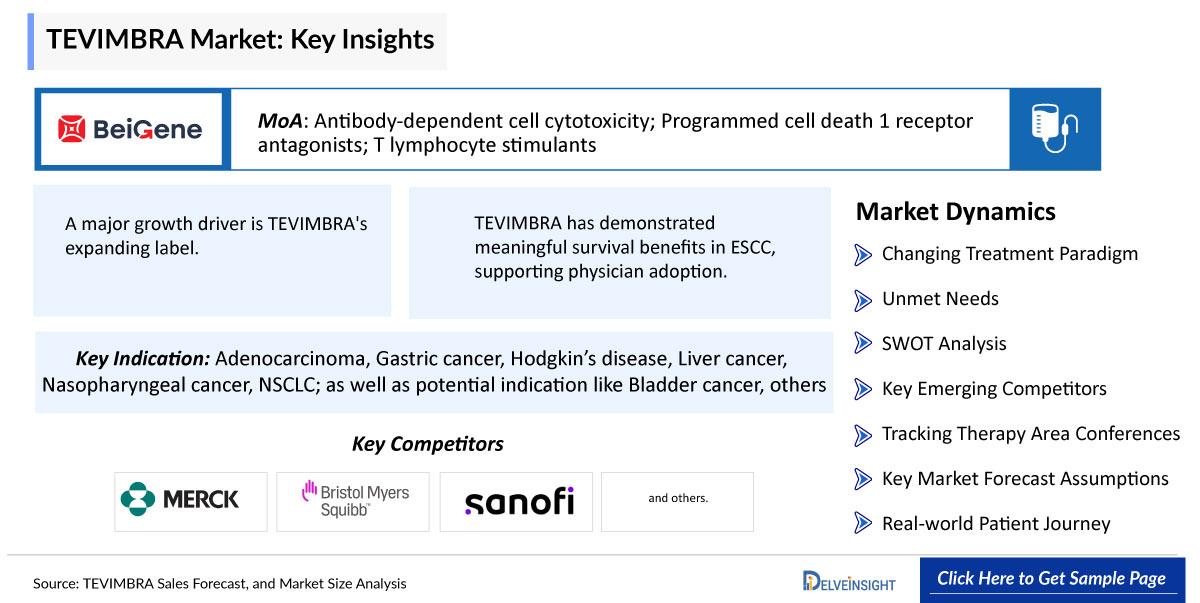
A major growth driver is TEVIMBRA's expanding label. In the U.S., it is approved for previously treated advanced/metastatic esophageal squamous cell carcinoma (ESCC) and for first-line ESCC in combination with chemotherapy, as well as first-line HER2-negative gastric/gastroesophageal-junction (G/GEJ) adenocarcinoma in combination with chemotherapy. FDA approval for first-line G/GEJ cancer came in December 2024, followed by first-line ESCC approval in March 2025. The European Commission has also expanded TEVIMBRA into extensive-stage small-cell lung cancer (ES-SCLC), based on the RATIONALE-312 Phase III study. Each additional indication increases the number of patients and treatment settings in which the drug can be prescribed.
2. Strong and clinically meaningful efficacy in ESCC
TEVIMBRA has demonstrated meaningful survival benefits in ESCC, supporting physician adoption. In the Phase III RATIONALE-302 study in previously treated advanced/metastatic ESCC, median overall survival was 8.6 months with tislelizumab versus 6.3 months with chemotherapy (HR 0.70; p=0.0001). The 12-month survival rate was 37.4% versus 23.7%, respectively. In the first-line RATIONALE-306 study, the combination of TEVIMBRA and chemotherapy also significantly improved overall survival, providing the evidence base for its expanded first-line ESCC indication.
3. Opportunity in gastric and gastroesophageal-junction cancers
The US approval of TEVIMBRA plus platinum/fluoropyrimidine chemotherapy for first-line HER2-negative gastric or GEJ adenocarcinoma creates another sizeable commercial opportunity. The approval was supported by RATIONALE-305, a global Phase III study, and is particularly relevant in patients whose tumors express PD-L1. This combination strategy allows TEVIMBRA to compete in an important first-line treatment setting rather than being restricted to later-line therapy.
4. Growing global commercial footprint
TEVIMBRA has moved well beyond its original Chinese market. The product has obtained approvals in more than 50 markets, with expansion across the U.S., Europe and other international markets. The EMA describes TEVIMBRA as a PD-1 antibody that restores immune-cell activity by blocking PD-1 interactions with PD-L1/PD-L2. Increasing international availability provides a major structural growth driver because sales are no longer dependent on a single geography.
5. Combination therapy broadens its addressable population
TEVIMBRA is increasingly used as part of chemotherapy-immunotherapy combinations, rather than only as monotherapy. Its approvals include combinations with platinum-based chemotherapy in ESCC and platinum/fluoropyrimidine chemotherapy in G/GEJ cancer. In addition, the ES-SCLC indication uses TEVIMBRA with etoposide plus platinum chemotherapy. This allows TEVIMBRA to participate in first-line treatment, where patient volumes and treatment duration can be greater than in heavily pretreated populations.
TEVIMBRA Recent Developments
In April 2026, the US FDA granted Priority Review to BeOne Medicines (formerly BeiGene) for TEVIMBRA combined with ZIIHERA and chemotherapy for first-line HER2-positive gastric and gastroesophageal adenocarcinoma, following positive Phase III HERIZON-GEA-01 trial results showing a median overall survival of 26.4 months.
“TEVIMBRA Sales Forecast, and Market Size Analysis – 2034” report provides comprehensive insights of TEVIMBRA for approved indication like Adenocarcinoma, Gastric cancer, Hodgkin’s disease, Liver cancer, Nasopharyngeal cancer, NSCLC; as well as potential indication like Bladder cancer, Cervical cancer, Colorectal cancer, Lung cancer, Lymphoma, and Rectal cancer in the 7MM. A detailed picture of TEVIMBRA’s existing usage in approved and anticipated entry and performance in potential indications in the 7MM, i.e., the United States, EU4 (Germany, France, Italy, and Spain) and the United Kingdom, and Japan for the study period 2020 –2034 is provided in this report along with a detailed description of the TEVIMBRA for approved and potential indications. The TEVIMBRA market report provides insights about TEVIMBRA’s sales forecast, mechanism of action (MoA), dosage and administration, as well as research and development including regulatory milestones, along with other developmental activities. Further, it also consists of historical and current TEVIMBRA performance, future market assessments inclusive of the TEVIMBRA market forecast analysis for approved and potential indications in the 7MM, SWOT, analysts’ views, comprehensive overview of market competitors, and brief about other emerging therapies in respective indications. It also provides analysis of TEVIMBRA sales forecasts, along with factors driving its market.
TEVIMBRA Drug Summary
TEVIMBRA is a humanized IgG4 monoclonal antibody targeting programmed death receptor-1 (PD-1), developed by BeiGene as an immune checkpoint inhibitor for the treatment of several advanced solid tumors, including esophageal squamous cell carcinoma (ESCC), gastric and gastroesophageal junction (G/GEJ) adenocarcinoma, and non-small cell lung cancer (NSCLC) in approved settings. Tislelizumab binds to PD-1 on T cells and blocks its interaction with the ligands PD-L1 and PD-L2, thereby preventing inhibitory signaling and restoring T-cell activity against tumor cells. The antibody is also Fc-engineered to minimize binding to Fc-gamma receptors, which is intended to reduce antibody-dependent removal of activated T cells and support sustained immune activation. TEVIMBRA is administered intravenously, with the U.S.-approved dosage generally being 200 mg every three weeks, either as monotherapy or in combination with chemotherapy depending on the indication. In the United States, TEVIMBRA is approved for first-line treatment of PD-L1-positive unresectable or metastatic ESCC in combination with platinum-containing chemotherapy, previously treated unresectable or metastatic ESCC as a single agent, and first-line HER2-negative gastric or G/GEJ adenocarcinoma with PD-L1 expression in combination with platinum- and fluoropyrimidine-based chemotherapy. The report provides TEVIMBRA’s sales, growth barriers and drivers, post usage and approvals in multiple indications.
Scope of the TEVIMBRA Market Report
The report provides insights into:
- A comprehensive product overview including the TEVIMBRA MoA, description, dosage and administration, research and development activities in approved indications like Adenocarcinoma, Gastric cancer, Hodgkin’s disease, Liver cancer, Nasopharyngeal cancer, NSCLC; as well as potential indication like Bladder cancer, Cervical cancer, Colorectal cancer, Lung cancer, Lymphoma, and Rectal cancer.
- Elaborated details on TEVIMBRA regulatory milestones and other development activities have been provided in TEVIMBRA market report.
- The report also highlights TEVIMBRA‘s cost estimates and regional variations, reported and estimated sales performance, research and development activities in approved and potential indications across the United States, Europe, and Japan.
- The TEVIMBRA market report also covers the patents information, generic entry and impact on cost cut.
- The TEVIMBRA market report contains current and forecasted TEVIMBRA sales for approved and potential indications till 2034.
- Comprehensive coverage of the late-stage emerging therapies for respective indications.
- The TEVIMBRA market report also features the SWOT analysis with analyst views for TEVIMBRA in approved and potential indications.
Methodology
The TEVIMBRA market report is built using data and information sourced primarily from internal databases, primary and secondary research and in-house analysis by DelveInsight’s team of industry experts. Information and data from the secondary sources have been obtained from various printable and nonprintable sources like search engines, news websites, global regulatory authorities websites, trade journals, white papers, magazines, books, trade associations, industry associations, industry portals and access to available databases.
TEVIMBRA Analytical Perspective by DelveInsight
- In-depth TEVIMBRA Market Assessment
This TEVIMBRA sales market forecast report provides a detailed market assessment of TEVIMBRA for approved indication like Adenocarcinoma, Gastric cancer, Hodgkin’s disease, Liver cancer, Nasopharyngeal cancer, NSCLC; as well as potential indication like Bladder cancer, Cervical cancer, Colorectal cancer, Lung cancer, Lymphoma, and Rectal cancer in the seven major markets, i.e., the United States, EU4 (Germany, France, Italy, and Spain) and the United Kingdom, and Japan. This segment of the report provides current and forecasted TEVIMBRA sales data uptil 2034.
- TEVIMBRA Clinical Assessment
The TEVIMBRA market report provides the clinical trials information of TEVIMBRA for approved and potential indications covering trial interventions, trial conditions, trial status, start and completion dates.
TEVIMBRA Competitive Landscape
The report provides Insights on competitors and marketed products within the domain, along with a summary of emerging products and their respective launch dates, posing significant competition in the market.
TEVIMBRA Market Potential & Revenue Forecast
- Projected market size for the TEVIMBRA and its key indications
- Estimated TEVIMBRA sales potential (TEVIMBRA peak sales forecasts)
- TEVIMBRA Pricing strategies and reimbursement landscape
TEVIMBRA Competitive Intelligence
- Number of competing drugs in development (pipeline analysis)
- TEVIMBRA Market positioning compared to existing treatments
- TEVIMBRA Strengths & weaknesses relative to competitors
TEVIMBRA Regulatory & Commercial Milestones
- TEVIMBRA Key regulatory approvals & expected launch timelines
- Commercial partnerships, licensing deals, and M&A activity
TEVIMBRA Clinical Differentiation
- TEVIMBRA Efficacy & safety advantages over existing drugs
- TEVIMBRA Unique selling points
TEVIMBRA Market Report Highlights
- In the coming years, the TEVIMBRA market scenario is set to change due to strong adoption, increased prescriptions and broader uptake in multiple immunological indications; which would expand the size of the market.
- The TEVIMBRA companies are developing therapies that focus on novel approaches to treat/improve the disease condition, assess challenges, and seek opportunities that could influence TEVIMBRA’s dominance.
- Other emerging products for Adenocarcinoma, Gastric cancer, Hodgkin’s disease, Liver cancer, Nasopharyngeal cancer, NSCLC; as well as potential indication like Bladder cancer, Cervical cancer, Colorectal cancer, Lung cancer, Lymphoma, and Rectal cancer are expected to give tough market competition to TEVIMBRA and launch of late-stage emerging therapies in the near future will significantly impact the market.
- A detailed description of regulatory milestones, and developmental activities, provide the current development scenario of TEVIMBRA in approved and potential indications.
- Analyse TEVIMBRA cost, pricing trends and market positioning to support strategic decision-making in the immunology landscape.
- Our in-depth analysis of the forecasted TEVIMBRA sales data uptil 2034 will support the clients in decision-making process regarding their therapeutic portfolio by identifying the overall scenario of TEVIMBRA in approved and potential indications.
Key Questions
- What is the class of therapy, route of administration and mechanism of action of TEVIMBRA? How strong is TEVIMBRA’s clinical and commercial performance?
- What is TEVIMBRA’s clinical trial status in each individual indications such as Adenocarcinoma, Gastric cancer, Hodgkin’s disease, Liver cancer, Nasopharyngeal cancer, NSCLC; as well as potential indication like Bladder cancer, Cervical cancer, Colorectal cancer, Lung cancer, Lymphoma, and Rectal cancer and study completion date?
- What are the key collaborations, mergers and acquisitions, licensing and other activities related to the TEVIMBRA Manufacturers?
- What are the key designations that have been granted to TEVIMBRA for approved and potential indications? How are they going to impact TEVIMBRA’s penetration in various geographies?
- What is the current and forecasted TEVIMBRA market scenario for approved and potential indications? What are the key assumptions behind the forecast?
- What are the current and forecasted sales of TEVIMBRA in the seven major countries, including the United States, Europe (Germany, France, Italy, Spain) and the United Kingdom, and Japan?
- What are the other emerging products available and how are these giving competition to TEVIMBRA for approved and potential indications?
- Which are the late-stage emerging therapies under development for the treatment of approved and potential indications?
- How cost-effective is TEVIMBRA? What is the duration of therapy and what are the geographical variations in cost per patient?

