Thrombotic Thrombocytopenic Purpura (TTP) Insights and Trends
- Thrombotic thrombocytopenic purpura (TTP) is caused by a severe deficiency or absence of ADAMTS13 enzyme activity. The disease can occur in either a congenital form, resulting from inherited mutations in the ADAMTS13 gene, or a more common acquired form, which is driven by autoantibodies that inhibit ADAMTS13 activity.
- TTP most often occurs after age 40, but congenital forms can occur in children. TTP is more common in women, with a 2:1 female-to-male predominance.
- TTP is a rare disorder with an estimated prevalence of approximately 1 per 100,000 individuals. The disease predominantly affects adults, accounting for nearly 90% of cases, while pediatric-onset TTP represents only about 10% of the patient population.
- Congenital thrombotic thrombocytopenic purpura (cTTP), caused by inherited mutations in the ADAMTS13 gene, accounts for approximately 3–5% of all TTP cases. Although its exact prevalence remains uncertain, current estimates suggest that cTTP affects approximately 0.5–2 individuals per million population, highlighting its ultra-rare nature.
- ISTH guidelines recommend that every patient should get daily plasma exchange, daily caplacizumab, as well as immunosuppressive therapy, particularly corticosteroids and rituximab, or some other immunosuppressant as well.
- Rituximab is commonly added in refractory or relapsed cases, while agents such as cyclosporine, cyclophosphamide, vincristine, and splenectomy are reserved for patients who fail first-line therapy.
- Because aTTP is a rare and potentially life-threatening disease, evidence is largely derived from clinical trials, observational studies, and patient registries. While current therapies are effective in managing acute episodes, long-term evidence remains limited, particularly regarding relapse prediction and the possibility of a durable cure.
- Key therapies in the TTP treatment landscape include caplacizumab (CABLIVI; Sanofi), apadamtase alfa (ADZYNMA; Takeda), which are contributing to the evolving management of TTP and expanding available treatment options for patients.
- The emerging TTP pipeline remains limited, with only a few promising candidates in development. Key therapies include TGD001 (TargED), an investigational targeted therapy designed to address the underlying thrombotic mechanisms of TTP.
Thrombotic Thrombocytopenic Purpura (TTP) Market Size and Forecast in the 7MM
- 2025 TTP Market Size: ~USD XX million
- 2036 Projected TTP Market Size: ~USD XX million
- TTP Growth Rate (2026–2036): XX% CAGR
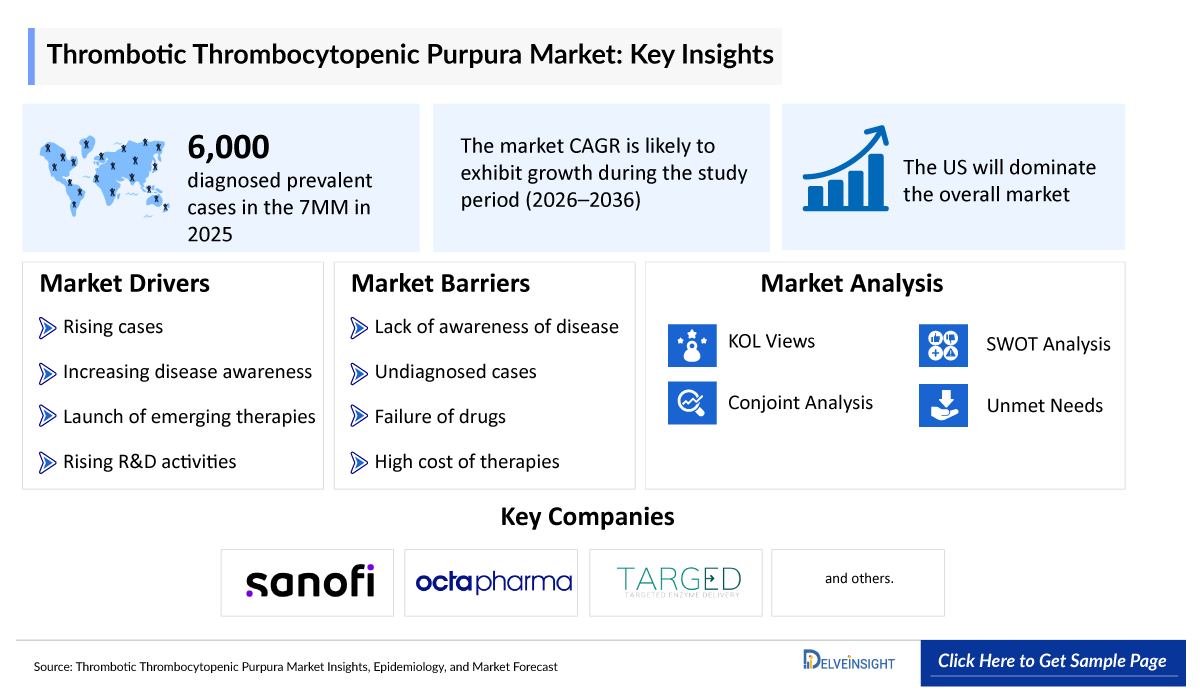
DelveInsight's ‘Thrombotic Thrombocytopenic Purpura (TTP) Market Insights, Epidemiology and Market Forecast – 2036’ report delivers an in-depth understanding of the acute pancreatitis, historical and forecasted epidemiology, as well as the TTP market trends in the United States, EU4 (Germany, Spain, Italy, and France), and the United Kingdom, and Japan.
The thrombotic thrombocytopenic purpura market report delivers a comprehensive analysis of the current treatment landscape, including standards of care, clinical practices, and evolving therapeutic algorithms. It evaluates thrombotic thrombocytopenic purpura patient burden trends, revenue & market share dynamics, peak patient share & therapy uptake analysis, and provides an in-depth market size assessment, and growth rate projections (Historical & Forecast 2022–2036) across global regions. The report highlights key unmet medical needs in TTP and maps the competitive and clinical landscape to uncover high‑value opportunities, providing a clear outlook on future market growth potential.
|
Study Period |
2022–2036 |
|
Historical Year |
2022–2025 |
|
Forecast Period |
2026–2036 |
|
Base Year |
2026 |
|
Geographies Covered |
|
|
Thrombotic Thrombocytopenic Purpura (TTP) Market CAGR (Forecast period) |
XX% (2026–2036) |
|
Thrombotic Thrombocytopenic Purpura (TTP) Epidemiology Segmentation Analysis |
Patient Burden Assessment
|
|
Thrombotic Thrombocytopenic Purpura (TTP) Companies |
|
|
Thrombotic Thrombocytopenic Purpura (TTP) Therapies |
|
|
Thrombotic Thrombocytopenic Purpura (TTP) Market |
Segmented by
|
|
Analysis |
|
Key Factors Driving the Thrombotic Thrombocytopenic Purpura (TTP) Market
Improved survival rates leading to a larger treated patient population
The TTP market is being driven by increased utilization of ADAMTS13 testing, improved physician awareness, and advances in diagnostic capabilities that enable earlier diagnosis and intervention. Enhanced recognition of the disease and broader access to targeted therapies have significantly improved survival rates, contributing to a growing prevalent patient population requiring long-term monitoring and treatment.
Rising utilization of plasma exchange and immunosuppressive therapies in specialized centers
The TTP treatment landscape is evolving with the adoption of targeted therapies such as caplacizumab and continued use of plasma exchange and immunosuppressive agents. In parallel, emerging therapies including TGD001 (TargED) and mezagitamab (Takeda) are being investigated to address underlying disease mechanisms, reduce relapse risk, and improve long-term patient outcomes, supporting future market growth.
Thrombotic Thrombocytopenic Purpura (TTP) Understanding
Thrombotic Thrombocytopenic Purpura (TTP) Overview
Thrombotic thrombocytopenic purpura (TTP) is a rare, life-threatening thrombotic microangiopathy characterized by severe deficiency of ADAMTS13 activity, resulting in the accumulation of ultra-large von Willebrand factor multimers, platelet aggregation, and widespread microvascular thrombosis. TTP can occur in either an acquired form, driven by autoantibodies against ADAMTS13, or a congenital form caused by inherited mutations in the ADAMTS13 gene. Patients commonly present with thrombocytopenia, microangiopathic hemolytic anemia, neurological manifestations, renal dysfunction, and fever. Current treatment strategies include therapeutic plasma exchange, immunosuppressive therapies such as corticosteroids and rituximab, and targeted agents such as caplacizumab, aimed at controlling acute episodes, preventing relapses, and reducing morbidity and mortality.
Diagnosis of TTP is based on clinical suspicion supported by laboratory evidence of thrombocytopenia and microangiopathic hemolytic anemia. Key diagnostic findings include schistocytes on peripheral blood smear, elevated lactate dehydrogenase levels, reduced haptoglobin, and severe ADAMTS13 deficiency, often accompanied by anti-ADAMTS13 autoantibodies in acquired TTP. Additional laboratory assessments help evaluate organ involvement and exclude other thrombotic microangiopathies. Early and accurate diagnosis is critical, as prompt initiation of therapy can significantly improve outcomes and prevent irreversible organ damage or death.
Further details are provided in the report.
Thrombotic Thrombocytopenic Purpura (TTP) Treatment
Treatment of TTP primarily focuses on rapidly controlling acute thrombotic episodes, preventing relapses, and reducing organ damage and mortality. Standard management includes therapeutic plasma exchange and corticosteroids, often combined with immunosuppressive therapies such as rituximab to suppress anti-ADAMTS13 autoantibody production. Caplacizumab has emerged as a targeted therapy that inhibits von Willebrand factor-mediated platelet aggregation, enabling faster disease control and reducing the risk of thrombotic complications. In congenital TTP, plasma infusion or ADAMTS13 replacement therapy may be used to restore enzyme activity. Treatment is individualized based on disease subtype, severity, relapse risk, organ involvement, and patient response to therapy.
Further details related to country-based variations are provided in the report.
Thrombotic Thrombocytopenic Purpura (TTP) Unmet Needs
The section “unmet needs of acute pancreatitis” outlines the critical gaps between the current state of patient care, diagnosis, and the ideal & effective management of the disease. It highlights the obstacles experienced by patients, clinicians, and researchers and identifies potential solutions for future progress.
-
Delayed diagnosis and limited access to rapid ADAMTS13 testing
-
High relapse risk and lack of durable disease-modifying therapies
-
Significant treatment burden associated with plasma exchange and immunosuppression, and others…..
Note: Comprehensive unmet needs insights in TTP and their strategic implications are provided in the full report.
Thrombotic Thrombocytopenic Purpura (TTP) Epidemiology
Key Findings from Thrombotic Thrombocytopenic Purpura (TTP) Epidemiological Analysis and Forecast
- The United States accounted for approximately 6,000 diagnosed prevalent cases of TTP in 2025 and it is expected to increase by 2036.
- Immune-mediated TTP (iTTP) predominantly affects adults, with pediatric-onset cases accounting for only about 10% of the total patient population. The disease also exhibits a marked female predominance, with women being approximately two to three times more likely to develop iTTP than men.
- Congenital TTP (cTTP), caused by inherited mutations in the ADAMTS13 gene leading to severe ADAMTS13 deficiency, accounts for approximately 3–5% of all TTP cases. Although the exact prevalence remains uncertain, current estimates suggest that cTTP affects approximately 0.5–2 individuals per million population, underscoring its ultra-rare nature.
- Immune-mediated TTP is extremely rare, with an estimated annual incidence of approximately 0.2 cases per million population and a prevalence of about 1 case per million.
- There are two main types of TTP – aTTP (the most common) and cTTP (relatively uncommon). In 2025, in United States aTTP and cTTP contributed to 5,500 and 600 diagnosed prevalent cases, respectively.
Thrombotic Thrombocytopenic Purpura (TTP) Drug Analysis & Competitive Landscape
The TTP drug chapter provides a detailed, market-focused review of the emerging pipeline across Phase I–III clinical trials. It covers the mechanism of action, clinical trial data, regulatory approvals, patents, collaborations, and strategic partnerships for each therapy, along with their advantages, limitations, and recent developments. This section offers critical insights into the acute pancreatitis treatment landscape, supporting market assessment, competitive analysis, and growth forecasting for the acute pancreatitis therapeutics market.
Approved Therapies for Thrombotic Thrombocytopenic Purpura (TTP)
Caplacizumab (CABLIVI): Sanofi
Caplacizumab (CABLIVI; Sanofi) is the first and only FDA-approved targeted therapy for acquired/immune-mediated thrombotic thrombocytopenic purpura (aTTP/iTTP). Approved for use in combination with plasma exchange and immunosuppressive therapy, CABLIVI has significantly transformed the treatment landscape by reducing the time to platelet count normalization and lowering the risk of TTP-related complications and recurrence.
It was approved by the FDA in February 2019 for adults with aTTP, with the indication expanded in December 2025 to include pediatric patients aged 12 years and older.
Apadamtase alfa (ADZYNMA): Takeda
Apadamtase (ADZYNMA; TAK-755), developed by Takeda Pharmaceutical Company, is a recombinant ADAMTS13 enzyme replacement therapy approved for congenital thrombotic thrombocytopenic purpura (cTTP). It replaces deficient ADAMTS13 activity, preventing the formation of microvascular thrombi and reducing TTP-related complications. As the first recombinant ADAMTS13 therapy, it offers a targeted treatment approach that addresses the underlying cause of cTTP.
Apadamtase was approved by the FDA in November 2023 for the treatment of congenital TTP (cTTP).
|
Hypophosphatasia Marketed/Approved Therapies | ||||||
|
Drug/Therapy |
Company |
Indication |
Molecule Type |
MoA |
RoA |
Marketed Region |
|
Caplacizumab (CABLIVI) |
Sanofi |
aTTP/iTTP |
Monoclonal antibodies |
Von Willebrand factor inhibitors |
IV |
US: 2019 EU: 2018 |
|
Apadamtase alfa (ADZYNMA) |
Takeda |
cTTP |
Recombinant proteins |
ADAMTS13 protein replacements |
IV Infusion |
US: 2023 EU: 2024 JP: 2024 |
Thrombotic Thrombocytopenic Purpura (TTP) Pipeline Analysis
TGD001: TargED
TGD001 (TargED Biopharmaceuticals) is a first-in-class targeted thrombolytic fusion protein designed to bind von Willebrand factor (VWF) and promote localized clot breakdown. By selectively targeting thrombi and activating plasmin generation at the clot site, TGD001 aims to rapidly dissolve microvascular thrombi while minimizing systemic bleeding risk.
The therapy is currently in Phase I/II clinical development for immune-mediated thrombotic thrombocytopenic purpura (iTTP) and other thrombotic microangiopathies.
|
Table 1: Competitive landscape of emerging therapies | |||||||
|
Drug Name |
Company |
Highest Phase |
Indication |
RoA |
MoA |
Molecule Type |
Anticipated Launch |
|
TGD001 |
TargED |
I/II |
TTP |
IV infusion |
Von Willebrand factor inhibitors |
Recombinant fusion proteins |
Information is available in the full report |
|
TAGX-0004 |
TagCyx Biotechnologies |
Preclinical |
TTP |
NA |
Anti-VWF aptamer |
NA |
Information is available in the full report |
|
Note: Launch insights are provisional and may change with future report updates or the occurrence of major key catalysts. | |||||||
Note: Detailed marketed therapies assessment will be provided in the final report.
Thrombotic Thrombocytopenic Purpura (TTP) Key Players, Market Leaders, and Emerging Companies
- Sanofi
- Takeda
- TargED
Thrombotic Thrombocytopenic Purpura (TTP) Drug Updates
- In March 2025, TGD001 receives Orphan Drug Designation in the United States.
- In December 2024, TargED enters clinic with Phase I trial of its groundbreaking thrombolytic TGD001.
Drug Class Insights
Thrombotic Thrombocytopenic Purpura (TTP) Market Outlook
The treatment of thrombotic thrombocytopenic purpura (TTP) is primarily focused on rapidly controlling acute thrombotic episodes, restoring ADAMTS13 activity, preventing relapses, and reducing organ damage. In acquired/immune-mediated TTP (iTTP), treatment typically consists of therapeutic plasma exchange, corticosteroids, rituximab, and caplacizumab to remove autoantibodies, suppress immune activity, and prevent microvascular thrombosis. For congenital TTP (cTTP), plasma infusions or recombinant ADAMTS13 replacement therapy are used to correct the underlying enzyme deficiency. Treatment is individualized based on disease subtype, severity, organ involvement, relapse risk, and patient response to therapy.
The TTP treatment landscape is expected to evolve with the development of targeted therapies aimed at improving long-term disease control, reducing treatment burden, and preventing relapses. Emerging approaches, including recombinant ADAMTS13 replacement therapies, novel immunomodulators, and agents targeting the underlying autoimmune mechanisms, have the potential to further transform disease management. As understanding of TTP pathophysiology advances, treatment strategies are likely to become increasingly personalized, leading to improved outcomes, enhanced quality of life, and reduced morbidity. Overall, continued therapeutic innovation is expected to address remaining unmet needs and strengthen the long-term management of both immune-mediated and congenital TTP.
Potential expansion of recombinant ADAMTS13 (rADAMTS13) into immune-mediated TTP (iTTP), along with the development of rapid and sensitive ADAMTS13 assays, is expected to improve disease diagnosis, monitoring, and treatment personalization. Advances in immunomodulatory therapies aimed at preventing autoantibody formation and reducing relapse risk may further enhance long-term patient outcomes. Beyond TTP, ongoing research is exploring the role of ADAMTS13-targeted approaches in other thrombotic and microvascular disorders, creating new opportunities for broader clinical applications. Looking ahead, the integration of novel biologics, precision diagnostics, and preventive treatment strategies has the potential to transform TTP management, enabling earlier intervention, improved disease control, and better quality of life for patients.
Further details will be provided in the report….
Drug Class/Insights into Leading Emerging and Marketed Therapies in TTP (2022–2036 Forecast)
Von Willebrand factor inhibitors: Caplacizumab (CABLIVI) play a key role in immune-mediated TTP (iTTP) by preventing microvascular thrombosis, reducing anti-ADAMTS13 autoantibody production, and lowering relapse risk. The class has shown strong clinical adoption, with caplacizumab emerging as a major targeted therapy in iTTP. Supported by patent protection and market exclusivity, monoclonal antibodies are expected to maintain a strong position in the TTP market, although future competition from novel ADAMTS13-targeted therapies may impact long-term growth.
Thrombotic Thrombocytopenic Purpura (TTP) Drug Uptake
This section focuses on the uptake rate of potential drugs expected to be launched in the market during the forecast period (2026–2036). The analysis covers the acute pancreatitis drug’s uptake, performance at peak, factors affecting performance during prime years of growth, patient uptake by therapy, and anticipated sales generated by each drug.
Detailed insights of emerging therapies' drug uptake is included in the report.
Market Access and Reimbursement of Thrombotic Thrombocytopenic Purpura (TTP)
Reimbursement is a crucial factor that affects the drug’s access to the market. Often, the decision to reimburse comes down to the price of the drug relative to the benefit it produces in treated patients. To reduce the healthcare burden of these high-cost therapies, many payment models are being considered by payers and other industry insiders.
NOTE: Further Details are provided in the final report….
Thrombotic Thrombocytopenic Purpura (TTP) Therapies Price Scenario & Trends
Pricing and analogue assessment of acute pancreatitis therapies highlights evolving price dynamics structures. This section summarizes the cost of approved treatments, the closest and most appropriate analogue selection for emerging therapies, and understanding of how pricing influences market access, adherence, and long-term uptake.
Further details are provided in the final report…
Industry Experts and Physician Views for Thrombotic Thrombocytopenic Purpura (TTP)
To keep up with acute pancreatitis market trends, we take Key Opinion Leaders (KOLs) and Subject Matter Experts (SMEs) opinions working in the domain through primary research to fill the data gaps and validate our secondary research. Industry experts were contacted for insights on the emerging acute pancreatitis therapies, evolving treatment landscape, patient adherence to conventional therapies, therapy switching trends, drug adoption and uptake, accessibility challenges, and epidemiology and real-world prescription patterns in acute pancreatitis, including MD, PhD, Instructor, Postdoctoral Researcher, Professor, Researcher, and others.
DelveInsight’s analysts connected with 10+ KOLs to gather insights at the country level. Centers such as the Johns Hopkins University, Universitätsmedizin Berlin, Osaka University Hospital, Erasmus University Medical Center Rotterdam etc., were contacted. Their opinion helps understand and validate current and emerging acute pancreatitis therapies, highlight unmet medical needs, provide epidemiological context, and support strategic decisions for market access, therapy adoption, and pipeline prioritization in TTP.
|
Region |
Key Opinion Leaders (KOLs) and Subject Matter Experts (SMEs) |
|
Europe |
“KOLs uniformly emphasize that suspected immune TTP (iTTP) should be treated immediately before ADAMTS13 confirmation due to high mortality risk (~90% untreated).” |
|
Germany |
“Caplacizumab has transformed acute TTP management into a rapidly controllable disease but must be paired with immunosuppression.” |
Qualitative Analysis: SWOT and Conjoint Analysis
We perform qualitative and market Intelligence analysis using various approaches, such as SWOT analysis and conjoint analysis.
In the SWOT Analysis of TTP, strengths, weaknesses, opportunities, and threats in terms of disease diagnosis, patient awareness, patient burden, competitive landscape, cost-effectiveness, and geographical accessibility of therapies are provided.
Conjoint analysis analyzes emerging therapies based on relevant attributes such as safety, efficacy, frequency of administration, route of administration, and order of entry. Scoring is given based on these parameters to analyze the effectiveness of therapy.
The team of analysts analyzes promising emerging therapies based on relevant attributes such as safety, efficacy, frequency of administration, route of administration, and order of entry. In efficacy, the trial’s primary and secondary outcome measures are evaluated, whereas the therapies’ safety is evaluated, wherein the acceptability, tolerability, and adverse events are majorly observed. In addition, the scoring is also based on the route of administration, order of entry, probability of success, and the addressable patient pool for each therapy. According to these parameters, the final weightage score and the ranking of the emerging therapies are decided.
Scope of the Report
- The report covers a segment of key events, an executive summary, a descriptive overview of acute pancreatitis, explaining their causes, signs and symptoms, pathogenesis, and currently available treatments.
- Comprehensive insight has been provided into the epidemiology segments and forecasts, the future growth potential of the diagnosis rate, and disease progression along treatment guidelines.
- Additionally, an all-inclusive account of both the current and emerging treatments, along with the elaborate profiles of late-stage and prominent therapies, will have an impact on the current treatment landscape.
- A detailed review of the TTP market, historical and forecasted market size, market share by therapies, detailed assumptions, and rationale behind our approach is included in the report, covering the 7MM drug outreach.
- The report provides an edge while developing business strategies by understanding trends through SWOT analysis and expert insights/KOL views, patient journey, and treatment preferences that help in shaping and driving the 7MM TTP market.
Report Insights
- TTP Patient Population Forecast
- TTP Therapeutics Market Size
- TTP Pipeline Analysis
- TTP Market Size and Trends
- TTP Market Opportunity (Current and Forecasted)
Report Key Strengths
- Epidemiology‑based (Epi‑based) Bottom‑up Forecasting
- Artificial Intelligence (AI)-Enabled Market Research Report
- 11-Year Forecast
- TTP Market Outlook (North America, Europe, Asia-Pacific)
- Patient Burden Trends (By Geography)
- TTP Treatment Addressable Market (TAM)
- TTP Competitive Landscape
- TTP Major Companies Insights
- TTP Price Trends and Analogue Assessment
- TTP Therapies Drug Adoption/Uptake
- TTP Therapies Peak Patient Share Analysis
Report Assessment
- TTP Current Treatment Practices
- TTP Unmet Needs
- TTP Clinical Development Analysis
- TTP Emerging Drugs Product Profiles
- TTP Market Attractiveness
- TTP Qualitative Analysis (SWOT and Conjoint Analysis)
FAQs
Market Insights
- What was the acute pancreatitis market size, the market size by therapies, the market share (%) distribution in 2025, and what would it look like by 2036? What are the contributing factors for this growth?
- What are the anticipated pricing variations among different geographies for the emerging therapies in the future?
- What can be the future treatment paradigm of TTP?
- What are the disease risks, burdens, and unmet needs of TTP? What will be the growth opportunities across the 7MM concerning the patient population with TTP?
- Who is the major future competitor in the market, and how will the competitors affect their market share?
- What are the current options for the treatment of TTP? What are the current guidelines for treating acute pancreatitis in the US, Europe, and Japan?
Reasons to Buy
- The report will help in developing business strategies by understanding the latest trends and changing treatment dynamics driving the TTP market.
- Bottom-up forecasting builds from the affected population to product forecasts, delivering a robust, data-driven approach ideal for new therapies and novel classes.
- Insights on patient burden/disease incidence, evolution in diagnosis, and factors contributing to the change in the epidemiology of the disease during the forecast years.
- Understand the existing market opportunities in varying geographies and the growth potential over the coming years.
- Identifying strong upcoming players in the market will help devise strategies to help get ahead of competitors.
- Detailed analysis and ranking of class-wise potential current and emerging therapies under the conjoint analysis section to provide visibility around leading classes.
- To understand KOLs’ perspectives on the accessibility, acceptability, and compliance-related challenges of existing treatment to overcome barriers in the future.
- Detailed insights into the unmet needs of the existing market so that the upcoming players can strengthen their development and launch strategy.
- This Artificial Intelligence (AI)- enabled report summarizes and simplifies complex datasets within the report into clear, actionable insights for stakeholders, investors, and healthcare providers, enabling faster, data-driven decisions.