
Tradipitant Sales Forecast Summary
Key Factors Driving Tradipitant Growth
Novel NK1 Receptor Antagonist Mechanism Addressing Nausea and Vomiting
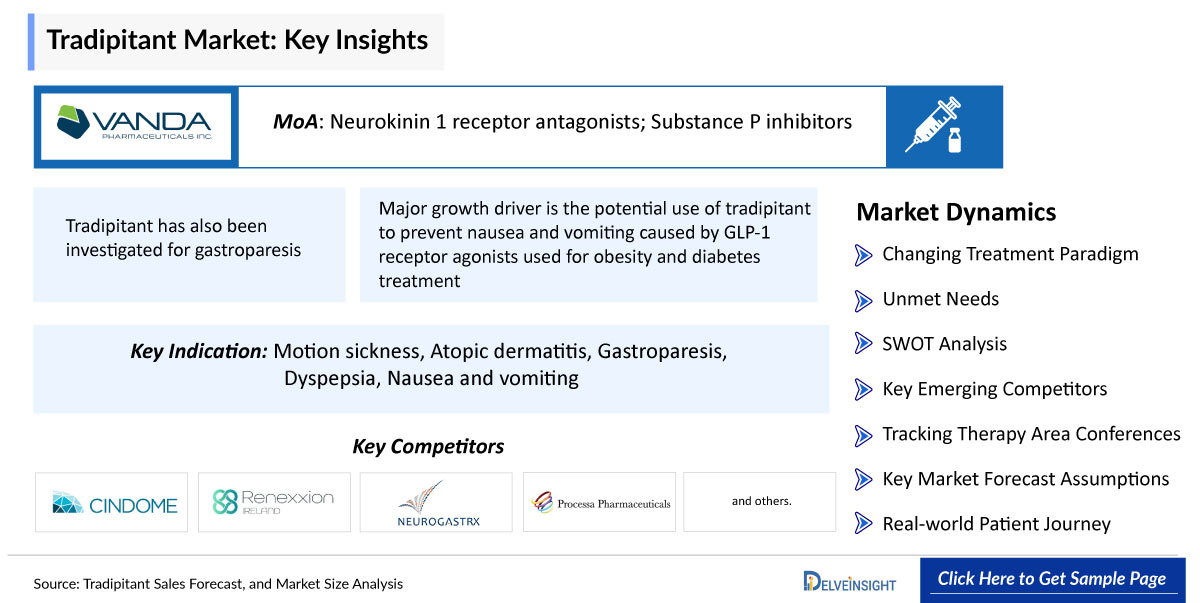
Tradipitant is an oral neurokinin-1 (NK1) receptor antagonist that blocks the binding of substance P, a neurotransmitter involved in the central and peripheral pathways controlling nausea and vomiting. This mechanism acts both in the central nervous system and gastrointestinal tract, helping reduce emetic signaling and improve symptoms in disorders such as gastroparesis and motion sickness.
NK1 antagonists have demonstrated strong anti-emetic activity in other therapeutic areas (e.g., chemotherapy-induced nausea), supporting the biological rationale for tradipitant’s broader use.
Potential Use as an Adjunct Therapy in the Rapidly Expanding GLP-1 Market
Another major growth driver is the potential use of tradipitant to prevent nausea and vomiting caused by GLP-1 receptor agonists used for obesity and diabetes treatment.
In a randomized controlled study of 116 overweight or obese adults, tradipitant significantly reduced vomiting:
- 29.3% vomiting rate with tradipitant vs 58.6% with placebo
- Approximately 50% relative reduction in vomiting
- Significant improvement in combined nausea and vomiting endpoints.
This opportunity is particularly important because 30–50% of patients discontinue GLP-1 therapies due to gastrointestinal side effects.
The GLP-1 obesity drug market is extremely large, generating over $50 billion in sales during the first nine months of 2025 alone, creating a massive potential adjunct market for tradipitant if it proves effective in improving treatment adherence.
Opportunity in Gastroparesis Despite Regulatory Setbacks
Tradipitant has also been investigated for gastroparesis, a disorder characterized by delayed gastric emptying and severe nausea.
A Phase II randomized trial showed statistically significant improvements in symptoms:
- Significant reduction in nausea severity (p = 0.0099)
- Increased nausea-free days (p = 0.0160)
- Improvements in symptom scores such as GCSI and PAGI-SYM.
However, a Phase III trial did not meet its primary endpoint, leading the FDA to issue a Complete Response Letter in 2024 requesting additional evidence.
Despite this setback, Vanda continues to pursue regulatory approval and expanded access programs for patients. If future trials demonstrate stronger efficacy, the gastroparesis indication could still represent a meaningful commercial opportunity.
Multi-Indication Development Strategy
Another growth driver is tradipitant’s development across multiple indications involving nausea and vomiting, including:
- Motion sickness (approved)
- Gastroparesis
- GLP-1 therapy-induced nausea
- Other gastrointestinal disorders
A multi-indication strategy increases the drug’s total addressable market and allows revenue diversification across therapeutic areas.
Large Addressable Market for Nausea-Related Disorders
Nausea and vomiting are among the most common symptoms across many diseases and treatments.
Key commercial opportunities include:
- Motion sickness affecting millions of travelers annually
- Obesity therapies with high discontinuation rates due to GI side effects
- Gastroparesis patients with limited treatment options
Because these indications span neurology, gastroenterology, and metabolic diseases, tradipitant could reach multiple patient populations and prescribing specialties.
Tradipitant Recent Developments
- In December 2025, Vanda Pharmaceuticals announced that the US Food and Drug Administration (FDA) approved NEREUS (tradipitant), an oral neurokinin-1 (NK-1) receptor antagonist, for the prevention of vomiting induced by motion. This approval marks the first new pharmacologic treatment in motion sickness in over four decades, representing a significant advancement in the understanding and management of this debilitating physiologic response that affects a substantial portion of the population and has long been recognized as a factor affecting military operational readiness.
“Tradipitant Sales Forecast, and Market Size Analysis – 2034” report provides comprehensive insights of Tradipitant for approved indication like Motion sickness; as well as potential indication like Atopic dermatitis, Gastroparesis, Dyspepsia, Nausea and vomiting in the 7MM. A detailed picture of Tradipitant’s existing usage in approved and anticipated entry and performance in potential indications in the 7MM, i.e., the United States, EU4 (Germany, France, Italy, and Spain) and the United Kingdom, and Japan for the study period 2020 –2034 is provided in this report along with a detailed description of the Tradipitant for approved and potential indications. The Tradipitant market report provides insights about Tradipitant’s sales forecast, mechanism of action (MoA), dosage and administration, as well as research and development including regulatory milestones, along with other developmental activities. Further, it also consists of historical and current Tradipitant performance, future market assessments inclusive of the Tradipitant market forecast analysis for approved and potential indications in the 7MM, SWOT, analysts’ views, comprehensive overview of market competitors, and brief about other emerging therapies in respective indications. It also provides analysis of Tradipitant sales forecasts, along with factors driving its market.
Tradipitant Drug Summary
Tradipitant (VLY-686, LY686017, branded as NEREUS™) is an FDA-approved (as of late 2025), orally bioavailable small-molecule neurokinin-1 (NK1) receptor antagonist developed by Vanda Pharmaceuticals, primarily indicated for the prevention of motion sickness-induced vomiting in adults and under investigation for gastroparesis, functional dyspepsia, and chronic pruritus. By competitively binding to central and peripheral NK1 receptors, it blocks substance P-mediated signaling, thereby inhibiting emesis, pruritus, and neurogenic inflammation without the sedative effects of antihistamines or anticholinergics. Administered as a daily capsule, it offers a favorable safety profile with no black-box warnings for QT prolongation (unlike some prior NK1 antagonists), supported by positive Phase III data in motion sickness and ongoing trials for diabetic gastroparesis symptoms like nausea and delayed gastric emptying. The report provides Tradipitant’s sales, growth barriers and drivers, post usage and approvals in multiple indications.
Scope of the Tradipitant Market Report
The report provides insights into:
- A comprehensive product overview including the Tradipitant MoA, description, dosage and administration, research and development activities in approved indications like Motion sickness; as well as potential indication like Atopic dermatitis, Gastroparesis, Dyspepsia, Nausea and vomiting.
- Elaborated details on Tradipitant regulatory milestones and other development activities have been provided in Tradipitant market report.
- The report also highlights Tradipitant‘s cost estimates and regional variations, reported and estimated sales performance, research and development activities in approved and potential indications across the United States, Europe, and Japan.
- The Tradipitant market report also covers the patents information, generic entry and impact on cost cut.
- The Tradipitant market report contains current and forecasted Tradipitant sales for approved and potential indications till 2034.
- Comprehensive coverage of the late-stage emerging therapies for respective indications.
- The Tradipitant market report also features the SWOT analysis with analyst views for Tradipitant in approved and potential indications.
Tradipitant Market Report Methodology
The Tradipitant market report is built using data and information sourced primarily from internal databases, primary and secondary research and in-house analysis by DelveInsight’s team of industry experts. Information and data from the secondary sources have been obtained from various printable and nonprintable sources like search engines, news websites, global regulatory authorities websites, trade journals, white papers, magazines, books, trade associations, industry associations, industry portals and access to available databases.
Tradipitant Analytical Perspective by DelveInsight
-
In-depth Tradipitant Market Assessment
This Tradipitant sales market forecast report provides a detailed market assessment of Tradipitant for approved indication like Motion sickness; as well as potential indication like Atopic dermatitis, Gastroparesis, Dyspepsia, Nausea and vomiting in the seven major markets, i.e., the United States, EU4 (Germany, France, Italy, and Spain) and the United Kingdom, and Japan. This segment of the report provides current and forecasted Tradipitant sales data uptil 2034.
-
Tradipitant Clinical Assessment
The Tradipitant market report provides the clinical trials information of Tradipitant for approved and potential indications covering trial interventions, trial conditions, trial status, start and completion dates.
Tradipitant Competitive Landscape
The report provides Insights on competitors and marketed products within the domain, along with a summary of emerging products and their respective launch dates, posing significant competition in the market.
Tradipitant Market Potential & Revenue Forecast
- Projected market size for the Tradipitant and its key indications
- Estimated Tradipitant sales potential (Tradipitant peak sales forecasts)
- Tradipitant Pricing strategies and reimbursement landscape
Tradipitant Competitive Intelligence
- Number of competing drugs in development (pipeline analysis)
- Tradipitant Market positioning compared to existing treatments
- Tradipitant Strengths & weaknesses relative to competitors
Tradipitant Regulatory & Commercial Milestones
- Tradipitant Key regulatory approvals & expected launch timelines
- Commercial partnerships, licensing deals, and M&A activity
Tradipitant Clinical Differentiation
- Tradipitant Efficacy & safety advantages over existing drugs
- Tradipitant Unique selling points
Tradipitant Market Report Highlights
- In the coming years, the Tradipitant market scenario is set to change due to strong adoption, increased prescriptions and broader uptake in multiple immunological indications; which would expand the size of the market.
- The Tradipitant companies are developing therapies that focus on novel approaches to treat/improve the disease condition, assess challenges, and seek opportunities that could influence Tradipitant’s dominance.
- Other emerging products for Motion sickness; as well as potential indication like Atopic dermatitis, Gastroparesis, Dyspepsia, Nausea and vomiting are expected to give tough market competition to Tradipitant and launch of late-stage emerging therapies in the near future will significantly impact the market.
- A detailed description of regulatory milestones, and developmental activities, provide the current development scenario of Tradipitant in approved and potential indications.
- Analyse Tradipitant cost, pricing trends and market positioning to support strategic decision-making in the immunology landscape.
- Our in-depth analysis of the forecasted Tradipitant sales data uptil 2034 will support the clients in decision-making process regarding their therapeutic portfolio by identifying the overall scenario of Tradipitant in approved and potential indications.
Key Questions
- What is the class of therapy, route of administration and mechanism of action of Tradipitant? How strong is Tradipitant’s clinical and commercial performance?
- What is Tradipitant’s clinical trial status in each individual indications such as Motion sickness; as well as potential indication like Atopic dermatitis, Gastroparesis, Dyspepsia, Nausea and vomiting and study completion date?
- What are the key collaborations, mergers and acquisitions, licensing and other activities related to the Tradipitant Manufacturers?
- What are the key designations that have been granted to Tradipitant for approved and potential indications? How are they going to impact Tradipitant’s penetration in various geographies?
- What is the current and forecasted Tradipitant market scenario for approved and potential indications? What are the key assumptions behind the forecast?
- What are the current and forecasted sales of Tradipitant in the seven major countries, including the United States, Europe (Germany, France, Italy, Spain) and the United Kingdom, and Japan?
- What are the other emerging products available and how are these giving competition to Tradipitant for approved and potential indications?
- Which are the late-stage emerging therapies under development for the treatment of approved and potential indications?
- How cost-effective is Tradipitant? What is the duration of therapy and what are the geographical variations in cost per patient?

