
Transcatheter Embolization And Occlusion Devices Market Summary
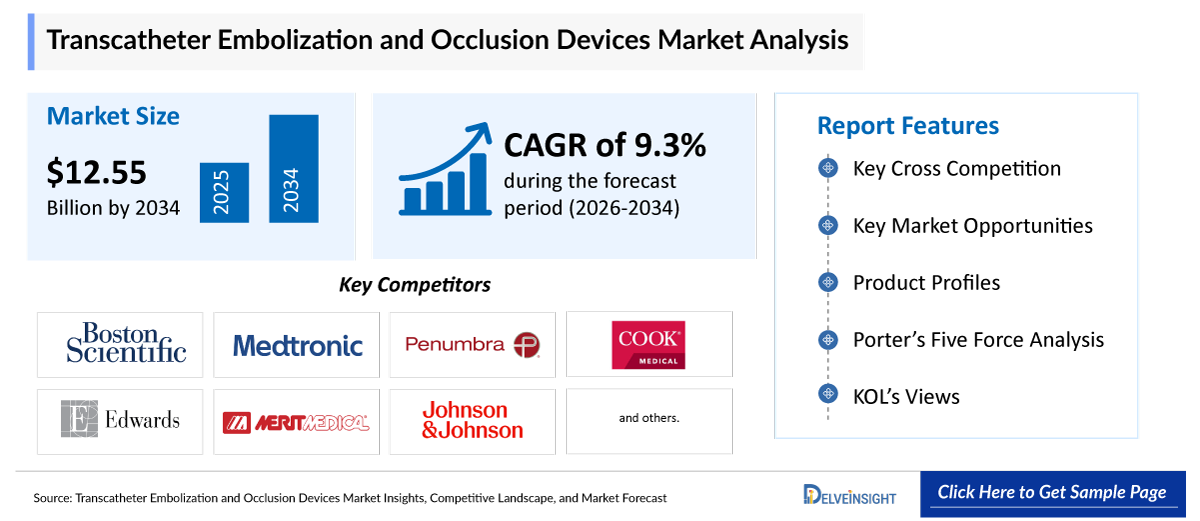
- The transcatheter embolization and occlusion devices market is estimated at USD 5.62 billion in 2025 and is projected to reach USD 12.55 billion by 2034. Growth is anchored in the rising global burden of cancer and expanding interventional oncology, the growing prevalence of vascular malformations and peripheral vascular disease, and the increasing integration of advanced imaging and AI-assisted navigation into embolization procedures.
- The global Transcatheter Embolization and Occlusion Devices market is growing at a CAGR of 9.3% during the forecast period from 2026 to 2034.
- By type, the Non-Coiled devices segment dominated the Transcatheter Embolization and Occlusion Devices market with a 51% share in 2025.
- By application, the Oncology segment dominated the Transcatheter Embolization and Occlusion Devices market with a 45% share in 2025.
- By end-users, the Hospitals & Clinics segment dominated the Transcatheter Embolization and Occlusion Devices market with a 58% share in 2025.
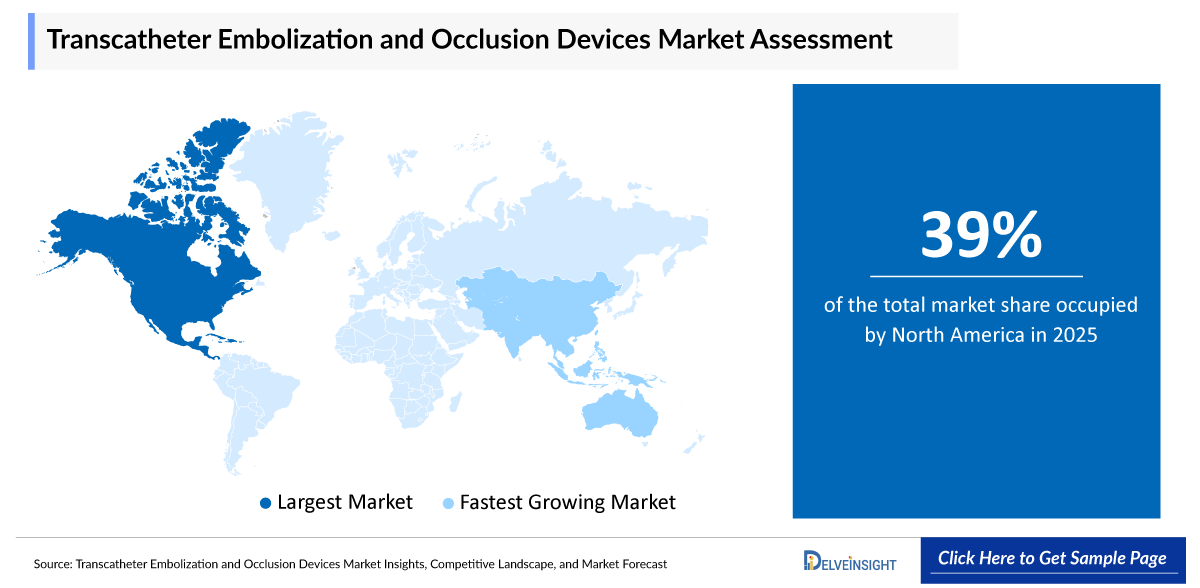
- North America dominated the global Transcatheter Embolization and Occlusion Devices market revenue with a 39% share in 2025, representing the highest regional market share globally.
Transcatheter embolization and occlusion devices are minimally invasive interventional tools, including coils, vascular plugs, embolization particles, and liquid embolic agents, that are deployed through a catheter to intentionally block or reduce blood flow within a targeted blood vessel. Guided by real-time fluoroscopic or cross-sectional imaging, an interventionalist advances a delivery system to the target vessel and introduces an embolic agent to achieve controlled, precise occlusion. These devices are central to modern interventional radiology and cardiology, supporting the management of hemorrhage, aneurysms, arteriovenous malformations, uterine fibroids, and structural heart defects, and are integral to interventional oncology procedures such as transcatheter arterial chemoembolization (TACE) and radioembolization for liver, kidney, and lung tumors. The market is organized by type across coiled devices, including pushable and detachable coils, and non-coiled devices, including flow-diverting devices, embolization particles, liquid embolic agents, and other embolic materials; by application, spanning peripheral vascular disease, oncology, neurology, and urology; and by end-user, led by hospitals and clinics. Driven by rising cancer prevalence, a structural shift toward minimally invasive care, and continuous innovation in embolic materials and delivery systems, transcatheter embolization and occlusion devices have become indispensable tools across interventional radiology, oncology, and vascular medicine.
Transcatheter Embolization and Occlusion Devices Market Key Growth Drivers
- The rising global burden of cancer, particularly liver, lung, kidney, and pancreatic cancers, is expanding demand for interventional oncology procedures such as TACE and radioembolization, with cancer diagnoses projected to reach approximately 32.5 million globally by 2045.
- The growing prevalence of vascular malformations, aneurysms, arteriovenous malformations, and gastrointestinal and pulmonary hemorrhage is expanding the addressable pool of patients requiring precise, catheter-based vascular occlusion.
- A structural shift toward minimally invasive procedures over open surgery, driven by reduced surgical trauma, shorter hospital stays, and faster patient recovery, is accelerating adoption of embolization and occlusion devices across hospitals and specialized clinics.
- Integration of advanced imaging and navigation, including real-time fluoroscopy, three-dimensional imaging, and AI-assisted catheter guidance, is improving procedural precision and safety, encouraging wider clinical adoption.
- Continuous product innovation, including bioresorbable and drug-eluting embolic materials, next-generation detachable coil systems, and microcatheter-compatible vascular plugs, is broadening clinical applications and improving procedural outcomes.
- Large-scale strategic consolidation is reshaping the competitive landscape, headlined by Boston Scientific’s agreement to acquire Penumbra for approximately USD 14.5 billion, announced in January 2026, and Stryker’s USD 4.9 billion acquisition of Inari Medical in 2025, both expanding embolization and thrombectomy portfolios.
- Expanding regulatory approvals and new product launches, including CE Mark and FDA clearances for next-generation coils, plugs, and liquid embolic systems, are sustaining a steady cadence of clinical adoption across major markets.
Key Companies in Transcatheter Embolization and Occlusion Devices Market
The competitive landscape is led by the following active device manufacturers:
- Boston Scientific Corporation
- Medtronic
- Penumbra, Inc.
- Cook
- Edwards Lifesciences Corporation
- Merit Medical Systems, Inc.
- Johnson & Johnson Services, Inc.
- Lepu Medical Technology(Beijing) Co., Ltd
- Kaneka Medix Corporation
- Stryker
For illustrative purposes, only the top 10 companies are listed in the Table of Contents. The report may include analysis and references to additional companies relevant to the market assessment.
Transcatheter Embolization and Occlusion Devices Market Size
The following snapshot summarizes the principal report metrics for the transcatheter embolization and occlusion devices market.
|
Report Metrics |
Details |
|
2025 Market Size |
USD 5.62 billion |
|
2034 Projected Market Size |
USD 12.55 billion |
|
Growth Rate (2026-2034) |
9.3% CAGR |
|
Largest Market |
North America |
|
Fastest Growing Market |
Asia-Pacific |
|
Market Structure |
Moderately Consolidated |
All market values are expressed in USD and represent DelveInsight estimates synthesized from primary and secondary research.
Factors Contributing to the Growth of the Transcatheter Embolization and Occlusion Devices Market
Market Drivers
Rising Global Cancer Burden and Expanding Interventional Oncology
The most significant driver of the Transcatheter Embolization and Occlusion Devices market is the rising global burden of cancer and the expanding role of interventional oncology in its management. Liver, lung, kidney, and pancreatic cancers are increasingly managed through catheter-based, localized therapies such as transcatheter arterial chemoembolization and radioembolization, which enable clinicians to deliver therapeutic agents directly to a tumor while simultaneously occluding its blood supply, maximizing local efficacy while minimizing systemic toxicity. Cancer incidence continues to rise globally, with projections indicating that approximately 32.5 million individuals worldwide will be diagnosed with cancer by 2045, and conventional surgical options are often limited by tumor location, patient comorbidities, or advanced disease stage. As oncology centers and hospitals continue to invest in interventional radiology infrastructure, demand for embolization and occlusion devices used in oncological procedures is expected to expand steadily through 2034.
Growing Prevalence of Vascular Malformations and Peripheral Vascular Disease
The increasing incidence of vascular malformations, aneurysms, arteriovenous malformations, and peripheral vascular disease is expanding the patient population requiring precise, catheter-based vascular occlusion. Transcatheter embolization and occlusion devices provide a minimally invasive, targeted approach to managing uncontrolled bleeding, abnormal vessel connections, and structural vascular defects, reducing reliance on open surgical repair. As diagnostic imaging improves detection of these conditions and physician awareness of minimally invasive treatment options grows, demand for embolization coils, plugs, and liquid embolic agents used in peripheral vascular interventions continues to rise.
Increasing Preference for Minimally Invasive Procedures
Patients and healthcare providers are increasingly favoring minimally invasive procedures over traditional open surgery due to reduced surgical trauma, lower complication risk, shorter hospital stays, and faster recovery. This shift is particularly pronounced among elderly and high-risk patients, for whom open surgical intervention carries greater risk. Transcatheter embolization and occlusion devices align closely with this trend, enabling precise vascular occlusion without the need for open surgery, and this structural preference for minimally invasive care is expected to sustain adoption across hospitals and ambulatory surgical centers through the forecast period.
Integration of Advanced Imaging, Navigation, and AI-Assisted Guidance
Technological advancement in imaging and navigation, including real-time fluoroscopy, three-dimensional imaging, and AI-assisted catheter guidance, is enhancing the precision, safety, and efficiency of embolization procedures. These tools allow clinicians to accurately target affected vessels, monitor device deployment in real time, and reduce the risk of non-target embolization or procedural complications. As AI-powered planning and image-guided delivery systems become more widely integrated into interventional radiology suites, physician confidence in performing complex embolization procedures is increasing, supporting broader clinical adoption of transcatheter embolization and occlusion devices.
Product Innovation in Embolic Materials and Delivery Systems
Continuous innovation in embolic materials and delivery systems is broadening the clinical applications of transcatheter embolization and occlusion devices. Recent product introductions include microcatheter-compatible, self-expanding vascular plugs such as Merit Medical’s Siege Vascular Plug, extended-length detachable coil systems such as Penumbra’s Ruby XL System, and resorbable hydrogel-based liquid embolic systems such as Instylla’s Embrace Hydrogel Embolic System, which received FDA premarket approval in 2025. These innovations improve deliverability, procedural speed, and the safety profile of embolization procedures, encouraging wider adoption across both established and emerging clinical applications.
Strategic Consolidation and Big-Ticket M&A Reshaping Competitive Scale
Large-scale mergers and acquisitions are reshaping the competitive structure of the market and expanding the scale of leading manufacturers. In January 2026, Boston Scientific announced a definitive agreement to acquire Penumbra for approximately USD 14.5 billion, a deal expected to close in 2026 and to provide Boston Scientific with a scaled entry into mechanical thrombectomy, neurovascular embolization, and peripheral embolization. This follows Stryker’s USD 4.9 billion acquisition of Inari Medical in early 2025, which added pulmonary embolism and deep vein thrombosis devices to its portfolio. This wave of consolidation among the market’s largest players is expected to intensify competitive dynamics, expand combined product portfolios, and channel further investment toward next-generation embolization and occlusion technologies through the forecast period.
Market Restraints
Despite strong underlying demand, the Transcatheter Embolization and Occlusion Devices market faces material constraints. The risk of procedural complications, including infection, vessel injury, or inadvertent non-target embolization, can lead to extended recovery times or the need for additional interventions, tempering physician and patient confidence in certain settings. The success and safety of these minimally invasive procedures depend heavily on operator expertise, and a shortage of highly skilled interventional radiologists and cardiologists in some regions constrains procedural volumes and market expansion. High device costs limit adoption in price-sensitive and emerging markets, while evolving regulatory requirements across major geographies can lengthen product approval timelines. U.S. tariffs on imported medical device components have further increased manufacturing costs, prompting some manufacturers to reconsider sourcing and production strategies. Reimbursement policy for newer embolic technologies also remains uneven across geographies. Together, these clinical, workforce, cost, and regulatory barriers temper the pace of growth, even as the underlying drivers of rising disease burden and the shift toward minimally invasive care remain firmly intact.
Transcatheter Embolization and Occlusion Devices Market Segment Analysis
The Transcatheter Embolization and Occlusion Devices by Type (Coiled [Pushable Coils, Detachable Coils], Non-Coiled [Flow Diverting Devices, Embolization Particles, Liquid Embolic, Others]), Application (Peripheral Vascular Disease, Oncology, Neurology, Urology, Others), End-Users (Hospitals & Clinics, Ambulatory Surgical Centers, and Others), and Geography (North America, Europe, Asia-Pacific, and Rest of World).
By Type
Dominant Subsegment: Non-Coiled Devices. The non-coiled devices category is expected to dominate the market.
Dominant: Small Molecule ~ 51%
The non-coiled segment accounted for 51% of the transcatheter embolization and occlusion devices market in 2025. Non-coiled devices, including flow-diverting devices, embolization particles, and liquid embolic agents, are the leading type because they offer precise vascular occlusion with predictable deployment, making them particularly effective for treating larger vessels, high-flow vascular malformations, and complex tumors. Unlike traditional coils, non-coiled devices such as vascular plugs and drug-eluting microspheres provide controlled delivery of embolic material with a reduced risk of migration and are especially preferred in procedures such as transcatheter arterial chemoembolization, uterine artery embolization, and management of gastrointestinal or pulmonary hemorrhage. Continued innovation, including bioresorbable plugs and drug-eluting microspheres, is further enhancing therapeutic efficacy. While coiled devices, particularly detachable coils, remain essential for neurovascular and aneurysm applications, the versatility and expanding procedural use of non-coiled devices secure the segment’s leadership across the forecast period.
By Application
Dominant Subsegment: Oncology. The oncology category is expected to dominate the market.
Dominant: Oncology ~ 45%
The oncology segment accounted for 45% of the Transcatheter Embolization and Occlusion Devices market in 2025. Oncology is the leading application because embolization devices are integral to procedures such as transcatheter arterial chemoembolization and radioembolization, which are widely used to treat primary and metastatic liver, lung, kidney, and pancreatic tumors. These procedures enable the precise delivery of therapeutic agents directly to the tumor site while simultaneously occluding its blood supply, maximizing local efficacy while limiting systemic toxicity, particularly valuable for patients whose tumor location, comorbidities, or disease stage limit surgical options. Embolization and occlusion devices also play a critical role in managing cancer-related complications such as tumor hemorrhage. As oncology centers and hospitals continue to invest in advanced interventional radiology infrastructure and newer embolic materials, including drug-eluting beads and bioresorbable agents, the oncology segment is expected to retain its leadership through 2034.
By End-Users
Dominant Subsegment: Hospitals & Clinics. The hospitals & clinics category is expected to dominate the market.
Dominant: Hospitals & Clinics ~ 58%
The hospitals & clinics segment accounted for approximately 58% of the Transcatheter Embolization and Occlusion Devices market in 2025. Hospitals and clinics hold the largest share because they possess the comprehensive infrastructure, specialized interventional radiology departments, catheterization labs, and highly skilled healthcare professionals required to perform complex embolization procedures. These facilities also serve as referral centers for severe and complicated cases, including advanced cancer, vascular malformations, and hemorrhagic emergencies, where embolization is critical to patient management. Ambulatory surgical centers are gaining share for lower-complexity peripheral vascular procedures as reimbursement frameworks evolve and device portability improves, but the high patient throughput, comprehensive post-procedure monitoring capability, and integrated care available at hospitals and clinics secure their dominant position across the forecast period.
Transcatheter Embolization and Occlusion Devices Market Region Analysis
Dominant Region: North America
Dominant: North America ~ 39% (Largest)
North America accounted for 39% of the global transcatheter embolization and occlusion devices market revenue in 2025, representing the highest regional market share globally. The region’s dominance is driven by the high prevalence of cancer and chronic respiratory disorders, including COPD, in the United States, along with associated risk factors that increase demand for embolization procedures such as bronchial artery embolization and transcatheter arterial chemoembolization. The widespread adoption of advanced medical technologies, robust FDA regulatory frameworks, and a dense network of interventional radiology centers reinforce the region’s leadership. Cancer prevalence continues to rise sharply in the United States, and the presence of leading device manufacturers, including Boston Scientific, Medtronic, Penumbra, and Merit Medical, alongside strong reimbursement and a deep clinical evidence base, sustains substantial procedural volumes and device demand across the forecast period.
Fastest Growing Region: Asia-Pacific
Asia-Pacific is the fastest-growing region in the transcatheter embolization and occlusion devices market, reflecting a robust CAGR of approximately 10.8% during the forecast period. The region’s elevated growth is driven by the rising prevalence of cancer, particularly liver and lung cancers, expanding healthcare investment, and rapid growth in interventional radiology infrastructure across China, Japan, India, South Korea, and Australia. Technological advancements in device design and procedural technique are enhancing the safety and effectiveness of embolization procedures, building confidence among healthcare providers and patients across the region. Japan is expected to experience particularly strong growth, supported by advanced diagnostic capabilities and a strong clinical focus on outcomes and cost-effectiveness, positioning Asia-Pacific as the principal source of incremental growth in the global market through 2034.
Regional Commentary
North America
North America accounted for 39% of the global market revenue in 2025. The United States dominates on the strength of its interventional radiology infrastructure, high cancer and chronic respiratory disease burden, and clear FDA regulatory pathways, while the presence of leading device manufacturers and strong reimbursement frameworks reinforce its leadership.
Europe
Europe is a large and advanced regional market, supported by the rising prevalence of cancer, vascular malformations, and uterine fibroids, expanding interventional radiology capabilities, and improving healthcare infrastructure. Germany, France, and the United Kingdom are expected to lead regional growth, supported by advanced healthcare systems, high patient awareness, and increasing adoption of minimally invasive interventions.
Asia-Pacific
Asia-Pacific is the fastest-growing region, propelled by rising cancer incidence, rapid expansion of interventional radiology infrastructure, and growing healthcare investment across China, Japan, India, South Korea, and Australia. Japan is expected to experience the highest growth, supported by improved patient awareness and advanced diagnostic capabilities.
Rest of World
The Rest of World region, spanning the Middle East, Africa, and South America, is an emerging growth frontier. Expanding healthcare infrastructure, rising cancer and vascular disease burden, and gradual alignment of regulatory frameworks with global standards are broadening access to transcatheter embolization and occlusion devices across the region.
Transcatheter Embolization and Occlusion Devices Market Competitive Landscape
The Transcatheter Embolization and Occlusion Devices market is classified as Moderately Consolidated. A group of scaled, multinational players including Boston Scientific, Medtronic, Stryker, and Terumo anchor the top tier through broad product portfolios spanning coiled and non-coiled devices, while specialized providers such as Penumbra, Merit Medical, Cook, and Edwards Lifesciences compete through focused innovation in vascular plugs, embolization particles, and structural occlusion technologies. Large-scale consolidation, most notably Boston Scientific’s pending acquisition of Penumbra, is expected to further concentrate competitive scale among the market’s leading players.
The competitive landscape can be evaluated across the following dimensions:
- Market concentration: Moderately consolidated, with a small group of scaled multinational manufacturers leading and specialized providers competing on focused innovation.
- Leading players: Boston Scientific, Medtronic, Stryker, and Terumo anchor the top tier through broad, multi-category embolization and occlusion portfolios.
- Product portfolio strength: Top players offer end-to-end portfolios spanning pushable and detachable coils, vascular plugs, embolization particles, and liquid embolic systems.
- M&A activity: Active consolidation, including Boston Scientific’s approximately USD 14.5 billion agreement to acquire Penumbra (January 2026) and Stryker’s USD 4.9 billion acquisition of Inari Medical (2025).
- Innovation focus: Bioresorbable and drug-eluting embolic materials, extended-length detachable coil systems, microcatheter-compatible vascular plugs, and AI-assisted procedural planning.
- Regulatory strength: A steady cadence of FDA clearances, premarket approvals, and CE Mark approvals for next-generation coils, plugs, and liquid embolic systems underpins competitive positioning.
- Manufacturing capabilities: Nitinol and polymer-based device engineering, sterile packaging, and global distribution networks are key competitive moats.
- Geographic reach: Leaders operate global commercial and manufacturing networks, supporting broad distribution across North America, Europe, and Asia-Pacific.
Transcatheter Embolization and Occlusion Devices Market Recent Developmental Activities
In January 2026, Boston Scientific Corporation announced a definitive agreement to acquire Penumbra, Inc. for approximately USD 14.5 billion in cash and stock, a deal expected to close in 2026. Strategic significance: Provides scaled entry into mechanical thrombectomy and neurovascular embolization and substantially expands Boston Scientific’s peripheral and neuro embolization portfolio.
In January 2026, Boston Scientific Corporation received CE Mark approval for its Embold detachable coil system, a new generation of fully retractable embolization coils indicated to obstruct or reduce blood flow in the peripheral vasculature. Strategic significance: Strengthens Boston Scientific’s coiled-device portfolio in the European market.
In September 2025, Penumbra, Inc. launched the Ruby XL System, the largest and longest detachable embolization coil in its portfolio, alongside the Lightning Bolt 6X device. Strategic significance: Expands Penumbra’s coiled-device offering for complex, high-volume vascular occlusion procedures.
In 2025, Stryker expanded its minimally invasive neurovascular treatment portfolio with advanced occlusion technologies, building on its 2025 acquisition of Inari Medical for approximately USD 4.9 billion, which added pulmonary embolism and deep vein thrombosis devices. Strategic significance: Broadens Stryker’s vascular intervention and occlusion device portfolio.
In October 2024, Merit Medical Systems, Inc. launched its Siege Vascular Plug in the United States following FDA 510(k) clearance, a nitinol, self-expanding, microcatheter-compatible plug designed for peripheral artery embolization within approximately 1.3 minutes. Strategic significance: Strengthens Merit’s embolics portfolio for peripheral vascular applications.
In May 2024, Merit Medical Systems, Inc. received FDA 510(k) clearance for the Siege Vascular Plug and launched its Bearing nsPVA Express prefilled syringe of embolization particles in the United States and Australia. Strategic significance: Broadens Merit’s embolic materials offering across plug and particle-based embolization.
In 2025-2026, Medtronic continued to expand its Onyx liquid embolic system portfolio, including FDA approval for reduced preparation shake time for Onyx 18 and Onyx 34, improving procedural workflow for neurovascular embolization. Strategic significance: Enhances the clinical usability of Medtronic’s established liquid embolic platform.
In 2025, Instylla, Inc., a privately held developer of resorbable liquid embolics, received premarket approval for its Embrace Hydrogel Embolic System for hypervascular tumor embolization and completed its first commercial procedure in January 2026. Strategic significance: Signals continued innovation and potential consolidation interest in the liquid embolic segment relevant to established manufacturers.
In 2024, Cook Medical continued to broaden its embolization coil portfolio, including fully retractable coil systems designed for precise, controlled vascular occlusion. Strategic significance: Reinforces Cook’s position in the coiled-device segment of the market.
In 2024-2025, Edwards Lifesciences Corporation continued to advance its structural heart and vascular occlusion technologies supporting minimally invasive closure procedures. Strategic significance: Extends Edwards’ presence in the vascular and structural occlusion device segment adjacent to core embolization applications.
Transcatheter Embolization and Occlusion Devices Market Segmentation
Transcatheter Embolization and Occlusion Devices Market by Type
- Coiled
- Pushable Coils
- Detachable Coils
- Non-Coiled
- Flow Diverting Devices
- Embolization Particles
- Liquid Embolic
- Others
Transcatheter Embolization and Occlusion Devices Market by Application
- Peripheral Vascular Disease
- Oncology
- Neurology
- Urology
- Others
Transcatheter Embolization and Occlusion Devices Market by End-Users
- Hospitals & Clinics
- Ambulatory Surgical Centers
- Others
Transcatheter Embolization and Occlusion Devices Market by Geography
- North America Transcatheter Embolization and Occlusion Devices Market
- United States Transcatheter Embolization and Occlusion Devices Market Size in USD million (2023-2034)
- Canada Transcatheter Embolization and Occlusion Devices Market Size in USD million (2023-2034)
- Mexico Transcatheter Embolization and Occlusion Devices Market Size in USD million (2023-2034)
- Europe Transcatheter Embolization and Occlusion Devices Market
- Germany Transcatheter Embolization and Occlusion Devices Market Size in USD million (2023-2034)
- United Kingdom Transcatheter Embolization and Occlusion Devices Market Size in USD million (2023-2034)
- France Transcatheter Embolization and Occlusion Devices Market Size in USD million (2023-2034)
- Italy Transcatheter Embolization and Occlusion Devices Market Size in USD million (2023-2034)
- Spain Transcatheter Embolization and Occlusion Devices Market Size in USD million (2023-2034)
- Rest of Europe Transcatheter Embolization and Occlusion Devices Market Size in USD million (2023-2034)
- Asia-Pacific Transcatheter Embolization and Occlusion Devices Market
- China Transcatheter Embolization and Occlusion Devices Market Size in USD million (2023-2034)
- Japan Transcatheter Embolization and Occlusion Devices Market Size in USD million (2023-2034)
- India Transcatheter Embolization and Occlusion Devices Market Size in USD million (2023-2034)
- Australia Transcatheter Embolization and Occlusion Devices Market Size in USD million (2023-2034)
- South Korea Transcatheter Embolization and Occlusion Devices Market Size in USD million (2023-2034)
- Rest of Asia-Pacific Transcatheter Embolization and Occlusion Devices Market Size in USD million (2023-2034)
- Rest of the World (RoW) Transcatheter Embolization and Occlusion Devices Market
- Middle East Transcatheter Embolization and Occlusion Devices Market Size in USD million (2023-2034)
- Africa Transcatheter Embolization and Occlusion Devices Market Size in USD million (2023-2034)
- South America Transcatheter Embolization and Occlusion Devices Market Size in USD million (2023-2034)
Transcatheter Embolization and Occlusion Devices Market Recent Industry Trends and Milestones (2023-2026)
|
Category |
Key Developments |
|
Transcatheter Embolization and Occlusion Devices Market Product Approval |
Regulatory momentum continued across the market. Boston Scientific received CE Mark approval for its Embold detachable coil system in January 2026, while Penumbra launched the Ruby XL System, its largest detachable embolization coil, in September 2025. Merit Medical received FDA 510(k) clearance and launched its Siege Vascular Plug and Bearing nsPVA Express prefilled syringe. Instylla received premarket approval for its resorbable Embrace Hydrogel Embolic System, completing its first commercial procedure in January 2026. Each approval expands available treatment options across coiled, plug, and liquid embolic categories. |
|
Transcatheter Embolization and Occlusion Devices Market Expansion |
Manufacturers broadened their embolic device portfolios across coiled and non-coiled categories. Medtronic improved procedural workflow for its Onyx liquid embolic system, Cook Medical expanded its retractable coil offering, and Merit Medical broadened its embolics portfolio with plug and particle-based products. Providers continued to integrate AI-assisted imaging and navigation to improve procedural precision across embolization and occlusion applications. |
|
Transcatheter Embolization and Occlusion Devices Market Investment |
Capital and consolidation accelerated sharply among leading players. Boston Scientific announced an agreement to acquire Penumbra for approximately USD 14.5 billion in January 2026, expanding into mechanical thrombectomy and neurovascular embolization. Stryker acquired Inari Medical for approximately USD 4.9 billion in 2025, adding pulmonary embolism and deep vein thrombosis devices. Emerging private companies such as Instylla and Shape Memory Medical continued to attract growth capital to advance resorbable and shape-memory polymer embolic technologies. |
|
Company Strategy |
Boston Scientific Corporation: Portfolio expansion through the pending Penumbra acquisition and new coiled-device approvals. Medtronic: Continued enhancement of its established Onyx liquid embolic platform. Penumbra, Inc.: Expansion of its detachable coil offering ahead of its acquisition by Boston Scientific. Merit Medical Systems, Inc.: Broadening of its embolics portfolio across plugs and particles. Stryker: Scale expansion in vascular intervention following the Inari Medical acquisition. Cook, Edwards Lifesciences, Johnson & Johnson, Lepu Medical Technology, and Kaneka Medix: Continued investment in coiled, non-coiled, and structural occlusion technologies across regional markets. |
|
Emerging Technologies |
Bioresorbable and drug-eluting embolic materials, extended-length and fully retractable detachable coil systems, and microcatheter-compatible self-expanding vascular plugs represent the leading edge of device innovation. AI-assisted catheter navigation and procedural planning, real-time three-dimensional imaging integration, and hydrogel-based resorbable liquid embolic systems are emerging as key technology differentiators shaping the next phase of competitive advantage in the market. |
Transcatheter Embolization and Occlusion Devices Market Startup Funding and Investment Trends
Investment in the transcatheter embolization and occlusion device ecosystem has concentrated on resorbable and shape-memory polymer embolic materials, next-generation liquid embolics, and hydrogel-based technologies for hypervascular tumor and peripheral vascular embolization. The following companies illustrate recent funding and investment activity and technology focus.
|
Company |
Total Funding |
Funding Stage |
Main Offering |
Core Technology |
|
Instylla, Inc. |
Privately Held |
PMA Approval / Commercial Launch (2025-2026) |
Resorbable Liquid Embolic Systems |
Hydrogel-based hypervascular tumor and peripheral embolization |
|
Shape Memory Medical, Inc. |
USD 38 million Series C |
Growth / Series C |
Shape-Memory Polymer Embolic Plugs |
Self-expanding porous polymer scaffold for vascular and aortic embolization |
|
Request for unlocking the report of the @ Transcatheter Embolization and Occlusion Devices Market | ||||
Capital is flowing toward manufacturers that scale coiled and non-coiled portfolios and toward emerging developers of resorbable and shape-memory embolic materials. Boston Scientific’s approximately USD 14.5 billion agreement to acquire Penumbra and Stryker’s USD 4.9 billion acquisition of Inari Medical underscore the strategic value that leading manufacturers place on embolization and vascular intervention scale. Emerging developers such as Instylla and Shape Memory Medical continue to advance next-generation resorbable and shape-memory polymer embolic technologies, signaling continued innovation and potential consolidation interest across the embolic materials segment through the forecast period.
Key Takeaways from the Transcatheter Embolization and Occlusion Devices Market Report Study
- Market size analysis for the current transcatheter embolization and occlusion devices market size (2025), and market forecast for 9 years (2026 to 2034).
- Top key product/technology developments, mergers, acquisitions, partnerships, and joint ventures that happened over the last 3 years.
- Key companies dominating the global transcatheter embolization and occlusion devices market.
- Various opportunities available for competitors in the transcatheter embolization and occlusion devices market space.
- What are the top-performing segments in 2025? How will these segments perform in 2034?
- Which are the top-performing regions and countries in the current Transcatheter embolization and occlusion devices market scenario?
- Which are the regions and countries where companies should concentrate their opportunities for transcatheter embolization and occlusion devices market growth in the future?
Target audience who can benefit from this Transcatheter Embolization and Occlusion Devices market report study
- Transcatheter embolization and occlusion devices product providers
- Research organizations and consulting companies
- Transcatheter embolization and occlusion devices-related organizations, associations, forums, and other alliances
- Government and corporate offices
- Start-up companies, venture capitalists, and private equity firms
- Distributors and traders dealing in transcatheter embolization and occlusion devices
- Various end-users who want to know more about the transcatheter embolization and occlusion devices market and the latest technological developments in the transcatheter embolization and occlusion devices market.

