
Transradial Access Products Market Summary
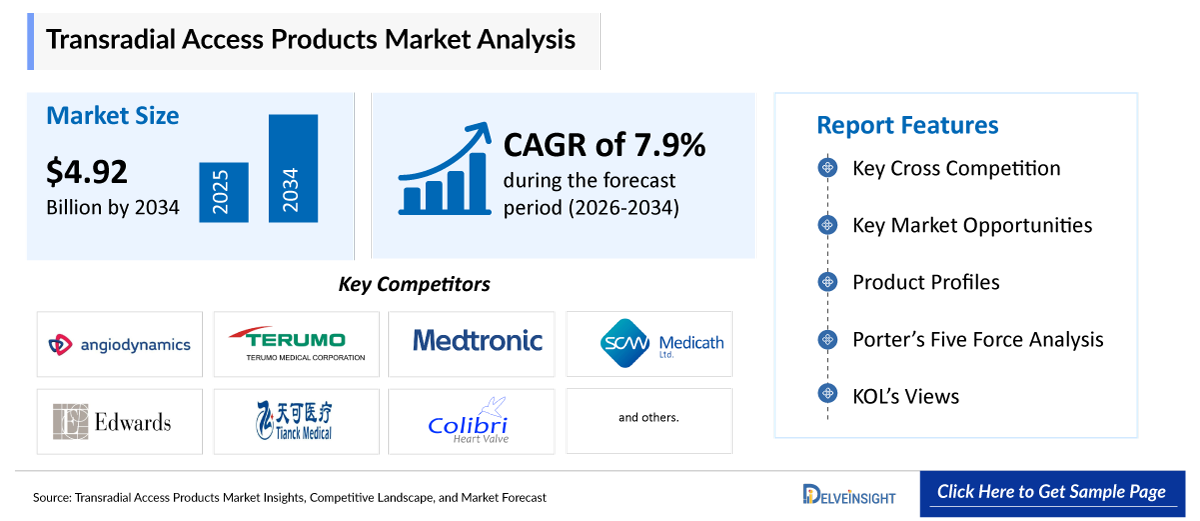
- The Transradial Access Products Market Size is estimated at USD 2.48 billion in 2025 and is projected to reach USD 4.92 billion by 2034. Growth is anchored in the accelerating global shift from femoral to radial arterial access for coronary and peripheral procedures, rising percutaneous coronary intervention (PCI) volumes, and continuous innovation in low-profile, hydrophilic-coated access devices.
- The Global Transradial Access Products Market Size is growing at a CAGR of 7.9% during the forecast period from 2026 to 2034.
Transradial Access Products Market Trends & Insights
- By product, the catheter segment dominated the Transradial Access Products market with a 38% share in 2025.
- By application, the diagnostic & interventional segment dominated the Transradial Access Products market with a 72% share in 2025.
- By end-user, the hospitals & clinics segment dominated the Transradial Access Products market with a 65% share in 2025.
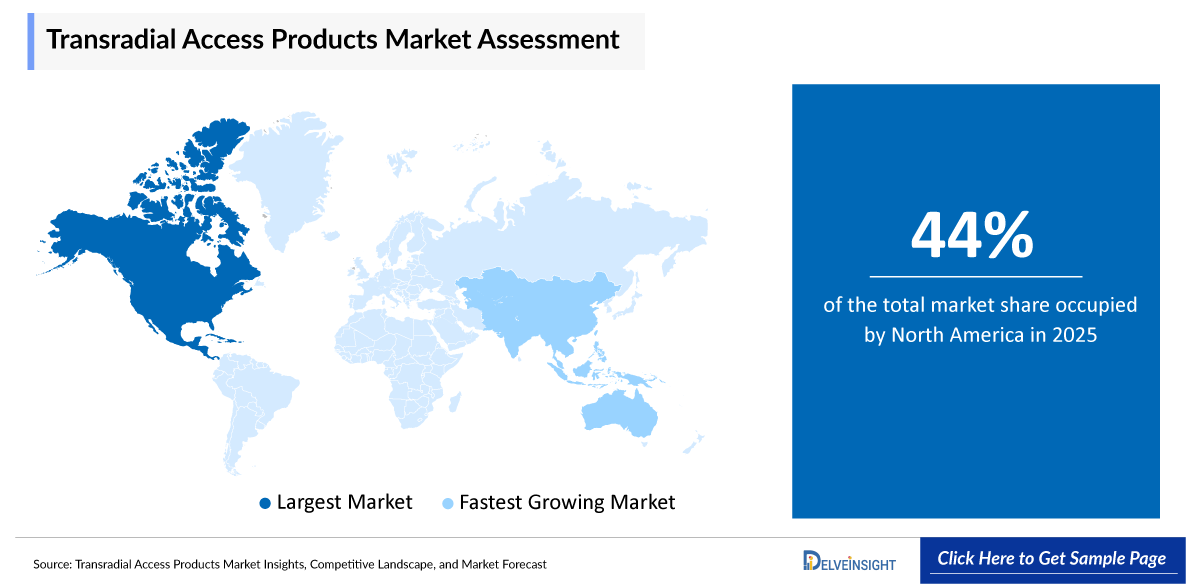
- North America dominated the global Transradial Access Products market revenue with a 44% share in 2025, representing the highest regional market share globally.
Request to unlock the Sample Page of "Transradial Access Products Market"
Transradial Access Products Market Size
The following snapshot summarizes the principal report metrics for the Transradial Access Products market.
Report Metrics |
Details |
|
2025 Market Size | |
|
2034 Projected Market Size | |
|
Growth Rate (2026-2034) | |
|
Largest Market |
North America |
|
Fastest Growing Market |
Asia-Pacific |
|
Market Structure |
Moderately Concentrated |
All market values are expressed in USD and represent DelveInsight estimates synthesized from primary and secondary research.
Factors Contributing to the Growth of the Transradial Access Products Market
Transradial Access Products Market Drivers
-
Rising Global Cardiovascular Disease Burden and PCI Volumes
The most powerful driver of the Transradial Access Products market is the sustained rise in coronary artery disease and the resulting growth in coronary angiography and percutaneous coronary intervention volumes worldwide. Global utilization of transradial procedures has expanded rapidly, with radial access now accounting for a majority of percutaneous coronary interventions across developed healthcare systems, reflecting broad clinical acceptance.
Rising incidence of coronary heart disease deaths and hospitalizations, including documented increases across developed markets such as Australia, continues to expand the pool of patients requiring catheter-based diagnosis and treatment. Because every procedure requires a dedicated access catheter, guidewire, and sheath, this procedural growth translates directly into recurring device demand. As cardiovascular disease prevalence continues to climb alongside aging populations, demand for transradial access products expands directly, anchoring market growth through 2034.
-
Clinical Evidence and Guideline Support for Radial-First Protocols
A deep and growing body of clinical evidence favoring transradial over transfemoral access is a central growth engine for the market. Randomized trials and scientific statements, including guidance from the American Heart Association on best practices for transradial coronary angiography and intervention, consistently demonstrate reduced bleeding, fewer vascular complications, faster patient mobilization, and materially lower hospital costs with radial access.
Cost-effectiveness research has shown hospital savings exceeding several hundred dollars per PCI with radial access, with savings compounding further among patients at higher bleeding risk. As professional societies and hospital quality programs increasingly codify radial-first protocols as standard of care, procedural volumes performed radially continue to rise, directly enlarging the addressable Transradial Access Products Market through the forecast period.
-
Continuous Innovation in Low-Profile and Slender-Sheath Technology
Ongoing device innovation is expanding the range of procedures that can be safely performed through the radial artery, broadening the market's addressable base. Manufacturers have introduced thin-wall, hydrophilic-coated sheaths that reduce the effective outer diameter without compromising inner lumen size, allowing operators to perform complex, large-bore interventions radially that previously required femoral access.
Complementary innovations in hemostasis and securement, such as compression devices and snap-fit sheath securement systems designed to reduce radial artery spasm and occlusion, are improving procedural safety and patient comfort. As device makers continue to refine coatings, kink-resistant guidewire cores, and low-profile catheter platforms, adoption of transradial access broadens into more complex interventional cardiology and peripheral vascular procedures, sustaining product demand across the forecast period.
-
Expansion of Ambulatory Surgical Centers and Outpatient Cardiovascular Care
A structural shift of cardiovascular procedures toward outpatient and ambulatory settings is a significant growth driver. Transradial access enables same-day discharge because it eliminates the extended bed rest required after femoral access, making it especially well suited to the ambulatory surgical center setting.
As payers and health systems increasingly favor lower-cost outpatient sites of care for diagnostic angiography and select interventional procedures, ambulatory surgical centers are adopting transradial access product lines at a faster pace than the hospital segment overall. This shift is expanding the end-user base for transradial access products and creating a durable, faster-growing channel alongside the traditional hospital and cath-lab market.
-
Growing Geriatric Population and Rising Chronic Disease Prevalence
The rising global geriatric population is expanding the pool of patients requiring cardiovascular diagnosis and intervention, and thereby sustaining recurring demand for vascular access devices. Older patients are more likely to present with coronary artery disease, peripheral vascular disease, and comorbidities requiring repeated catheter-based procedures, while radial access is particularly beneficial in this population given its lower bleeding risk profile.
Growing use of radial access techniques in pediatric patients is also broadening the addressable patient base at the other end of the age spectrum. As demographic aging continues across developed and developing economies alike, the underlying patient population driving transradial procedure volumes continues to expand across the forecast period.
-
Regulatory and Health-System Support for Minimally Invasive Access
Regulatory bodies and national health systems are increasingly promoting minimally invasive vascular access as a means of reducing complications, shortening hospital stays, and lowering healthcare expenditure. In the United Kingdom, organizations including NICE and the NHS Innovation Accelerator are facilitating evaluation and adoption of newer radial access devices and techniques.
Comparable initiatives across other developed markets are reinforcing hospital-level standardization on radial-first protocols. As regulatory and reimbursement frameworks continue to favor lower-complication, lower-cost access techniques, adoption of transradial access products is reinforced across both developed and emerging healthcare systems through the forecast period.
Transradial Access Products Market Restraints
Despite strong momentum, the Transradial Access Products Market faces material constraints. Radial artery spasm and occlusion remain clinically significant complications, reported in up to a fifth of patients for spasm and several percent for occlusion, and can limit the feasibility of transradial access in certain complex or large-bore procedures, requiring continued device and technique refinement.
The relatively small caliber of the radial artery imposes a learning curve for operators transitioning from femoral technique, and a shortage of trained interventional cardiologists and radiologists proficient in radial access constrains adoption in some developing regions. High cost and ongoing maintenance requirements for specialized radial access and hemostasis devices can be a barrier for smaller hospitals and price-sensitive markets.
Reimbursement frameworks and adoption of newer radial-specific technologies remain uneven across geographies, and supply-chain dependence on a concentrated group of device manufacturers introduces pricing and availability risk. Together, these clinical, workforce, cost, and reimbursement barriers temper the pace of growth, even as the underlying drivers of cardiovascular disease burden, guideline support, and outpatient care expansion remain firmly intact.
Transradial Access Products Overview
Transradial access products are specialized catheters, guidewires, sheaths, and adjunct hemostasis devices used to gain percutaneous arterial access through the radial artery in the wrist rather than the femoral artery in the groin, enabling coronary angiography, percutaneous coronary intervention, peripheral vascular procedures, and other catheter-based interventions with substantially lower access-site bleeding and vascular complications.
Because the radial artery is smaller and more superficial than the femoral artery, transradial procedures require purpose-built low-profile sheaths, hydrophilic coatings, slender-sheath technology, kink-resistant guidewires, and dedicated compression and hemostasis devices to minimize radial artery spasm and occlusion while preserving procedural success.
The market is organized by product across catheters, guidewires, sheaths, and other access and hemostasis accessories; by application across diagnostic and interventional cardiology, drug administration, blood transfusion, and other vascular access uses; by end-user across hospitals and clinics, ambulatory surgical centers, and other care settings; and by geography across North America, Europe, Asia-Pacific, and the Rest of the World.
Driven by rising cardiovascular disease prevalence, strong clinical evidence favoring radial-first protocols, an aging population, and rapid growth of outpatient cardiovascular care, transradial access products have become a foundational technology underpinning modern minimally invasive interventional medicine.
Transradial Access Products Market Key Growth Drivers
- The rising global burden of cardiovascular disease and the growing volume of coronary angiography and PCI procedures are directly expanding demand for radial-specific catheters, sheaths, and guidewires.
- Strong and growing clinical evidence, including scientific statements from the American Heart Association and SCAI favoring radial-first protocols, is driving hospitals to standardize on transradial access for both diagnostic and interventional procedures.
- Continuous product innovation, including low-profile hydrophilic sheaths such as Terumo's Glidesheath Slender and Merit Medical's Prelude Wave with SnapFix securement technology, is expanding the range of complex, large-bore procedures that can be performed radially.
- The documented cost and outcomes advantage of radial access, including materially lower hospital costs per PCI and shorter length of stay compared with femoral access, is accelerating hospital adoption.
- Rapid growth of ambulatory surgical centers and outpatient cardiovascular care, which favor same-day discharge enabled by radial access, is broadening the addressable end-user base.
- An aging population and rising prevalence of peripheral vascular disease and chronic conditions requiring repeated vascular access are sustaining recurring procedure volumes.
- Government and health-system initiatives promoting less invasive cardiovascular care, such as NICE and NHS Innovation Accelerator support for radial access devices in the United Kingdom, are reinforcing adoption in developed markets.
Transradial Access Products Market Segment Analysis
The Transradial Access Products by Market by Product (Catheter, Guidewire, Sheath, and Others), Application (Diagnostic & Interventional, Drug Administration, Blood Transfusion, and Others), End-User (Hospitals & Clinics, Ambulatory Surgical Centers, and Others), and Geography (North America, Europe, Asia-Pacific, and Rest of World).
-
Transradial Access Products Market Segmentation By Product
Dominant Subsegment: Catheter.
Dominant: Catheter ~ 38%
The catheter segment accounted for 38% of the transradial access products market in 2025. Catheters are the leading product category because every diagnostic and interventional radial procedure requires one or more specialized diagnostic or guiding catheters to navigate from the wrist to the coronary or peripheral vasculature, and because catheters are consumed with every single case, generating the highest and most consistent unit volumes of any product category.
The breadth of catheter shapes and sizes required to accommodate diverse anatomies and procedure types, combined with continuous innovation in torque control, kink resistance, and trackability, sustains great and dependable demand for catheter manufacturing and distribution.
Sheaths are the fastest-growing product category, propelled by the rapid adoption of slender, hydrophilic-coated introducer sheaths that enable larger-bore procedures through smaller punctures, while guidewires remain an essential, high-volume complementary product. Nonetheless, the sheer procedural necessity and volume of catheter use secures the segment's leadership across the forecast period.
-
Transradial Access Products Market Segmentation By Application
Dominant Subsegment: Diagnostic & Interventional.
Dominant: Diagnostic & Interventional ~ 72%
The diagnostic & interventional segment accounted for 72% of the Transradial Access Products market in 2025. Diagnostic and interventional cardiology and radiology procedures, including coronary angiography, percutaneous coronary intervention, and peripheral vascular interventions, are the leading application because they generate the highest procedural volumes and the broadest, most consistent use of dedicated access catheters, guidewires, and sheaths.
The well-documented safety and cost benefits of radial access relative to femoral access have made it the default approach for the large majority of diagnostic and interventional cardiac catheterization procedures across developed healthcare systems. Drug administration and blood transfusion applications, which use radial and related vascular access for medication delivery and blood-product administration, represent smaller but steady demand pools.
While drug administration is growing quickly as vascular access standardization extends beyond cardiology, the volume, frequency, and clinical centrality of diagnostic and interventional cardiovascular procedures secure this segment's clear leadership across the forecast period.
-
Transradial Access Products Market Segmentation By End-User
Dominant Subsegment: Hospitals & Clinics.
Dominant: Hospitals & Clinics ~ 65%
The hospitals & clinics segment accounted for 65% of the Transradial Access Products market in 2025. Hospitals and clinics remain the leading end-user because they house the majority of cardiac catheterization laboratories and perform the overwhelming share of complex, high-acuity, and emergency interventional procedures that require full surgical and critical-care backup.
Their established infrastructure, deep inventories of catheters, guidewires, and sheaths across sizes and configurations, and role as primary sites for physician training in radial technique reinforce their scale. Ambulatory surgical centers are the fastest-growing end-user segment, benefiting directly from the shift toward same-day discharge enabled by radial access and from payer incentives favoring lower-cost outpatient sites of care for diagnostic and select interventional procedures.
Nonetheless, the breadth of procedure complexity handled in the hospital setting keeps hospitals & clinics the dominant end-user across the forecast period.
Transradial Access Products Market Region Analysis
Dominant Region: North America
Dominant: North America ~ 44% (Largest)
North America accounted for 44% of the global Transradial Access Products market revenue in 2025, representing the highest regional market share globally. The region's dominance reflects a mature interventional cardiology ecosystem, high procedural volumes, strong reimbursement frameworks, and rapid, well-documented adoption of radial-first protocols across leading health systems in the United States and Canada.
North America hosts the largest concentration of high-volume cardiac catheterization laboratories and benefits from the presence of major device manufacturers headquartered in the region, supporting rapid access to the latest low-profile sheath and catheter innovations.
Strong clinical-research infrastructure, favorable reimbursement for outpatient cardiovascular procedures, and growing adoption of transradial access in ambulatory surgical centers continue to reinforce the region's leadership across the forecast period.
Fastest Growing Region: Asia-Pacific
Asia-Pacific is the fastest-growing region in the Transradial Access Products market. The region's elevated CAGR is driven by rising cardiovascular disease incidence, rapid expansion of cardiac catheterization infrastructure, and growing healthcare investment across China, Japan, India, South Korea, and Australia.
China continues to expand its network of cardiac catheterization laboratories and interventional cardiology training programs, Japan maintains a long-standing and mature radial-access clinical culture, India is scaling low-cost domestic manufacturing and interventional cardiology capacity, and Australia benefits from a well-established interventional cardiology base.
Government healthcare investment, an expanding population living with cardiovascular disease, and rising awareness of the clinical benefits of radial access are accelerating adoption across the region, positioning Asia-Pacific as the principal source of incremental growth over the forecast period.
Transradial Access Products Regional Commentary
- North America
North America accounted for 44% of the global Transradial Access Products market revenue in 2025. The United States dominates on the strength of its high-volume cardiac catheterization infrastructure, favorable reimbursement environment, and early, well-documented adoption of radial-first protocols, while the presence of leading device manufacturers and growing use of transradial access in ambulatory surgical centers reinforce its leadership.
- Europe
Europe is a large and advanced regional market, supported by well-established interventional cardiology guidelines, high radial-access adoption rates in countries such as Germany, Spain, and Portugal, and strong regulatory frameworks under CE marking. Government initiatives such as NICE and NHS Innovation Accelerator support in the United Kingdom, alongside growing single-use radial kit adoption to minimize infection risk, reinforce the region's role in supplying both diagnostic and interventional transradial access programs across Germany, France, the United Kingdom, Italy, and Spain.
- Asia-Pacific
Asia-Pacific is the fastest-growing region, propelled by rising cardiovascular disease incidence, rapid cardiac catheterization infrastructure build-out, and growing healthcare investment across China, Japan, India, South Korea, and Australia. China's expanding cath-lab network, Japan's mature radial-access clinical culture, India's low-cost manufacturing base, and South Korea's advanced interventional cardiology adoption are accelerating regional market growth and clinical training activity.
- Rest of World
The Rest of World region, spanning Latin America, the Middle East, and Africa, is an emerging growth frontier. Expanding cardiac catheterization and healthcare infrastructure, rising demand for minimally invasive diagnostic and interventional cardiovascular care, and efforts to align regulatory frameworks with global standards are gradually broadening access, while growing physician training in radial technique and international partnerships support the build-out of regional interventional cardiology capacity.
Transradial Access Products Market Competitive Landscape
The Transradial Access Products Market is classified as Moderately Concentrated. A group of large, diversified medical device manufacturers with global distribution reach, including Terumo Medical Corporation, Medtronic, Merit Medical Systems, and Edwards Lifesciences Corporation, secures large hospital contracts and anchors the top tier, while specialized and regionally focused providers such as AngioDynamics, SCW Medicath, Tianck Medical, Shanghai Kindly Medical Instruments, Colibri Heart Valve, and Nipro Medical Corporation compete through niche product breadth, regional manufacturing scale, and targeted clinician relationships, increasing competition in fast-growing emerging markets.
The Transradial Access Products Competitive Landscape can be evaluated across the following dimensions:
- Market concentration: Moderately concentrated, with globally diversified device makers leading and a growing field of regionally focused and specialized manufacturers.
- Leading players: Terumo Medical Corporation, Medtronic, Merit Medical Systems, and Edwards Lifesciences Corporation anchor the top tier through global distribution networks and broad interventional product portfolios.
- Geographic reach: Leaders operate global, multi-region distribution and manufacturing networks essential for supplying hospitals and ambulatory centers across developed and emerging markets alike.
- Product portfolio strength: Top players offer end-to-end radial access portfolios spanning catheters, guidewires, sheaths, hemostasis and compression devices, and procedural accessories.
- Manufacturing scale: Regional manufacturers such as Shanghai Kindly Medical Instruments, SCW Medicath, and Tianck Medical compete on cost-efficient, high-volume production and regulatory approvals in China and other Asia-Pacific markets.
- Innovation focus: Hydrophilic and slender-sheath coatings, snap-fit securement technology, kink-resistant guidewire cores, and improved compression and hemostasis devices are key competitive differentiators.
- Clinical partnerships: Collaboration with interventional cardiology societies and sponsorship of radial-technique training and clinical trials extend physician relationships and support product adoption.
- M&A and portfolio activity: Continued bolt-on acquisitions of complementary access and hemostasis product lines are expanding portfolio breadth among leading manufacturers.
Transradial Access Products Market Recent Developmental Activities
- In August 2025, Merit Medical Systems announced the U.S. commercial launch of the Prelude Wave Hydrophilic Sheath Introducer with SnapFix Securement Technology, a low-profile sheath designed to reduce radial artery spasm and occlusion while improving sheath retention during radial access procedures. Strategic significance: Strengthens Merit's Access portfolio and reinforces its radial-first product strategy.
- In October 2025, Merit Medical Systems acquired the assets of Radial Assist, including the RAD BOARD, RAD BOARD XTRA, RAD TRAC, and RAD REST radial procedural support devices. Strategic significance: Expands Merit's radial-access accessory portfolio and procedural support offerings.
- In 2025, Merit Medical Systems launched several new access-related products including the 10FoRe hemostasis valve, the Ventrax Delivery System, and MAK Gold Mini Access Kits, broadening its interventional access platform. Strategic significance: Extends Merit's addressable procedures and reinforces its position as a leading radial access device supplier.
- In 2025 and 2026, Terumo Medical Corporation continued global expansion of its Glidesheath Slender platform and associated clinical training programs under its GS26 strategic initiative, with continued investment targeted at China and Southeast Asia to support near-term market share gains. Strategic significance: Reinforces Terumo's role as a pioneer and global leader in low-profile radial sheath technology.
- In 2025, Medtronic continued to expand its interventional cardiology and peripheral vascular access portfolio, supporting radial-compatible guide catheters and delivery systems for coronary and structural heart procedures. Strategic significance: Broadens Medtronic's radial-compatible procedural ecosystem across cardiology and vascular intervention.
- In 2025, AngioDynamics continued to expand its introducer and micro-access portfolio, including coaxial microintroducer kits and peel-away sheath systems used in vascular access procedures. Strategic significance: Strengthens AngioDynamics' vascular access product breadth across interventional radiology and cardiology settings.
- In 2025, Shanghai Kindly Medical Instruments Co., Ltd., continued to expand its NMPA-registered vascular access sheath and guiding catheter portfolio, supporting growing cardiovascular intervention volumes across China. Strategic significance: Reinforces Kindly's position as a leading domestic supplier of interventional access devices in the Asia-Pacific region.
- In 2025, Nipro Medical Corporation continued to broaden its vascular access device portfolio, supporting sheath introducer and catheter demand across both developed and emerging cardiovascular care markets. Strategic significance: Extends Nipro's global vascular access footprint alongside its established renal and diabetes care businesses.
- In 2025, Edwards Lifesciences Corporation continued to support transradial and transfemoral delivery-compatible access systems for its structural heart therapy portfolio, reinforcing vascular access standardization across catheter-based interventions. Strategic significance: Reinforces access-device alignment with Edwards' broader structural heart therapy platform.
- In 2025, SCW Medicath Ltd. and Tianck Medical Co., Ltd. continued to expand regional manufacturing capacity and product registrations for radial and femoral introducer sheaths and catheters across Asia-Pacific markets. Strategic significance: Supports growing regional demand for cost-competitive vascular access devices in high-growth emerging markets.
Transradial Access Products Companies
The Transradial Access Products competitive landscape is led by the following active device manufacturers:
- AngioDynamics
- Terumo Medical Corporation
- Medtronic
- SCW Medicath Ltd.
- Tianck Medical Co., Ltd.
- Edwards Lifesciences Corporation
- Shanghai Kindly Medical Instruments Co., Ltd.
- Colibri Heart Valve
- Merit Medical Systems
- Nipro Medical Corporation
For illustrative purposes, only the top 10 companies are listed in the Table of Contents. The report may include analysis and references to additional companies relevant to the market assessment.
Transradial Access Products Market Segmentation
Transradial Access Products Market by Product
- Catheter
- Guidewire
- Sheath
- Others
Transradial Access Products Market by Application
- Diagnostic & Interventional
- Drug Administration
- Blood Transfusion
- Others
Transradial Access Products Market by End User
- Hospitals & Clinics
- Ambulatory Surgical Centers
- Others
Transradial Access Products Market by Geography
- North America Transradial Access Products Market
- United States Transradial Access Products Market Size in USD million (2023-2034)
- Canada Transradial Access Products Market Size in USD million (2023-2034)
- Mexico Transradial Access Products Market Size in USD million (2023-2034)
- Europe Transradial Access Products Market
- Germany Transradial Access Products Market Size in USD million (2023-2034)
- United Kingdom Transradial Access Products Market Size in USD million (2023-2034)
- France Transradial Access Products Market Size in USD million (2023-2034)
- Italy Transradial Access Products Market Size in USD million (2023-2034)
- Spain Transradial Access Products Market Size in USD million (2023-2034)
- Rest of Europe Transradial Access Products Market Size in USD million (2023-2034)
- Asia-Pacific Transradial Access Products Market
- China Transradial Access Products Market Size in USD million (2023-2034)
- Japan Transradial Access Products Market Size in USD million (2023-2034)
- India Transradial Access Products Market Size in USD million (2023-2034)
- Australia Transradial Access Products Market Size in USD million (2023-2034)
- South Korea Transradial Access Products Market Size in USD million (2023-2034)
- Rest of Asia-Pacific Transradial Access Products Market Size in USD million (2023-2034)
- Rest of the World (RoW) Transradial Access Products Market
- Middle East Transradial Access Products Market Size in USD million (2023-2034)
- Africa Transradial Access Products Market Size in USD million (2023-2034)
- South America Transradial Access Products Market Size in USD million (2023-2034)
Transradial Access Products Market Recent Industry Trends and Milestones (2023-2026)
|
Category |
Key Developments |
|
Transradial Access Products Market Product Approval |
Regulatory clearances continue to expand the range of low-profile radial devices available to operators. Merit Medical secured U.S. commercial release of the Prelude Wave Hydrophilic Sheath Introducer with SnapFix Securement Technology in August 2025, while Shanghai Kindly Medical Instruments secured NMPA Class III registration for its vascular access sheath platform. Each approval creates durable demand for compliant manufacturing, distribution, and clinician training, the large majority of which flows to established transradial access device suppliers. |
|
Transradial Access Products Market Expansion |
Manufacturers broadened access and hemostasis product portfolios across the value chain. Merit Medical acquired the assets of Radial Assist, adding RAD BOARD, RAD TRAC, and RAD REST procedural support devices, while Terumo continued global expansion of its Glidesheath Slender training and education programs under its GS26 initiative, with investment targeted at China and Southeast Asia. AngioDynamics, Nipro, and regional Asia-Pacific manufacturers continued to expand introducer and microintroducer kit offerings. |
|
Transradial Access Products Market Investment |
Capital investment concentrated on low-profile sheath innovation, hemostasis device development, and regional manufacturing capacity expansion. Leading manufacturers continued targeted R&D investment in hydrophilic coatings, kink-resistant guidewire cores, and automated compression devices, while regional Asia-Pacific producers expanded manufacturing capacity to support rising domestic and export demand for cost-competitive access devices. |
|
Company Strategy |
Terumo Medical Corporation: Global leadership in low-profile sheath technology through its Glidesheath Slender platform and GS26 strategic initiative. Medtronic: Broad interventional cardiology and peripheral vascular access ecosystem supporting radial-compatible procedures. Merit Medical Systems: Continued Access portfolio expansion through new product launches and the Radial Assist acquisition. Edwards Lifesciences: Access-device alignment with its structural heart therapy platform. AngioDynamics, SCW Medicath, Tianck Medical, Shanghai Kindly Medical Instruments, Colibri Heart Valve, and Nipro Medical Corporation: Regional manufacturing scale, niche product breadth, and targeted clinician relationships. |
|
Emerging Technologies |
Slender, hydrophilic-coated sheath technology and snap-fit securement systems designed to reduce radial artery spasm and occlusion represent the leading edge of product innovation. Kink-resistant nitinol guidewire cores, automated and radar-based localization tools, and improved compression-based hemostasis devices are improving procedural safety and patient comfort. Growing use of single-use radial kits to minimize infection risk and expanding physician training and digital education platforms are accelerating standardization of radial-first protocols across both developed and emerging markets. |
Transradial Access Products Market Startup Funding and Investment Trends
Investment in the Transradial Access Products ecosystem has concentrated on low-profile sheath innovation, hemostasis and compression device development, and decentralized ambulatory access platforms. The following companies illustrate recent funding and investment activity and technology focus.
|
Company |
Total Funding |
Funding Stage |
Main Offering |
Core Technology |
|
Access Point Technologies |
Series C |
Late-stage venture |
Hemostasis and compression devices |
Automated patent, band-based compression |
|
Request for unlocking the report of the @ Transradial Access Products Market | ||||
Capital continues to flow toward device makers that improve procedural safety and broaden the range of interventions feasible through radial access. Established manufacturers such as Merit Medical Systems and Terumo Medical Corporation continue to reinvest in low-profile sheath and hemostasis innovation, while emerging developers of radial-first access kits and compression technologies are scaling venture-backed product platforms.
Collectively, these investments signal conviction that sheath-profile innovation, hemostasis safety, and outpatient-ready procedural ecosystems will define the next phase of competitive advantage in the global Transradial Access Products market.
Key Takeaways from the Transradial Access Products Market Report Study
- Market size analysis for the current Transradial Access Products Market Size (2025), and market forecast for 9 years (2026 to 2034).
- Top key product/technology developments, mergers, acquisitions, partnerships, and joint ventures that happened over the last 3 years.
- Key companies dominating the global transradial access products market.
- Various opportunities available for competitors in the transradial access products market space.
- What are the top-performing segments in 2025? How will these segments perform in 2034?
- Which are the top-performing regions and countries in the current transradial access products market scenario?
- Which are the regions and countries where companies should concentrate their opportunities for transradial access products market growth in the future?
Target audience who can benefit from this transradial access products market report study
- Transradial access products product providers
- Research organizations and consulting companies
- Transradial access products-related organizations, associations, forums, and other alliances
- Government and corporate offices
- Start-up companies, venture capitalists, and private equity firms
- Distributors and traders dealing in transradial access products
- Various end-users who want to know more about the transradial access products market and the latest technological developments in the transradial access products market.
Stay updated with us for Recent Articles @ New DelveInsight Blogs

