
Trichotillomania Market Summary
Trichotillomania Market Insights and Forecast
- The Trichotillomania Market is expected to strengthen as awareness of the disease increases, and more effective interventions are being developed.
- The leading Trichotillomania Companies such as Hamilton Health Sciences Corporation, Promentis Pharmaceuticals Inc., Yale University, Massachusetts General Hospital, and others.
Request for Unlocking the Sample Page of the "Trichotillomania Treatment Market"
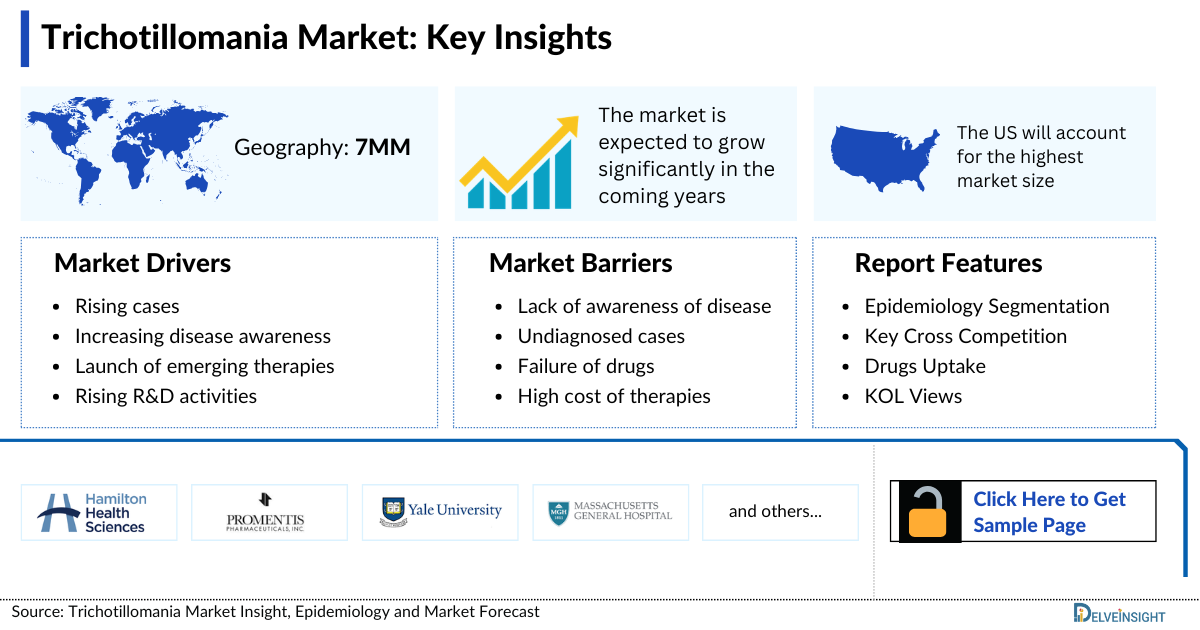
Key Factors Driving the Trichotillomania Market Growth
-
Rising Awareness of Body-Focused Repetitive Behaviors (BFRBs)
Increasing public and clinical awareness about trichotillomania and other BFRBs is encouraging more individuals to seek medical help, leading to improved diagnosis rates and greater demand for effective therapies.
-
Improved Diagnostic Practices
Growing understanding among healthcare professionals regarding psychiatric and behavioral disorders has enhanced the recognition and diagnosis of trichotillomania, contributing to an expanding patient pool and greater treatment adoption.
-
Increasing Prevalence of Mental Health Disorders
The global rise in anxiety, obsessive-compulsive spectrum disorders, and stress-related conditions is indirectly increasing the number of individuals affected by trichotillomania, thereby driving market demand for targeted treatments.
-
Advancements in Behavioral and Pharmacological Therapies
Continuous research in cognitive behavioral therapy (CBT), habit reversal training (HRT), and emerging pharmacological interventions is creating new opportunities for effective disease management and improving patient outcomes.
-
Growing Investment in Neuropsychiatric Research
Pharmaceutical companies, academic institutions, and research organizations are investing more resources into understanding neurobehavioral disorders, leading to the development of innovative treatment strategies for trichotillomania.
-
Expansion of Digital Mental Health Solutions
The rise of telemedicine, mental health apps, and online therapy platforms has made behavioral therapies more accessible, helping patients receive timely interventions and boosting the overall treatment market.
-
Support from Patient Advocacy Groups
Advocacy organizations and awareness campaigns are helping reduce stigma associated with psychiatric disorders, encouraging individuals to seek treatment and contributing to market growth.
-
Increasing Focus on Personalized Treatment Approaches
Advances in neuroscience and precision medicine are enabling more individualized therapeutic approaches, which is expected to improve treatment effectiveness and stimulate the development of new therapies.
-
Pipeline Development and Emerging Therapies
The presence of promising investigational therapies and ongoing clinical research programs is anticipated to expand the future treatment landscape and support long-term growth of the trichotillomania market.
-
Growing Healthcare Expenditure on Mental Health
Governments and healthcare systems worldwide are increasing funding for mental health services, improving access to treatment and creating favorable conditions for the expansion of the trichotillomania therapeutics market.
DelveInsight's "Trichotillomania Market Insights, Epidemiology, and Market Forecast-2034" report delivers an in-depth understanding of the Trichotillomania, historical and forecasted epidemiology as well as the Trichotillomania market trends in the United States, EU5 (Germany, Spain, Italy, France, and United Kingdom) and Japan.
The Trichotillomania Treatment Market Report provides current treatment practices, emerging drugs, Trichotillomania market share of the individual therapies, current and forecasted Trichotillomania market Size from 2020 to 2034 segmented by seven major markets. The Report also covers current Trichotillomania treatment practice/algorithm, market drivers, market barriers and unmet medical needs to curate the best of the opportunities and assesses the underlying potential of the Trichotillomania market.
Scope of the Trichotillomania Market Report | |
|
Study Period |
2020 to 2034 |
|
Forecast Period |
2024 to 2034 |
|
Geographies Covered |
|
|
Trichotillomania Market |
|
|
Trichotillomania Market Size | Request for Sample Page |
|
Trichotillomania Companies |
|
Trichotillomania Understanding
The DelveInsight’s Trichotillomania market report gives a thorough understanding of the Trichotillomania by including details such as disease definition, symptoms, causes, pathophysiology, diagnosis, and treatment. Trichotillomania, also known as hair-pulling disorder, is a mental health condition characterized by a recurrent, irresistible urge to pull out hair from the scalp, eyebrows, eyelashes, or other parts of the body. It is classified under obsessive-compulsive and related disorders and often begins during adolescence, though it can affect individuals of any age. People with trichotillomania may experience increasing tension or anxiety before pulling their hair and a sense of relief afterward. The condition can lead to noticeable hair loss, emotional distress, and impairment in social or occupational functioning. While the exact cause is not fully understood, genetic factors, psychological stress, and neurobiological influences are believed to play important roles in its development.
Trichotillomania Diagnosis
This segment of the report covers the detailed diagnostic methods or tests for Trichotillomania. The diagnosis of trichotillomania is primarily clinical and is based on a thorough psychological evaluation and patient history. Mental health professionals assess symptoms such as recurrent hair pulling that results in hair loss, repeated attempts to reduce or stop the behavior, and significant distress or impairment caused by the condition. Diagnostic criteria are often guided by standard psychiatric classifications that help distinguish trichotillomania from other causes of hair loss, such as dermatological conditions or medical disorders. In some cases, dermatological examination may also be conducted to rule out other hair-loss conditions. Early diagnosis is important because the disorder can worsen over time if not properly managed.
Trichotillomania Treatment
It covers the details of conventional and current medical therapies available in the Trichotillomania market for the treatment of the condition. It also provides Trichotillomania treatment algorithms and guidelines in the United States, Europe, and Japan. Treatment for trichotillomania typically involves a combination of behavioral therapy, psychological support, and sometimes medication. Cognitive behavioral therapy (CBT), particularly habit reversal training (HRT), is considered one of the most effective approaches. This therapy helps patients recognize triggers for hair pulling and develop healthier alternative behaviors. Additional supportive therapies such as mindfulness techniques, stress management, and counseling can also help patients cope with urges and emotional triggers. In certain cases, medications such as antidepressants or other psychiatric drugs may be prescribed to manage underlying anxiety, depression, or compulsive behaviors. A comprehensive treatment plan, including psychological therapy and long-term support, can significantly improve symptom control and quality of life for individuals with trichotillomania.
Trichotillomania Epidemiology
The Trichotillomania epidemiology section provides insights about the historical and current Trichotillomania patient pool and forecasted trends for individual seven major countries. It helps to recognize the causes of current and forecasted trends by exploring numerous studies and the views of key opinion leaders. This part of the Trichotillomania market report also provides the diagnosed patient pool and their trends along with assumptions undertaken.
Key Findings from Trichotillomania Epidemiological Analysis
The disease epidemiology covered in the report provides historical as well as forecasted Trichotillomania Prevalence scenario in the 7MM covering the United States, EU5 countries (Germany, Spain, Italy, France, and the United Kingdom), and Japan from 2020 to 2034.
- According to the American Psychiatric Association (2023), in the general population, trichotillomania affects an estimated 1–2% of adults and adolescents in a given year and it is much more common among females.
Country Wise- Trichotillomania Epidemiology
The epidemiology segment also provides the Trichotillomania epidemiology data and findings across the United States, EU5 (Germany, France, Italy, Spain, and the United Kingdom), and Japan.
Trichotillomania Epidemiology Segmentation in the 7MM
- Trichotillomania Diagnosed Prevalent Cases
- Trichotillomania Age-specific Cases
- Trichotillomania Gender-specific Cases
- Trichotillomania Treated Cases
Trichotillomania Market Recent Breakthroughs and Developments
- In February 2026, Yale University conducted a trial aimed to evaluate the efficacy, safety, and tolerability of valbenazine, titrated to the subject's optimal dose of 40mg or 80mg, administered once daily, for 12 weeks, for the treatment of trichotillomania (TTM) in a double blind placebo controlled design study. After week 12, subjects will begin a 12-week, open-label portion of the study. During the open-label portion of the study, all subjects will receive the study drug at their optimal dose. The primary endpoint of these studies will be the change from baseline of placebo vs. active scores utilizing the Massachusetts General Hospital Hairpulling Scale (MGH-HPS) at the end of Week 12.
Trichotillomania Drug Analysis
The drug chapter segment of the Trichotillomania therapeutics market report encloses the detailed analysis of Trichotillomania marketed drugs and late-stage (Phase-III and Phase-II) Trichotillomania Pipeline Drugs. It also helps to understand the Trichotillomania clinical trial details, expressive pharmacological action, agreements and collaborations, approval and patent details, advantages and disadvantages of each included drug, and the latest news and press releases.
Trichotillomania Marketed Drugs
The Trichotillomania therapeutics market report provides the details of the marketed products/off-label treatments available for Trichotillomania treatment.
Trichotillomania Emerging Drugs
- Clomipramine
- N-acetylcysteine
- Valbenazine (Neurocrine Biosciences)
- SXC-2023 (Promentis Pharmaceuticals)
Trichotillomania Market Outlook
The Trichotillomania Market Outlook of the report helps to build a detailed comprehension of the historic, current, and forecasted Trichotillomania market trends by analyzing the impact of current Trichotillomania therapies on the market, Trichotillomania unmet needs, drivers and barriers, and demand for better technology.
This segment gives a thorough detail of Trichotillomania Market Trend of each marketed drug and late-stage pipeline therapy by evaluating their impact based on the annual cost of therapy, inclusion and exclusion criteria's, mechanism of action, compliance rate, growing need of the market, increasing patient pool, covered patient segment, expected launch year, competition with other therapies, brand value, their impact on the market and view of the key opinion leaders. The calculated Trichotillomania market data are presented with relevant tables and graphs to give a clear view of the market at first sight.
"According to DelveInsight, the Trichotillomania Treatment Market in 7MM is expected to witness a major change in the study period 2020-2034"
Key Findings
This section includes a glimpse of the Trichotillomania market in 7MM.
The United States Market Outlook
This section provides the total Trichotillomania market size and market size by therapies in the United States.
EU-5 Countries: Market Outlook
The total Trichotillomania market size and market size by therapies in Germany, France, Italy, Spain, and the United Kingdom is provided in this section.
Japan Market Outlook
The total Trichotillomania market size and market size by therapies in Japan is also mentioned.
Trichotillomania Drugs Uptake
This section focuses on the rate of uptake of the potential Trichotillomania drugs recently launched in the Trichotillomania market or expected to get launched in the market during the study period 2020-2034. The analysis covers Trichotillomania market uptake by drugs; patient uptake by therapies; and sales of each drug. Trichotillomania Drugs Uptake helps in understanding the drugs with the most rapid uptake, reasons behind the maximal use of New Trichotillomania Drugs, and allow the comparison of the drugs on the basis of Trichotillomania market share and size which again will be useful in investigating factors important in market uptake and in making financial and regulatory decisions.
Trichotillomania Clinical Trials Activities
The Trichotillomania pipeline segment provides insights into different therapeutic candidates in Phase II, and Phase III stage. It also analyses Trichotillomania Companies involved in developing targeted therapeutics.
Trichotillomania Pipeline Development Activities
The Trichotillomania pipeline segment covers the detailed information of collaborations, acquisition, and merger, licensing, patent details, and other information for Trichotillomania emerging therapies.
Trichotillomania Reimbursement Scenario
Approaching reimbursement proactively can have a positive impact both during the late stages of product development and well after product launch. In a report, we take reimbursement into consideration to identify economically attractive indications and market opportunities. When working with finite resources, the ability to select the markets with the fewest reimbursement barriers can be a critical business and price strategy.
Latest KOL- Views on Trichotillomania
To keep up with current Trichotillomania market trends, we take KOLs and SMEs ' opinion working in the Trichotillomania domain through primary research to fill the data gaps and validate our secondary research. Their opinion helps to understand and validate current and emerging therapies treatment patterns or Trichotillomania market trends. This will support the clients in potential upcoming novel treatment by identifying the overall scenario of the market and the Trichotillomania unmet needs.
Trichotillomania Competitive Intelligence Analysis
We perform Competitive and Market Intelligence analysis of the Trichotillomania Market by using various Competitive Intelligence tools that include - SWOT analysis, PESTLE analysis, Porter's five forces, BCG Matrix, Market entry strategies etc. The inclusion of the analysis entirely depends upon the data availability.
Major Trichotillomania Companies
Hamilton Health Sciences Corporation, Promentis Pharmaceuticals Inc., Yale University, Massachusetts General Hospital, and others.
Trichotillomania Market Report Scope
- The Trichotillomania Therapeutics Market Report covers the descriptive overview, explaining its causes, signs and symptoms, pathophysiology, diagnosis, and currently available therapies
- Comprehensive insight has been provided into the Trichotillomania epidemiology and treatment in the 7MM
- Additionally, an all-inclusive account of both the current and emerging therapies for Trichotillomania is provided, along with the assessment of new therapies, which will have an impact on the current treatment landscape
- A detailed review of the Trichotillomania Treatment Market; historical and forecasted is included in the report, covering drug outreach in the 7MM
- The patient-based Trichotillomania market forecasting report provides an edge while developing business strategies, by understanding trends shaping and driving the global Trichotillomania market
Trichotillomania Market Report Highlights
- In the coming years, the Trichotillomania Treatment Market is set to change due to the rising awareness of the disease, and incremental healthcare spending across the world; which would expand the size of the market to enable the drug manufacturers to penetrate more into the market
- The Trichotillomania Companies and academics are working to assess challenges and seek opportunities that could influence Trichotillomania R&D. The therapies under development are focused on novel approaches to treat/improve the disease condition
- Major Trichotillomania Companies are involved in developing therapies for Trichotillomania. The launch of emerging therapies will significantly impact the Trichotillomania market
- A better understanding of disease pathogenesis will also contribute to the development of novel therapeutics for Trichotillomania
- Our in-depth analysis of the Trichotillomania Pipeline assets across different stages of development (Phase III and Phase II), different emerging trends, and comparative analysis of pipeline products with detailed Trichotillomania clinical trials profiles, key cross-competition, launch date along with product development activities will support the clients in the decision-making process regarding their therapeutic portfolio by identifying the overall scenario of the research and development activities.
Trichotillomania Market Report Insights
- Patient-based Trichotillomania Market Forecasting
- Therapeutic Approaches
- Trichotillomania Pipeline Drugs Analysis
- Trichotillomania Market Size and Trends
- Trichotillomania Drugs Market Opportunities
- Impact of upcoming Trichotillomania Therapies
Trichotillomania Market Report Key Strengths
- 10 Years Trichotillomania Market Forecast
- 7MM Coverage
- Trichotillomania Epidemiology Segmentation
- Key Cross Competition
- Highly Analyzed Trichotillomania Drugs Market
- Trichotillomania Drugs Uptake
Trichotillomania Market Report Assessment
- Current Trichotillomania Treatment Market Practices
- Trichotillomania Unmet Needs
- Trichotillomania Pipeline Drugs Profiles
- Trichotillomania Market Attractiveness
- Trichotillomania Market Drivers
- Trichotillomania Market Barriers
Key Questions Answered in the Trichotillomania Market Report
TRK Fusion Treatment Market Insights:
- What was the Trichotillomania Drugs Market Share (%) distribution in 2020 and how it would look like in 2034?
- What would be the total Trichotillomania Drugs Market Size as well as market size by therapies across the 7MM during the forecast period (2024-2034)?
- What are the key findings pertaining to the market across 7MM and which country will have the largest Trichotillomania market size during the forecast period (2024-2034)?
- At what CAGR, the Trichotillomania market is expected to grow by 7MM during the forecast period (2024-2034)?
- What would be the Trichotillomania market outlook across the 7MM during the forecast period (2024-2034)?
- What would be the Trichotillomania market growth till 2024, and what will be the resultant market Size in the year 2034?
- How would the Trichotillomania Unmet needs affect the market dynamics and subsequent analysis of the associated trends?
Trichotillomania Epidemiology Insights:
- What are the disease risk, burden, and regional/ethnic differences of the Trichotillomania?
- What are the key factors driving the epidemiology trend for seven major markets covering the United States, EU5 (Germany, Spain, France, Italy, UK), and Japan?
- What is the historical Trichotillomania patient pool in seven major markets covering the United States, EU5 (Germany, Spain, France, Italy, UK), and Japan?
- What would be the forecasted patient pool of Trichotillomania in seven major markets covering the United States, EU5 (Germany, Spain, France, Italy, UK), and Japan?
- Where will be the growth opportunities in the 7MM with respect to the patient population pertaining to Trichotillomania?
- Out of all 7MM countries, which country would have the highest prevalent population of Trichotillomania during the forecast period (2024-2034)?
- At what CAGR the Trichotillomania patient population is expected to grow in 7MM during the forecast period (2024-2034)?
Current Trichotillomania Treatment Market Scenario, Marketed Drugs and Emerging Therapies
- What are the current options for the Trichotillomania treatment in addition to the approved therapies?
- What are the current treatment guidelines for the treatment of Trichotillomania in the USA, Europe, and Japan?
- What are the Trichotillomania marketed drugs and their respective Trichotillomania MOA, regulatory milestones, product development activities, advantages, disadvantages, safety and efficacy, etc.?
- How many companies are developing therapies for the treatment of Trichotillomania?
- How many therapies are in-development by each company for Trichotillomania treatment?
- How many are emerging therapies in mid-stage, and late stage of development for Trichotillomania treatment?
- What are the key collaborations (Industry - Industry, Industry - Academia), Mergers and acquisitions, licensing activities related to the Trichotillomania therapies?
- What are the recent novel therapies, targets, Trichotillomania mechanisms of action and technologies being developed to overcome the limitation of existing therapies?
- What are the clinical studies going on for Trichotillomania and their status?
- What are the current challenges faced in drug development?
- What are the key designations that have been granted for the emerging therapies for Trichotillomania?
- What are the global historical and forecasted Trichotillomania Market?
Reasons to Buy the Trichotillomania Market Report
- The patient-based Trichotillomania market forecasting report will help in developing business strategies by understanding trends shaping and driving the Trichotillomania drugs market
- To understand the future Trichotillomania Drugs Market competition in the Trichotillomania market and Insightful review of the key market drivers and barriers
- Organize sales and marketing efforts by identifying the best opportunities for Trichotillomania in the US, Europe (Germany, Spain, Italy, France, and the United Kingdom) and Japan
- Identification of strong upcoming players in the Trichotillomania Drugs Market will help in devising strategies that will help in getting ahead of competitors
- Organize sales and marketing efforts by identifying the best opportunities for Trichotillomania Drugs Market
- To understand the future market competition in the Trichotillomania Drugs Market
Click here to Read More about the Related Articles @ New DelveInsight Blogs
-pipeline.png&w=256&q=75)