
Tuberculosis Therapeutics Market Summary
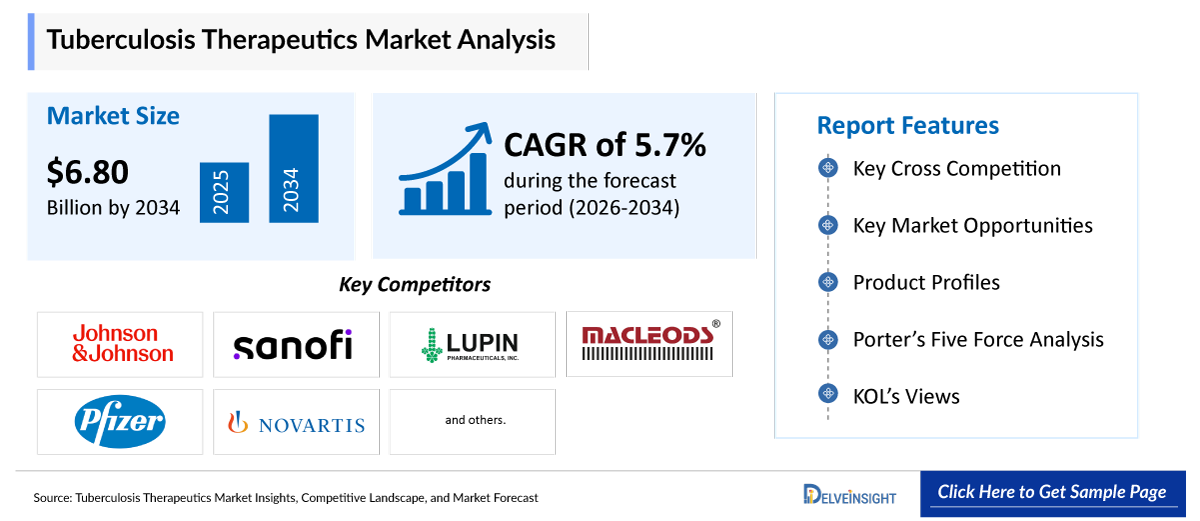
● The Tuberculosis Therapeutics market is estimated at USD 4.15 billion in 2025 and is projected to reach USD 6.80 billion by 2034. Growth is anchored in the persistently high global TB burden, accelerating rollout of shorter all-oral drug-resistant TB regimens, and expanding access to next-generation anti-TB drugs across high-burden countries.
● The global Tuberculosis Therapeutics market is growing at a CAGR of 5.7% during the forecast period from 2026 to 2034.
● By drug type, the first-line anti-tuberculosis drugs segment dominated the Tuberculosis Therapeutics market with a 54% share in 2025.
● By disease type, the active TB segment dominated the Tuberculosis Therapeutics market with a 69% share in 2025.
● By formulation, the tablets segment dominated the Tuberculosis Therapeutics market with a 61% share in 2025.
● By patient type, the adult segment dominated the Tuberculosis Therapeutics market with a 72% share in 2025.
● By distribution channel, the hospital pharmacies segment dominated the Tuberculosis Therapeutics market with a 44% share in 2025.
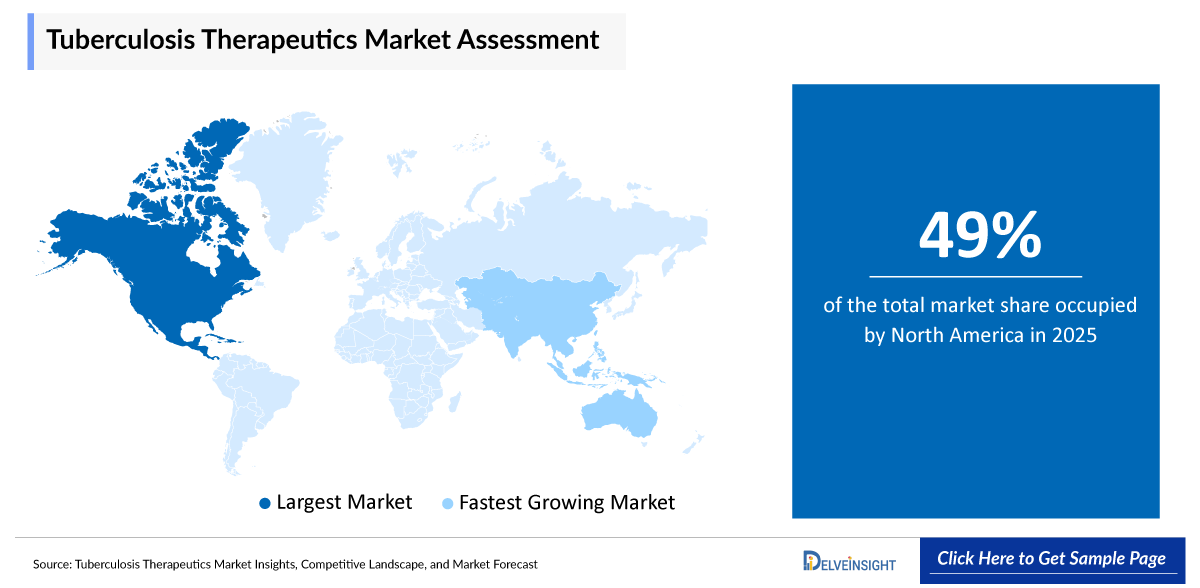
● Asia-Pacific dominated the global Tuberculosis Therapeutics market revenue with a 49% share in 2025, representing the highest regional market share globally, reflecting the concentration of the global TB burden in the region.
Tuberculosis therapeutics comprise the anti-tubercular medicines used to prevent, treat, and manage active TB, latent TB infection, and multidrug- and extensively drug-resistant TB (MDR-TB and XDR-TB) caused by Mycobacterium tuberculosis. Standard treatment of drug-susceptible active TB relies on a backbone of first-line agents, isoniazid, rifampicin, pyrazinamide, and ethambutol, most often delivered as fixed-dose combination tablets to improve adherence and reduce pill burden under directly observed treatment programs. Drug-resistant TB requires second-line agents, including bedaquiline, pretomanid, linezolid, delamanid, and fluoroquinolones, increasingly deployed in shorter, all-oral regimens such as BPaL and BPaLM that have replaced older 18-20 month injectable-containing regimens. The market is organized by drug type across first-line, second-line/drug-resistant, and fixed-dose combination therapies; by disease type across active TB, latent TB, MDR-TB, and XDR-TB; by formulation across tablets, capsules, and injections; by patient type across adult, pediatric, and geriatric populations; and by distribution channel across hospital pharmacies, retail pharmacies, online pharmacies, and other channels such as national TB program clinics. Driven by the scale of the global TB burden, the rapid adoption of shorter drug-resistant TB regimens, expanding generic access through voluntary licensing, and sustained government and global-health-partner investment, tuberculosis therapeutics remain a cornerstone of infectious-disease public health infrastructure worldwide.
Tuberculosis Therapeutics Market Key Growth Drivers
• The persistently high global TB burden is sustaining demand, with the WHO Global Tuberculosis Report 2025 estimating that TB affected 10.7 million people and caused over 1.2 million deaths in 2024.
• Rapid national and global adoption of the shorter, all-oral BPaLM/BPaL regimens for MDR/RR-TB, including India's September 2024 approval of BPaLM under its National TB Elimination Program, is expanding demand for bedaquiline, pretomanid, and linezolid.
• Voluntary licensing arrangements that opened generic manufacturing of bedaquiline and pretomanid to producers in high-burden low- and middle-income countries are broadening access and expanding the addressable generics market.
• Government-led national TB elimination programs and global health-partner procurement, including Global Fund and Global Drug Facility supply agreements, continue to underpin large-volume public-sector demand for first-line and FDC therapies.
• Growing investment in pediatric-friendly, dispersible fixed-dose combinations and expanded latent TB preventive therapy, including the rifapentine-based 3HP regimen, is widening the treated population.
• An active late-stage pipeline of novel anti-TB candidates and next-generation regimens from TB Alliance and industry partners is expected to sustain innovation-led growth through the forecast period.
• Persistent and, in some regions, rising rates of multidrug-resistant and extensively drug-resistant TB are increasing reliance on costlier, specialized second-line therapies.
Key Companies in Tuberculosis Therapeutics Market
The competitive landscape is led by the following active manufacturers:
• Johnson & Johnson
• Sanofi
• Lupin Limited
• Macleods Pharmaceuticals
• Lupin Pharmaceuticals
• Otsuka Pharmaceutical
• Sandoz
• Teva Pharmaceutical Industries
• Viatris
• Pfizer
• Novartis
Factors Contributing to the Growth of the Tuberculosis Therapeutics Market
Market Drivers
High and Persistent Global TB Burden
The single most powerful driver of the tuberculosis therapeutics market is the sheer scale of the disease burden. The WHO Global Tuberculosis Report 2025 estimates that TB affected 10.7 million people and caused more than 1.2 million deaths in 2024, keeping it among the leading causes of death worldwide from a single infectious agent. Roughly 87% of cases are concentrated in 30 high-burden countries, led by India, Indonesia, the Philippines, China, Pakistan, Nigeria, the Democratic Republic of the Congo, and Bangladesh. Although the global TB incidence rate fell 12% and TB deaths fell 29% between 2015 and 2024, both reductions remain well short of the End TB Strategy's 2025 milestones, meaning the absolute number of patients requiring treatment stays large. This sustained caseload anchors durable, high-volume demand for first-line regimens, FDC tablets, and specialized drug-resistant therapies across the forecast period.
Rapid Adoption of Shorter, All-Oral Drug-Resistant TB Regimens
The shift from lengthy, injectable-containing MDR-TB regimens toward shorter, all-oral combinations is reshaping demand within the market. The WHO-recommended six-month BPaLM regimen, bedaquiline, pretomanid, linezolid, and moxifloxacin, replaces regimens that could run 18 to 20 months, improving completion rates and patient tolerability. India's Ministry of Health and Family Welfare approved BPaLM under its National TB Elimination Program in September 2024, extending the shorter regimen to tens of thousands of drug-resistant TB patients, and other high-burden countries are following a similar adoption path. Because BPaLM concentrates demand on a small set of second-line molecules, it is directly expanding the addressable market for bedaquiline, pretomanid, and linezolid manufacturers and their generic counterparts.
Market Restraints
Despite favorable demand fundamentals, the tuberculosis therapeutics market faces material constraints. Global TB funding remains critically short, with WHO reporting that funding sits at only about 25% of the 2027 target and warning that sustained donor funding cuts could result in up to 2 million additional TB deaths and 10 million additional cases between 2025 and 2035, directly threatening program-level drug procurement and treatment continuity. Diagnostic gaps compound this risk, as rapid molecular testing coverage reached only 54% in 2024, leaving a substantial share of cases undiagnosed, untreated, or treated empirically without confirmation of resistance status. Generic price erosion, while beneficial for access, compresses margins for first-line and increasingly second-line manufacturers as competition intensifies following voluntary licensing expansion. Treatment adherence remains challenging even under shortened regimens, given side-effect profiles associated with linezolid and other second-line agents, and stigma, poverty, and weak health infrastructure continue to limit access and completion rates in the highest-burden geographies. A comparatively thin late-stage pipeline of genuinely novel mechanisms, reliance on a small number of second-line molecules, and uneven diagnostic and treatment infrastructure across low-income regions further temper the pace of growth, even as the underlying drivers of disease burden, regimen innovation, and generic access remain firmly intact.
Tuberculosis Therapeutics Market Segment Analysis
The tuberculosis therapeutics market by drug type (first-line anti-tuberculosis drugs, second-line / drug-resistant tb drugs, fixed-dose combination (fdc) therapies), disease type (active tb, latent tb, mdr-tb, and xdr-tb), formulation (tablets, capsule, injections), patient type (adult, pediatric, geriatric), distribution channel (hospital pharmacies, retail pharmacies, online pharmacies, and others), and geography (North America, Europe, Asia-Pacific, and Rest of World).
By Drug Type
Dominant Subsegment: First-Line Anti-Tuberculosis Drugs.
The first-line anti-tuberculosis drugs segment accounted for 54% of the Tuberculosis Therapeutics market in 2025. First-line drugs, isoniazid, rifampicin, pyrazinamide, and ethambutol, remain the leading drug type because they form the standard six-month regimen recommended for the large majority of newly diagnosed, drug-susceptible active TB patients under national TB programs worldwide. Their inclusion on the WHO Essential Medicines List, broad off-patent generic availability, and central role in public-sector procurement through national TB elimination programs and pooled mechanisms such as the Global Drug Facility sustain very large, recurring volumes. Fixed-dose combination formulations of these agents further reinforce the segment by improving adherence and simplifying procurement and dispensing. While second-line and drug-resistant TB drugs are the fastest-growing drug type, propelled by BPaLM rollout, the sheer scale of drug-susceptible TB caseloads secures first-line therapies' leadership across the forecast period.
By Disease Type
Dominant Subsegment: Active TB.
The active TB segment accounted for 69% of the Tuberculosis Therapeutics market in 2025. Active TB is the leading disease type because it represents the overwhelming majority of diagnosed and treated cases globally, with the WHO Global Tuberculosis Report 2025 estimating that TB affected 10.7 million people in 2024, the large majority with active pulmonary or extrapulmonary disease requiring immediate multidrug therapy. National TB programs prioritize case-finding and treatment initiation for active disease under directly observed treatment protocols, driving consistent, high-volume consumption of first-line and, where resistance is confirmed, second-line therapies. MDR-TB and XDR-TB, while accounting for a smaller share of cases, are the fastest-growing disease types in value terms given their materially higher per-patient drug cost, and latent TB treatment is expanding as preventive therapy scales up. Nonetheless, the scale of the active TB caseload secures its clear leadership across the forecast period.
Tuberculosis Therapeutics Market Region Analysis
Dominant Region: Asia-Pacific
Asia-Pacific accounted for 49% of the global Tuberculosis Therapeutics market revenue in 2025, representing the highest regional market share globally. The region's dominance directly reflects the concentration of the global TB burden, with the WHO Global Tuberculosis Report 2025 attributing roughly 87% of cases to 30 high-burden countries, led by India at approximately 25% of the global caseload, followed by Indonesia, the Philippines, China, and Pakistan. Large-scale national TB elimination programs, including India's NTEP and China's TB control initiatives, drive substantial public-sector procurement of first-line FDCs and expanding drug-resistant TB regimens. The region also hosts a dense base of generics manufacturing, including Lupin, Macleods, and other Indian producers that supply both domestic programs and international markets through WHO prequalification and Global Drug Facility channels. Rising diagnostic capacity, expanding BPaLM rollout, and sustained government investment anchor the region's continued leadership across the forecast period.
Fastest Growing Region: Rest of World
Rest of World is the fastest-growing region in the Tuberculosis Therapeutics market. The region's elevated growth rate is driven by rising TB-HIV coinfection burden and expanding case-finding across Sub-Saharan Africa, growing Global Fund and international donor-supported procurement of both first-line and drug-resistant TB therapies, and the phased rollout of shorter BPaLM/BPaL regimens across African and Middle Eastern national TB programs. Nigeria and the Democratic Republic of the Congo, both among the WHO's highest-burden countries, are scaling diagnostic and treatment infrastructure, while regional manufacturing partnerships and technology transfer agreements are gradually expanding local production capacity. Continued donor engagement, expanding preventive therapy coverage, and infrastructure build-out position Rest of World as the principal source of incremental growth over the forecast period, even as funding volatility remains a key risk to sustaining this trajectory.
Regional Commentary
North America
North America is a comparatively small but stable market, reflecting low domestic TB incidence relative to global high-burden regions. Demand centers on treatment of imported and drug-resistant cases, robust public health surveillance, and reliable access to newer second-line agents including bedaquiline and pretomanid through well-funded national and state TB control programs.
Europe
Europe combines low overall TB incidence with a defined drug-resistant TB burden concentrated in parts of Eastern Europe and among migrant populations. Established EMA regulatory pathways, strong national TB surveillance systems, and coordinated procurement support consistent access to both first-line and newer all-oral drug-resistant regimens across Germany, the United Kingdom, France, Italy, and Spain.
Asia-Pacific
Asia-Pacific is the largest regional market, propelled by the concentration of global TB burden in India, China, Indonesia, the Philippines, and Pakistan, extensive national TB elimination programs, and a deep base of generic anti-TB drug manufacturing that supplies both domestic and international markets.
Rest of World
The Rest of World region, spanning Sub-Saharan Africa, the Middle East, and Latin America, is an emerging growth frontier shaped by high TB-HIV coinfection rates, expanding Global Fund-supported procurement, and gradual local manufacturing capacity build-out, tempered by continued dependence on international donor financing.
Tuberculosis Therapeutics Market Competitive Landscape
The Tuberculosis Therapeutics market is classified as Moderately Fragmented. A group of originator companies with proprietary second-line agents and global regulatory reach, including Johnson & Johnson, Otsuka Pharmaceutical, and Sanofi, anchors the branded segment, while large generics and FDC manufacturers, including Lupin Limited, Lupin Pharmaceuticals, Macleods Pharmaceuticals, Sandoz, Teva Pharmaceutical Industries, Viatris, Pfizer, and Novartis, compete on scale, WHO prequalification, and public-sector procurement contracts, increasing competition as voluntary licensing broadens access to second-line molecules.
The competitive landscape can be evaluated across the following dimensions:
• Market concentration: Moderately fragmented, with originator companies anchoring proprietary second-line agents and a broad base of generics manufacturers competing on first-line and FDC supply.
• Leading players: Johnson & Johnson, Sanofi, and Otsuka Pharmaceutical anchor the branded, innovator segment through proprietary bedaquiline, rifapentine, and delamanid franchises.
• Geographic reach: Leaders operate global supply networks essential to national TB programs; Indian manufacturers including Lupin and Macleods supply both domestic programs and international markets through WHO prequalification.
• Product portfolio strength: Top players offer first-line FDCs, second-line drug-resistant TB agents, and pediatric-friendly dispersible formulations across the treatment continuum.
• Access and licensing: Voluntary licensing and non-exclusive supply agreements coordinated through the Stop TB Partnership's Global Drug Facility have expanded generic manufacturing access to bedaquiline and pretomanid, a decisive factor in market structure.
• Strategic partnerships: Collaborations between originator companies, TB Alliance, and generics manufacturers, such as pediatric formulation development with Macleods Pharmaceuticals, extend reach into underserved patient populations.
• Procurement relationships: Strong positioning with the Global Fund, Global Drug Facility, and national TB elimination programs is a key competitive advantage given the public-sector-driven nature of TB drug demand.
• Manufacturing capabilities: WHO-prequalified, GMP-compliant manufacturing capacity and fixed-dose combination formulation expertise are key competitive moats.
• Innovation focus: Shorter all-oral regimen development, pediatric and latent TB formulations, and next-generation drug-resistant TB candidates such as TBAJ-876 define the innovation frontier.
Tuberculosis Therapeutics Market Recent Developmental Activities
In November 2025, the World Health Organization released the Global Tuberculosis Report 2025, confirming that funding sits at only about 25% of the 2027 target and warning that continued donor funding cuts could result in up to 2 million additional TB deaths and 10 million additional cases between 2025 and 2035. Strategic significance: Highlights the funding risk that could disrupt anti-TB drug procurement and treatment continuity across high-burden countries.
In September 2024, India's Ministry of Health and Family Welfare approved the introduction of the BPaLM regimen, a four-drug combination of bedaquiline, pretomanid, linezolid, and moxifloxacin, under the National TB Elimination Program as the new standard shorter treatment for drug-resistant TB. Strategic significance: Expands demand for bedaquiline, pretomanid, and linezolid across one of the world's largest drug-resistant TB patient populations.
Tuberculosis Therapeutics Market Segmentation
Tuberculosis Therapeutics Market by Drug Type
• First-Line Anti-Tuberculosis Drugs
• Second-Line / Drug-Resistant TB Drugs
• Fixed-Dose Combination (FDC) Therapies
Tuberculosis Therapeutics Market by Disease Type
• Active TB
• Latent TB
• MDR-TB
• XDR-TB
Tuberculosis Therapeutics Market by Formulation
• Tablets
• Capsule
• Injections
Tuberculosis Therapeutics Market by Patient Type
• Adult
• Pediatric
• Geriatric
Tuberculosis Therapeutics Market by Distribution Channel
• Hospital Pharmacies
• Retail Pharmacies
• Online Pharmacies
• Others
Tuberculosis Therapeutics Market by Geography
• North America Tuberculosis Therapeutics Market
▪ United States Tuberculosis Therapeutics Market Size in USD million (2023-2034)
▪ Canada Tuberculosis Therapeutics Market Size in USD million (2023-2034)
▪ Mexico Tuberculosis Therapeutics Market Size in USD million (2023-2034)
• Europe Tuberculosis Therapeutics Market
▪ Germany Tuberculosis Therapeutics Market Size in USD million (2023-2034)
▪ United Kingdom Tuberculosis Therapeutics Market Size in USD million (2023-2034)
▪ France Tuberculosis Therapeutics Market Size in USD million (2023-2034)
▪ Italy Tuberculosis Therapeutics Market Size in USD million (2023-2034)
▪ Spain Tuberculosis Therapeutics Market Size in USD million (2023-2034)
▪ Rest of Europe Tuberculosis Therapeutics Market Size in USD million (2023-2034)
• Asia-Pacific Tuberculosis Therapeutics Market
▪ China Tuberculosis Therapeutics Market Size in USD million (2023-2034)
▪ Japan Tuberculosis Therapeutics Market Size in USD million (2023-2034)
▪ India Tuberculosis Therapeutics Market Size in USD million (2023-2034)
▪ Australia Tuberculosis Therapeutics Market Size in USD million (2023-2034)
▪ South Korea Tuberculosis Therapeutics Market Size in USD million (2023-2034)
▪ Rest of Asia-Pacific Tuberculosis Therapeutics Market Size in USD million (2023-2034)
• Rest of the World (RoW) Tuberculosis Therapeutics Market
▪ Middle East Tuberculosis Therapeutics Market Size in USD million (2023-2034)
▪ Africa Tuberculosis Therapeutics Market Size in USD million (2023-2034)
▪ South America Tuberculosis Therapeutics Market Size in USD million (2023-2034)
Key Takeaways from the Tuberculosis Therapeutics Market Report Study
• Market size analysis for the current Tuberculosis Therapeutics market size (2025), and market forecast for 9 years (2026 to 2034).
• Top key product/technology developments, mergers, acquisitions, partnerships, and joint ventures that happened over the last 3 years.
• Key companies dominating the global Tuberculosis Therapeutics market.
• Various opportunities available for competitors in the Tuberculosis Therapeutics market space.
• What are the top-performing segments in 2025? How will these segments perform in 2034?
• Which are the top-performing regions and countries in the current Tuberculosis Therapeutics market scenario?
• Which are the regions and countries where companies should concentrate their opportunities for Tuberculosis Therapeutics market growth in the future?
Target audience who can benefit from this Tuberculosis Therapeutics market report study
• Tuberculosis Therapeutics product providers
• Research organizations and consulting companies
• Tuberculosis Therapeutics -related organizations, associations, forums, and other alliances
• Government and corporate offices
• Start-up companies, venture capitalists, and private equity firms
• Distributors and traders dealing in Tuberculosis Therapeutics
• Various end-users who want to know more about the Tuberculosis Therapeutics market and the latest technological developments in the Tuberculosis Therapeutics market.

