
Ultrasound Transducers Market Summary
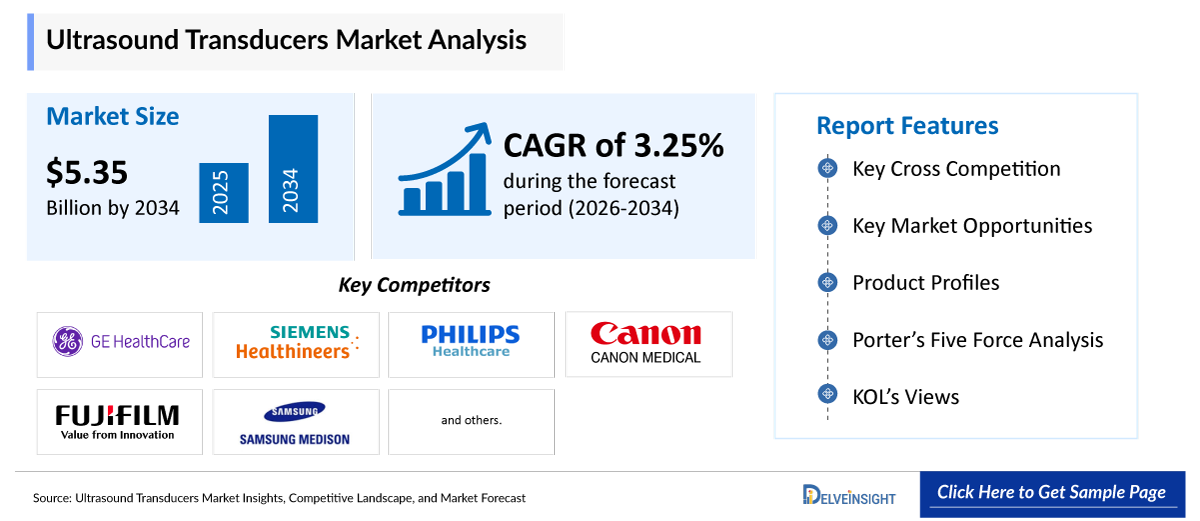
- The Ultrasound Transducer market size is estimated at USD 4.01 billion in 2025 and is projected to reach USD 5.35 billion by 2034. Growth is anchored in the rising global burden of chronic and age-related disease, expanding point-of-care and handheld ultrasound adoption, and steady replacement demand from an installed base of diagnostic imaging systems across hospitals, imaging centers, and ambulatory settings.
- The global ultrasound transducer market is growing at a CAGR of 3.25% during the forecast period from 2026 to 2034.
- By product type, the diagnostic ultrasound transducers segment dominated the Ultrasound Transducer market with a 92% share in 2025.
- By transducer type, the curvilinear/convex transducers segment dominated the Ultrasound Transducer market with a 34% share in 2025.
- By technology, the piezoelectric transducers segment dominated the Ultrasound Transducer market with an 86% share in 2025.
- By application, the general imaging segment dominated the Ultrasound Transducer market with a 38% share in 2025.
- By end-user, the hospitals & clinics segment dominated the Ultrasound Transducer market with a 52% share in 2025.
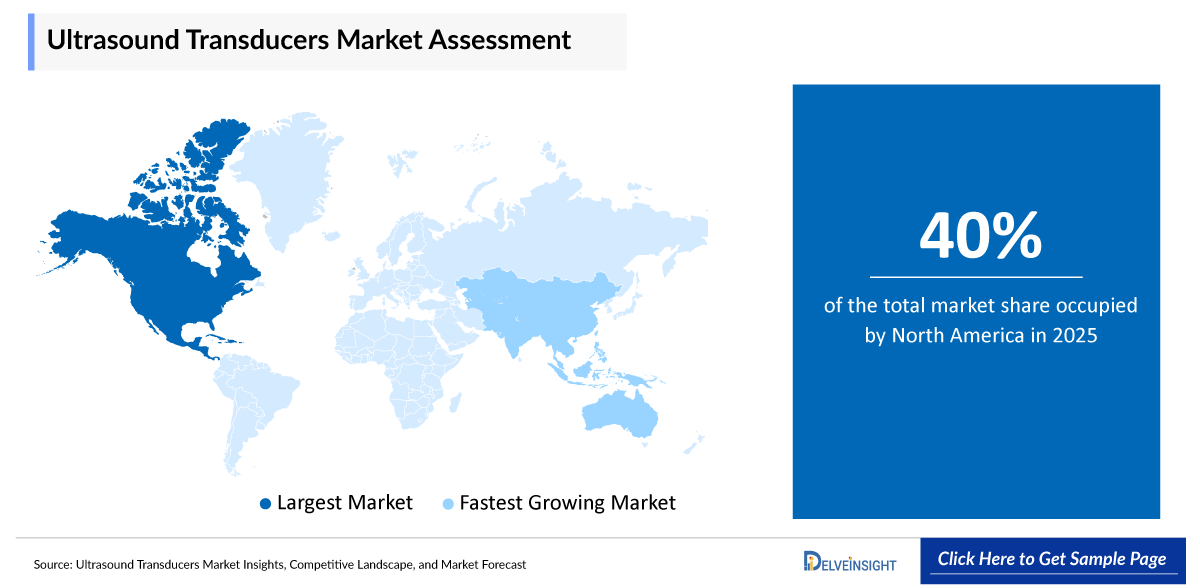
- North America dominated the global ultrasound transducer market revenue with a 40% share in 2025, representing the highest regional market share globally.
An ultrasound transducer, also known as a probe, is the component of an ultrasound imaging system that converts electrical energy into high-frequency sound waves and converts returning echoes into electrical signals to generate real-time diagnostic or therapeutic images. Transducers are engineered around piezoelectric ceramics or, increasingly, capacitive and piezoelectric micromachined ultrasonic transducer (CMUT/PMUT) technology, and are matched to specific clinical needs through array geometry, footprint, and operating frequency.
The market is organized by product type across diagnostic and therapeutic ultrasound transducers; by transducer type, including linear array, curvilinear/convex, phased array, matrix array, pencil, endocavitary, CW Doppler, and 3D/4D transducers; by technology across piezoelectric, capacitive micromachined ultrasonic transducers (CMUTs), and piezoelectric micromachined ultrasonic transducers (PMUTs); by frequency across low, mid, and high bands; and by application, led by general imaging, cardiology, obstetrics & gynecology, musculoskeletal, and urology. Driven by the global shift toward non-invasive diagnostics, the rapid rise of point-of-care and handheld ultrasound, and the integration of artificial intelligence into image acquisition and interpretation, ultrasound transducers have become an essential and continuously replenished component of the global medical imaging supply chain.
Ultrasound Transducers Market Key Growth Drivers
- The rising global burden of cardiovascular, oncological, musculoskeletal, and obstetric conditions is expanding procedure volumes and driving recurring transducer replacement and upgrade demand across hospitals and imaging centers.
- The rapid adoption of point-of-care ultrasound (POCUS) and handheld, semiconductor-based probes is broadening use beyond radiology into emergency medicine, anesthesiology, and primary care.
- The integration of artificial intelligence and machine learning into image acquisition, auto-segmentation, and interpretation is improving diagnostic accuracy and accelerating clinician adoption of newer transducer platforms.
- Growing demand for 3D/4D and matrix array transducers in obstetrics, cardiology, and advanced structural imaging is expanding the premium segment of the market.
- Rising investment in healthcare infrastructure and local manufacturing incentives across Asia-Pacific, including India's production-linked incentive program and China's expanding domestic device base, is enlarging addressable demand.
- Frequent new product launches and the commercialization of next-generation CMUT and PMUT-based probes are shortening replacement cycles and expanding premium average selling prices.
- Increasing merger, acquisition, and strategic partnership activity among global imaging leaders is expanding transducer manufacturing capacity, distribution reach, and technology depth.
Key Companies in Ultrasound Transducers Market
The competitive landscape is led by the following active manufacturers:
- GE HealthCare
- Siemens Healthineers
- Koninklijke Philips
- Canon Medical Systems Corporation
- FUJIFILM Healthcare
- Samsung Medison
- Hitachi Healthcare
- Shenzhen Mindray Bio-Medical Electronics
- Esaote
- Alpinion Medical Systems, and others
For illustrative purposes, only the top 10 companies are listed in the Table of Contents. The report may include analysis and references to additional companies relevant to the market assessment.
Ultrasound Transducers Market Size
The following snapshot summarizes the principal report metrics for the Ultrasound Transducers market.
|
Report Metrics |
Details |
|
2025 Market Size |
USD 4.01 billion |
|
2034 Projected Market Size |
USD 5.35 billion |
|
Growth Rate (2026-2034) |
3.25% CAGR |
|
Largest Market |
North America |
|
Fastest Growing Market |
Asia-Pacific |
|
Market Structure |
Moderately Concentrated |
All market values are expressed in USD and represent DelveInsight estimates synthesized from primary and secondary research.
Factors Contributing to the Growth of the Ultrasound Transducers Market
Ultrasound Transducers Market Drivers
- Rising Global Disease Burden and Aging Population: The most fundamental driver of the Ultrasound Transducer market is the rising global burden of cardiovascular, oncological, musculoskeletal, and obstetric conditions, compounded by an aging population that requires more frequent diagnostic imaging. Ultrasound is a first-line, non-invasive, and radiation-free imaging modality for a wide range of conditions, and every additional scan performed contributes to cumulative transducer wear and eventual replacement, since probes are consumable, high-precision instruments with finite operating lifespans. As hospitals and imaging centers expand procedure volumes to meet growing patient demand, the installed base of ultrasound systems requires larger and more frequent transducer purchases across general imaging, cardiology, and obstetric applications. This structural, demographically anchored demand underpins steady market growth through 2034.
- Rapid Adoption of Point-of-Care and Handheld Ultrasound: The rapid rise of point-of-care ultrasound (POCUS) and handheld, semiconductor-based probes is broadening the addressable market well beyond traditional radiology departments. Compact linear and phased array transducers connected to smartphones, tablets, or dedicated handheld consoles are increasingly used in emergency medicine, anesthesiology, critical care, and primary care settings, enabling bedside diagnosis without transporting patients to centralized imaging suites. The smart portable ultrasound segment is growing at a substantially faster pace than the broader market, reflecting strong clinician demand for immediate, workflow-embedded imaging. As reimbursement pathways mature and training programs expand access to POCUS, transducer volumes tied to portable and handheld platforms are expected to expand steadily across the forecast period.
- Integration of Artificial Intelligence into Ultrasound Imaging: The integration of artificial intelligence and machine learning into ultrasound acquisition and interpretation is a significant driver of transducer upgrades and new system sales. AI-enabled auto-segmentation, automated measurement, and guided-acquisition tools are lowering the skill barrier for less-experienced operators and improving diagnostic consistency, and more than 30 FDA-cleared AI algorithms now support ultrasound image interpretation. Leading manufacturers are embedding these capabilities directly into transducer and system firmware, encouraging healthcare providers to replace older analog and early-digital probes with AI-compatible transducers to access these workflow and accuracy benefits, sustaining premium replacement demand.
- Growing Demand for 3D/4D and Advanced Matrix Array Imaging: Growing clinical demand for 3D/4D and matrix array transducers in obstetrics, cardiology, and advanced structural and interventional imaging is expanding the premium tier of the market. Matrix array probes, which use two-dimensional element grids to generate real-time volumetric images, are increasingly adopted for fetal anatomy assessment, congenital heart disease evaluation, and image-guided procedures, commanding higher average selling prices than conventional 2D linear or convex transducers. As clinical evidence supporting volumetric imaging accumulates and manufacturers broaden their matrix array portfolios, this premium segment is expected to grow faster than the overall market through 2034.
- Healthcare Infrastructure Investment and Regional Manufacturing Expansion: Rising investment in healthcare infrastructure and local manufacturing incentives, particularly across Asia-Pacific, is expanding both demand for and regional production of ultrasound transducers. India's production-linked incentive program has triggered numerous Greenfield medical device projects, including a Siemens Healthineers ultrasound manufacturing investment announced in 2025, while China's evolving device-regulation framework has accelerated capacity expansion by global manufacturers, including a Fujifilm facility expansion in Suzhou. Government healthcare spending, expanding hospital networks, and growing diagnostic imaging penetration across China, India, Japan, and South Korea are increasing transducer volumes and encouraging manufacturers to localize production closer to high-growth demand centers.
- Frequent Product Launches and Next-Generation Transducer Technology: A steady cadence of new product launches, supported by the commercialization of next-generation capacitive and piezoelectric micromachined ultrasonic transducer (CMUT/PMUT) technology, is shortening replacement cycles and expanding average selling prices. CMUT and PMUT-based probes offer wider bandwidth, improved image uniformity, and simplified manufacturing relative to conventional piezoelectric ceramic arrays, and leading manufacturers are increasingly incorporating these technologies into premium cart-based and portable platforms. As clinical performance advantages become more widely demonstrated and manufacturing costs decline, semiconductor-based transducer technology is expected to capture a growing share of new system and replacement-probe sales.
- Rising Merger, Acquisition, and Strategic Partnership Activity: Increasing consolidation and strategic collaboration among global imaging leaders is expanding transducer manufacturing capacity, technology depth, and distribution reach. Recent activity includes Hologic's acquisition of Gynesonics to enter the women's-health ultrasound market, long-term value partnerships between system manufacturers and large health systems, and cross-company integrations such as the digital linkage between GE HealthCare's intraoperative ultrasound platform and third-party surgical navigation systems. This wave of M&A and partnership activity validates the sector's long-term growth prospects and channels investment toward manufacturers with scale, proprietary transducer technology, and broad clinical application coverage.
Ultrasound Transducers Market Restraints
Despite steady momentum, the Ultrasound Transducer market faces material constraints. The high upfront cost of premium transducers and complete ultrasound systems remains a significant barrier, particularly for smaller clinics, ambulatory centers, and providers in price-sensitive emerging markets, slowing adoption and extending replacement cycles. A persistent global shortage of trained sonographers and ultrasound-credentialed clinicians constrains procedure volumes and, by extension, transducer demand, even as imaging needs grow. Reimbursement pressure and cost-containment measures across several healthcare systems are limiting capital equipment budgets and delaying probe replacement in some regions. The limited global supply of single-crystal piezoelectric materials used in premium transducer arrays creates episodic component-level supply constraints, while the technical complexity of transitioning to CMUT and PMUT manufacturing platforms requires substantial capital investment that smaller manufacturers struggle to fund. Intense price-based competition among a large field of established and emerging Asia-Pacific manufacturers is compressing margins in mid- and low-tier product segments. Together, these cost, workforce, reimbursement, and supply-chain barriers temper the pace of growth, even as the underlying drivers of disease burden, point-of-care adoption, and technological advancement remain firmly intact.
Ultrasound Transducers Market Segment Analysis
The ultrasound transducers market by product type (diagnostic ultrasound transducers, therapeutic ultrasound transducers), transducer type (linear array transducers, curvilinear/convex transducers, phased array transducers, matrix array transducers, pencil transducers, endocavitary transducers, cw doppler transducers, 3d/4d transducers), technology (piezoelectric transducers, capacitive micromachined ultrasonic transducers (cmuts), piezoelectric micromachined ultrasonic transducers (pmuts)), frequency (low-frequency (<5 mhz), mid-frequency (5-10 mhz), high-frequency (>10 mhz)), application (general imaging, cardiology, obstetrics & gynecology, musculoskeletal, urology, others), end-users (hospitals & clinics, diagnostic imaging centers, ambulatory surgical centers, others), and geography (North America, Europe, Asia-Pacific, and Rest of World).
By Product Type
Dominant Subsegment: Diagnostic Ultrasound Transducers.
The diagnostic ultrasound transducers segment accounted for 92% of the Ultrasound Transducer market in 2025. Diagnostic transducers are the leading product type because ultrasound imaging is embedded as a first-line, non-invasive modality across nearly every major clinical department, including radiology, cardiology, obstetrics, emergency medicine, and musculoskeletal care, generating very high and recurring procedure volumes worldwide. The breadth of diagnostic applications, the large and continuously expanding installed base of ultrasound systems, and the routine, consumable nature of probe wear and replacement sustain dependable demand for diagnostic transducer manufacturing. Therapeutic ultrasound transducers, used in applications such as high-intensity focused ultrasound (HIFU) ablation and lithotripsy, represent a smaller but faster-growing niche as image-guided, non-invasive therapeutic procedures gain clinical traction. While therapeutic ultrasound transducers post a higher relative growth rate, the sheer scale, ubiquity, and clinical entrenchment of diagnostic imaging secure the diagnostic segment's leadership across the forecast period.
By Transducer Type
Dominant Subsegment: Curvilinear/Convex Transducers.
The curvilinear/convex transducers segment accounted for 34% of the Ultrasound Transducer market in 2025. Curvilinear/convex transducers are the leading transducer type because their curved footprint and lower operating frequency provide the wide field of view and deeper tissue penetration required for abdominal, obstetric, and general imaging, the single largest block of ultrasound procedures performed globally. Their versatility across transvaginal, transrectal, and general abdominal applications, combined with widespread use in both hospital and point-of-care settings, sustains high replacement volumes. Linear array transducers, favored for superficial, vascular, and musculoskeletal imaging, represent the second-largest category and are expanding quickly alongside point-of-care ultrasound adoption. Matrix array and 3D/4D transducers, while a smaller share of unit volume, are the fastest-growing category by value given their premium pricing and expanding use in cardiology and obstetric structural imaging. Nonetheless, the breadth of clinical use and high procedure volume of convex probes secure their leadership across the forecast period.
By Technology
Dominant Subsegment: Piezoelectric Transducers.
The piezoelectric transducers segment accounted for 86% of the Ultrasound Transducer market in 2025. Piezoelectric ceramic and single-crystal technology remains the dominant transducer platform because it is a mature, well-validated, and cost-effective technology deeply embedded in the manufacturing processes and clinical performance standards of virtually every major ultrasound system on the market today. Decades of incremental refinement have optimized piezoelectric arrays for image resolution, bandwidth, and durability across the full range of clinical applications. Capacitive micromachined ultrasonic transducers (CMUTs) and piezoelectric micromachined ultrasonic transducers (PMUTs) are emerging semiconductor-based alternatives that offer wider bandwidth, simplified batch manufacturing, and easier integration with handheld and wireless platforms, and both are the fastest-growing technology categories as manufacturers commercialize next-generation portable and AI-enabled probes. As CMUT and PMUT manufacturing scales and costs decline, their share is expected to expand steadily, but the entrenched performance, cost, and manufacturing base of piezoelectric technology secures its leadership across the forecast period.
By Frequency
Dominant Subsegment: Mid-Frequency (5-10 MHz).
The mid-frequency (5-10 MHz) segment accounted for 46% of the Ultrasound Transducer market in 2025. Mid-frequency transducers are the leading frequency category because they offer the optimal balance between tissue penetration and image resolution required for the largest single block of ultrasound procedures, including general abdominal, obstetric, and routine cardiology imaging. Their versatility across a broad range of body types and clinical indications makes mid-frequency probes the standard choice for general-purpose curvilinear and phased array systems. Low-frequency (<5 MHz) transducers remain essential for deep abdominal and cardiac imaging in larger patients, while high-frequency (>10 MHz) transducers are the fastest-growing category, driven by rising demand for superficial, vascular, musculoskeletal, and small-parts imaging where fine resolution is prioritized over penetration depth. The broad clinical applicability of mid-frequency probes secures their leadership across the forecast period.
By Application
Dominant Subsegment: General Imaging.
The general imaging segment accounted for 38% of the Ultrasound Transducer market in 2025. General imaging is the leading application because it encompasses the highest-volume, most routinely performed ultrasound procedures, including abdominal, renal, hepatobiliary, and soft-tissue assessment, which are conducted across nearly every hospital, clinic, and diagnostic imaging center worldwide. The broad and recurring nature of general imaging referrals, combined with its role as the entry point for many diagnostic pathways, sustains large and dependable transducer demand. Cardiology represents a substantial and technologically advanced application, driven by the specialized phased array and matrix probes required for echocardiography, while obstetrics & gynecology sustains steady demand anchored in routine prenatal care. Musculoskeletal and urology applications are growing quickly as point-of-care adoption expands into orthopedics, sports medicine, and interventional urology. Nonetheless, the sheer breadth and procedure volume of general imaging secure its leadership across the forecast period.
By End-Users
Dominant Subsegment: Hospitals & Clinics.
The hospitals & clinics segment accounted for 52% of the Ultrasound Transducer market in 2025. Hospitals and clinics are the leading end-user category because they house the largest concentration of ultrasound systems globally, spanning radiology, cardiology, obstetrics, emergency medicine, and surgical departments, and perform the highest aggregate volume of diagnostic and point-of-care procedures. Their broad multidisciplinary transducer requirements, combined with capital budgets that support both premium cart-based systems and portable point-of-care devices, sustain large and diversified transducer purchasing. Diagnostic imaging centers represent a significant and stable end-user category focused on high-throughput, referral-based imaging, while ambulatory surgical centers are the fastest-growing category as minimally invasive, image-guided procedures increasingly shift to outpatient settings. Nonetheless, the scale and clinical breadth of hospital-based ultrasound use secure the hospitals & clinics segment's leadership across the forecast period.
Ultrasound Transducers Market Region Analysis
Dominant Region: North America
North America accounted for 40% of the global ultrasound transducer market revenue in 2025, representing the highest regional market share globally. The region's dominance reflects a mature diagnostic imaging infrastructure, high per-capita healthcare spending, broad insurance reimbursement for ultrasound procedures, and the concentrated presence of leading manufacturers including GE HealthCare and their principal United States operations. North America hosts a dense network of hospitals, diagnostic imaging centers, and ambulatory surgical facilities with high rates of ultrasound system utilization and replacement, and sponsors benefit from rapid access to newly cleared, AI-enabled transducer technology through the FDA's well-established regulatory pathway. The commercial rollout of point-of-care and handheld ultrasound platforms, combined with rising prevalence of cardiovascular disease and an aging population, drives substantial replacement and upgrade demand. Strong reimbursement, regulatory clarity, and the region's role as the primary launch market for next-generation transducer technology anchor its continued leadership across the forecast period.
Fastest Growing Region: Asia-Pacific
Asia-Pacific is the fastest-growing region in the Ultrasound Transducer market. The region's elevated CAGR is driven by rising chronic disease incidence, rapid expansion of hospital and diagnostic imaging infrastructure, and growing healthcare investment across China, Japan, India, and South Korea. India's production-linked incentive program has triggered numerous Greenfield ultrasound manufacturing projects, China's evolving device-regulation framework is accelerating both local production and market access for global manufacturers, and Japan continues to fund advanced elastography and high-frequency transducer research. Government healthcare spending, expanding insurance coverage, and rising point-of-care ultrasound adoption in primary care and rural settings are accelerating regional demand, while local and regional manufacturers scale production to compete with established global players. The combination of high disease burden, infrastructure build-out, and manufacturing localization positions Asia-Pacific as the principal source of incremental growth over the forecast period.
Ultrasound Transducers Market Regional Commentary
North America
North America accounted for 40% of the global ultrasound transducer market revenue in 2025. The United States dominates on the strength of its diagnostic imaging infrastructure, reimbursement environment, regulatory clarity, and concentration of leading manufacturers, while rising adoption of point-of-care and AI-enabled ultrasound platforms reinforces the region's leadership.
Europe
Europe is a large and technologically advanced regional market, supported by established national healthcare systems, harmonized EU medical device regulation, and a strong base of premium system manufacturers including Siemens Healthineers, Philips, and Esaote. Steady replacement demand across Germany, France, the United Kingdom, Italy, and Spain, combined with growing adoption of portable ultrasound in emergency and primary care, sustains the region's role as a mature, innovation-driven market.
Asia-Pacific
Asia-Pacific is the fastest-growing region, propelled by rising chronic disease incidence, rapid hospital infrastructure build-out, and growing healthcare investment across China, Japan, India, and South Korea. Local manufacturing incentives, expanding insurance coverage, and rising point-of-care ultrasound adoption in primary and rural care are accelerating regional transducer demand and manufacturing capacity.
Rest of World
The Rest of World region, spanning Latin America, the Middle East, and Africa, is an emerging growth frontier. Expanding hospital and diagnostic imaging infrastructure, rising demand for accessible, non-invasive diagnostic tools, and growing international partnerships and donor-funded imaging programs are gradually broadening access to ultrasound technology, while price-sensitive demand favors mid- and entry-tier transducer platforms.
Ultrasound Transducers Market Competitive Landscape
The Ultrasound Transducer market is classified as Moderately Concentrated. A group of large, diversified imaging leaders with global manufacturing and distribution networks, including GE HealthCare, Siemens Healthineers, Koninklijke Philips, and Canon Medical Systems Corporation, secures the majority of premium hospital contracts and anchors the top tier, while established specialists such as FUJIFILM Healthcare, Samsung Medison, Hitachi Healthcare, Shenzhen Mindray Bio-Medical Electronics, Esaote, and Alpinion Medical Systems compete through focused product portfolios, regional manufacturing strength, and targeted application expertise, increasing competition in point-of-care and mid-tier segments.
The competitive landscape can be evaluated across the following dimensions:
- Market concentration: Moderately concentrated, with large diversified imaging leaders anchoring premium segments and a broad field of specialized and regional manufacturers competing in point-of-care and mid-tier categories.
- Leading players: GE HealthCare, Siemens Healthineers, Koninklijke Philips, and Canon Medical Systems Corporation anchor the top tier through global manufacturing scale and installed-base breadth.
- Geographic reach: Leading manufacturers operate global sales, service, and manufacturing networks; Shenzhen Mindray Bio-Medical Electronics and Samsung Medison have expanded aggressively into North America, Europe, and emerging markets.
- Product portfolio strength: Top players offer end-to-end transducer portfolios spanning linear, convex, phased array, matrix array, and endocavitary probes across cart-based, portable, and handheld platforms.
- Technology access: Ownership of proprietary piezoelectric single-crystal formulations and early investment in CMUT and PMUT semiconductor transducer technology is a decisive advantage.
- Strategic partnerships: Long-term value partnerships with health systems, such as the Siemens Healthineers-Onvida Health agreement, and cross-company technology integrations, such as GE HealthCare's intraoperative ultrasound and surgical navigation integration with Medtronic, extend clinical reach.
- M&A activity: Active consolidation, including Hologic's acquisition of Gynesonics to enter the women's-health ultrasound market, is reshaping competitive positioning in specialized application segments.
- Manufacturing capabilities: Piezoelectric single-crystal fabrication, automated array assembly, and emerging semiconductor-based CMUT/PMUT production lines are key competitive moats.
- Innovation focus: AI-enabled image acquisition and interpretation, point-of-care and handheld miniaturization, matrix array 3D/4D imaging, and next-generation semiconductor transducer technology.
Ultrasound Transducers Market Recent Developmental Activities
- In April 2026, GE HealthCare announced a digital integration between its bkActiv intraoperative ultrasound (iUS) system and a leading third-party surgical navigation platform, enabling real-time advanced imaging during cranial and spinal procedures. Strategic significance: Expands intraoperative and surgical-guidance applications for premium ultrasound transducer technology.
- In April 2026, Siemens Healthineers signed a 10-year value partnership with a major United States health system to bring the latest ultrasound and broader medical imaging technology across its hospital network. Strategic significance: Secures long-term installed-base growth and recurring transducer replacement demand.
- In May 2026, FUJIFILM Healthcare launched the EB-710US Ultrasound Bronchoscope, integrating advanced transducer technology into a dedicated endobronchial imaging platform. Strategic significance: Extends transducer technology into specialized interventional pulmonology applications.
- In June 2026, Shenzhen Mindray Bio-Medical Electronics launched the Hepatus-Series ultrasound systems featuring advanced diagnostic transducers with non-invasive quantification tools for dedicated gastroenterology imaging. Strategic significance: Broadens Mindray's premium transducer portfolio into specialized abdominal and hepatic imaging.
- In June 2026, FUJIFILM Healthcare renewed its strategic equipment supply partnership to strengthen distribution of its ultrasound and transducer product lines. Strategic significance: Reinforces global distribution reach for Fujifilm's diagnostic transducer portfolio.
- In March 2026, Esaote launched Prostate Attention Map, a urological imaging technology that automates multi-parametric analysis for localized, transducer-guided prostate biopsies. Strategic significance: Strengthens Esaote's position in specialized urology transducer applications.
- In late 2025, Samsung Medison unveiled the R20 premium ultrasound scanner, showcasing new AI-centric transducer and imaging technology for global export markets. Strategic significance: Advances Samsung Medison's premium, AI-enabled transducer platform for international expansion.
- In May 2025, Siemens Healthineers announced an approximately USD 11 million investment to establish a new ultrasound manufacturing facility in India under the country's production-linked incentive program. Strategic significance: Expands regional transducer manufacturing capacity and strengthens Asia-Pacific supply chain resilience.
- In 2025, FUJIFILM Healthcare advanced a USD 120 million expansion of its Suzhou, China manufacturing facility to support growing regional transducer and ultrasound system production. Strategic significance: Strengthens China-based manufacturing capacity amid evolving domestic device regulation.
- In January 2025, Hologic, Inc. acquired Gynesonics for approximately USD 350 million, adding transducer-based intrauterine imaging and transcervical fibroid treatment technology to its portfolio. Strategic significance: Extends specialized transducer technology into the women's-health ultrasound market.
Ultrasound Transducers Market Segmentation
- Ultrasound Transducers Market by Product Type
- Diagnostic Ultrasound Transducers
- Therapeutic Ultrasound Transducers
- Ultrasound Transducers Market by Transducer Type
- Linear Array Transducers
- Curvilinear/Convex Transducers
- Phased Array Transducers
- Matrix Array Transducers
- Pencil Transducers
- Endocavitary Transducers
- CW Doppler Transducers
- 3D/4D Transducers
- Ultrasound Transducers Market by Technology
- Piezoelectric Transducers
- Capacitive Micromachined Ultrasonic Transducers (CMUTs)
- Piezoelectric Micromachined Ultrasonic Transducers (PMUTs)
- Ultrasound Transducer Market by Frequency
- Low-Frequency (<5 MHz)
- Mid-Frequency (5-10 MHz)
- High-Frequency (>10 MHz)
- Ultrasound Transducer Market by Application
- General Imaging
- Cardiology
- Obstetrics & Gynecology
- Musculoskeletal
- Urology
- Others
- Ultrasound Transducer Market by End-Users
- Hospitals & Clinics
- Diagnostic Imaging Centers
- Ambulatory Surgical Centers
- Others
Ultrasound Transducers Market by Geography
- North America Ultrasound Transducers Market
- United States Ultrasound Transducers Market Size in USD million (2023-2034)
- Canada Ultrasound Transducers Market Size in USD million (2023-2034)
- Mexico Ultrasound Transducers Market Size in USD million (2023-2034)
- Europe Ultrasound Transducers Market
- Germany Ultrasound Transducers Market Size in USD million (2023-2034)
- United Kingdom Ultrasound Transducers Market Size in USD million (2023-2034)
- France Ultrasound Transducers Market Size in USD million (2023-2034)
- Italy Ultrasound Transducers Market Size in USD million (2023-2034)
- Spain Ultrasound Transducers Market Size in USD million (2023-2034)
- Rest of Europe Ultrasound Transducers Market Size in USD million (2023-2034)
- Asia-Pacific Ultrasound Transducers Market
- China Ultrasound Transducers Market Size in USD million (2023-2034)
- Japan Ultrasound Transducers Market Size in USD million (2023-2034)
- India Ultrasound Transducers Market Size in USD million (2023-2034)
- Australia Ultrasound Transducers Market Size in USD million (2023-2034)
- South Korea Ultrasound Transducers Market Size in USD million (2023-2034)
- Rest of Asia-Pacific Ultrasound Transducers Market Size in USD million (2023-2034)
- Rest of the World (RoW) Ultrasound Transducers Market
- Middle East Ultrasound Transducers Market Size in USD million (2023-2034)
- Africa Ultrasound Transducers Market Size in USD million (2023-2034)
- South America Ultrasound Transducers Market Size in USD million (2023-2034)
Ultrasound Transducers Market Recent Industry Trends and Milestones (2023-2026):
|
Category |
Key Developments |
|
Ultrasound Transducers Market Product Approval |
Regulatory clearances are steadily expanding commercial deployment of AI-enabled and next-generation transducers. More than 30 FDA-cleared AI algorithms now support ultrasound image acquisition and interpretation, and manufacturers including GE HealthCare, Siemens Healthineers, and Fujifilm have secured clearances for AI-integrated portable and handheld probes. Each clearance creates durable demand for compliant manufacturing, quality testing, and clinical training, the large majority of which flows to established global transducer manufacturers. |
|
Ultrasound Transducers Market Expansion |
Manufacturers broadened capacity and application coverage across the value chain. GE HealthCare integrated its intraoperative ultrasound platform with third-party surgical navigation systems, Fujifilm launched a dedicated ultrasound bronchoscope, and Mindray introduced specialized gastroenterology imaging transducers. Decentralized, point-of-care manufacturing expanded to meet handheld probe demand, while automated array assembly and semiconductor fabrication improved throughput and consistency. |
|
Ultrasound Transducers Market Investment |
Capital and consolidation accelerated across the sector. Hologic acquired Gynesonics for approximately USD 350 million (January 2025) to enter the women's-health ultrasound market, Siemens Healthineers invested roughly USD 11 million in a new India manufacturing facility (May 2025), and Fujifilm advanced a USD 120 million expansion of its Suzhou, China facility. Long-term value partnerships between manufacturers and health systems, such as the Siemens Healthineers-Onvida Health agreement, further reinforced installed-base investment. |
|
Company Strategy |
GE HealthCare: Intraoperative ultrasound integration and AI-driven auto-segmentation leadership. Siemens Healthineers: Long-term health-system value partnerships and India manufacturing expansion. Koninklijke Philips: Broad premium and portable transducer portfolio with global distribution reach. Canon Medical Systems Corporation: Multi-purpose transducer manufacturing anchored in North America and Asia. FUJIFILM Healthcare: Point-of-care probe leadership and specialized interventional transducer expansion. Samsung Medison: AI-centric premium scanner development for global export markets. Hitachi Healthcare, Shenzhen Mindray Bio-Medical Electronics, Esaote, and Alpinion Medical Systems: Specialized application focus, competitive pricing, and regional manufacturing strength. |
|
Emerging Technologies |
Semiconductor-based transducer technology is the leading edge of innovation, with CMUT and PMUT platforms scaling on the back of point-of-care and handheld demand, supported by new manufacturing investment and product launches. AI-driven auto-segmentation, guided acquisition, and automated measurement are increasingly embedded directly into transducer firmware, while matrix array 3D/4D imaging continues to expand in cardiology and obstetrics. Wireless connectivity, cloud-based image sharing, and collaborations between manufacturers and academic research institutions are accelerating the clinical translation of next-generation transducer technology. |
Ultrasound Transducers Market Startup Funding and Investment Trends
Investment in the Ultrasound Transducer ecosystem has concentrated on point-of-care miniaturization, AI-enabled imaging software, and next-generation semiconductor transducer technology. The following companies illustrate recent funding and investment activity and technology focus.
|
Company |
Total Funding |
Funding Stage |
Main Offering |
Core Technology |
|
Gynesonics, Inc. |
USD 350 million acquisition |
Acquired by Hologic (2025) |
Transducer-based intrauterine imaging |
Transcervical fibroid treatment ultrasound |
|
Request for unlocking the report of the @ Ultrasound Transducers Market Insights | ||||
Capital continues to flow toward manufacturers and technology developers that combine transducer hardware innovation with AI-enabled software. Hologic's approximately USD 350 million acquisition of Gynesonics in January 2025 underscores the strategic value of specialized transducer-based imaging platforms, while established players including GE HealthCare, Siemens Healthineers, and Fujifilm continue to invest in handheld and portable transducer platforms to capture growing point-of-care demand. Emerging semiconductor-transducer and handheld-probe developers are attracting venture investment as clinicians increasingly favor compact, wireless, and AI-integrated devices. Collectively, these investments signal conviction that point-of-care miniaturization, AI integration, and next-generation CMUT/PMUT transducer technology will define the next phase of competitive advantage in the global ultrasound transducer market.
Key Takeaways from the Ultrasound Transducers Market Report Study
- Market size analysis for the current ultrasound transducers market size (2025), and market forecast for 9 years (2026 to 2034).
- Top key product/technology developments, mergers, acquisitions, partnerships, and joint ventures that happened over the last 3 years.
- Key companies dominating the global ultrasound transducers market.
- Various opportunities available for competitors in the ultrasound transducers market space.
- What are the top-performing segments in 2025? How will these segments perform in 2034?
- Which are the top-performing regions and countries in the current ultrasound transducers market scenario?
- Which are the regions and countries where companies should concentrate their opportunities for ultrasound transducers market growth in the future?
Target audience who can benefit from this ultrasound transducers market report study
- Ultrasound transducers product providers
- Research organizations and consulting companies
- Neurodegenerative disease therapeutics-related organizations, associations, forums, and other alliances
- Government and corporate offices
- Start-up companies, venture capitalists, and private equity firms
- Distributors and traders dealing in ultrasound transducers
- Various end-users who want to know more about the ultrasound transducers market and the latest technological developments in the ultrasound transducers market.

