
Value-Based Healthcare Market Summary
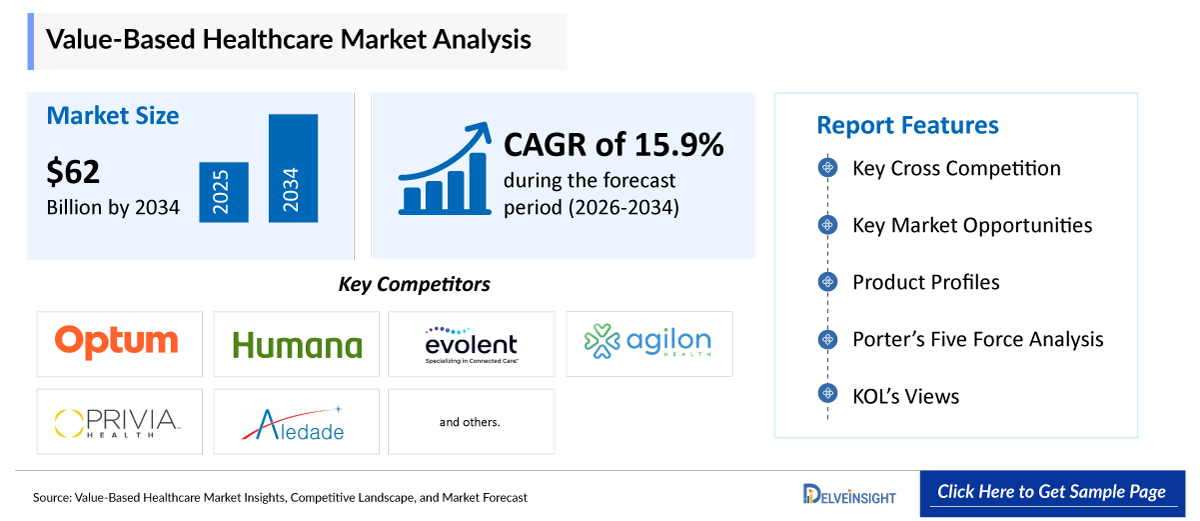
- The Global Value-Based Healthcare Market Size was valued at USD 16.50 billion in 2025 and is projected to reach USD 62.00 billion by 2034.
- The Value-Based Healthcare Market Size is expected to expand at a CAGR of 15.9% during the forecast period 2026-2034, supported by government mandates and the accountable care goal of the Centers for Medicare and Medicaid Services, the unsustainable growth of healthcare costs, the expansion of accountable care organizations and alternative payment models, and the adoption of population health management technology.
Value-Based Healthcare Market Trends & Insights
- By model, the accountable care organizations segment dominated the value-based healthcare market with a 40% share in 2025.
- By component, the services segment dominated the value-based healthcare market with a 62% share in 2025.
- By application, the population health management segment dominated the value-based healthcare market with a 38% share in 2025.
- By end-user, the healthcare providers segment dominated the value-based healthcare market with a 46% share in 2025.
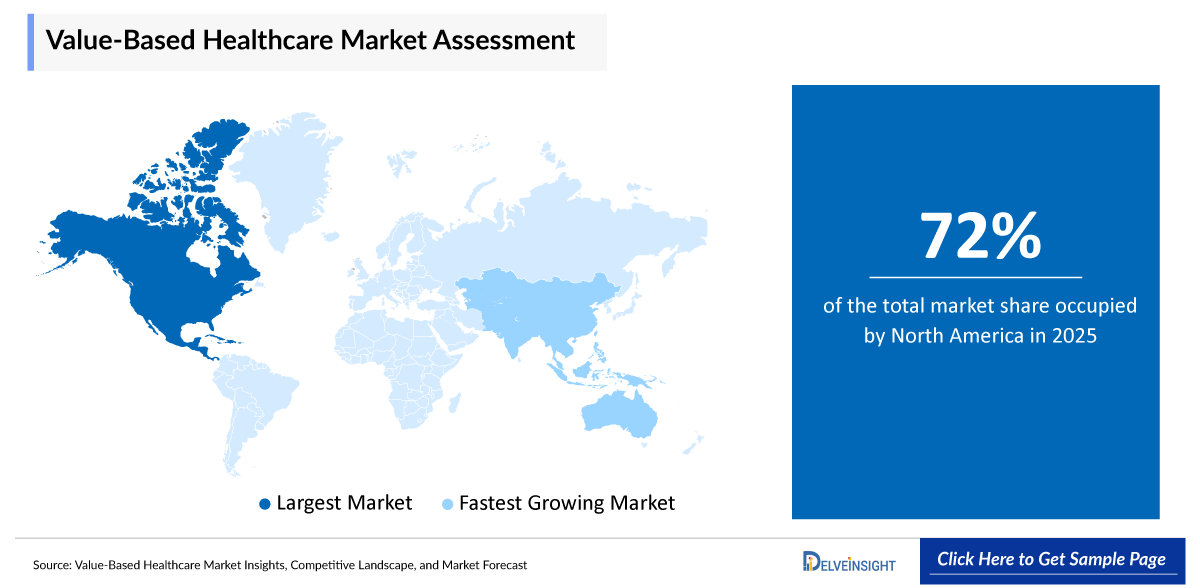
- North America accounted for the largest share of the value-based healthcare market at 72% in 2025, while Asia-Pacific is anticipated to register the fastest growth through 2034.
Request to unlock the sample page of the "Value-Based Healthcare Market"
Value-Based Healthcare Market Size in the 7MM
The following table summarizes the headline market metrics for the global value-based healthcare market across the base year and the forecast horizon.
|
Report Metrics |
Details |
|
2025 Market Size | |
|
2034 Projected Market Size | |
|
Growth Rate (2026-2034) | |
|
Largest Market |
North America (72% share in 2025) |
|
Fastest Growing Market |
Asia-Pacific |
|
Market Structure |
Fragmented |
All market values are expressed in USD and represent DelveInsight estimates synthesized from primary and secondary research.
Factors Contributing to the Growth of the Value-Based Healthcare Market
Value-Based Healthcare Market Drivers
-
Government Mandates and the Accountable Care Goal
The foundational driver of the value-based healthcare market is the commitment of the Centers for Medicare and Medicaid Services to accountable care, which sets the direction of the United States healthcare system toward value. The Center for Medicare and Medicaid Innovation, established in 2010 by the Affordable Care Act, tests and scales payment models that reward quality and cost efficiency, and the Centers for Medicare and Medicaid Services has pursued the goal of placing all Traditional Medicare beneficiaries in an accountable care relationship by 2030.
Progress toward this goal has advanced, and half of Traditional Medicare beneficiaries are now cared for by accountable care organizations, a substantial rise from the level of five years earlier. The agency has refined its permanent programs and introduced advanced investment payments to bring new, low-revenue accountable care organizations in rural and underserved areas into value-based arrangements, and it continues to test new models.
As the largest payer in the United States commits to accountable care and aligns its rules and models to expand it, providers and payers must build the capabilities to succeed in value-based arrangements, which drives demand for the enablement, technology, and services that the market provides. The commitment of the Centers for Medicare and Medicaid Services to accountable care, and the alignment of its programs and rules to advance it, anchor the direction of the healthcare system toward value and sustain the growth of the market across the forecast period.
-
The Scale and Growth of the Medicare Shared Savings Program
The scale and growth of the Medicare Shared Savings Program, the permanent accountable care organization program established in 2012 by the Affordable Care Act, drive the expansion of value-based healthcare. For the 2025 performance year, the Medicare Shared Savings Program comprised 476 accountable care organizations with 655,725 health care providers and organizations serving 11.2 million people with Traditional Medicare, a rise from the previous year.
The Centers for Medicare and Medicaid Services approved 228 applications for the year, including 55 new accountable care organizations and 173 renewing or reentering organizations, the largest annual number of renewals in the history of the program. Accountable care organizations in the program deliver care through thousands of federally qualified health centers, rural health clinics, and critical access hospitals, extending value-based care to underserved communities.
The Medicare Shared Savings Program is the largest accountable care initiative in the country, and its growth reflects the movement of providers into accountable care and the demand for the enablement and technology that success in the program requires. As the program grows and as providers join accountable care organizations to share in savings and manage risk, demand for the population health, care coordination, quality measurement, and analytics capabilities that the program requires grows. The scale and continued growth of the Medicare Shared Savings Program sustain demand for value-based healthcare enablement and technology across the forecast period.
-
Unsustainable Healthcare Costs and the Shift from Fee-for-Service
The unsustainable growth of healthcare costs is a powerful driver of the shift from fee-for-service toward value-based payment. Healthcare spending consumes a large and rising share of the economy, and the fee-for-service model, which pays for the volume of services regardless of outcome, is widely recognized to incentivize utilization rather than value and to contribute to unsustainable cost growth. Payers, employers, and policymakers seek to control costs while improving quality, and value-based payment aligns financial incentives with outcomes, quality, and efficiency by rewarding providers for keeping populations healthy and for reducing avoidable utilization.
The transition from fee-for-service to value shifts financial risk to providers and rewards the coordination, prevention, and management that reduce total cost of care, and it requires the capabilities to manage populations, stratify risk, coordinate care, and measure performance. As the pressure to control healthcare costs intensifies and as payers and employers demand value, the movement toward value-based payment accelerates, driving demand for the models, technology, and services that enable it.
The imperative to control unsustainable healthcare costs while improving quality sustains the shift from volume to value and the demand for value-based healthcare enablement across the forecast period, and it aligns the interests of payers, providers, and patients with value.
-
Expansion of Physician Enablement and Risk-Bearing Models
The expansion of physician enablement and risk-bearing models is a defining driver that broadens participation in value-based care and concentrates demand for enablement services and technology. Physician enablement companies partner with primary care and specialty providers to help them transition to value-based arrangements, providing the technology, capital, data, and services that independent and group practices require to manage attributed populations and to succeed under shared savings and risk.
Privia Health, one of the largest physician enablement companies, operates across many states and manages 1.5 million attributed lives in value-based arrangements through scaled provider networks, risk-bearing entities, and a technology and service platform, and it has expanded through the acquisition of accountable care organization businesses. Agilon Health empowers primary care physicians in value-based care, Aledade enables independent practices to participate in accountable care, and Evolent Health provides technology-enabled services and specialty care management, reporting substantial revenue growth.
These companies enable providers who lack the scale or infrastructure to build value-based capabilities on their own, and they expand the reach of value-based care to independent and community practices. As physician enablement and risk-bearing models grow and as providers seek partners to manage the transition to value, demand for enablement services, technology, and capital grows. The expansion of physician enablement and risk-bearing models broadens participation in value-based care and sustains demand across the forecast period.
-
Adoption of Population Health Management Technology and Analytics
The adoption of population health management technology and analytics is a central driver, since success in value-based care depends on the ability to manage populations, stratify risk, coordinate care, and measure quality using data. Value-based arrangements require providers and payers to aggregate and analyze data across sources, identify high-risk and rising-risk patients, coordinate care across settings, close gaps in care, measure and report quality, and manage the total cost of care, all of which require population health management platforms and analytics.
Population health technology companies such as Innovaccer, Health Catalyst, and Arcadia provide data platforms and analytics that unify healthcare data and enable population health management, risk stratification, and quality measurement, and physician enablement companies and payers deploy these capabilities to manage attributed populations. The integration of claims, clinical, and social data, the application of analytics and artificial intelligence to identify risk and opportunity, and the measurement of quality and cost are essential to value-based care.
As providers and payers take on accountable care and risk, they require the data and analytics capabilities that population health technology provides, and the sophistication of these capabilities increasingly determines success in value-based arrangements. The dependence of value-based care on data and analytics, and the adoption of population health management technology to provide them, sustain demand for value-based healthcare technology across the forecast period.
-
Growth of Medicare Advantage and Managed Care
The growth of Medicare Advantage and managed care expands the capitated and risk-based arrangements that are central to value-based healthcare. Medicare Advantage, in which private plans receive capitated payments to manage the care of enrolled beneficiaries, has grown to cover a large and rising share of Medicare beneficiaries, and it embeds risk-based payment and the management of populations at its core.
Payers and providers in Medicare Advantage manage the total cost of care for enrolled populations, and risk adjustment, care management, and quality measurement determine performance, which drives demand for the enablement and technology that value-based care requires. Physician enablement companies partner with providers to manage Medicare Advantage populations under risk, and payer-aligned organizations manage care for enrolled members.
The growth of managed Medicaid and commercial value-based arrangements further expands risk-based payment beyond Medicare. As Medicare Advantage and managed care grow and as more populations are managed under capitation and risk, demand for the risk adjustment, population health, care management, and quality capabilities that value-based care requires grows.
The growth of Medicare Advantage and managed care expands the risk-based arrangements at the heart of value-based healthcare and sustains demand for enablement and technology across the forecast period, reinforcing the movement of the healthcare system toward value.
-
Focus on Outcomes, Quality, and Health Equity
The focus on health outcomes, care quality, and health equity aligns the healthcare system with value and drives the adoption of value-based models and the technology and services that support them. Value-based care is defined by the measurement of and accountability for outcomes and quality, and payers and policymakers increasingly tie payment to performance on quality measures, patient outcomes, and patient experience. The recognition that fee-for-service does not reward quality or coordination has focused the system on measuring and improving outcomes, reducing fragmentation, and coordinating care, and value-based arrangements provide the structure and incentives to do so.
Health equity has become an explicit objective, and accountable care models have incorporated the expansion of accountable care into underserved communities and the reduction of disparities, with advanced investment payments supporting accountable care organizations in rural and underserved areas. The measurement of quality and equity, the accountability for outcomes, and the alignment of payment with performance require the quality measurement, reporting, and analytics capabilities that value-based healthcare technology and services provide.
As the system focuses on outcomes, quality, and equity and ties payment to them, demand for the models, measurement, and enablement that deliver and demonstrate value grows. The focus on outcomes, quality, and health equity sustains the adoption of value-based healthcare and the demand for its enablement across the forecast period.
Value-Based Healthcare Overview
Value-based healthcare is a model of care delivery and payment in which providers are reimbursed on the basis of patient health outcomes, care quality, and cost efficiency rather than the volume of services delivered under fee-for-service. The scope encompasses the payment models that tie financial rewards to performance, including accountable care organizations, pay-for-performance, bundled payments, capitation, and patient-centered medical homes, together with the technology platforms and services that enable providers and payers to succeed in these arrangements.
The enablement of value-based care spans population health management, risk stratification and adjustment, care coordination and management, quality measurement and reporting, and analytics, delivered through software platforms and through the services of physician enablement companies and payers.
Leading participants include payer-aligned organizations such as Optum and Humana, physician enablement and risk-bearing companies such as Evolent Health, Agilon Health, Privia Health, and Aledade, and population health technology companies such as Innovaccer, Health Catalyst, and Arcadia. The model connects providers, payers, and patients through attributed populations, shared savings and risk, and quality measurement. The contemporary market is defined by the movement of Medicare and commercial payers toward accountable care, the growth of physician enablement, and the adoption of data and analytics to manage populations.
Value-Based Healthcare Market Key Growth Drivers
- Government mandates and the accountable care goal, with the Centers for Medicare and Medicaid Services pursuing the objective of placing all Traditional Medicare beneficiaries in an accountable care relationship by 2030.
- The scale of the Medicare Shared Savings Program, which for the 2025 performance year comprised 476 accountable care organizations with 655,725 providers and organizations serving 11.2 million people with Traditional Medicare.
- The unsustainable growth of healthcare costs drives payers and policymakers to shift payment from volume to value.
- The expansion of accountable care organizations, alternative payment models, and physician enablement companies that manage attributed populations under shared savings and risk.
- Adoption of population health management technology and analytics that enable providers and payers to manage populations, stratify risk, and measure quality.
- Growth of Medicare Advantage and managed care that expands capitated and risk-based arrangements.
- Focus on outcomes, quality, and health equity that aligns care delivery with value.
Value-Based Healthcare Companies
The leading participants in the value-based healthcare market include the following:
- Optum, Inc.
- Humana Inc.
- Evolent Health, Inc.
- Agilon Health, Inc.
- Privia Health Group, Inc.
- Aledade, Inc.
- Innovaccer Inc.
- Health Catalyst, Inc.
- Signify Health, Inc.
- Arcadia Solutions, LLC, and others.
For illustrative purposes, only the top 10 companies are listed in the Table of Contents. The report may include analysis and references to additional companies relevant to the market assessment.
Value-Based Healthcare Market Restraints
The value-based healthcare market faces several interrelated restraints that temper its growth. The foremost is the complexity and financial risk of the transition from fee-for-service to value, since providers must invest in infrastructure, capabilities, and data before they can succeed under risk, and the assumption of financial risk exposes providers to losses if they cannot manage cost and quality, which deters participation and slows adoption.
The uncertainty of the policy and model environment is a significant restraint, since the models tested by the Center for Medicare and Medicaid Innovation are subject to modification and termination, with prominent models scheduled to conclude, and the strategic direction of the Innovation Center has shifted, creating uncertainty about the future of specific models and goals that complicates the long-term investment that value-based care requires.
The modest and uncertain savings of many payment models, documented by government analyses that found that only a small number of the models tested produced savings and that some increased spending, raise questions about the effectiveness of value-based payment and temper enthusiasm. The number of accountable care organizations has fluctuated, and periods of decline have raised concern about the trajectory of participation. Data and interoperability challenges persist, since value-based care requires the aggregation and analysis of data across fragmented systems and sources, and gaps in interoperability and data quality constrain the capabilities that value-based care requires.
The complexity of attribution, benchmarking, risk adjustment, and quality measurement creates administrative burden and disputes. The upfront investment, the change management, and the provider resistance associated with the transition to value further constrain adoption, particularly for smaller and independent practices. Together, these factors moderate the pace and scope of the shift to value and require enablers and technology companies to demonstrate clear financial, clinical, and operational value to sustain growth.
Value-Based Healthcare Market Segment Analysis
The global value-based healthcare market is segmented by model (accountable care organization, pay for performance, bundled payments, capitation, and patient centered medical homes), by component (services and software and platforms), by application (population health management, care coordination and management, risk adjustment and stratification, quality reporting and analytics, and others), by end-users (healthcare providers, payers, employers, and government and others) and by geography (North America, Europe, Asia-Pacific, and the Rest of the World).
-
Value-Based Healthcare Market Segment By Model
Dominant Subsegment: Accountable Care Organizations.
The accountable care organizations category is expected to dominate the market. The accountable care organizations segment accounted for a 40% share of the value-based healthcare market in 2025. Accountable care organizations, in which groups of providers accept accountability for the quality and total cost of care of a defined population and share in the savings they generate, are the largest and most established value-based model, anchored by the Medicare Shared Savings Program, the largest accountable care initiative in the country.
The dominance of the segment reflects the scale of accountable care organization participation, the permanence and growth of the Medicare Shared Savings Program, and the central role of accountable care in the strategy of the Centers for Medicare and Medicaid Services. For the 2025 performance year, the Medicare Shared Savings Program comprised 476 accountable care organizations serving 11.2 million people with Traditional Medicare, and accountable care organizations now care for half of Traditional Medicare beneficiaries.
Accountable care organizations require population health management, care coordination, risk stratification, quality measurement, and analytics to succeed, and physician enablement companies and technology vendors provide the capabilities that accountable care organizations require. The commitment of the Centers for Medicare and Medicaid Services to accountable care, the growth of the Medicare Shared Savings Program, and the expansion of accountable care into commercial and Medicare Advantage arrangements sustain the leadership of the accountable care organizations segment. Its scale, permanence, and central role in value-based payment sustain its leadership across the forecast period and anchor demand for the enablement and technology that the market provides.
-
Value-Based Healthcare Market Segment By Component
Dominant Subsegment: Services.
The services category is expected to dominate the market. The services segment accounted for a 62% share of the value-based healthcare market in 2025. Services encompass the enablement, care management, population health, risk adjustment, quality reporting, and consulting services through which physician enablement companies and payers help providers transition to and succeed in value-based arrangements, and they represent the larger share of the market because success in value-based care depends on the ongoing management of populations and risk rather than on software alone.
The dominance of the segment reflects the labor and expertise intensity of value-based care, the reliance of providers on enablement partners to manage the transition to value, and the recurring nature of enablement and care management services. Physician enablement companies provide scaled provider networks, risk-bearing entities, capital, data, and services that enable providers to manage attributed populations, and payers provide care management and population health services for enrolled members.
The service component, including the management of attributed lives, the coordination of care, and the operation of value-based arrangements, is the largest part of the value that value-based care requires. As providers transition to value and rely on enablement partners, and as the management of populations and risk grows, demand for value-based care services grows. The labor and expertise intensity of value-based care, the reliance on enablement services, and the recurring nature of care management sustain the leadership of the services segment across the forecast period.
-
Value-Based Healthcare Market Segment By Application
Dominant Subsegment: Population Health Management.
The population health management category is expected to dominate the market. The population health management segment accounted for a 38% share of the value-based healthcare market in 2025. Population health management, the aggregation and analysis of data across a population to identify risk, coordinate care, close gaps, and manage the total cost of care, is the foundational application of value-based healthcare, since accountable care and risk-based arrangements require the management of defined populations.
The dominance of the segment reflects the centrality of population health to value-based care and the dependence of accountable care organizations, physician enablement companies, and payers on population health management to succeed under shared savings and risk. Population health management integrates claims, clinical, and social data, stratifies risk, identifies high-risk and rising-risk patients, coordinates care across settings, and measures quality and cost, and population health technology companies provide the platforms and analytics that enable it.
Success in value-based arrangements depends on the sophistication of population health management, since it determines the ability to identify and manage risk and to reduce avoidable utilization. As accountable care and risk-based arrangements grow and as providers and payers take on the management of populations, demand for population health management grows. The centrality of population health to value-based care, and the dependence of value-based arrangements on it, sustain the leadership of the population health management segment across the forecast period and anchor demand for the technology and analytics that provide it.
-
Value-Based Healthcare Market Segment By End-User
Dominant Subsegment: Healthcare Providers.
The healthcare providers category is expected to dominate the market. The healthcare providers segment accounted for a 46% share of the value-based healthcare market in 2025. Healthcare providers, including physician groups, primary care practices, and health systems, are the participants that accept accountability for the quality and cost of care under value-based arrangements, and they are the principal adopters of the enablement, technology, and services that value-based care requires, which concentrates market value in this segment.
The dominance of the segment reflects the central role of providers in delivering value-based care, the investment providers make in the capabilities to manage populations and risk, and the reliance of providers on enablement partners and technology to succeed. Providers join accountable care organizations, enter risk-based arrangements, and partner with physician enablement companies to manage attributed populations, and they deploy population health management, care coordination, and quality measurement capabilities.
Primary care providers in particular are central to value-based care, since they coordinate care and manage the health of populations. While payers, employers, and government are important participants and purchasers, the healthcare providers segment leads through the central role of providers in delivering value-based care and the depth of their investment in enablement and technology. The central role of providers, the depth of their investment, and their reliance on enablement and technology sustain the leadership of the healthcare providers segment across the forecast period, and it shapes the direction of the market.
Value-Based Healthcare Market Region Analysis
-
Dominant Region: North America
North America accounted for a 72% share of the global value-based healthcare market in 2025, representing the highest regional market share globally. The leadership of the region reflects the central role of the United States in the development and adoption of value-based care, the commitment of the Centers for Medicare and Medicaid Services to accountable care, the concentration of the leading enablement and technology companies, and the scale of the United States healthcare system.
The United States is the largest national market by a wide margin, supported by the movement of Medicare, Medicaid, and commercial payers toward value-based payment, the scale of the Medicare Shared Savings Program and the Center for Medicare and Medicaid Innovation models, and the presence of the physician enablement and population health technology companies that enable value-based care. The Centers for Medicare and Medicaid Services has pursued the goal of placing all Traditional Medicare beneficiaries in accountable care relationships by 2030, and half of Traditional Medicare beneficiaries are now cared for by accountable care organizations.
The concentration of payer-aligned organizations, physician enablement companies, and population health technology companies in the United States, and the depth of value-based arrangements across Medicare, Medicaid, and commercial markets, reinforce the leadership of the region. The central role of the United States in value-based payment, the commitment of the Centers for Medicare and Medicaid Services, and the concentration of enablers and technology sustain the position of North America as the largest regional market across the forecast period.
-
Fastest Growing Region: Asia-Pacific
Asia-Pacific is projected to register the fastest compound annual growth rate through 2034. The region is beginning to adopt value-based and outcomes-based approaches as governments and health systems seek to control costs and improve quality across large populations, which drives the initial adoption of value-based healthcare. China, Japan, and India are the principal national markets, supported by government efforts to reform payment and control healthcare costs, the growth of health insurance, and the adoption of outcomes-based and quality-based approaches.
Aging populations, the rising burden of chronic disease, and the pressure on healthcare budgets drive governments and payers to explore value-based payment and population health management as means to improve value. The digitization of healthcare and the growth of data and analytics enable the population health capabilities that value-based care requires. As governments reform payment, as insurers adopt value-based approaches, and as providers build population health capabilities, the region increases its adoption of value-based healthcare from a low base, creating substantial long-term growth.
The combination of cost pressure, payment reform, insurance growth, and healthcare digitization positions Asia-Pacific as the fastest-growing regional market, and it attracts the attention of global enablers and technology companies.
Value-Based Healthcare Market Regional Commentary
- North America
North America leads the market, supported by the central role of the United States in value-based care, the commitment of the Centers for Medicare and Medicaid Services to accountable care, and the concentration of the leading enablement and technology companies. The United States dominates the region through the scale of the Medicare Shared Savings Program and the Innovation Center models, the movement of Medicare Advantage and commercial payers toward value, and the presence of physician enablement and population health technology companies. The commitment of the Centers for Medicare and Medicaid Services to accountable care sustains demand, tempered by the uncertainty of the model environment.
- Europe
Europe is an emerging market for value-based healthcare shaped by universal and statutory health systems, national efforts to improve value and outcomes, and the adoption of outcomes-based and integrated care approaches. Germany, the United Kingdom, France, Italy, and Spain are the principal national markets, supported by government efforts to control costs and improve quality, the integration of care, and the measurement of outcomes. Demand is sustained by the pressure on healthcare budgets and by the adoption of value-based and integrated care within public systems.
- Asia-Pacific
Asia-Pacific is the fastest-growing region, driven by government efforts to reform payment and control costs, the growth of health insurance, and the adoption of outcomes-based approaches across China, Japan, and India. Aging populations, the rising burden of chronic disease, and healthcare digitization sustain demand, and the region attracts the attention of global enablers and technology companies as value-based approaches take hold from a low base.
- Rest of World
The Rest of World, spanning Latin America, the Middle East, and Africa, represents an early-stage opportunity as governments and payers explore value-based and outcomes-based approaches to control costs and improve quality. Growth is supported by healthcare reform, the growth of insurance, and the digitization of healthcare, though adoption is at an early stage and varies by market. Global enablers and technology companies engage these markets as value-based approaches emerge.
Value-Based Healthcare Market Competitive Landscape
The global value-based healthcare market is classified as Fragmented. A large number of participants compete across the value-based care value chain, including payer-aligned organizations, physician enablement and risk-bearing companies, population health technology companies, and specialist care management providers, and no single participant holds a dominant share of the global market. Competition centers on the ability to manage attributed populations and risk, the breadth of enablement services and technology, the depth of data and analytics, clinical and financial performance, and the scale of provider networks, and acquisitions, partnerships, and the growth of attributed lives intensify the contest.
The Value-Based Healthcare Competitive Landscape is evaluated across the following dimensions:
- Market concentration: Fragmented, with payer-aligned organizations, physician enablement and risk-bearing companies, population health technology companies, and specialist care management providers, and no single participant holding a dominant global share.
- Leading players: Optum and Humana lead among payer-aligned organizations with extensive primary care networks and care management, Evolent Health, Agilon Health, Privia Health, and Aledade lead among physician enablement and risk-bearing companies, and Innovaccer, Health Catalyst, and Arcadia lead among population health technology companies, with Signify Health and other providers contesting defined segments.
- Geographic reach: The leading participants operate across many states in the United States, and physician enablement companies expand their footprint through provider partnerships and acquisitions, while the market remains concentrated in the United States.
- Service and technology portfolio strength: Competitive advantage rests on the ability to manage attributed populations and risk, the breadth of enablement services, and the depth of population health, risk adjustment, care coordination, and quality technology, delivered through scaled networks and platforms.
- Pipeline strength: Development is concentrated in population health and analytics, risk adjustment, specialty and total cost of care management, artificial intelligence, and the expansion into new value-based arrangements and populations.
- Strategic partnerships: Collaboration spans partnerships between enablement companies and provider practices, between payers and providers in risk arrangements, and between technology companies and enablers, together with the integration of data across sources.
- M&A activity: Consolidation has shaped the field, exemplified by the acquisition of accountable care organization businesses, including the acquisition by Privia Health of an accountable care organization business from Evolent Health, and by the acquisition of value-based care providers by payers and retailers, alongside continued consolidation of enablers and technology.
- Innovation focus: Innovation is shifting toward advanced population health and analytics, artificial intelligence for risk and care management, specialty and total cost of care management, and the expansion of value-based arrangements across populations.
- Regulatory standing: Command of the Medicare Shared Savings Program, the Center for Medicare and Medicaid Innovation models, Medicare Advantage risk adjustment, and quality measurement, together with the ability to perform under shared savings and risk, is a decisive competitive credential and a principal axis of competition among the leaders.
Value-Based Healthcare Market Recent Developmental Activities
- In September 2025, Privia Health Group, Inc. agreed to acquire an accountable care organization business from Evolent Health, adding 120,000 attributed lives and bringing its total to 1.5 million attributed lives in value-based arrangements, for a payment of 100 million dollars at closing and a performance-based amount tied to Medicare Shared Savings Program results. Strategic significance: the acquisition expanded the footprint of a leading physician enablement company and illustrated the consolidation of accountable care organization businesses in the value-based care market.
- In 2025, the Centers for Medicare and Medicaid Services approved 228 applications for the Medicare Shared Savings Program, including 55 new and 173 renewing or reentering accountable care organizations, bringing the program to 476 accountable care organizations serving 11.2 million people with Traditional Medicare for the 2025 performance year. Strategic significance: the growth of the program reinforced the movement of providers into accountable care and the demand for value-based care enablement and technology.
- In May 2025, the Centers for Medicare and Medicaid Services published a new strategic direction for its Innovation Center, emphasizing prevention, consumer engagement, technology-enabled care, and financial performance in the next phase of value-based payment reform. Strategic significance: the strategy signaled the evolution of the model environment and the continued commitment to value-based care while introducing change in the direction of specific models.
- In 2024 and 2025, Evolent Health, Inc. advanced its technology-enabled services and specialty care management for oncology, cardiology, and other complex conditions, reporting full-year 2024 revenue of 2.55 billion dollars, a rise from the previous year. Strategic significance: the growth reinforced the position of a leading value-based care services company and the expansion of specialty and total cost of care management.
- In 2024 and 2025, Agilon Health, Inc. advanced its platform empowering primary care physicians to participate in value-based care for senior populations under Medicare Advantage and Medicare arrangements. Strategic significance: the developments reinforced the growth of physician enablement for senior-focused value-based primary care.
- In 2024 and 2025, Aledade, Inc. advanced its enablement of independent primary care practices in accountable care organizations and value-based arrangements across many states. Strategic significance: the developments reinforced the expansion of value-based care to independent and community practices.
- In 2024 and 2025, Innovaccer Inc. advanced its healthcare data and analytics platform for population health management, care coordination, and value-based care with artificial intelligence capabilities. Strategic significance: the developments reinforced the role of population health technology and artificial intelligence in enabling value-based care.
- In 2024 and 2025, Health Catalyst, Inc. and Arcadia Solutions, LLC advanced their healthcare data platforms and analytics for population health management, risk stratification, and quality measurement. Strategic significance: the developments reinforced the dependence of value-based care on data and analytics and the role of population health technology companies.
- In 2024 and 2025, Optum, Inc. and Humana Inc. advanced their value-based primary care and care management for senior and complex populations through extensive primary care networks. Strategic significance: the developments reinforced the role of payer-aligned organizations in delivering value-based care at scale.
- In 2023 and 2024, the Centers for Medicare and Medicaid Services introduced advanced investment payments providing upfront funding to new, low-revenue accountable care organizations in rural and underserved areas to join the Medicare Shared Savings Program. Strategic significance: the payments expanded the reach of accountable care into underserved communities and advanced health equity within value-based care.
- In 2024 and 2025, the Centers for Medicare and Medicaid Services continued to test accountable care and total cost of care models, with prominent models scheduled to conclude at the end of 2026 and new models under development. Strategic significance: the evolution of the model portfolio shaped the trajectory of value-based care and the planning of participants.
- In 2024 and 2025, the leading participants expanded attributed lives, advanced population health and analytics, and deepened risk-based and specialty management across the value-based care value chain. Strategic significance: the convergence of the leaders on attributed lives, population health, analytics, and risk management confirmed these as the defining axes of competition and signaled a market advancing toward accountable, data-driven, and risk-based care.
Value-Based Healthcare Market Segmentation
-
Value-Based Healthcare Market Assessment by Model
- Accountable Care Organizations
- Pay-for-Performance
- Bundled Payments
- Capitation
- Patient-Centered Medical Homes
-
Value-Based Healthcare Market Assessment by Component
- Services
- Software and Platforms
-
Value-Based Healthcare Market Assessment by Application
- Population Health Management
- Care Coordination and Management
- Risk Adjustment and Stratification
- Quality Reporting and Analytics
- Others
-
Value-Based Healthcare Market Assessment by End-User
- Healthcare Providers
- Payers
- Employers
- Government and Others
Value-Based Healthcare Market Assessment by Geography
-
North America Value-Based Healthcare Market Assessment
- United States Value-Based Healthcare Market Size in USD million (2023-2034)
- Canada Value-Based Healthcare Market Size in USD million (2023-2034)
- Mexico Value-Based Healthcare Market Size in USD million (2023-2034)
-
Europe Value-Based Healthcare Market Assessment
- Germany Value-Based Healthcare Market Size in USD million (2023-2034)
- United Kingdom Value-Based Healthcare Market Size in USD million (2023-2034)
- France Value-Based Healthcare Market Size in USD million (2023-2034)
- Italy Value-Based Healthcare Market Size in USD million (2023-2034)
- Spain Value-Based Healthcare Market Size in USD million (2023-2034)
- Rest of Europe Value-Based Healthcare Market Size in USD million (2023-2034)
-
Asia-Pacific Value-Based Healthcare Market Assessment
- China Value-Based Healthcare Market Size in USD million (2023-2034)
- Japan Value-Based Healthcare Market Size in USD million (2023-2034)
- India Value-Based Healthcare Market Size in USD million (2023-2034)
- Australia Value-Based Healthcare Market Size in USD million (2023-2034)
- South Korea Value-Based Healthcare Market Size in USD million (2023-2034)
- Rest of Asia-Pacific Value-Based Healthcare Market Size in USD million (2023-2034)
-
Rest of the World Value-Based Healthcare Market Assessment
- Middle East Value-Based Healthcare Market Size in USD million (2023-2034)
- Africa Value-Based Healthcare Market Size in USD million (2023-2034)
- South America Value-Based Healthcare Market Size in USD million (2023-2034)
Value-Based Healthcare Market Recent Industry Trends and Milestones (2023-2026):
|
Category |
Key Developments |
|
Value-Based Healthcare Market Model Advancement |
The period was defined by the growth and evolution of accountable care and alternative payment models. The Centers for Medicare and Medicaid Services grew the Medicare Shared Savings Program to 476 accountable care organizations serving 11.2 million people with Traditional Medicare, introduced advanced investment payments for underserved accountable care organizations, and published an Innovation Center strategy emphasizing prevention, consumer engagement, and technology-enabled care. Physician enablement companies advanced their models for primary care and specialty value-based care. Together, these developments advanced the movement of the healthcare system toward accountable, risk-based, and value-based care. |
|
Value-Based Healthcare Market Service Expansion |
Service expansion advanced along three axes. The first is physician enablement, as companies expanded scaled provider networks, risk-bearing entities, and technology and service platforms to help providers manage attributed populations. The second is specialty and total cost of care management, as companies extended value-based management to oncology, cardiology, and other complex conditions. The third is population health and analytics, as technology companies advanced data platforms and analytics for population health management, risk stratification, and quality measurement. Companies also expanded attributed lives and deepened participation in Medicare, Medicare Advantage, Medicaid, and commercial arrangements. |
|
Value-Based Healthcare Market Investment |
Investment was shaped by consolidation and by the growth of attributed lives. Physician enablement companies acquired accountable care organization businesses and provider practices, exemplified by the acquisition by Privia Health of an accountable care organization business from Evolent Health, and payers and retailers acquired value-based care providers. Companies invested in population health technology, artificial intelligence, and specialty management, and in the capital and infrastructure required to manage risk. Investment also flowed into the data and analytics capabilities that value-based care requires, and companies expanded across states and populations. |
|
Company Strategy |
The unifying strategic theme is the growth of attributed lives under value-based arrangements supported by population health technology and analytics. Optum and Humana are advancing value-based primary care at scale, Evolent Health, Agilon Health, Privia Health, and Aledade are advancing physician enablement and risk-bearing models, and Innovaccer, Health Catalyst, and Arcadia are advancing population health technology. Companies are differentiating on the ability to manage risk, the depth of data and analytics, and the breadth of enablement, and they expand through provider partnerships and acquisitions. Across the field, strategy centers on attributed lives, population health, analytics, and risk management. |
|
Emerging Technologies |
The defining emerging technologies are population health management platforms that unify claims, clinical, and social data to manage populations; artificial intelligence and analytics that stratify risk, identify care gaps, and support care management; risk adjustment and quality measurement technology; and care coordination platforms that connect providers across settings. Supporting these are the integration of data across sources, the application of artificial intelligence to identify risk and opportunity, and the measurement of outcomes, quality, and total cost of care. Across these, the trajectory is toward value-based care that is data-driven, analytics-enabled, and increasingly supported by artificial intelligence, improving the ability of providers and payers to manage populations and risk and to demonstrate value. |
Value-Based Healthcare Market Startup Funding and Investment Trends
Investment in the value-based healthcare field has concentrated on models and technologies that enable providers to succeed under risk, namely physician enablement, population health and analytics technology, and specialty and condition-specific value-based management. Because the market is fragmented and served by payer-aligned organizations, physician enablement companies, and population health technology companies, innovators pursue differentiated enablement models and technologies that serve defined provider segments and populations or that a larger participant can absorb. The table below summarizes representative companies advancing the next generation of value-based care.
|
Company |
Total Funding |
Funding Stage |
Main Product/Offering |
Core Technology |
|
Aledade, Inc. |
Venture-backed |
Commercial stage |
Accountable care enablement |
Independent practice value-based enablement |
|
Innovaccer Inc. |
Venture-backed |
Commercial stage |
Healthcare data platform |
Population health data and analytics |
|
Request for unlocking the report of the @ Value-Based Healthcare Market Insights | ||||
Capital formation in this field is shaped by the fragmentation of the market and by the presence of large payer-aligned organizations and established enablers, so investors have favored companies that introduce differentiated enablement models, such as risk-bearing primary care enablement, or technologies, such as population health analytics and clinical artificial intelligence, that help providers succeed under risk.
Physician enablement is the clearest thesis, seeking to help independent and group practices manage attributed populations and succeed in accountable care.
Population health and analytics technology constitutes a second thesis, providing the data and analytics that value-based care requires, and specialty and condition-specific value-based management a third. The archetypal outcome is acquisition by a payer, retailer, or larger enabler seeking attributed lives, capability, or population reach, exemplified by the consolidation of accountable care organization businesses and value-based care providers, which provides a path that sustains earlier-stage investment.
The principal risks are the complexity and financial risk of value-based arrangements, the uncertainty of the model and policy environment, the modest and uncertain savings of many models, and the data and interoperability challenges of managing populations.
Key Takeaways from the Value-Based Healthcare Market Report Study
- Market size analysis for the current value-based healthcare market size (2025), and market forecast for 9 years (2026 to 2034).
- Top key model, technology, and service developments, mergers, acquisitions, partnerships, and joint ventures that happened over the last 3 years.
- Key companies dominating the global value-based healthcare market.
- Various opportunities available for competitors in the value-based healthcare market space.
- What are the top-performing segments in 2025? How will these segments perform in 2034?
- Which are the top-performing regions and countries in the current value-based healthcare market scenario?
- Which are the regions and countries where companies should concentrate their opportunities for value-based healthcare market growth in the future?
Target audience who can benefit from this value-based healthcare market report study
- Value-based healthcare enablement, technology, and service providers
- Research organizations and consulting companies
- Value-based healthcare-related organizations, associations, forums, and other alliances
- Government and corporate offices
- Start-up companies, venture capitalists, and private equity firms
- Payers, providers, and health systems participating in value-based care
- Various end-users who want to know more about the value-based healthcare market and the latest developments in the value-based healthcare market.
Stay updated with us for Recent Articles

