Vernal Keratoconjunctivitis Market Summary
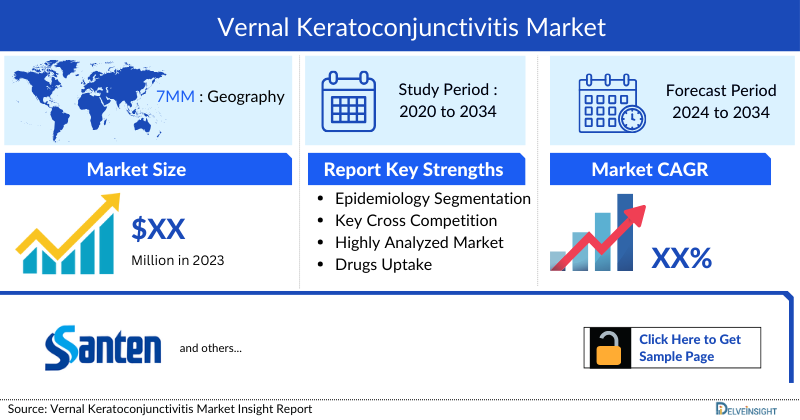
- The Vernal Keratoconjunctivitis Market is expected to maintain a stable Compound Annual Growth Rate (CAGR) during the forecast period (2024-2034). This increase in market revenue is primarily driven by advancements in diagnostic techniques, increased awareness of the condition, and a rising number of reported cases.
Vernal Keratoconjunctivitis Market Insights and Trends
- The cases of Vernal Keratoconjunctivitis are increasing due to various factors, including allergens, climate change, and poor hygiene, among others.
- While various treatment modalities exist for Vernal Keratoconjunctivitis, including topical antihistamines, mast cell stabilizers, corticosteroids, and immunomodulators, not all patients respond adequately to these therapies. There is a need for more targeted and effective treatments, particularly for severe or refractory cases.
- Current Vernal Keratoconjunctivitis market is characterized by less competition as there are a very few companies such as Santen Pharmaceutical, among others whose assets are approved for the treatment of Vernal Keratoconjunctivitis.
- To drive the Vernal Keratoconjunctivitis market in future years, several companies are developing their assets in the mid-late stage of development. With the expected approval of these therapies during the forecast period [2024–2034], the overall therapeutic market of Vernal Keratoconjunctivitis is likely to witness a rise at a significant CAGR.
Factors Affecting Vernal Keratoconjunctivitis Market Growth
Rising Disease Prevalence & Environmental Factors
- Increasing incidence of allergic conjunctivitis / ocular allergies, especially in hot, humid, and tropical/subtropical climates.
- Air pollution, climate change, and greater exposure to allergens (pollen, dust mites, animal dander) aggravate Vernal Keratoconjunctivitis rates.
Demographics & Patient Population
- Vernal Keratoconjunctivitis disproportionately affects children, young adults, and males. Growth in pediatric population in high-risk regions drives demand.
- Persistence into adolescence or even adulthood in some cases, broadening the treatment population.
Advances in Treatment Options & Therapeutic Innovation
- Development and adoption of non-steroidal and immunomodulatory therapies (e.g. cyclosporine, tacrolimus, newer biologics) that offer safer long-term management.
- Novel drug delivery systems: preservative-free formulations, gels, eye drops, and possibly ocular inserts that improve compliance and reduce side-effects.
Increasing Awareness, Diagnosis & Health Infrastructure
- Greater awareness among healthcare providers (ophthalmologists, pediatricians) and among parents/caregivers leading to earlier recognition and initiation of treatment.
- Improved diagnostic tools and practices (clinical exams, allergen testing, ophthalmic imaging) enable better detection and management.
- Expansion of specialty eye care clinics, allergy clinics, and immunology services especially in emerging markets.
Regulatory & Product Approval Momentum
- New product approvals (e.g. treatments specifically labeled for Vernal Keratoconjunctivitis) helping to validate the disease segment and encourage investment.
- Regulatory push toward safer therapies, steroid-sparing options due to concerns about long-term side effects of corticosteroids.
Quality of Life Consideations & Patient Demand
- Vernal Keratoconjunctivitis causes significant discomfort — itching, photophobia, eye redness — which impacts daily life, schooling for children, etc. This drives patient/caregiver demand for more effective, less burdensome treatments.
- Preference for formulations that are easier to use, fewer side effects (e.g. preservative-free drops, less reliance on steroids) to improve adherence
DelveInsight’s comprehensive report titled “Vernal Keratoconjunctivitis (Vernal Keratoconjunctivitis) Market Insights, Epidemiology, and Market Forecast – 2034” offers a detailed analysis of Vernal Keratoconjunctivitis. The report presents historical and projected epidemiological data covering Total Prevalent Cases and Diagnosed Prevalent Cases of Vernal Keratoconjunctivitis further segmented by Gender, Type, Severity, and Age. In addition to epidemiology, the market report encompasses various aspects related to the patient population. These aspects include the diagnosis process, prescription patterns, physician perspectives, market accessibility, treatment options, and prospective developments in the market across seven major markets: the United States, EU4 (Germany, France, Italy, and Spain), the United Kingdom, and Japan, spanning from 2020 to 2034.
The report analyzes the existing treatment practices and unmet medical requirements in Vernal Keratoconjunctivitis. It evaluates the market potential and identifies potential business prospects for enhancing therapies or interventions. This valuable information enables stakeholders to make well-informed decisions regarding product development and strategic planning for the market.
Vernal Keratoconjunctivitis Understanding: Overview, Treatment and Diagnosis
Vernal Keratoconjunctivitis Overview
Vernal keratoconjunctivitis (Vernal Keratoconjunctivitis) is a chronic allergic conjunctivitis most commonly observed in young males. While many forms of allergic conjunctivitis do not impair vision, Vernal Keratoconjunctivitis stands out as damage to the cornea from this condition can lead to vision loss. Despite its typical seasonal nature, year-round symptoms can occur, sometimes leading to uncertain diagnoses.
It characteristically affects young males in hot, dry climates seasonally; however, this is not always the case.
Vernal Keratoconjunctivitis is more prevalent in dry, hot climates, particularly in the Mediterranean Basin, the Middle East, Central and West Africa, India, and South America. It affects males more frequently than females.
Vernal Keratoconjunctivitis Diagnosis and Treatment Algorithm
The diagnosis of Vernal Keratoconjunctivitis is typically established by identifying papillae at the limbus and/or tarsal level. This differentiation distinguishes Vernal Keratoconjunctivitis from seasonal or perennial allergic conjunctivitis.
There is currently no defined gold-standard treatment algorithm for Vernal Keratoconjunctivitis. However, various treatment options are available, and therapy should be tailored to the individual. Individuals undergoing treatment should be closely monitored for the development of any corneal complications.
The current treatment options include mast cell stabilizers, antihistamines, nonsteroidal anti-inflammatory drugs (NSAIDs), topical corticosteroids, cyclosporine, and tacrolimus.
Mast cell stabilizers prevent the degranulation of mast cells. Commonly used mast cell stabilizers include cromolyn sodium and lodoxamide, which are frequently used as first-line therapy. Lodoxamide is superior to cromolyn sodium in relieving symptoms and clinical signs of Vernal Keratoconjunctivitis. These medications should be used 4–6 times daily and may take up to 2 weeks to show a response in mild cases of Vernal Keratoconjunctivitis.
Cyclosporine, a fungal metabolite, reduces the signs and symptoms of Vernal Keratoconjunctivitis. It is a calcineurin inhibitor that works by suppressing cytokine production by T-lymphocytes. Additionally, it has inhibitory effects on eosinophils and mast cell activation. Low doses of cyclosporine are used in certain cases of Vernal Keratoconjunctivitis.
Tacrolimus is another calcineurin inhibitor that inhibits T-lymphocyte activation and the release of inflammatory cytokines. In clinical trials, tacrolimus has proven to be highly effective in treating Vernal Keratoconjunctivitis at various concentrations.
Vernal Keratoconjunctivitis Epidemiology
The epidemiology section of the Vernal Keratoconjunctivitis market report offers information on the patient populations, including historical and projected trends for each of the seven major markets. Examining key opinion leader views from physicians or clinical experts can assist in identifying the reasons behind historical and projected trends. The diagnosed patient pool, their trends, and the underlying assumptions are all included in this section of the report.
This section also presents the data with relevant tables and graphs, offering a clear and concise view of the prevalence of Vernal Keratoconjunctivitis. Additionally, the report discloses the assumptions made during the analysis, ensuring data interpretation and presentation transparency. This epidemiological data is valuable for understanding the disease burden and its impact on the patient population across various regions.

Key Findings in the Vernal Keratoconjunctivitis Epidemiological Landscape
During Vernal Keratoconjunctivitis analysis, it was found that the majority of patients experienced Palpebral symptoms, accounting for approximately 48% of cases observed in the US in 2021. The remaining cases were attributed to Bulbar symptoms (44%) and Mixed symptoms (8%).
- It was noted that the prevalence of Vernal Keratoconjunctivitis ranges between 2.4% to 27.8% in Italy.
- The prevalence of Vernal Keratoconjunctivitis was estimated to be approximately between 0.7% and 3.3% in France.
- It was found that Vernal Keratoconjunctivitis is more prevalent in males as compared to females.
- As per the analysis, the majority of Vernal Keratoconjunctivitis occurs in patients between the ages of 0–20 years old with an age of onset between 10–12 years old; however there are reports of patients as young as 5-months-old.
- The epidemiology of Vernal Keratoconjunctivitis is expected to change during the forecast period (2024-2034).
Vernal Keratoconjunctivitis Market Outlook
The Vernal Keratoconjunctivitis therapeutics market is further expected to increase by the major drivers, such as the rising prevalent population, technological advancements, and upcoming therapies in the forecast period [2024–2034].
In October 2005, PAPILOCK Mini Ophthalmic Solution 0.1% was approved by the PMDA in Japan for the treatment of Vernal Keratoconjunctivitis.
With ongoing research and continued dedication, the future holds hope for even more effective treatments and, ultimately, a cure for this challenging condition. According to DelveInsight, the Vernal Keratoconjunctivitis market in the 7MM is expected to change significantly during the study period 2020–2034.

Vernal Keratoconjunctivitis Drug Analysis
Marketed Vernal Keratoconjunctivitis Drugs
VERKAZIA (Cyclosporine Ophthalmic Emulsion): Santen Pharmaceutical
VERKAZIA is a prescription-only, uniquely formulated oil-in-water cationic emulsion that provides improved ocular bioavailability of cyclosporine, which is effective in the management of Vernal Keratoconjunctivitis. It works by inhibiting T-cell activation and reducing the level of immune cells and mediators that cause the chronic, severe, potentially debilitating allergic inflammation of the ocular surface that is seen in those affected by Vernal Keratoconjunctivitis. Worldwide, VERKAZIA is available for the treatment of Vernal Keratoconjunctivitis in select countries across Asia, Europe, and North America.
Note: Detailed marketed therapies assessment will be provided in the final report...
Vernal Keratoconjunctivitis Market Segmentation
DelveInsight’s ‘Vernal Keratoconjunctivitis (Vernal Keratoconjunctivitis) – Market Insights, Epidemiology, and Market Forecast – 2034’ report provides a detailed outlook of the current and future Vernal Keratoconjunctivitis market, segmented within countries, by therapies, and by classes. Further, the market of each region is then segmented by each therapy to provide a detailed view of the current and future market share of all therapies.
Vernal Keratoconjunctivitis Market Size by Countries
The Vernal Keratoconjunctivitis market size is assessed separately for various countries, including the United States, EU4 (Germany, France, Italy, and Spain), the UK, and Japan. In 2023, the United States held a significant share of the overall 7MM (Seven Major Markets) Vernal Keratoconjunctivitis market, primarily attributed to the country's higher prevalence of the condition and the elevated cost of the available treatments. This dominance is projected to persist, especially with the potential early introduction of new products.
Vernal Keratoconjunctivitis Market Size by Therapies
Vernal Keratoconjunctivitis Market Size by Therapies is categorized into current and emerging markets for the study period 2020–2034.
Note: Detailed market segment assessment will be provided in the final report...
Vernal Keratoconjunctivitis Drugs Uptake
This section focuses on the sales uptake of potential Vernal Keratoconjunctivitis drugs that have recently been launched or are anticipated to be launched in the Vernal Keratoconjunctivitis market between 2020 and 2034. It estimates the market penetration of Vernal Keratoconjunctivitis drugs for a given country, examining their impact within and across classes and segments. It also touches upon the financial and regulatory decisions contributing to the probability of success (PoS) of the drugs in the Vernal Keratoconjunctivitis market.
The emerging Vernal Keratoconjunctivitis therapies are analyzed based on various attributes such as safety and efficacy in randomized clinical trials, order of entry and other market dynamics, and the unmet need they fulfill in the Vernal Keratoconjunctivitis market.
Note: Detailed assessment of drug uptake and attribute analysis will be provided in the full report on Vernal Keratoconjunctivitis...
Vernal Keratoconjunctivitis Market Access and Reimbursement
DelveInsight’s ‘Vernal Keratoconjunctivitis Market Insights, Epidemiology, and Market Forecast – 2034’ report provides a descriptive overview of the market access and reimbursement scenario of Vernal Keratoconjunctivitis.
This section includes a detailed analysis of the country-wise healthcare system for each therapy, enlightening the market access, reimbursement policies, and health technology assessments.
Latest KOL Views on Vernal Keratoconjunctivitis
To keep up with current Vernal Keratoconjunctivitis market trends and fill gaps in secondary findings, we interview KOLs and SMEs working in the Vernal Keratoconjunctivitis domain. Their opinion helps understand and validate current and emerging therapies and treatment patterns or Vernal Keratoconjunctivitis market trends. This will support the clients in potential upcoming novel treatments by identifying the overall scenario of the market and the Vernal Keratoconjunctivitis's unmet needs.
What KOLs are saying on Vernal Keratoconjunctivitis Patient Trends?
DelveInsight’s analysts connected with 50+ KOLs to gather insights; however, interviews were conducted with 15+ KOLs in the 7MM. These KOLs were from organizations, institutes, and hospitals, such as Department of Optometry, College of Medicine and Health Sciences, University of Gondar, Gondar, Ethiopia Aston University School of Life and Health Sciences in the UK, University of Catania, University of Messina in Italy, Department of Pediatrics, Division of Respiratory Medicine, Immunology and Critical Care Medicine, Charité Universitätsmedizin Berlin in Germany, Hospital Regional Universitario de Malaga in Spain, among others.
“To treat Vernal Keratoconjunctivitis, most physicians use topical therapies such as antihistamines, mast cell stabilizers, dual-acting agents, immunomodulators (cyclosporines and tacrolimus), and corticosteroids (prednisolone, loteprednol, fluorometholone, and dexamethasone).”
“The prevalence of Vernal Keratoconjunctivitis is higher in males by a ratio of three to one. Vernal Keratoconjunctivitis usually appears from early spring until autumn but is more prevalent and perennial in countries with warmer climates.”
Note: Detailed assessment of KOL Views will be provided in the full report on Vernal Keratoconjunctivitis...
Vernal Keratoconjunctivitis Competitive Intelligence Analysis
We conduct a Competitive and Market Intelligence analysis of the Vernal Keratoconjunctivitis Market, utilizing various Competitive Intelligence tools such as SWOT analysis and market entry strategies. The inclusion of these analyses is contingent upon data availability, ensuring a comprehensive and well-informed assessment of the market landscape and competitive dynamics.
Vernal Keratoconjunctivitis Clinical Trials analysis
The report offers an analysis of therapeutic candidates in Phase II and III stages and examines companies involved in developing targeted therapeutics for Vernal Keratoconjunctivitis. It provides valuable insights into the advancements and progress of potential treatments in clinical development for this condition.
Vernal Keratoconjunctivitis Pipeline Development Activities
The report covers information on collaborations, acquisitions and mergers, licensing, patent details, and other information for emerging Vernal Keratoconjunctivitis therapies.
Scope of the Vernal Keratoconjunctivitis Market Report
Vernal Keratoconjunctivitis Market Report Insights
- Vernal Keratoconjunctivitis Patient Population
- Therapeutic Approaches
- Vernal Keratoconjunctivitis Pipeline Analysis
- Vernal Keratoconjunctivitis Market Size and Trends
- Vernal Keratoconjunctivitis Market Opportunities
- Impact of Upcoming Therapies
Vernal Keratoconjunctivitis Market Report Key Strengths
- 11 Years Forecast
- The 7MM Coverage
- Vernal Keratoconjunctivitis Epidemiology Segmentation
- Key Cross Competition
- Highly Analyzed Vernal Keratoconjunctivitis Market
- Vernal Keratoconjunctivitis Drugs Uptake
Vernal Keratoconjunctivitis Market Report Assessment
- Vernal Keratoconjunctivitis Current Treatment Practices
- Unmet Needs
- Vernal Keratoconjunctivitis Pipeline Product Profiles
- Vernal Keratoconjunctivitis Market Attractiveness
Key Questions answered in the Vernal Keratoconjunctivitis Market Report
- How common is Vernal Keratoconjunctivitis?
- What are the key findings of Vernal Keratoconjunctivitis epidemiology across the 7MM, and which country will have the highest number of patients during the study period (2020–2034)?
- What are the currently available treatments for Vernal Keratoconjunctivitis?
- What is the disease risk, burden, and unmet needs of Vernal Keratoconjunctivitis?
- At what CAGR is the Vernal Keratoconjunctivitis market and its epidemiology expected to grow in the 7MM during the forecast period (2024–2034)?
- How would the unmet needs impact the Vernal Keratoconjunctivitis market dynamics and subsequently influence the analysis of the related trends?
- What would be the forecasted patient pool of Vernal Keratoconjunctivitis in the 7MM covering the United States, EU4 (Germany, France, Italy, and Spain), the UK, and Japan?
- Among EU4 and the UK, which country will have the highest number of patients during the forecast period (2024–2034)?
- How many companies are currently developing therapies for the treatment of Vernal Keratoconjunctivitis?
Reasons to buy
- The report will help in developing business strategies by understanding the latest trends and changing treatment dynamics driving the Vernal Keratoconjunctivitis Market.
- Insights on patient burden/disease prevalence, evolution in diagnosis, and factors contributing to the change in the epidemiology of the disease during the forecast years
- To understand the existing market opportunity in varying geographies and the growth potential over the coming years.
- Distribution of historical and current patient share based on real-world prescription data along with reported sales of current treatment in the US, EU4 (Germany, France, Italy, and Spain), the United Kingdom, and Japan.
- Identification of strong upcoming players in the market will help in devising strategies that will help in getting ahead of competitors.
- Detailed analysis and ranking of class-wise potential current and emerging therapies under the conjoint analysis section to provide visibility around leading classes.
- Highlights of Access and Reimbursement policies of approved therapies, barriers to accessibility of off-label expensive therapies, and patient assistance programs.
- To understand the perspective of Key Opinion Leaders around the accessibility, acceptability, and compliance-related challenges of existing treatment to overcome barriers in the future.
- Detailed insights on the unmet needs of the existing market so that the upcoming players can strengthen their development and launch strategy.
Frequently Asked Questions
1. What are the treatment goals for Vernal Keratoconjunctivitis?
The primary treatment goal for Vernal Keratoconjunctivitis is to alleviate symptoms, prevent complications, and improve the quality of life for affected individuals.
2. What are the challenges in managing Vernal Keratoconjunctivitis?
Managing Vernal Keratoconjunctivitis presents several challenges. One of the main key challenges is the limited efficacy of conventional therapies. Traditional treatments such as topical antihistamines, mast cell stabilizers, and corticosteroids provide symptomatic relief but may not adequately control inflammation in severe or refractory cases of Vernal Keratoconjunctivitis.
3. What are the key factors driving the growth of the Vernal Keratoconjunctivitis market?
The Vernal Keratoconjunctivitis market is propelled by factors like increasing prevalence, medical advancements, rising awareness, and the introduction of novel therapies by key pharmaceutical players. These elements fuel demand for innovative treatments, addressing unmet medical needs and driving market expansion.
4. How will the Vernal Keratoconjunctivitis Market and Epidemiology Forecast Report benefit the clients
-
Preference for formulations that are easier to use, fewer side effects (e.g. preservative-free drops, less reliance on steroids) to improve adherence
DelveInsight’s comprehensive report titled “Vernal Keratoconjunctivitis (Vernal Keratoconjunctivitis) Market Insights, Epidemiology, and Market Forecast – 2034” offers a detailed analysis of Vernal Keratoconjunctivitis. The report presents historical and projected epidemiological data covering Total Prevalent Cases and Diagnosed Prevalent Cases of Vernal Keratoconjunctivitis further segmented by Gender, Type, Severity, and Age. In addition to e?
The report will provide comprehensive insights into the current Vernal Keratoconjunctivitis market landscape, emerging therapies, competitive dynamics, regulatory requirements, and market access considerations, enabling informed decision-making, strategic planning, and optimization of business strategies to capitalize on market opportunities and drive growth.