
Vertigo Market
- The Vertigo market size is projected to witness steady growth throughout the forecast period (2023–2032) due to the increasing prevalence of benign paroxysmal positional vertigo (BPPV) and vestibular migraine (VM), as well as comorbid anxiety at the population level along with consistent association of vertigo and migraine.
- Analysts at DelveInsight have recently observed a significant uptick in the prevalence of vertigo. Risk factor research, advancements in epidemiologic studies, and breakthrough discoveries are expected to drive market growth by introducing new therapeutic approaches.
- To drive the Vertigo Market in future years, several companies such as AdvaCare Pharma, Auris Medical AG, Sound Pharmaceuticals Incorporated, and others are developing their assets in various stages of development. With the expected approval of these therapies during the forecast period (2023–2032), the overall therapeutic market of vertigo will likely witness an upsurge at a significant CAGR.
Download the Sample PDF to Get More Insight @ Vertigo Market
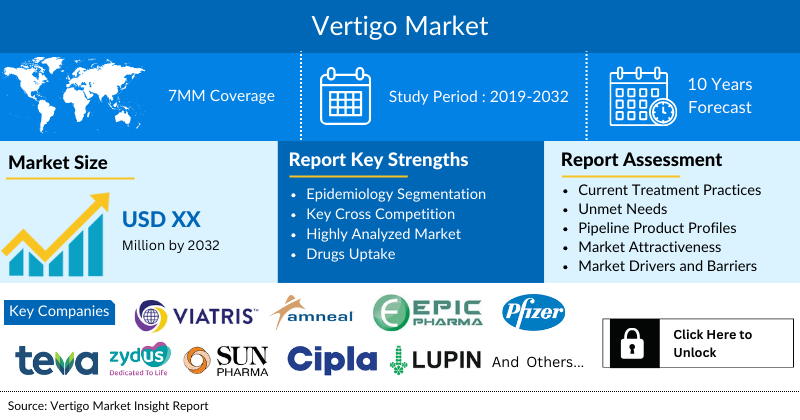
DelveInsight’s report titled “Vertigo Market Insights, Epidemiology, and Market Forecast – 2032” comprehensively analyzes vertigo. The report includes a detailed examination of the historical and projected epidemiology data, including incident cases of vertigo segmented by gender-specific cases. The Vertigo market report offers an in-depth understanding of the various aspects related to the patient population, including diagnosis, prescription patterns, physician perspectives, market access, treatment, and future market developments for the seven major markets, including the United States, EU4 (Germany, France, Italy, and Spain) and the UK, and Japan from 2019 to 2032.
To gauge the market’s overall potential and identify business opportunities, the report discusses current Vertigo treatment practices and algorithms and the related unmet medical needs.
Vertigo Treatment Market
Vertigo Overview
Vertigo is a symptom of vestibular dysfunction and has been described as a sensation of motion, most commonly rotational motion. Vertigo affects all ages. In younger patients, middle ear pathology is most often the cause. In the elderly, specific assessment is needed due to the risk of falls and their complications. Vertigo is most often caused by a dysfunction in the vestibular system from a peripheral or central lesion.
Asymmetry in the vestibular system accounts for the symptoms of vertigo. Asymmetry may result from damage or dysfunction in the peripheral system, such as the vestibular labyrinth or vestibular nerve, or a central disturbance in the brainstem or cerebellum. Though there may be a permanent vestibular disturbance, the symptom of vertigo is never permanent as the central nervous system adapts over days to weeks.
Vertigo Diagnosis
The acronym STANDING describes a four-step algorithm based on nystagmus observation and well-known diagnostic maneuvers. It includes the discrimination between SponTAneous and positional nystagmus, evaluation of the Nystagmus Direction, the head Impulse test, and the evaluation of equilibrium (staNdinG). Laboratory testing is often not useful in identifying the etiology of vertigo. Diagnostic testing with brain imaging is indicated if a central lesion is suspected. Clinicians may find it difficult to distinguish between a central lesion, such as infarction, and a peripheral lesion, such as vestibular neuritis, where the symptoms of vertigo can last for days. In this case, neuroimaging is recommended in patients with risk factors for stroke, associated focal neurologic deficits, a new headache, and when the physical exam is not entirely consistent with a peripheral lesion. The modality of choice is MRI and MRA, as CT scans are less sensitive than MRI for diagnosing and evaluating central lesions. However, if MRI is unavailable or contraindicated, a CT scan with thin cuts may be used, particularly through the brain stem and cerebellum.
The differential diagnosis of vertigo is extensive as it can arise from a central or peripheral lesion in the vestibular system. Therefore, it is important to differentiate vertigo from symptoms of disequilibrium and pre-syncope, such as imbalance and lightheadedness.
Vertigo Diagnosis and Treatment Landscape
Treatment of vertigo depends on the etiology, and treating the underlying etiology will often improve the symptoms of vertigo. Medications may be useful to suppress vestibular symptoms in acute episodes that may last a few hours to days. The most common medications used for symptomatic relief include antihistamines, benzodiazepines, and antiemetics. The most common antihistamine used is meclizine, which is safe during pregnancy.
Vertigo Epidemiology
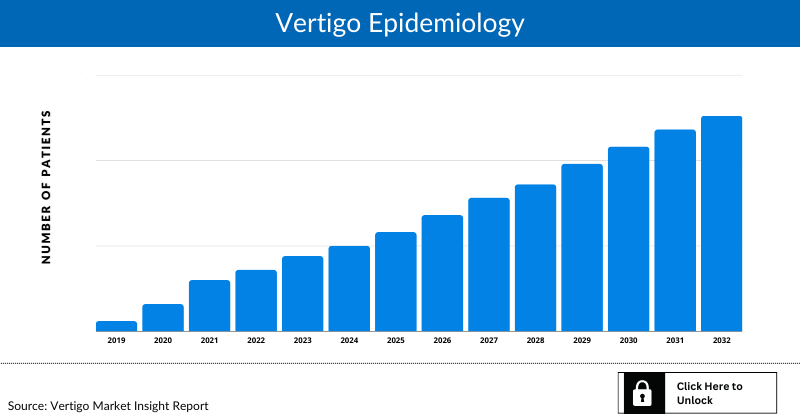
The Vertigo epidemiology section provides insights into the historical and current Vertigo patient pool and forecasted trends for seven individual major countries. It helps recognize the causes of current and forecasted trends by exploring numerous studies and views of key opinion leaders. This part of the report also provides the diagnosed patient pool, its trends, and assumptions undertaken.
The epidemiology section on the Vertigo market report offers information on the patient populations, including historical and projected trends for each of the seven major markets. Examining key opinion leader views from physicians or clinical experts can assist in identifying the reasons behind historical and projected trends. The diagnosed patient pool, their trends, and the underlying assumptions are all included in this section of the report.
Key Findings
- As per a study by Stanton et al. (2023), vertigo affects both men and women but is about two to three times more common in women than men. Prevalence increases with age and varies depending on the underlying diagnosis. Based on a survey of the general population, the 1-year prevalence of vertigo is about 5% and an annual incidence of 1.4%. Dizziness, including vertigo, affects about 15% to over 20% of adults yearly.
- Based on data by Neuhauser (2016), titled “The epidemiology of dizziness and vertigo,” the Vestibular Vertigo incidence rate is 1.4% in Germany, whereas the Vestibular Vertigo prevalence rate is 4.9%. Also, the lifetime prevalence of Vestibular Vertigo is 7.4%. Dizziness (including vertigo) affects about 15% to over 20% of adults yearly in large population-based studies.
Vertigo Market Outlook
The market outlook for vertigo indicates potential growth and increased attention in the coming years. The market is expected to expand with the rising prevalence of vertigo, advancements in understanding the disorder, and the development of targeted therapies. Pharmaceutical companies actively engage in research and clinical trials to introduce novel treatments to manage Vertigo symptoms effectively. LABIRIN (bethistine dihydrochloride) is indicated for treating Ménière’s Syndrome, characterized by the triad of symptoms: vertigo (with nausea and vomiting), ringing in the ears, and hearing loss or difficulty. The market outlook for vertigo suggests a promising landscape with opportunities for innovation, improved treatment options, and better outcomes for individuals affected by dizziness and vertigo.
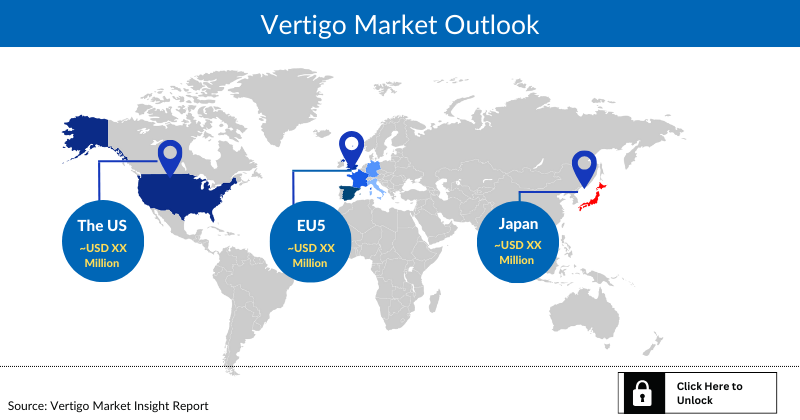
According to DelveInsight, the Vertigo market in the 7MM is expected to significantly change during the study period 2019–2032.
Vertigo Drug Chapters
Marketed Vertigo Drugs
LABIRIN (bethistine dihydrochloride): Apsen Farmacêutica SA
LABIRIN (bethistine dihydrochloride) is indicated for treating Ménière’s Syndrome, characterized by the triad of symptoms including vertigo (with nausea and vomiting). Betahistine accelerates vestibule recovery after animal neurectomy, promoting and facilitating vestibular compensation. This effect, characterized by a regulation in the turnover and release of histamine, is mediated by H3 receptor antagonism. In humans, recovery time after a vestibular neurectomy was reduced when treated with betahistine.
Note: Detailed marketed therapies assessment will be provided in the final report...
Emerging Vertigo Drugs
The currently available treatments for vertigo aim to mitigate the existing treatment gap in the vertigo landscape. The Vertigo market dynamics are expected to change, primarily due to increased healthcare spending worldwide. Vertigo Market players such as AdvaCare Pharma, Auris Medical AG, Sound Pharmaceuticals Incorporated, and others are actively involved in developing Vertigo treatments.
SPI-1005: Sound Pharmaceuticals Incorporated
SPI-1005 is an investigational new drug that contains ebselen, a small molecule that is a new chemical entity or NCE under FDA classification. Ebselen is a selenorganic compound that mimics and induces glutathione peroxidase (GPx) activity and represents a novel class of anti-inflammatory. GPx activity is critical to several cell types and tissues in the inner ear, retina, brain, lung, and kidney and is often reduced during exposures to environmental insults. SPI-1005 is given orally and is being tested in several neurotologic indications, including noise-induced hearing loss and tinnitus, and two types of ototoxicity (hearing loss, tinnitus, dizziness, or vertigo) due to aminoglycoside antibiotics (such as tobramycin), and due to platinum-based chemotherapy. In earlier clinical trials, SPI-1005 demonstrated strong proof-of-concept data supporting the potential treatment in preventing and treating noise-induced hearing loss and Meniere’s disease.
Note: Detailed emerging therapies assessment will be provided in the final report...
Vertigo Market Segmentation
DelveInsight’s ‘Vertigo Market Insights, Epidemiology, and Market Forecast – 2032’ report provides a detailed outlook of the current and future Vertigo market, segmented within countries, by therapies, and by classes. Further, the market of each region is then segmented by each therapy to provide a detailed view of the current and future market share of all therapies.
Vertigo Market Size by Countries
The total Vertigo market size is analyzed for individual countries (the United States Market, EU4 [Germany, France, Italy, and Spain] and the UK market, and Japan). The United States accounted for a larger portion of the 7MM market for vertigo in 2022 due to the increasing cases and the cost of treatments. This dominance is predicted to continue with the potential early entry of new products.
Vertigo Market Size by Therapies
The clinical pattern of vertigo is significant for diagnosing vestibular system disease, and duration is the most important clinical feature. Vertigo can arise from the labyrinth (peripheral nervous) or vestibular (central nervous) system. Common peripheral causes of vertigo include vestibular neuritis (sudden, unilateral vestibular loss), Ménière’s disease (episodic vertigo), benign paroxysmal positional vertigo (BPPV), and bilateral vestibular loss. Common central causes of vertigo include vestibular migraine, cerebrovascular disease, and acoustic neuroma. As research and development efforts continue, it is expected that the market size for Vertigo therapies will expand further, driven by advancements in assessing the risk factors, treatment options, increased awareness, and growing demand for innovative approaches to address the needs of individuals experiencing vertigo.
Note: Detailed market segment assessment will be provided in the final report...
Vertigo Drugs Uptake
This section focuses on the sales uptake of potential Vertigo drugs that have recently launched or are anticipated to be launched in the Vertigo market between 2019 and 2032. It estimates the market penetration of Vertigo drugs for a given country, examining their impact within and across classes and segments. It also touches upon the financial and regulatory decisions contributing to the drug’s probability of success (PoS) in the Vertigo market.
The emerging Vertigo therapies are analyzed based on various attributes such as safety and efficacy in randomized clinical trials, order of entry and other market dynamics, and the unmet need they fulfill in the Vertigo market.
Note: Detailed assessment of drug uptake and attribute analysis will be provided in the full report on vertigo...
Vertigo Market Access and Reimbursement
DelveInsight’s ‘Vertigo Market Insights, Epidemiology, and Market Forecast – 2032’ report provides a descriptive overview of the market access and reimbursement scenario of vertigo.
This section includes a detailed analysis of the country-wise healthcare system for each therapy, enlightening the market access, reimbursement policies, and health technology assessments.
KOL Views
To keep up with current Vertigo market trends and fill gaps in secondary findings, we interview KOLs and SMEs working in the Vertigo domain. Their opinion helps understand and validate current and emerging therapies, treatment patterns, or Vertigo market trends. This will support the clients in potential upcoming novel treatments by identifying the overall scenario of the market and the Vertigo unmet needs.
Vertigo: KOL Insights
- DelveInsight’s analysts connected with 50+ KOLs to gather insights; however, interviews were conducted with 15+ KOLs in the 7MM. These KOLs were from organizations, institutes, and hospitals, such as the Harnett Health, Southeastern Regional Medical Center, the Department of Epidemiology and Health Monitoring, Robert Koch Institute, Berlin, Germany, and many others.
- “The patient who has vertigo may have a nonspecific complaint that must be further differentiated into either an altered somatic sensation (giddiness, wooziness, disequilibrium), orthostatic lightheadedness (sensation of fainting), or the sensation of the environment (or patient) spinning (true vertigo).”
- “About 80% of cases of vertigo are due to a peripheral lesion (pathology of the vestibular structures or cranial nerve VIII). Although peripheral vertigo is benign and not life-threatening, it may cause significant disability.”
Note: Detailed assessment of KOL Views will be provided in the full report of vertigo...
Competitive Intelligence Analysis
We perform Competitive and Market Intelligence analysis of the Vertigo Market using various Competitive Intelligence tools, including SWOT analysis, Market entry strategies, etc. The inclusion of the analysis entirely depends upon the data availability.
Vertigo Pipeline Development Activities
The report provides insights into Vertigo Clinical Trials within Phase II and III stages. It also analyzes Vertigo Companies involved in developing targeted therapeutics.
Pipeline Development Activities
The report covers information on collaborations, acquisition and merger, licensing, patent details, and other information for emerging Vertigo therapies.
Vertigo Report Insights
- Vertigo Patient Population
- Vertigo Therapeutic Approaches
- Vertigo Pipeline Analysis
- Vertigo Market Size and Trends
- Vertigo Market Opportunities
- Impact of Upcoming Vertigo Therapies
Vertigo Report Key Strengths
- 10 Years Forecast
- The 7MM Coverage
- Vertigo Epidemiology Segmentation
- Key Cross Competition
- Highly Analyzed Vertigo Market
- Vertigo Drugs Uptake
Vertigo Report Assessment
- Vertigo Current Treatment Practices
- Vertigo Unmet Needs
- Vertigo Pipeline Product Profiles
- Vertigo Market Attractiveness
- Vertigo Market Drivers
- Vertigo Market Barriers
Key Questions Answered In The Vertigo Market Report
- What are the key findings of the market across the 7MM, and what country will have the largest Vertigo market size during the forecast period (2023–2032)?
- At what CAGR is the Vertigo market, and is epidemiology expected to grow in the 7MM during the forecast period (2023–2032)?
- What are the key drivers of growth in the Vertigo market (2023–2032)?
- What are the most commonly prescribed medications for vertigo (2023–2032)?
- Are regulatory or reimbursement challenges affecting the Vertigo market (2023–2032)?
- Are there any market barriers or challenges hindering the growth of the Vertigo market (2023–2032)?
- What strategies are pharmaceutical companies adopting to capture a larger share of the Vertigo market (2023–2032)?