
Vials and Ampoules Market Summary
Overview
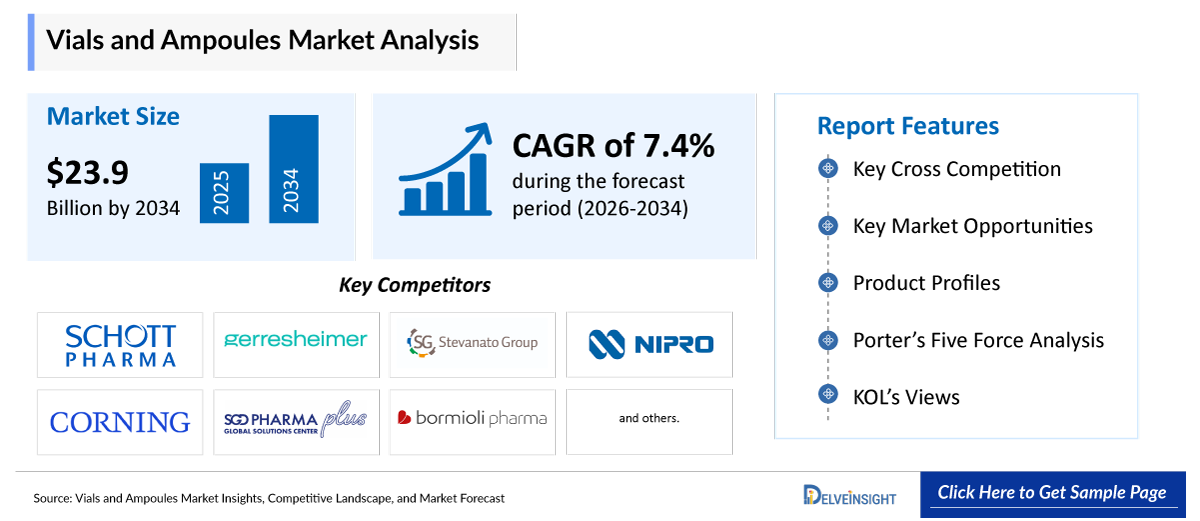
• The Vials and Ampoules market is estimated at USD 12.6 billion in 2025 and is projected to reach USD 23.9 billion by 2034. Growth is anchored in the structural expansion of injectable biologics and vaccines, regulatory tightening under revised aseptic manufacturing rules, and the industry-wide migration from bulk glass to ready-to-use sterile containers.
• The global Vials and Ampoules market is growing at a CAGR of 7.4% during the forecast period from 2026 to 2034.
• By product type, the vials segment dominated the Vials and Ampoules market with a 68% share in 2025.
• By material type, the Type I borosilicate glass segment dominated the Vials and Ampoules market with a 74% share in 2025.
• By packaging format, the bulk non-sterile segment dominated the Vials and Ampoules market with a 62% share in 2025.
• By application, the biologics and biosimilars segment dominated the Vials and Ampoules market with a 34% share in 2025.
• By end user, the pharmaceutical and biotechnology companies segment dominated the Vials and Ampoules market with a 58% share in 2025.
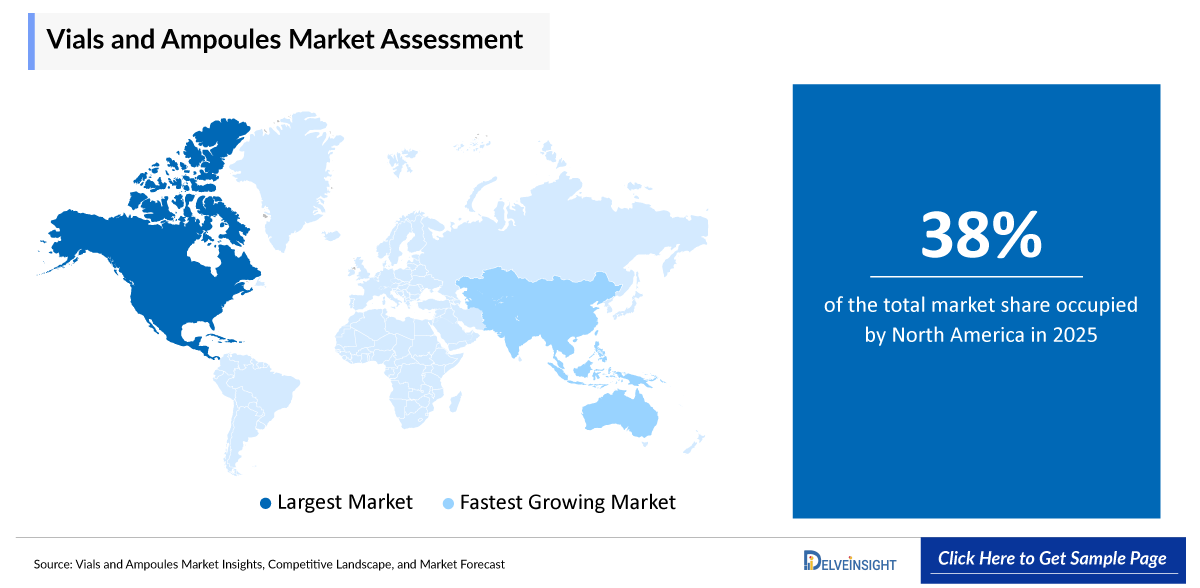
• North America dominated the global Vials and Ampoules market revenue with a 38% share in 2025, representing the highest regional market share globally.
Vials and ampoules are the primary containers in which parenteral medicines are filled, stored, transported, and administered. A vial is a small, reclosable container sealed with an elastomeric stopper and an aluminium crimp cap, available in single-dose or multi-dose presentations; an ampoule is a hermetically flame-sealed container opened by snapping the neck, used where absolute closure integrity and single-dose administration are required. Both are manufactured predominantly from Type I borosilicate glass, produced either by converting drawn glass tubing on rotary machines or by moulding, and increasingly from cyclic olefin polymers or from engineered polymers carrying a glass-like barrier coating applied by plasma-enhanced chemical vapour deposition. The ecosystem spans glass tubing producers, converters, coating technology licensors, washing and depyrogenation equipment suppliers, nest and tub sterilisation providers, and the aseptic fill-finish operations of pharmaceutical companies and contract manufacturers. Containers reach customers either as bulk non-sterile units requiring on-site washing, depyrogenation, and sterilisation, or as ready-to-use nested, pre-sterilised units that enter the filling line directly. Applications span biologics and biosimilars, vaccines, small-molecule injectables, antibody-drug conjugates, and diagnostics. Once a commoditised consumable, the category has evolved into an engineered, high-value component of the drug product, judged on particulate burden, delamination resistance, dimensional precision, breakage performance on filling lines, and container closure integrity.
Vials and Ampoules Market Key Growth Drivers
• Structural growth in injectable biologics, biosimilars, and vaccines is expanding unit demand for parenteral primary containers faster than the pharmaceutical market as a whole.
• Revised European Union GMP Annex 1, applicable from August 2023, elevates contamination control strategy and container closure integrity expectations, favouring validated, high-specification containers.
• The migration from bulk glass to ready-to-use nested sterile containers is accelerating, formalised by the Alliance for RTU established by Gerresheimer, Stevanato Group, and SCHOTT Pharma in October 2024.
• Coated and engineered glass is displacing conventional vials, with Corning Velocity vials improving filling line efficiency by up to 50%, reducing crack generation threefold, and cutting glass particulates by up to 96%.
• GLP-1 receptor agonists and antibody-drug conjugates are reshaping container requirements, driving demand for sterile cartridges and specially coated vials suited to highly potent compounds.
• Capacity expansion and supply chain localisation, including SCHOTT Pharma ramp-ups in Hungary and Serbia, Stevanato investment at Latina and Fishers, and the Corning and SGD Pharma tubing joint venture in India, are rebuilding regional resilience.
• Decarbonisation of glass manufacturing is emerging as a purchasing criterion, exemplified by lightweighted coated vials that use 20% less glass and cut cradle-to-gate Scope 3 emissions by up to 30%.
Key Companies in Vials and Ampoules Market
The competitive landscape is led by the following tubing producers, converters, coating technology owners, and containment system providers:
• SCHOTT Pharma AG & Co. KGaA
• Gerresheimer AG
• Stevanato Group S.p.A.
• Nipro Corporation
• Corning Incorporated
• SGD Pharma
• Bormioli Pharma S.p.A.
• Sisecam
• Piramal Glass Private Limited
• Borosil Scientific Limited
Factors Contributing to the Growth of the Vials and Ampoules Market
Market Drivers
Structural Growth in Injectable Biologics, Biosimilars, and Vaccines
The foundational driver of the vials and ampoules market is the shift of the pharmaceutical pipeline toward parenteral biologics, which cannot be administered orally and therefore require a sterile primary container for every dose. Monoclonal antibodies, antibody-drug conjugates, enzyme replacement therapies, cell and gene therapies, and vaccines all depend on vials for clinical supply and commercial launch, and regulators require final-container stability data from early clinical phases onward, so container consumption begins years before approval. Suppliers report that this demand is secular rather than cyclical: Stevanato Group attributes growth in its Biopharmaceutical and Diagnostic Solutions segment to the rise in biologics, citing a strong pipeline of monoclonal antibody projects in clinical phases spanning both novel applications and biosimilars, while SCHOTT Pharma reports broad-based demand for high-value solutions across ready-to-use products and specialty vials. Biosimilar entry multiplies rather than replaces container demand, since each competing product requires its own qualified container closure system. Multi-pathogen vaccine programmes and paediatric formulations add further volume in small-format presentations where dimensional accuracy and particulate thresholds are stringent. Because every incremental injectable dose requires a container, pipeline expansion translates directly and durably into unit growth, anchoring the market through 2034.
Regulatory Tightening under Revised Annex 1 and Container Closure Integrity Requirements
Regulation has converted primary packaging from a procurement line item into a controlled element of the contamination control strategy. The revised European Union GMP Annex 1, applicable from August 2023, requires manufacturers to formalise a contamination control strategy, apply quality risk management across the aseptic process, and demonstrate container closure integrity rather than relying solely on sterility testing. United States Pharmacopeia chapters governing glass containers and the evaluation of inner surface durability place delamination and particulate performance under formal scrutiny, and ISO 15378 establishes GMP requirements specific to primary packaging manufacture. The practical consequence is that container specification, supplier qualification, and change control now sit inside the drug application through the drug master file, which raises switching costs, rewards suppliers able to furnish extensive characterisation data, and shifts purchasing toward validated, high-specification products. It also favours container formats that reduce human intervention in the aseptic core, which is precisely the argument for pre-sterilised nested containers. Gerresheimer, Stevanato Group, and SCHOTT Pharma have explicitly framed the ready-to-use transition as a response to the stringent requirements of modern pharmaceutical production. Regulatory tightening therefore raises value per unit and concentrates demand among qualified suppliers across the forecast period.
Market Restraints
Despite favourable structural demand, the vials and ampoules market faces constraints that have already produced visible weakness. The most immediate is the post-pandemic inventory correction: pharmaceutical customers accumulated vial stock during the vaccine surge and spent subsequent years drawing it down, producing a destocking cycle that suppressed orders and left installed capacity underutilised. SCHOTT Pharma reported temporary underutilisation in vial capacities during 2025, and Stevanato Group described only a modest recovery in nested sterile vials as destocking gradually subsided, illustrating how sensitive the category is to customer inventory behaviour. Capital intensity compounds the problem, since glass furnaces run continuously, cannot be idled economically, and require multi-year lead times and eight-figure investment, so capacity added against pandemic demand cannot be withdrawn when demand normalises. Energy cost volatility flows directly into the cost base because melting is energy intensive. Switching costs cut both ways: because the container is specified within the drug master file, qualifying an alternative supplier requires stability studies and regulatory change control, which protects incumbents but slows adoption of superior technologies and suppresses price competition. Product risk persists through glass breakage on filling lines, delamination of the inner surface with sensitive formulations, and particulate contamination, each capable of triggering recalls. Substitution pressure is real, as prefilled syringes, cartridges, and pen systems displace vial-and-syringe presentation in chronic subcutaneous therapy, while ampoules face structural decline on particulate generation at the break point and their inability to support multi-dose use. Supply of borosilicate tubing remains concentrated among a few qualified producers, exposing converters to input risk, and tariff and trade measures introduce cost uncertainty. Governance risk has also surfaced, with Gerresheimer announcing in December 2025 a comprehensive correction of revenues recognised from bill-and-hold agreements. Together these factors temper the pace at which structural demand converts into supplier revenue.
Vials and Ampoules Market Segment Analysis
The Vials and Ampoules Market by Product Type (Vials, Ampoules), Material Type (Type I Borosilicate Glass, Type II Treated Soda-Lime Glass, Type III Soda-Lime Glass, Polymer and Coated Polymer), Packaging Format (Bulk Non-Sterile, Ready-to-Use Nested Sterile), Application (Biologics and Biosimilars, Vaccines, Small Molecule Injectables, Antibody-Drug Conjugates and High-Potency Drugs, Diagnostics and Others), End User (Pharmaceutical and Biotechnology Companies, Contract Manufacturing and Development Organizations, Research Laboratories, Others), and Geography (North America, Europe, Asia-Pacific, Rest of World).
By Product Type
Dominant Subsegment: Vials. The vials category is expected to dominate the market.
Dominant: Vials ~ 68%
The vials segment accounted for a 68% share of the Vials and Ampoules market in 2025. Vials dominate because they are the default primary container for the fastest-growing part of the pharmaceutical pipeline. Their reclosable elastomeric stopper and crimp seal permit multi-dose presentation, reconstitution of lyophilised powders at the point of care, and withdrawal of partial doses, none of which an ampoule supports. Lyophilisation is essential for monoclonal antibodies, antibody-drug conjugates, enzyme therapies, and many vaccines, and freeze-drying is performed in the vial itself, making the container an integral part of the process rather than a package applied afterwards. Vials also carry the innovation of the category: coated low-friction surfaces, aluminosilicate and coated polymer bodies, and nested sterile presentation are commercialised in vial format first, and suppliers report that specially coated vials for highly potent compounds command premium pricing and more complex production. Ampoules retain a defensible position where absolute closure integrity without an elastomeric interface is required, notably in emergency medicine, anaesthesia, ophthalmics, and generic small molecules, and they remain widely used in Asia-Pacific and Latin America. Their share nevertheless erodes structurally, constrained by particulate generation at the break point, single-dose limitation, and handling risk. Vials retain clear leadership across the forecast period.
By Material Type
Dominant Subsegment: Type I Borosilicate Glass. The Type I borosilicate glass category is expected to dominate the market.
Dominant: Type I Borosilicate Glass ~ 74%
The Type I borosilicate glass segment accounted for a 74% share of the Vials and Ampoules market in 2025. Type I borosilicate dominates because it is the material with the clearest global regulatory precedent for parenteral contact. Its low alkali content confers high hydrolytic resistance, chemical inertness across a broad pH range, thermal shock tolerance permitting depyrogenation and terminal sterilisation, and gas and moisture impermeability that underwrite multi-year shelf life. Pharmacopoeial chapters in the United States and Europe are written with reference to glass container types, and agencies applying strict container closure protocols effectively privilege Type I borosilicate for injectables and biologics. Suppliers such as SGD Pharma manufacture and release Type I tubular vials in accordance with pharmacopoeial and ISO GMP standards, and the coated products entering the market retain a borosilicate body precisely to preserve that regulatory position, since leaving the drug contact surface unaltered avoids additional post-marketing approval. Type II treated soda-lime and Type III soda-lime glass serve oral solids, diagnostics, and less demanding applications at lower cost. Polymer and coated polymer containers, including engineered polymers carrying plasma-deposited glass-like barriers that eliminate delamination, metal ions, and breakage, are the fastest-growing material and are gaining ground in cryogenic and cell therapy applications, but conservatism in qualification keeps Type I borosilicate firmly in the lead.
Vials and Ampoules Market Region Analysis
Dominant Region: North America
Dominant: North America ~ 38% (Largest)
North America accounted for a 38% share of the global Vials and Ampoules market revenue in 2025, representing the highest regional market share globally. Leadership rests on value rather than unit volume. The region hosts the largest concentration of biologics licence applications, commercial monoclonal antibody manufacture, and cell and gene therapy programmes, all of which consume high-specification containers at premium prices, and Food and Drug Administration container closure expectations privilege Type I borosilicate for injectables. Ready-to-use adoption is more advanced than elsewhere because United States fill-finish operators face high labour and validation costs that nested sterile formats offset. The region is also the innovation centre of the category: Corning develops Valor, Velocity, and lightweighted coated vials in New York, and engineered polymer containers with plasma-deposited glass-like barriers are manufactured in Alabama, with United States government awards having funded domestic primary packaging capacity following pandemic shortages. Suppliers have localised accordingly, with Stevanato Group expanding at Fishers, Indiana, in response to growing demand and rising United States capital investment. Tariff exposure has accelerated onshoring, and SCHOTT Pharma has indicated that the direct impact of United States tariffs is expected to be limited given local production. Premium mix, regulatory rigour, and format leadership sustain regional dominance across the forecast period. Source: company disclosures, 2023-2025.
Fastest Growing Region: Asia-Pacific
Asia-Pacific is the fastest-growing region in the Vials and Ampoules market. The region combines the largest unit volumes with the fastest capacity additions and the steepest upgrade path from commodity to high-specification containers. India is a leading supplier of generic injectables and is building domestic tubing independence: Corning and SGD Pharma have constructed a pharmaceutical glass tubing facility in Telangana with investment of about INR 5 billion, equivalent to USD 60.3 million, creating about 150 jobs, and SGD Pharma’s Vemula site produces three million vials and ampoules per day across 1 mL to 500 mL formats, holding first position in India for moulded glass and fifth worldwide for tubular vials. China hosts very large borosilicate converting capacity and has established a standard framework for pharmaceutical glass, while Japan contributes tubing and converting leadership through Nippon Electric Glass and Nipro Corporation, the latter having acquired Croatian producer Piramida to secure European supply. Expanding domestic biologics and biosimilar manufacture, national vaccine programmes, and the migration of global fill-finish capacity into the region are lifting both volume and specification. Cost-competitive production and rising quality position Asia-Pacific as the principal source of incremental demand through 2034.
Regional Commentary
North America
North America accounted for a 38% share of the global Vials and Ampoules market revenue in 2025. The United States dominates in biologics manufacturing, premium container mix, advanced ready-to-use adoption, and coating and polymer innovation, supported by government investment in domestic primary packaging capacity, while Canada and Mexico contribute converting and fill-finish capacity serving regional supply.
Europe
Europe is the second-largest regional market and the manufacturing and standards heartland of the category, home to SCHOTT Pharma, Gerresheimer, Stevanato Group, SGD Pharma, and Bormioli Pharma. Revised GMP Annex 1 originates here and drives ready-to-use adoption, while capacity is being rebalanced toward Hungary, Serbia, and Southern Europe. Energy costs and furnace decarbonisation are the defining commercial pressures.
Asia-Pacific
Asia-Pacific is the fastest-growing region, propelled by Indian generic injectable manufacture and new domestic tubing capacity, large Chinese converting capacity operating within an established national glass framework, and Japanese and South Korean technology leadership. Ampoule use remains proportionally higher than in Western markets, and the upgrade from soda-lime to Type I borosilicate is a persistent growth vector.
Rest of World
The Rest of World region, spanning the Middle East, Africa, and South America, is characterised by import dependence and emerging local converting capacity. Sovereign investment in vaccine sovereignty following pandemic supply shortages, expanding regional fill-finish operations, and demand for lower-cost moulded glass and ampoules underpin steady growth, although high-specification and ready-to-use adoption trails other regions.
Vials and Ampoules Market Competitive Landscape
The Vials and Ampoules market is classified as Moderately Concentrated. High-specification Type I tubular glass, and above all ready-to-use nested sterile containment, is concentrated among SCHOTT Pharma, Gerresheimer, Stevanato Group, and Nipro Corporation, with Corning controlling the dominant coating technology and licensing it to converters. The moulded glass and ampoule tiers are considerably more fragmented, populated by strong regional producers across India, China, Europe, and Latin America competing largely on cost and proximity. Barriers to entry are severe at the high end, arising from furnace capital intensity, ISO 15378 qualification, drug master file inclusion, and multi-year customer validation cycles, and low at the commodity end.
The competitive landscape can be evaluated across the following dimensions:
• Market concentration: Moderately concentrated, with ready-to-use and coated containment held by a few global suppliers and commodity moulded glass and ampoules widely fragmented.
• Leading players: SCHOTT Pharma, Gerresheimer, Stevanato Group, and Nipro Corporation anchor the containment tier; Corning owns the coating platform; SGD Pharma, Bormioli Pharma, and Sisecam hold strong converting and moulded positions.
• Geographic reach: Gerresheimer operates over 40 production sites across 16 countries and produces locally for regional markets; SCHOTT Pharma is ramping Hungary and Serbia; Stevanato is expanding at Latina and Fishers.
• Product portfolio strength: Leaders span bulk and nested sterile vials, ampoules, cartridges, and syringes, with Gerresheimer offering a tiered portfolio spanning value, advance, and elite grades for high-value biologics.
• Pipeline strength: Coated specialty vials for antibody-drug conjugates, ready-to-use cartridges for GLP-1 therapies, lightweighted low-carbon vials, and coated polymer containment for cryogenic and cell therapy applications.
• Strategic partnerships: The Alliance for RTU uniting Gerresheimer, Stevanato Group, and SCHOTT Pharma; Corning joint ventures with Gerresheimer and with SGD Pharma to co-manufacture coated vials.
• M&A activity: Gerresheimer acquired Bormioli Pharma at an enterprise value of about EUR 800 million, completed in December 2024; Nipro acquired Croatian producer Piramida; private equity interest in Gerresheimer was explored and discontinued in 2025.
• Manufacturing capabilities: Continuous borosilicate furnaces, tubing draw, high-speed converting, washing and depyrogenation, nest and tub sterilisation, and coating deposition constitute the principal barrier to entry.
• Innovation focus: Low-friction external coatings, aluminosilicate glass, plasma-deposited glass-like barriers on engineered polymers, lightweighting, furnace decarbonisation, and inline nest-level traceability.
Vials and Ampoules Market Recent Developmental Activities
In December 2025, Gerresheimer AG announced a comprehensive correction of revenues recognised from bill-and-hold agreements. Strategic significance: Introduces governance and reporting risk at a leading supplier and is expected to increase customer and investor scrutiny of revenue recognition practices across the primary packaging sector.
In October 2025, Gerresheimer AG presented a strategy update at a Capital Markets Day, disclosing the outcome of the strategic review of its Moulded Glass business and a new segmentation of its divisions, and guiding to mid-term organic revenue growth of 6% to 9% with an organic adjusted EBITDA margin of 23% to 25%. Strategic significance: Signals portfolio rebalancing away from commodity moulded glass toward high-value biologics containment.
Vials and Ampoules Market Segmentation
Vials and Ampoules Market by Product Type
• Vials
• Ampoules
Vials and Ampoules Market by Material Type
• Type I Borosilicate Glass
• Type II Treated Soda-Lime Glass
• Type III Soda-Lime Glass
• Polymer and Coated Polymer
Vials and Ampoules Market by Packaging Format
• Bulk Non-Sterile
• Ready-to-Use Nested Sterile
Vials and Ampoules Market by Application
• Biologics and Biosimilars
• Vaccines
• Small Molecule Injectables
• Antibody-Drug Conjugates and High-Potency Drugs
• Diagnostics and Others
Vials and Ampoules Market by End User
• Pharmaceutical and Biotechnology Companies
• Contract Manufacturing and Development Organizations
• Research Laboratories
• Others
Vials and Ampoules Market by Geography
• North America Vials and Ampoules Market
▪ United States Vials and Ampoules Market Size in USD million (2023-2034)
▪ Canada Vials and Ampoules Market Size in USD million (2023-2034)
▪ Mexico Vials and Ampoules Market Size in USD million (2023-2034)
• Europe Vials and Ampoules Market
▪ Germany Vials and Ampoules Market Size in USD million (2023-2034)
▪ United Kingdom Vials and Ampoules Market Size in USD million (2023-2034)
▪ France Vials and Ampoules Market Size in USD million (2023-2034)
▪ Italy Vials and Ampoules Market Size in USD million (2023-2034)
▪ Spain Vials and Ampoules Market Size in USD million (2023-2034)
▪ Rest of Europe Vials and Ampoules Market Size in USD million (2023-2034)
• Asia-Pacific Vials and Ampoules Market
▪ China Vials and Ampoules Market Size in USD million (2023-2034)
▪ Japan Vials and Ampoules Market Size in USD million (2023-2034)
▪ India Vials and Ampoules Market Size in USD million (2023-2034)
▪ Australia Vials and Ampoules Market Size in USD million (2023-2034)
▪ South Korea Vials and Ampoules Market Size in USD million (2023-2034)
▪ Rest of Asia-Pacific Vials and Ampoules Market Size in USD million (2023-2034)
• Rest of the World (RoW) Vials and Ampoules Market
▪ Middle East Vials and Ampoules Market Size in USD million (2023-2034)
▪ Africa Vials and Ampoules Market Size in USD million (2023-2034)
▪ South America Vials and Ampoules Market Size in USD million (2023-2034)
Key Takeaways from the Vials and Ampoules Market Report Study
• Market size analysis for the current vials and ampoules market size (2025), and market forecast for 9 years (2026 to 2034).
• Top key product/technology developments, mergers, acquisitions, partnerships, and joint ventures that happened over the last 3 years.
• Key companies dominating the global vials and ampoules market.
• Various opportunities available for competitors in the vials and ampoules market space.
• What are the top-performing segments in 2025? How will these segments perform in 2034?
• Which are the top-performing regions and countries in the current vials and ampoules market scenario?
• Which are the regions and countries where companies should concentrate their opportunities for vials and ampoules market growth in the future?
Target audience who can benefit from this vials and ampoules market report study
• Vials and Ampoules product providers
• Research organizations and consulting companies
• Vials and Ampoules-related organizations, associations, forums, and other alliances
• Government and corporate offices
• Start-up companies, venture capitalists, and private equity firms
• Distributors and traders dealing in vials and ampoules
• Various end-users who want to know more about the vials and ampoules market and the latest technological developments in the vials and ampoules market

