
Volixibat Market Insights
Key Factors Driving Volixibat Growth
• Positive Phase IIb PSC data substantially de-risked the program
In May 2026, Mirum announced that the Phase IIb VISTAS study in PSC achieved its primary endpoint, demonstrating clinically meaningful reductions in cholestatic pruritus (itch). Patients receiving volixibat experienced a 2.72-point reduction in itch scores compared with 1.08 points for placebo, with 55.6% achieving at least a two-point improvement. Serum bile acid reductions were also statistically significant. These results strongly support potential regulatory filings and commercial viability in PSC.
• PSC and PBC represent major unmet-need orphan markets
PSC currently has no approved therapies globally, while many PBC patients continue to experience severe itch despite existing treatments. Mirum estimates approximately 24,000 PSC patients and 140,000 PBC patients in the United States alone. Because cholestatic pruritus severely impacts quality of life, effective symptom control could drive rapid physician adoption and premium orphan-drug pricing.
• Breakthrough Therapy Designation may accelerate development and adoption
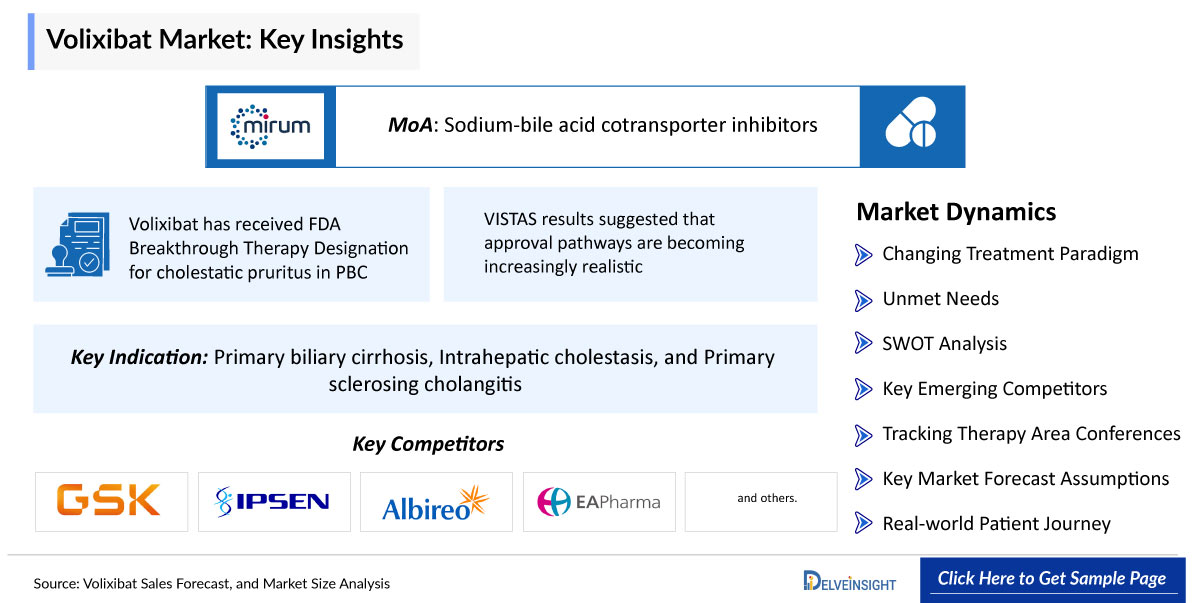
Volixibat has received FDA Breakthrough Therapy Designation for cholestatic pruritus in PBC. This designation reflects both the seriousness of the condition and the encouraging efficacy observed in earlier trials. Regulatory support may accelerate review timelines, improve physician awareness, and strengthen reimbursement prospects upon approval.
• Strong efficacy across multiple patient-relevant endpoints enhances differentiation
Beyond itch reduction, volixibat has demonstrated improvements in fatigue, sleep quality, serum bile acids, and inflammatory biomarkers such as IL-31. In the Phase IIb VANTAGE study in PBC, the combined dose group achieved a statistically significant 3.78-point reduction in itch scores (p<0.0001), while 70% of treated patients achieved ≥50% reductions in serum bile acids. Rapid onset of action, with responses observed as early as week 1, may further differentiate volixibat from competing cholestatic therapies.
• Validated IBAT inhibitor class reduces commercial and regulatory risk
The IBAT inhibitor class is already clinically validated through Mirum’s approved drug maralixibat (LIVMARLI) and other approved agents in rare cholestatic disorders. Because physicians are increasingly familiar with bile acid transporter inhibition and its mechanism in reducing toxic bile acid accumulation, volixibat may benefit from faster clinical uptake and lower educational barriers. The main adverse event profile—primarily mild-to-moderate diarrhea—also appears manageable and consistent with the class.
• Potential blockbuster opportunity with launch expected around 2027
Following the positive PSC Phase IIb readout, multiple analysts described volixibat as a potential “$1B+ commercial opportunity.” Investor commentary after the VISTAS results suggested that approval pathways are becoming increasingly realistic, with some analysts projecting potential launch timing around 2027. Because volixibat is being developed simultaneously in PSC and PBC, dual-indication expansion could significantly increase peak sales potential. Continued success in registrational studies may position volixibat as one of the leading therapies in adult cholestatic liver disease.
Volixibat Recent Developments
In May 2026, Mirum Pharmaceuticals, Inc. announced the primary endpoint was met in the VISTAS Phase IIb study evaluating Volixibat, an investigational oral ileal bile acid transporter (IBAT) inhibitor, in patients with primary sclerosing cholangitis (PSC).
“Volixibat Sales Forecast, and Market Size Analysis – 2034” report provides comprehensive insights of Volixibat for potential indication like Primary biliary cirrhosis, Intrahepatic cholestasis, and Primary sclerosing cholangitis in the 7MM. A detailed picture of Volixibat’s existing usage in anticipated entry and performance in potential indications in the 7MM, i.e., the United States, EU4 (Germany, France, Italy, and Spain) and the United Kingdom, and Japan for the study period 2020 –2034 is provided in this report along with a detailed description of the Volixibat for potential indications. The Volixibat market report provides insights about Volixibat’s sales forecast, mechanism of action (MoA), dosage and administration, as well as research and development including regulatory milestones, along with other developmental activities. Further, it also consists of historical and current Volixibat performance, future market assessments inclusive of the Volixibat market forecast analysis for potential indications in the 7MM, SWOT, analysts’ views, comprehensive overview of market competitors, and brief about other emerging therapies in respective indications. It also provides analysis of Volixibat sales forecasts, along with factors driving its market.
Volixibat Drug Summary
Volixibat is an investigational, orally administered apical sodium-dependent bile acid transporter (ASBT/IBAT) inhibitor developed by Sannova Biotherapeutics and previously by Mirum Pharmaceuticals for the treatment of cholestatic and metabolic liver diseases, including primary sclerosing cholangitis (PSC), nonalcoholic steatohepatitis (NASH), and pruritus associated with cholestatic disorders. By selectively inhibiting ASBT in the terminal ileum, volixibat reduces enterohepatic recirculation of bile acids, thereby increasing fecal bile acid excretion and lowering hepatic bile acid accumulation, which contributes to reduced cholestatic injury, inflammation, fibrosis, and itching. The drug’s mechanism also influences lipid and glucose metabolism, supporting its investigation in metabolic liver diseases. Clinical studies have demonstrated reductions in serum bile acid levels, improvements in pruritus symptoms, and favorable effects on liver biomarkers, although gastrointestinal adverse events such as diarrhea and abdominal discomfort have been commonly observed due to increased colonic bile acid exposure. Volixibat has been evaluated in multiple Phase II clinical trials, particularly in PSC and NASH, and continues to be explored as a non-systemic therapeutic option targeting bile acid dysregulation. The report provides Volixibat’s sales, growth barriers and drivers, post usage and approvals in multiple indications.
Scope of the Volixibat Market Report
The report provides insights into:
• A comprehensive product overview including the Volixibat MoA, description, dosage and administration, research and development activities in potential indication like Primary biliary cirrhosis, Intrahepatic cholestasis, and Primary sclerosing cholangitis.
• Elaborated details on Volixibat regulatory milestones and other development activities have been provided in Volixibat market report.
• The report also highlights Volixibat‘s cost estimates and regional variations, reported and estimated sales performance, research and development activities in potential indications across the United States, Europe, and Japan.
• The Volixibat market report also covers the patents information, generic entry and impact on cost cut.
• The Volixibat market report contains current and forecasted Volixibat sales for potential indications till 2034.
• Comprehensive coverage of the late-stage emerging therapies for respective indications.
• The Volixibat market report also features the SWOT analysis with analyst views for Volixibat in potential indications.
Methodology
The Volixibat market report is built using data and information sourced primarily from internal databases, primary and secondary research and in-house analysis by DelveInsight’s team of industry experts. Information and data from the secondary sources have been obtained from various printable and nonprintable sources like search engines, news websites, global regulatory authorities websites, trade journals, white papers, magazines, books, trade associations, industry associations, industry portals and access to available databases.
Volixibat Analytical Perspective by DelveInsight
• In-depth Volixibat Market Assessment
This Volixibat sales market forecast report provides a detailed market assessment of Volixibat for potential indication like Primary biliary cirrhosis, Intrahepatic cholestasis, and Primary sclerosing cholangitis in the seven major markets, i.e., the United States, EU4 (Germany, France, Italy, and Spain) and the United Kingdom, and Japan. This segment of the report provides current and forecasted Volixibat sales data uptil 2034.
• Volixibat Clinical Assessment
The Volixibat market report provides the clinical trials information of Volixibat for potential indications covering trial interventions, trial conditions, trial status, start and completion dates.
Volixibat Competitive Landscape
The report provides Insights on competitors and marketed products within the domain, along with a summary of emerging products and their respective launch dates, posing significant competition in the market.
Volixibat Market Potential & Revenue Forecast
• Projected market size for the Volixibat and its key indications
• Estimated Volixibat sales potential (Volixibat peak sales forecasts)
• Volixibat Pricing strategies and reimbursement landscape
Volixibat Competitive Intelligence
• Number of competing drugs in development (pipeline analysis)
• Volixibat Market positioning compared to existing treatments
• Volixibat Strengths & weaknesses relative to competitors
Volixibat Regulatory & Commercial Milestones
• Volixibat Key regulatory approvals & expected launch timelines
• Commercial partnerships, licensing deals, and M&A activity
Volixibat Clinical Differentiation
• Volixibat Efficacy & safety advantages over existing drugs
• Volixibat Unique selling points
Volixibat Market Report Highlights
• In the coming years, the Volixibat market scenario is set to change due to strong adoption, increased prescriptions and broader uptake in multiple immunological indications; which would expand the size of the market.
• The Volixibat companies are developing therapies that focus on novel approaches to treat/improve the disease condition, assess challenges, and seek opportunities that could influence Volixibat’s dominance.
• Other emerging products for Primary biliary cirrhosis, Intrahepatic cholestasis, and Primary sclerosing cholangitis are expected to give tough market competition to Volixibat and launch of late-stage emerging therapies in the near future will significantly impact the market.
• A detailed description of regulatory milestones, and developmental activities, provide the current development scenario of Volixibat in potential indications.
• Analyse Volixibat cost, pricing trends and market positioning to support strategic decision-making in the immunology landscape.
• Our in-depth analysis of the forecasted Volixibat sales data uptil 2034 will support the clients in decision-making process regarding their therapeutic portfolio by identifying the overall scenario of Volixibat in potential indications.
Key Questions
• What is the class of therapy, route of administration and mechanism of action of Volixibat? How strong is Volixibat’s clinical and commercial performance?
• What is Volixibat’s clinical trial status in each individual indications such as Primary biliary cirrhosis, Intrahepatic cholestasis, and Primary sclerosing cholangitis and study completion date?
• What are the key collaborations, mergers and acquisitions, licensing and other activities related to the Volixibat Manufacturers?
• What are the key designations that have been granted to Volixibat for potential indications? How are they going to impact Volixibat’s penetration in various geographies?
• What is the current and forecasted Volixibat market scenario for potential indications? What are the key assumptions behind the forecast?
• What are the current and forecasted sales of Volixibat in the seven major countries, including the United States, Europe (Germany, France, Italy, Spain) and the United Kingdom, and Japan?
• What are the other emerging products available and how are these giving competition to Volixibat for potential indications?
• Which are the late-stage emerging therapies under development for the treatment of potential indications?
• How cost-effective is Volixibat? What is the duration of therapy and what are the geographical variations in cost per patient?

