
Waldenstrom’s Macroglobulinemia Pipeline Summary
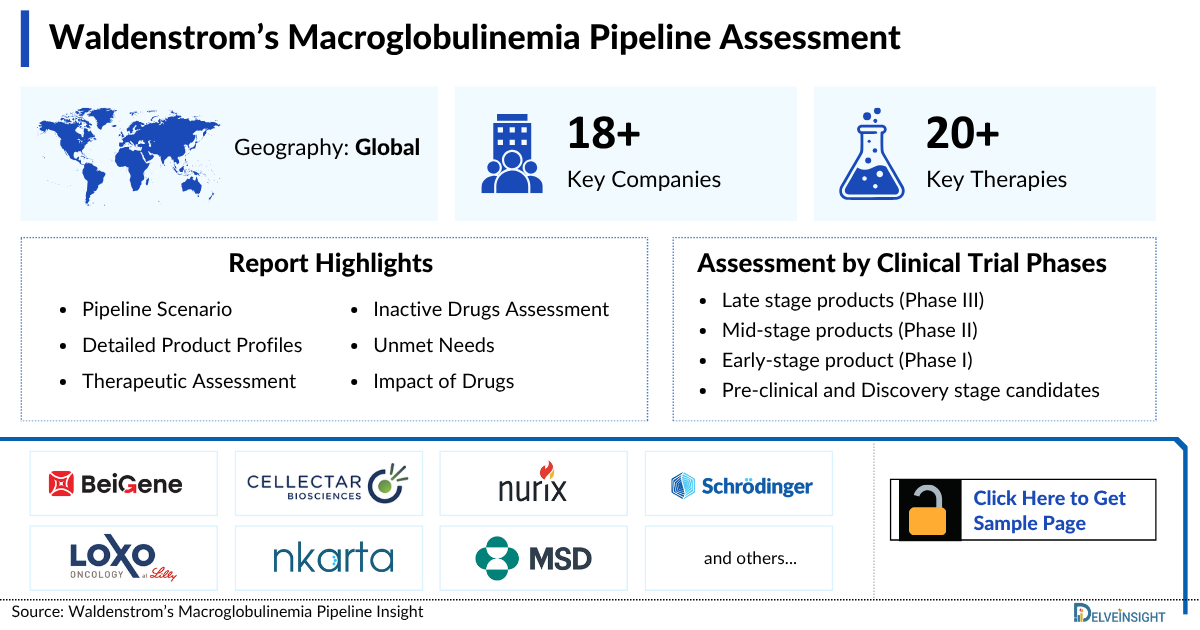
DelveInsight’s, “Waldenstrom’s Macroglobulinaemia Pipeline Insight, 2026” report provides comprehensive insights about 18+ companies and 20+ pipeline drugs in Waldenstrom’s Macroglobulinaemia pipeline landscape. It covers the pipeline drug profiles, including clinical and nonclinical stage products. It also covers the therapeutics assessment by product type, stage, route of administration, and molecule type. It further highlights the inactive pipeline products in this space.
Geography Covered
- Global coverage
Waldenstrom’s Macroglobulinaemia Disease Understanding
Waldenstrom’s Macroglobulinaemia Overview
Waldenström Macroglobulinemia (WM) is a rare, indolent B-cell lymphoproliferative disorder classified by the WHO as a lymphoplasmacytic lymphoma that secretes monoclonal immunoglobulin M (IgM). It accounts for approximately 2% of all non-Hodgkin lymphomas and is characterized by bone marrow infiltration with lymphoplasmacytic cells and the presence of monoclonal IgM in the serum. The clinical presentation of WM is highly variable; some patients may experience symptoms related to organ infiltration, such as anemia, lymphadenopathy, and splenomegaly, while others may present with complications arising from the physiochemical properties of IgM, including neuropathy, hyperviscosity syndrome, and cryoglobulinemia. Although WM generally follows an indolent course, certain manifestations like hyperviscosity may require urgent treatment to prevent serious complications. Recent advances, including the identification of MYD88 and CXCR4 mutations in most patients, have deepened understanding of WM pathogenesis and influenced therapeutic strategies. These insights, combined with evolving treatment options, are reshaping the management and prognosis of this complex disease.
Waldenström Macroglobulinemia (WM) presents with a wide range of symptoms resulting from both organ infiltration by malignant lymphoplasmacytic cells and the pathological effects of monoclonal IgM. Anaemia is the most common clinical finding, caused by bone marrow infiltration, functional iron deficiency linked to elevated hepcidin, or haemolysis. Other signs include lymphadenopathy, hepatosplenomegaly, and less frequently, extranodal involvement. IgM paraprotein can lead to serious complications such as hyperviscosity syndrome, typically when IgM levels exceed 4000–6000 mg/dL, causing visual changes, bleeding, and neurologic symptoms. Paraprotein-related neuropathies, cryoglobulinemia, and rare conditions like AL amyloidosis, Bing-Neel syndrome, and Schnitzler syndrome further contribute to WM’s complex clinical picture.
The diagnosis of Waldenström Macroglobulinemia (WM) requires the demonstration of bone marrow infiltration by lymphoplasmacytic cells and the presence of a monoclonal IgM gammopathy. While the Mayo Clinic suggests a =10% bone marrow involvement to distinguish WM from IgM-MGUS, the international consensus does not mandate a minimum threshold. Due to overlapping features with other B-cell lymphoproliferative disorders such as marginal zone lymphoma and IgM myeloma, diagnosis relies on a combination of histology, immunophenotyping, and molecular profiling. Immunophenotypically, WM cells express CD19, CD20, surface/cytoplasmic IgM, and lack myeloma-associated aberrations. Cytogenetically, deletions of 6q and trisomy 4 are common, but no pathognomonic chromosomal abnormality exists. The MYD88 L265P mutation, found in over 90% of WM cases, is a key diagnostic and pathogenic marker, while CXCR4 mutations—present in about 30%—further define disease biology and influence treatment response.
Treatment for Waldenström Macroglobulinemia (WM), like other indolent lymphomas, is initiated only in symptomatic patients, based on criteria defined by the Eighth International Workshop on WM. Urgent intervention is required in life-threatening situations such as symptomatic hyperviscosity syndrome, where plasmapheresis is used to rapidly reduce IgM levels, followed promptly by systemic therapy due to its transient effect. Treatment selection should be guided by disease-specific features at progression, and while randomized trials are limited due to the rarity of WM, therapeutic strategies are largely based on phase 2 studies and data from related indolent B-cell lymphomas.
"Waldenstrom’s Macroglobulinaemia Pipeline Insight, 2026" report by DelveInsight outlays comprehensive insights of present scenario and growth prospects across the indication. A detailed picture of the Waldenstrom’s Macroglobulinaemia pipeline landscape is provided which includes the disease overview and Waldenstrom’s Macroglobulinaemia treatment guidelines. The assessment part of the report embraces, in depth Waldenstrom’s Macroglobulinaemia commercial assessment and clinical assessment of the pipeline products under development. In the report, detailed description of the drug is given which includes mechanism of action of the drug, clinical studies, NDA approvals (if any), and product development activities comprising the technology, Waldenstrom’s Macroglobulinaemia collaborations, licensing, mergers and acquisition, funding, designations and other product related details.
Explore More Insights to the Report @ Waldenstrom's Macroglobulinaemia Treatment Market Size
Waldenstrom’s Macroglobulinaemia Pipeline Report Highlights
The companies and academics are working to assess challenges and seek opportunities that could influence Waldenstrom’s Macroglobulinaemia R&D. The therapies under development are focused on novel approaches to treat/improve Waldenstrom’s Macroglobulinaemia.
Waldenstrom’s Macroglobulinaemia Emerging Drugs Chapters
This segment of the Waldenstrom’s Macroglobulinaemia report encloses its detailed analysis of various drugs in different stages of clinical development, including Phase III, II, I, Preclinical and Discovery. It also helps to understand clinical trial details, expressive pharmacological action, agreements and collaborations, and the latest news and press releases.
Waldenstrom’s Macroglobulinaemia Emerging Drugs
Sonrotoclax: BeOne Medicines
Sonrotoclax is an investigational small molecule B-cell lymphoma 2 (BCL2) inhibitor with a differentiated profile. Sonrotoclax is an orally bioavailable inhibitor of the anti-apoptotic protein B-cell lymphoma 2 (Bcl-2), with potential pro-apoptotic and antineoplastic activities. Upon oral administration, sonrotoclax specifically binds to and inhibits the activity of the pro-survival protein Bcl-2. This restores apoptotic processes and inhibits cell proliferation in Bcl-2-overexpressing tumor cells. Bcl-2, a protein that belongs to the Bcl-2 family, is overexpressed in various tumor cell types and plays an important role in the negative regulation of apoptosis. Its tumor expression is associated with increased drug resistance and cancer cell survival. Currently, the drug is in Phase II stage of its development for the treatment of Waldenstrom’s Macroglobulinaemia.
Iopofosine: Cellectar Biosciences, Inc.
Iopofosine is a small molecule, radioconjugate, composed of our proprietary PLE, 18-(p-[I-131]iodophenyl) octadacyl phosphocholine, acting as a cancer-targeting delivery and retention vehicle, covalently labeled with iodine-131, a cytotoxic (cell-killing) radioisotope with a half-life of eight days that is already in common use to treat thyroid, pediatric tumors and other cancer types including NHL. Iopofosine binds to the cell surface of cancer cells and is delivered into the cytoplasm of the cancer cell. It is this “intracellular radiation” mechanism of cancer cell killing, coupled with delivery to a wide range of malignant tumor types that we believe provides iopofosine with anti-cancer activity and a unique product profile. Selective uptake and retention have been demonstrated in cancer stem cells compared with normal cells, offering the prospect of longer lasting anti-cancer activity. Currently, the drug is in Phase II stage of its development for the treatment of Waldenstrom’s Macroglobulinaemia.
NX-5948: Nurix Therapeutics, Inc.
Bexobrutideg is an oral, CNS-penetrant, small molecule degrader of Bruton’s tyrosine kinase (BTK) being evaluated in chronic lymphocytic leukemia (CLL), non-Hodgkin’s lymphoma (NHL), and Waldenström macroglobulinemia (WM). BTK is a master regulator of B-cell activity and is a clinically validated target for hematologic malignancies. While BTK inhibitors have shown clinical success, drug resistance often emerges due to acquired mutations in BTK. By removing BTK rather than merely inhibiting its activity, bexobrutideg may circumvent both kinase domain mutations and scaffolding-mediated resistance mutations to provide more durable responses. Additionally, its brain penetration suggests potential for treating challenging CNS-involved leukemias and lymphomas. The US FDA has also granted Fast Track Designation for NX-5948 for the Treatment of Relapsed or Refractory Waldenstrom’s Macroglobulinemia. Currently, the drug is in Phase I stage of its development for the treatment of Waldenstrom’s Macroglobulinaemia.
Further product details are provided in the report...
For more information, see the report @ Waldenstrom's Macroglobulinaemia Prevalence
Waldenstrom’s Macroglobulinaemia Therapeutic Assessment
This segment of the report provides insights about the different Waldenstrom’s Macroglobulinaemia drugs segregated based on following parameters that define the scope of the report, such as:
Major Players in Waldenstrom’s Macroglobulinaemia
There are approx. 18+ key companies which are developing the therapies for Waldenstrom’s Macroglobulinaemia. The companies which have their Waldenstrom’s Macroglobulinaemia drug candidates in the most advanced stage, i.e. Phase II include, BeOne Medicines, and others
Waldenstrom’s Macroglobulinaemia Pipeline Drug Phases
DelveInsight’s report covers around 20+ products under different phases of clinical development like
- Late stage products (Phase III)
- Mid-stage products (Phase II)
- Early-stage product (Phase I) along with the details of
- Pre-clinical and Discovery stage candidates
- Discontinued & Inactive candidates
Waldenstrom’s Macroglobulinaemia Drugs Route of Administration
Waldenstrom’s Macroglobulinaemia pipeline report provides the therapeutic assessment of the pipeline drugs by the Route of Administration. Products have been categorized under various ROAs such as
- Oral
- Intravenous
- Subcutaneous
- Parenteral
- Topical
Waldenstrom’s Macroglobulinaemia Drugs Molecule Type
Products have been categorized under various Molecule types such as
- Recombinant fusion proteins
- Small molecule
- Monoclonal antibody
- Peptide
- Polymer
- Gene therapy
Waldenstrom’s Macroglobulinaemia Pipeline Product Type
- Drugs have been categorized under various product types like Mono, Combination and Mono/Combination.
Waldenstrom’s Macroglobulinaemia Pipeline Development Activities
The Waldenstrom’s Macroglobulinaemia Pipeline report provides insights into different therapeutic candidates in Phase III, II, I, preclinical and discovery stage. It also analyses Waldenstrom’s Macroglobulinaemia therapeutic drugs key players involved in developing key drugs.
Waldenstrom’s Macroglobulinaemia Clinical Trials and Development Activities
The Waldenstrom’s Macroglobulinaemia clinical trials analysis report covers the detailed information of collaborations, acquisition and merger, licensing along with a thorough therapeutic assessment of emerging Waldenstrom’s Macroglobulinaemia drugs.
Waldenstrom’s Macroglobulinaemia Pipeline Report Insights
- Waldenstrom’s Macroglobulinaemia Pipeline Analysis
- Waldenstrom’s Macroglobulinaemia Therapeutic Assessment
- Waldenstrom’s Macroglobulinaemia Unmet Needs
- Impact of Waldenstrom’s Macroglobulinaemia Drugs
Waldenstrom’s Macroglobulinaemia Pipeline Report Assessment
- Waldenstrom’s Macroglobulinaemia Pipeline Product Profiles
- Waldenstrom’s Macroglobulinaemia Therapeutic Assessment
- Waldenstrom’s Macroglobulinaemia Pipeline Assessment
- Inactive Waldenstrom’s Macroglobulinaemia drugs assessment
- Waldenstrom’s Macroglobulinaemia Unmet Needs
Key Questions Answered in the Waldenstrom’s Macroglobulinaemia Pipeline Report:
Current Treatment Scenario and Emerging Therapies:
- How many companies are developing Waldenstrom’s Macroglobulinaemia drugs?
- How many Waldenstrom’s Macroglobulinaemia drugs are developed by each company?
- How many emerging drugs are in mid-stage, and late-stage of development for the treatment of Waldenstrom’s Macroglobulinaemia?
- What are the key collaborations (Industry–Industry, Industry–Academia), Mergers and acquisitions, licensing activities related to the Waldenstrom’s Macroglobulinaemia therapeutics?
- What are the recent trends, drug types and novel technologies developed to overcome the limitation of existing therapies?
- What are the clinical studies going on for Waldenstrom’s Macroglobulinaemia and their status?
- What are the key designations that have been granted to the emerging drugs?
Key Waldenstrom’s Macroglobulinaemia Companies
- BeiGene
- Cellectar Biosciences, Inc.
- Nurix Therapeutics, Inc.
- VelosBio Inc., a subsidiary of Merck & Co., Inc. (Rahway, New Jersey USA)
- Schrodinger, Inc.
- Loxo Oncology, Inc.
- Nkarta, Inc.
- Merck Sharp & Dohme LLC
- ADC Therapeutics S.A.
- Bio-Path Holdings, Inc.
- Millennium Pharmaceuticals, Inc.
- Carna Biosciences, Inc.
Key Waldenstrom’s Macroglobulinaemia Pipeline Products
- Sonrotoclax
- Iopofosine
- NX-5948
- Zilovertamab vedotin
- SGR-1505
- Pirtobrutinib
- NKX019
- Nemtabrutinib
- Loncastuximab Tesirine
- L-Bcl-2 antisense oligonucleotide
- Ixazomib Citrate
- Docirbrutinib
Stay updated with us for Recent Articles @ New DelveInsight Blogs

