Wound Healing Devices Market Summary
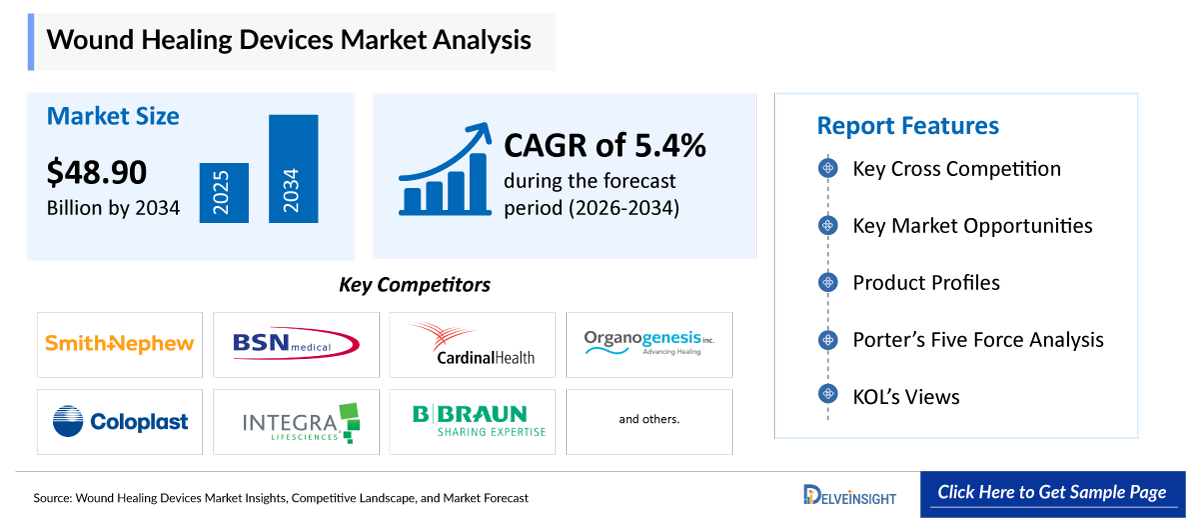
- The Wound Healing Devices market is estimated at USD 30.42 billion in 2025 and is projected to reach USD 48.90 billion by 2034. Growth is anchored in the rising global prevalence of chronic wounds such as diabetic foot ulcers, venous leg ulcers, and pressure ulcers, an expanding geriatric population, and sustained technological advancement across advanced dressings, negative pressure wound therapy, and bioengineered wound closure products.
- The global Wound Healing Devices market is growing at a CAGR of 5.4% during the forecast period from 2026 to 2034.
- By product, the wound closure devices segment dominated the Wound Healing Devices market with a 29% share in 2025.
- By wound type, the chronic wounds segment dominated the Wound Healing Devices market with a 54% share in 2025.
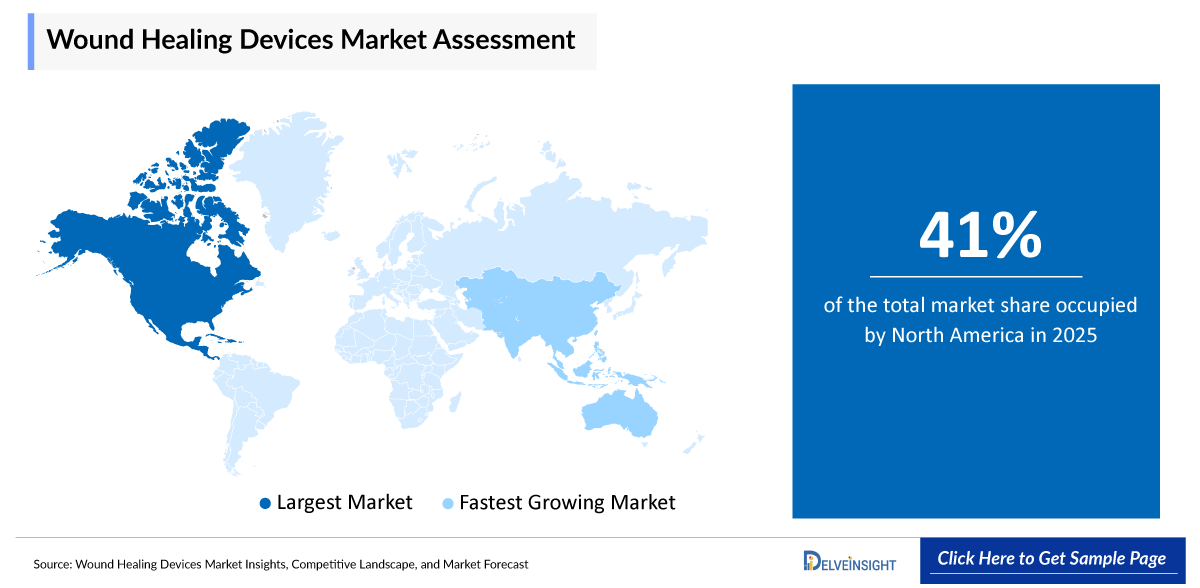
- North America dominated the global Wound Healing Devices market revenue with a 41% share in 2025, representing the highest regional market share globally.
Wound healing devices comprise a broad category of medical products and technologies used to manage, protect, and accelerate the closure of acute and chronic wounds. Beyond traditional dressings and bandages, these devices employ advanced mechanisms, absorbent and bioactive materials, mechanical closure systems, and energy-based therapies to create an optimal environment for tissue repair, control exudate, prevent infection, and restore blood flow to compromised tissue. Because chronic wounds are often slow to heal, prone to infection, and linked to underlying conditions such as diabetes, obesity, and vascular disease, hospitals, wound-care clinics, and home-care providers increasingly rely on advanced, purpose-built devices rather than conventional gauze alone. The market is organized by product across dressings, bandages, topical agents, wound closure devices, gauzes and sponges, tapes, and therapy devices; and by wound type across acute wounds, chronic wounds, and ulcers. Driven by the rising burden of diabetic foot ulcers and pressure ulcers, growing surgical and trauma case volumes, and accelerating innovation in negative pressure wound therapy, bioengineered skin substitutes, and smart digital wound monitoring, wound healing devices have become essential tools underpinning modern wound-management pathways across hospital, clinic, and home-care settings.
Wound Healing Devices Market Key Growth Drivers
- The rising global burden of chronic wounds, including diabetic foot ulcers, venous leg ulcers, and pressure ulcers, is expanding demand, with diabetic foot disease alone linked to tens of thousands of lower-limb amputations worldwide each year.
- The growing geriatric population and the associated rise in diabetes, obesity, and vascular disease are enlarging the pool of patients who require advanced, purpose-built wound-management solutions.
- Increasing surgical procedures and trauma cases are driving demand for sutures, staplers, sealants, and advanced closure systems to reduce complications and speed recovery.
- Rapid technological advancement, including portable and wearable negative pressure wound therapy systems, bioengineered skin and tissue substitutes, and sensor-enabled smart dressings, is improving healing outcomes and patient mobility.
- Rising product development and regulatory clearance activity, including the March 2025 FDA 510(k) clearance of the SkinDisc™ point-of-care platelet-rich plasma wound system, is expanding the range of available advanced therapies.
- The shift toward home healthcare and ambulatory wound management is increasing adoption of portable, easy-to-use devices that reduce hospital visits and support remote monitoring.
- Active strategic investment and M&A activity, including ConvaTec's acquisition of Triad Life Sciences and Mölnlycke Health Care's acquisition of P.G.F. Industry Solutions, is strengthening product portfolios and broadening manufacturing capacity across the market.
Key Companies in Wound Healing Devices Market
The competitive landscape is led by the following active manufacturers:
- Smith & Nephew plc.
- BSN medical
- Cardinal Health
- Organogenesis Inc.
- Coloplast Group
- Integra LifeSciences Corporation
- Acelity L.P., Inc.
- B. Braun Melsungen AG
- Hollister Incorporated
- Mölnlycke Health Care AB
For illustrative purposes, only the top 10 companies are listed in the Table of Contents. The report may include analysis and references to additional companies relevant to the market assessment.
Wound Healing Devices Market Size
The following snapshot summarizes the principal report metrics for the Wound Healing Devices market.
|
Report Metrics |
Details |
|
2025 Market Size |
USD 30.42 billion |
|
2034 Projected Market Size |
USD 48.90 billion |
|
Growth Rate (2026-2034) |
5.4% CAGR |
|
Largest Market |
North America |
|
Fastest Growing Market |
Asia-Pacific |
|
Market Structure |
Moderately to Highly Consolidated |
All market values are expressed in USD and represent DelveInsight estimates synthesized from primary and secondary research.
Factors Contributing to the Growth of the Wound Healing Devices Market
Market Drivers
Growing Prevalence of Chronic Wounds and Chronic Diseases
The single most powerful driver of the Wound Healing Devices market is the rising global burden of chronic wounds. As the geriatric population expands, so does the prevalence of conditions that impair the body's natural healing process. Diabetes continues to rise sharply worldwide, driving a corresponding increase in diabetic foot ulcers, a major and persistent segment of demand. Obesity is linked to a higher incidence of pressure ulcers and other chronic wounds, while venous and arterial disease impairs blood flow to the extremities, producing ulcers that are notoriously difficult to heal with conventional dressings alone. In several African countries, diabetic foot ulcer prevalence ranges between 11% and 25%, with lower-limb amputation rates reaching as high as 34%, underscoring the scale of unmet clinical need. This growing, chronic patient population ensures durable and expanding demand for advanced wound-management devices through 2034.
Rising Geriatric Population and Age-Related Comorbidities
The expansion of the global geriatric population is a structural driver of the market, since aging skin heals more slowly and is more susceptible to pressure injuries, venous disease, and delayed post-surgical recovery. Older patients frequently present with multiple comorbidities, including diabetes and cardiovascular disease, that further complicate wound healing and increase reliance on advanced dressings, compression therapy, and offloading devices. As life expectancy rises across both developed and emerging markets, healthcare systems face a growing volume of long-term, hard-to-heal wounds that require sustained device-based management rather than a single course of conventional treatment, reinforcing consistent demand for wound healing devices across care settings.
Increasing Surgical Procedures and Trauma Cases
Increasing surgical procedures and trauma cases are boosting the Wound Healing Devices market by creating sustained demand for sutures, staplers, sealants, and advanced wound-therapy systems that support faster recovery and reduce complications. The rise in elective surgeries, accident-related injuries, and burn cases is driving adoption of wound closure devices across hospitals, ambulatory surgical centers, and trauma units. In the United States alone, traumatic injuries remain a major health concern, with brain injuries occurring roughly every nine seconds and driving millions of related surgical and wound-management episodes annually. As neurosurgical, orthopedic, and general surgical volumes climb, demand for sutures, hemostatic agents, and advanced dressings that prevent infection and promote faster recovery expands in step.
Technological Advancements in Wound Care
Innovation is a powerful accelerator of market growth, with a clear focus on devices that improve clinical outcomes, shorten healing time, and are more patient-friendly. Negative pressure wound therapy systems remain a key growth driver, particularly in chronic wounds, with recent innovation centered on single-use, portable, and wearable systems that improve patient mobility and suit home-care use. Bioengineered skin and tissue substitutes, made from living cells, are increasingly used to treat complex wounds and burns, accelerating healing and providing a scaffold for new tissue growth. Smart, sensor-enabled dressings that monitor wound temperature, pH, and moisture, transmitting data to clinicians for remote monitoring, and AI-assisted wound-image analysis are reshaping how chronic wounds are tracked and treated.
Increasing Product Development and Regulatory Clearances
A steady stream of product development and regulatory clearance activity is expanding the range of advanced options available to clinicians and broadening the addressable market. In March 2025, the SkinDisc™ Wound System from Innoveren Scientific received FDA 510(k) clearance as a point-of-care blood-processing device that prepares platelet-rich plasma for topical application on exuding leg, pressure, and diabetic ulcers. In January 2025, Fesarius Therapeutics' DermiSphere hydrogel dermal regeneration template received FDA 510(k) clearance for advanced wound care and reconstructive surgery, while in February 2025 the FDA cleared Suturion's SutureTOOL™ surgical closure device. Each clearance expands the toolkit available to wound-care providers and reinforces continued innovation-led growth.
Growing Adoption of Home Healthcare and Ambulatory Wound Care
A structural shift toward home-based and ambulatory wound management is broadening the market for portable, easy-to-use devices. Portable and wearable negative pressure wound therapy systems, self-adhesive advanced dressings, and connected monitoring tools allow patients with chronic wounds to receive effective care outside the hospital, reducing readmission rates and overall treatment costs. This shift is particularly pronounced in markets with mature home-healthcare infrastructure and reimbursement support, and is expected to accelerate as payers and providers seek to reduce the cost burden of long-duration chronic wound management.
Strategic Investment and M&A Activity Strengthening Portfolios
Active strategic investment and consolidation are expanding capability and capacity across the market. ConvaTec acquired Triad Life Sciences Inc. to broaden its advanced wound-care portfolio, while Mölnlycke Health Care acquired P.G.F. Industry Solutions GmbH to strengthen its manufacturing base. Partnership activity is also accelerating, including Sanara MedTech's collaboration with InfuSystem and Kane Biotech's partnership with ProgenaCare. Emerging companies such as Medicud and Plasmacure are attracting venture funding for next-generation negative pressure and cold-plasma wound-therapy technologies. This wave of capital and consolidation is expanding manufacturing capacity, broadening technology portfolios, and reinforcing the strategic value of wound healing devices across the forecast period.
Market Restraints
Despite strong momentum, the Wound Healing Devices market faces material constraints. The high cost of advanced devices, particularly negative pressure wound therapy systems and bioengineered skin substitutes, can be financially prohibitive for healthcare systems and patients, especially in regions with limited reimbursement support. A shortage of healthcare professionals trained in advanced wound care presents a further bottleneck, since effective use of sophisticated technologies requires specialized knowledge that is not universally available. Patient non-compliance with treatment protocols, particularly in home-care settings, can undermine healing outcomes even where effective devices are prescribed. Stringent and often lengthy regulatory and certification processes raise costs and delay product launches, creating a high barrier to entry for smaller, innovative companies, while reimbursement frameworks for newer therapies remain uneven across geographies. Together, these cost, workforce, compliance, and regulatory barriers temper the pace of growth, even as the underlying drivers of chronic-wound prevalence, surgical volumes, and technological innovation remain firmly intact.
Wound Healing Devices Market Segment Analysis
The wound healing devices market by product (dressings [foam dressings, hydrocolloid dressings, hydrogel dressings, alginate dressings, and collagen dressings], bandages [elastic bandages, compression bandages, adhesive bandages, and liquid bandages], topical agents [hemostatic agents, antimicrobials, and wound cleansers], wound closure devices [sutures, adhesives and sealants, staplers, and strips], gauzes & sponges [sterile and non-sterile], tapes [cloth tape, paper tape, and silicon tape], and therapy device [negative pressure wound therapy devices and oxygen therapy device]), wound type (acute wound, chronic wounds), and geography (North America, Europe, Asia-Pacific, and Rest of World).
By Product
Dominant Subsegment: Wound Closure Devices.
The wound closure devices segment accounted for 29% of the Wound Healing Devices market in 2025. Wound closure devices, led by sutures, lead the product category because rising surgical volumes and trauma cases generate consistent, high-frequency demand for sutures, adhesives and sealants, staplers, and strips across hospitals and ambulatory surgical centers. Continuous innovation, including absorbable sutures, antibacterial-coated sutures that reduce infection risk, and emerging smart sutures capable of monitoring healing in real time, is reinforcing the segment's leadership. Dressings, spanning foam, hydrocolloid, hydrogel, alginate, and collagen formats, represent the fastest-growing product category as chronic wound management increasingly relies on moisture-balanced, bioactive dressing materials, while therapy devices, led by negative pressure wound therapy, are expanding quickly on the back of portable and wearable system innovation. Nonetheless, the sheer volume and recurring nature of surgical and trauma closure procedures secure wound closure devices' leadership across the forecast period.
By Wound Type
Dominant Subsegment: Chronic Wounds.
The chronic wounds segment accounted for 54% of the Wound Healing Devices market in 2025. Chronic wounds, including diabetic foot ulcers, venous leg ulcers, and pressure ulcers, lead the wound-type category because they are slow to heal, prone to infection, and require sustained, often multi-month device-based management rather than a single course of treatment. The sharp global rise in diabetes and the growing geriatric population are directly expanding the chronic-wound patient pool, while conditions such as obesity and vascular disease further raise the incidence of hard-to-heal wounds. Chronic wounds account for the majority of negative pressure wound therapy, advanced dressing, and bioengineered skin-substitute utilization. Acute wounds and ulcers, while smaller in share, are supported by steady surgical and trauma volumes and by the fast-growing ulcers subsegment tied to diabetic foot disease. Even so, the scale, duration, and recurring device demand associated with chronic wound management secure this segment's clear leadership across the forecast period.
Wound Healing Devices Market Region Analysis
Dominant Region: North America
North America accounted for 41% of the global Wound Healing Devices market revenue in 2025, representing the highest regional market share globally. The region's dominance reflects the high prevalence of chronic wounds linked to diabetes, obesity, and an aging population, combined with a strong base of advanced healthcare infrastructure and reimbursement support. North America benefits from early adoption of innovative technologies such as negative pressure wound therapy and portable wound-care devices, alongside the presence of major market players and rising demand for home-healthcare solutions. In the United States, high rates of traumatic injury, including several million traumatic brain injuries and related surgical episodes annually, sustain strong demand for sutures, hemostatic agents, and advanced dressings. Continued regulatory clearances, including new collagen-based dermal regeneration and platelet-rich plasma wound systems, further reinforce the region's leadership across the forecast period.
Fastest Growing Region: Asia-Pacific
Asia-Pacific is the fastest-growing region in the Wound Healing Devices market. The region's elevated growth is driven by a rapidly aging population, rising diabetes prevalence, increasing surgical procedures, and improving healthcare infrastructure across China, India, Japan, South Korea, and Australia. China, India, and Japan are witnessing strong demand for advanced wound-care products to manage chronic wounds such as diabetic foot ulcers and pressure ulcers, while government healthcare initiatives, growing medical tourism, and expanding local manufacturing investment are accelerating adoption. This combination of high disease burden, infrastructure build-out, and rising healthcare spending positions Asia-Pacific as the principal source of incremental growth over the forecast period.
Regional Commentary
North America
North America accounted for 41% of the global Wound Healing Devices market revenue in 2025. The United States leads on the strength of its chronic-disease burden, advanced healthcare infrastructure, reimbursement support, and early adoption of negative pressure wound therapy and portable devices, while continued regulatory clearances and strong demand from trauma and neurosurgical procedures reinforce its leadership.
Europe
Europe is a large and advanced regional market, supported by strong healthcare infrastructure, high awareness of advanced wound-care solutions, and supportive government initiatives. Rising prevalence of diabetic foot ulcers, venous leg ulcers, and pressure ulcers is creating consistent demand for innovative devices, while regulatory approvals and next-generation product launches, such as the 2025 European rollout of ConvaTec's ConvaNiox™ nitric-oxide-based wound technology across France, Germany, Italy, Poland, Spain, and the United Kingdom, highlight the region's focus on innovation.
Asia-Pacific
Asia-Pacific is the fastest-growing region, propelled by a rapidly aging population, rising diabetes cases, increasing surgical procedures, and improving healthcare infrastructure across China, India, Japan, South Korea, and Australia. Government healthcare initiatives, growing medical tourism, and local manufacturing investment are accelerating adoption of advanced wound-care products across the region.
Rest of World
The Rest of World region, spanning Latin America, the Middle East, and Africa, is an emerging growth frontier. Expanding healthcare infrastructure, rising awareness of advanced wound-management solutions, and a high underlying burden of diabetic foot disease, particularly across African countries, are gradually broadening access, while international partnerships and local manufacturing investment support the build-out of regional capacity.
Wound Healing Devices Market Competitive Landscape
The Wound Healing Devices market is classified as Moderately to Highly Consolidated. Leading companies such as Smith & Nephew, ConvaTec, Cardinal Health, and Mölnlycke Health Care dominate the space with extensive product portfolios, strong distribution networks, and continuous R&D investment, while a broad base of specialized and mid-sized firms compete through focus on niche areas such as bioengineered dressings, negative pressure wound therapy, and antimicrobial wound-care solutions.
The competitive landscape can be evaluated across the following dimensions:
- Market concentration: Moderately to highly consolidated, with globally established players leading and a growing field of specialized advanced wound-care providers.
- Leading players: Smith & Nephew plc., Cardinal Health, ConvaTec Inc., and Mölnlycke Health Care AB anchor the top tier through broad product portfolios and global distribution.
- Geographic reach: Leading companies operate extensive global manufacturing and distribution networks spanning hospitals, wound-care clinics, and home-care channels across major and emerging markets.
- Product portfolio strength: Top players offer end-to-end portfolios spanning dressings, bandages, topical agents, wound closure devices, gauzes and sponges, tapes, and therapy devices.
- Technology focus: Negative pressure wound therapy, bioengineered skin and tissue substitutes, antimicrobial and antibiofilm technologies, and sensor-enabled smart dressings are decisive competitive differentiators.
- Strategic partnerships: Collaborations such as Sanara MedTech's partnership with InfuSystem and Kane Biotech's partnership with ProgenaCare extend commercial reach and technology access.
- M&A activity: Active consolidation, including ConvaTec's acquisition of Triad Life Sciences and Mölnlycke Health Care's acquisition of P.G.F. Industry Solutions GmbH.
- Manufacturing capabilities: Scaled, regulatory-compliant manufacturing of sterile dressings, gauzes, closure devices, and therapy systems is a key competitive moat.
- Innovation focus: Portable and wearable negative pressure wound therapy, bioengineered and regenerative products, AI-driven wound monitoring, and sustainable, low-waste manufacturing.
Wound Healing Devices Market Recent Developmental Activities
In August 2026, BioLab Holdings, Inc., announced the publication of a real-world evidence study evaluating its human membrane wrap product for treating pressure ulcers, demonstrating positive clinical outcomes and improved wound-healing rates. Strategic significance: Validates the safety, efficacy, and practical clinical application of a bioengineered wound-management therapy.
In April 2025, ConvaTec Inc. announced the initial market launch of ConvaNiox™, a nitric-oxide-based antimicrobial and antibiofilm wound-care technology for managing diabetic foot ulcers, which reduced wound area three times faster and improved DFU healing by 60% versus standard care in clinical trials. Strategic significance: Strengthens ConvaTec's chronic wound antimicrobial portfolio ahead of a full 2026 European launch.
In February 2025, the U.S. Food and Drug Administration granted clearance for the SutureTOOL™ surgical closure device developed by Swedish MedTech firm Suturion. Strategic significance: Expands the range of advanced, regulator-cleared surgical wound-closure technologies available to clinicians.
In January 2025, Fesarius Therapeutics received FDA 510(k) clearance for its DermiSphere Hydrogel Dermal Regeneration Template for use in advanced wound care, reconstructive surgery, and regenerative medicine. Strategic significance: Adds a collagen-based extracellular-matrix-mimicking regeneration product to the advanced wound-care toolkit.
In 2025, Innoveren Scientific received FDA 510(k) clearance for its SkinDisc™ Wound System, a point-of-care peripheral blood-processing device that prepares platelet-rich plasma for topical application on exuding leg, pressure, and diabetic ulcers. Strategic significance: Broadens point-of-care regenerative options for chronic wound management.
In 2025, ConvaTec Inc. acquired Triad Life Sciences Inc. to broaden its advanced wound-care portfolio. Strategic significance: Expands ConvaTec's regenerative and advanced wound-care product range and manufacturing capacity.
In 2025, Mölnlycke Health Care AB acquired P.G.F. Industry Solutions GmbH to strengthen its manufacturing base. Strategic significance: Reinforces Mölnlycke's production capacity and supply-chain resilience across its dressings and wound-care portfolio.
In 2025, Sanara MedTech entered a partnership with InfuSystem to expand distribution and service reach for its advanced wound-care and negative pressure therapy offerings. Strategic significance: Broadens commercial access to Sanara's wound-management portfolio.
In 2025, Kane Biotech partnered with ProgenaCare to advance antimicrobial and antibiofilm wound-care technologies. Strategic significance: Strengthens the antimicrobial and antibiofilm segment of the wound-care technology landscape.
In April 2024, the U.S. Food and Drug Administration approved PowerHeal™, the first over-the-counter bioelectric bandage, which generates microcurrents via embedded silver-zinc batteries activated by wound exudate or moisture. Strategic significance: Introduces a novel, consumer-accessible bioelectric therapy category to the wound-care market.
Wound Healing Devices Market Segmentation
Wound Healing Devices Market by Product
- Dressings
- Foam Dressings
- Hydrocolloid Dressings
- Hydrogel Dressings
- Alginate Dressings
- Collagen Dressings
- Bandages
- Elastic Bandages
- Compression Bandages
- Adhesive Bandages
- Liquid Bandages
- Topical Agents
- Hemostatic Agents
- Antimicrobials
- Wound Cleansers
- Wound Closure Devices
- Sutures
- Adhesives and Sealants
- Staplers
- Strips
- Gauzes & Sponges
- Sterile
- Non-Sterile
- Tapes
- Cloth Tape
- Paper Tape
- Silicone Tape
- Therapy Device
- Negative Pressure Wound Therapy Devices
- Oxygen Therapy Device
Wound Healing Devices Market by Wound Type
- Acute Wound
- Chronic Wounds
Wound Healing Devices Market by Geography
- North America Wound Healing Devices Market
- United States Wound Healing Devices Market Size in USD million (2023-2034)
- Canada Wound Healing Devices Market Size in USD million (2023-2034)
- Mexico Wound Healing Devices Market Size in USD million (2023-2034)
- Europe Wound Healing Devices Market
- Germany Wound Healing Devices Market Size in USD million (2023-2034)
- United Kingdom Wound Healing Devices Market Size in USD million (2023-2034)
- France Wound Healing Devices Market Size in USD million (2023-2034)
- Italy Wound Healing Devices Market Size in USD million (2023-2034)
- Spain Wound Healing Devices Market Size in USD million (2023-2034)
- Rest of Europe Wound Healing Devices Market Size in USD million (2023-2034)
- Asia-Pacific Wound Healing Devices Market
- China Wound Healing Devices Market Size in USD million (2023-2034)
- Japan Wound Healing Devices Market Size in USD million (2023-2034)
- India Wound Healing Devices Market Size in USD million (2023-2034)
- Australia Wound Healing Devices Market Size in USD million (2023-2034)
- South Korea Wound Healing Devices Market Size in USD million (2023-2034)
- Rest of Asia-Pacific Wound Healing Devices Market Size in USD million (2023-2034)
- Rest of the World (RoW) Wound Healing Devices Market
- Middle East Wound Healing Devices Market Size in USD million (2023-2034)
- Africa Wound Healing Devices Market Size in USD million (2023-2034)
- South America Wound Healing Devices Market Size in USD million (2023-2034)
Wound Healing Devices Market Recent Industry Trends and Milestones (2023-2026)
|
Category |
Key Developments |
|
Wound Healing Devices Market Product Approval |
Regulatory momentum is expanding the range of advanced options available to clinicians. The FDA cleared Innoveren Scientific's SkinDisc™ point-of-care platelet-rich plasma wound system in 2025, Fesarius Therapeutics' DermiSphere hydrogel dermal regeneration template in January 2025, and Suturion's SutureTOOL™ surgical closure device in February 2025. The FDA also approved PowerHeal™, the first over-the-counter bioelectric bandage, in April 2024. Each clearance creates durable demand for advanced, regulator-cleared wound-management products across hospital and home-care settings. |
|
Wound Healing Devices Market Expansion |
Providers broadened capacity and capability across the value chain. ConvaTec launched ConvaNiox™ across key European markets, negative pressure wound therapy systems moved toward portable and wearable form factors suited to home care, and antimicrobial and antibiofilm technologies scaled through partnerships such as Kane Biotech's collaboration with ProgenaCare. Smart, sensor-enabled dressings and AI-assisted wound-image analysis expanded remote-monitoring capabilities for chronic-wound patients. |
|
Wound Healing Devices Market Investment |
Capital and consolidation accelerated across the market. ConvaTec acquired Triad Life Sciences to broaden its advanced wound-care portfolio, Mölnlycke Health Care acquired P.G.F. Industry Solutions GmbH to strengthen manufacturing capacity, and Sanara MedTech partnered with InfuSystem to expand commercial reach. Emerging companies including Medicud and Plasmacure attracted venture funding for next-generation negative pressure and cold-plasma wound-therapy technologies. |
|
Company Strategy |
Smith & Nephew plc.: Broad advanced wound-management portfolio anchored in orthopaedics-adjacent and sports-medicine synergies. ConvaTec Inc.: Next-generation antimicrobial products and a clinically engaged wound-hygiene protocol. Mölnlycke Health Care AB: Manufacturing expansion through the P.G.F. Industry Solutions acquisition. Cardinal Health: Broad distribution and supply-chain reach across hospital and home-care channels. Organogenesis Inc. and Integra LifeSciences Corporation: Focus on bioengineered skin substitutes and regenerative wound-care technologies. |
|
Emerging Technologies |
Bioelectric and thermal therapies, AI-driven wound monitoring and telehealth integration, nanomedicine and responsive wound-care materials, and biopolymer-based hydrogels represent the leading edge of innovation. Portable and wearable negative pressure wound therapy, cold-plasma stimulation, and platelet-rich plasma point-of-care systems are advancing rapidly, supported by new regulatory clearances and dedicated venture investment. |
Wound Healing Devices Market Startup Funding and Investment Trends
|
Company |
Total Funding |
Funding Stage |
Main Offering |
Core Technology |
|
Medicud |
€1.3 million |
Seed |
DRYUM system |
Negative pressure wound therapy for surgical incisions, aimed at reducing complications such as infection and improving outcomes in orthopaedic and other surgeries. |
|
Request for unlocking the report of the @ Wound Healing Devices Market | ||||
Investment in the Wound Healing Devices ecosystem has concentrated on next-generation negative pressure wound therapy, cold-plasma stimulation, and bioengineered wound-management technologies. The following companies illustrate recent funding and investment activity and technology focus.
Capital continues to flow toward providers that combine clinical evidence with differentiated, easy-to-adopt technology. Emerging providers such as Medicud and Plasmacure are scaling next-generation negative pressure and cold-plasma wound-therapy platforms, while established players such as ConvaTec and Mölnlycke Health Care pursue targeted acquisitions to broaden their advanced wound-care portfolios. Collectively, these investments signal conviction that portable therapy devices, bioengineered wound-management products, and antimicrobial technologies will define the next phase of competitive advantage in the global Wound Healing Devices market.
Key Takeaways from the Wound Healing Devices Market Report Study
- Market size analysis for the current Wound Healing Devices market size (2025), and market forecast for 9 years (2026 to 2034).
- Top key product/technology developments, mergers, acquisitions, partnerships, and joint ventures that happened over the last 3 years.
- Key companies dominating the global Wound Healing Devices market.
- Various opportunities available for competitors in the Wound Healing Devices market space.
- What are the top-performing segments in 2025? How will these segments perform in 2034?
- Which are the top-performing regions and countries in the current Wound Healing Devices market scenario?
- Which are the regions and countries where companies should concentrate their opportunities for Wound Healing Devices market growth in the future?
Target audience who can benefit from this Wound Healing Devices market report study
- Wound Healing Devices product providers
- Research organizations and consulting companies
- Wound Healing Devices -related organizations, associations, forums, and other alliances
- Government and corporate offices
- Start-up companies, venture capitalists, and private equity firms
- Distributors and traders dealing in Wound Healing Devices
- Various end-users who want to know more about the Wound Healing Devices market and the latest technological developments in the Wound Healing Devices market