
XEOMIN Market Summary
Key Factors Driving XEOMIN Growth
1. Rapid Expansion of the Global Botulinum Toxin Market
The most fundamental growth driver is the expansion of the botulinum toxin market, especially in aesthetics.
Market data
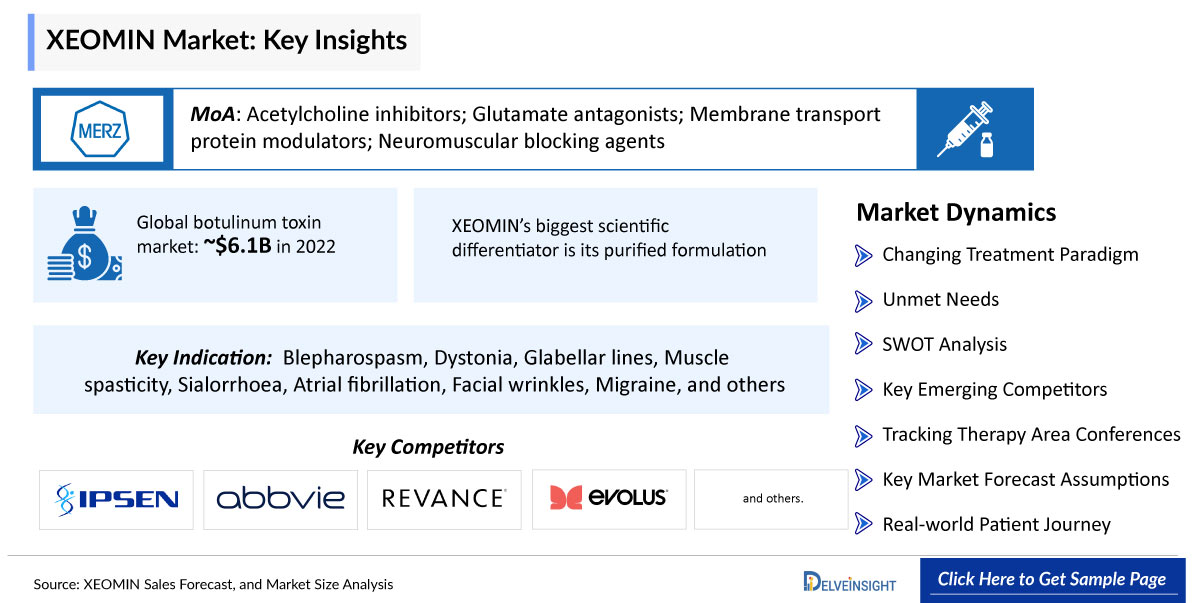
• Global botulinum toxin market: ~$6.1B in 2022
• Expected to reach ~$13.4B by 2032
• CAGR: ~8.4% (2023–2032)
Another estimate places the market at:
• $8.6B in 2025 → $12.2B by 2030 (7.2% CAGR)
Growth drivers
• Increasing demand for minimally invasive cosmetic procedures
• Rising aging population
• Expansion of therapeutic indications
More than 9.2 million botulinum toxin procedures were performed globally in 2022, reflecting strong demand for neuromodulators.
2. Product Differentiation: “Naked Toxin” Formulation
XEOMIN’s biggest scientific differentiator is its purified formulation.
Key attribute
• XEOMIN contains no complexing proteins, unlike many other botulinum toxins.
Potential advantages:
• Reduced risk of neutralizing antibody formation
• Improved long-term efficacy
• Higher clinical flexibility for repeat dosing
This purification profile helps XEOMIN target patients who become resistant to other toxins or require long-term therapy.
3. Label Expansion in Aesthetic Indications
Regulatory expansion significantly expands the treatable patient pool.
Key regulatory milestone
• In 2024–2025, the FDA approved XEOMIN for simultaneous treatment of upper facial lines, including:
o Forehead lines
o Glabellar lines
o Crow’s feet
This made it the first neurotoxin approved for treating all three upper-face lines in one session.
4. Growing Aesthetic Procedure Volumes
The aesthetic medicine industry is rapidly expanding due to lifestyle trends.
Key demand drivers:
• Rising cosmetic awareness
• Social media influence
• Younger patient cohorts seeking preventative aesthetics
• Increased disposable income
Botulinum toxin injections are among the most common minimally invasive cosmetic procedures globally, which strongly supports XEOMIN demand.
5. Expansion into Emerging Markets
Merz is expanding XEOMIN geographically.
Examples:
• Commercial presence in 90+ countries
• Distribution partnerships in markets such as Japan (via Teijin)
• Growth initiatives in Asia and Latin America, where aesthetic demand is rising.
6. Growth in Therapeutic Indications
Beyond aesthetics, XEOMIN is used for neurological disorders.
Key therapeutic uses:
• Cervical dystonia
• Blepharospasm
• Upper-limb spasticity
• Chronic sialorrhea
The therapeutic toxin segment is expanding, especially in neurology and urology indications.
XEOMIN Recent Developments
• In January 2026, Merz Therapeutics, a leading player in neurology-focused specialty pharma, announced that it had completed the regulatory submission for XEOMIN® (incobotulinumtoxinA) for the treatment of spasticity of the lower and upper limb in children and adolescents aged 2–17 years in the European Union (EU) and European Economic Area (EEA). If approved, the indication would expand access to an established botulinum neurotoxin therapy for some of the youngest and most vulnerable patients across Europe.
“XEOMIN Sales Forecast, and Market Size Analysis – 2034” report provides comprehensive insights of XEOMIN for approved indication like Blepharospasm, Dystonia, Glabellar lines, Muscle spasticity, Sialorrhoea; as well as potential indications like Atrial fibrillation, Facial wrinkles, Migraine, Skin aging, and Alopecia in the 7MM. A detailed picture of XEOMIN’s existing usage in approved and anticipated entry and performance in potential indications in the 7MM, i.e., the United States, EU4 (Germany, France, Italy, and Spain) and the United Kingdom, and Japan for the study period 2020 –2034 is provided in this report along with a detailed description of the XEOMIN for approved and potential indications. The XEOMIN market report provides insights about XEOMIN’s sales forecast, mechanism of action (MoA), dosage and administration, as well as research and development including regulatory milestones, along with other developmental activities. Further, it also consists of historical and current XEOMIN performance, future market assessments inclusive of the XEOMIN market forecast analysis for approved and potential indications in the 7MM, SWOT, analysts’ views, comprehensive overview of market competitors, and brief about other emerging therapies in respective indications. It also provides analysis of XEOMIN sales forecasts, along with factors driving its market.
XEOMIN Drug Summary
XEOMIN is a purified botulinum toxin type A formulation from Merz Pharmaceuticals, free of complexing proteins, supplied as a powder for reconstitution and injection into muscles or glands, indicated for improving moderate to severe upper facial lines (frown lines, forehead lines, crow's feet) in adults temporarily; treating chronic sialorrhea (drooling) in adults and children aged 2 years and older; managing upper limb spasticity in adults and children 2-17 years (excluding cerebral palsy-related); cervical dystonia with abnormal head position and neck pain in adults; and blepharospasm in adults previously treated with onabotulinumtoxinA. It acts as an acetylcholine release inhibitor at the neuromuscular junction, causing temporary chemical denervation and muscle relaxation by cleaving SNAP-25 proteins essential for neurotransmitter vesicle fusion, with effects lasting 3-4 months until new nerve terminals form. XEOMIN carries a boxed warning for distant spread of toxin effects potentially causing serious weakness, breathing, or swallowing difficulties, and requires caution in patients with pre-existing neuromuscular conditions. The report provides XEOMIN’s sales, growth barriers and drivers, post usage and approvals in multiple indications.
Scope of the XEOMIN Market Report
The report provides insights into:
• A comprehensive product overview including the XEOMIN MoA, description, dosage and administration, research and development activities in approved indications like Blepharospasm, Dystonia, Glabellar lines, Muscle spasticity, Sialorrhoea; as well as potential indications like Atrial fibrillation, Facial wrinkles, Migraine, Skin aging, and Alopecia.
• Elaborated details on XEOMIN regulatory milestones and other development activities have been provided in XEOMIN market report.
• The report also highlights XEOMIN‘s cost estimates and regional variations, reported and estimated sales performance, research and development activities in approved and potential indications across the United States, Europe, and Japan.
• The XEOMIN market report also covers the patents information, generic entry and impact on cost cut.
• The XEOMIN market report contains current and forecasted XEOMIN sales for approved and potential indications till 2034.
• Comprehensive coverage of the late-stage emerging therapies for respective indications.
• The XEOMIN market report also features the SWOT analysis with analyst views for XEOMIN in approved and potential indications.
Methodology
The XEOMIN market report is built using data and information sourced primarily from internal databases, primary and secondary research and in-house analysis by DelveInsight’s team of industry experts. Information and data from the secondary sources have been obtained from various printable and nonprintable sources like search engines, news websites, global regulatory authorities websites, trade journals, white papers, magazines, books, trade associations, industry associations, industry portals and access to available databases.
XEOMIN Analytical Perspective by DelveInsight
• In-depth XEOMIN Market Assessment
This XEOMIN sales market forecast report provides a detailed market assessment of XEOMIN for approved indication like Blepharospasm, Dystonia, Glabellar lines, Muscle spasticity, Sialorrhoea; as well as potential indications like Atrial fibrillation, Facial wrinkles, Migraine, Skin aging, and Alopecia in the seven major markets, i.e., the United States, EU4 (Germany, France, Italy, and Spain) and the United Kingdom, and Japan. This segment of the report provides current and forecasted XEOMIN sales data uptil 2034.
• XEOMIN Clinical Assessment
The XEOMIN market report provides the clinical trials information of XEOMIN for approved and potential indications covering trial interventions, trial conditions, trial status, start and completion dates.
XEOMIN Competitive Landscape
The report provides Insights on competitors and marketed products within the domain, along with a summary of emerging products and their respective launch dates, posing significant competition in the market.
XEOMIN Market Potential & Revenue Forecast
• Projected market size for the XEOMIN and its key indications
• Estimated XEOMIN sales potential (XEOMIN peak sales forecasts)
• XEOMIN Pricing strategies and reimbursement landscape
XEOMIN Competitive Intelligence
• Number of competing drugs in development (pipeline analysis)
• XEOMIN Market positioning compared to existing treatments
• XEOMIN Strengths & weaknesses relative to competitors
XEOMIN Regulatory & Commercial Milestones
• XEOMIN Key regulatory approvals & expected launch timelines
• Commercial partnerships, licensing deals, and M&A activity
XEOMIN Clinical Differentiation
• XEOMIN Efficacy & safety advantages over existing drugs
• XEOMIN Unique selling points
XEOMIN Market Report Highlights
• In the coming years, the XEOMIN market scenario is set to change due to strong adoption, increased prescriptions and broader uptake in multiple immunological indications; which would expand the size of the market.
• The XEOMIN companies are developing therapies that focus on novel approaches to treat/improve the disease condition, assess challenges, and seek opportunities that could influence XEOMIN’s dominance.
• Other emerging products for Blepharospasm, Dystonia, Glabellar lines, Muscle spasticity, Sialorrhoea; as well as potential indications like Atrial fibrillation, Facial wrinkles, Migraine, Skin aging, and Alopecia are expected to give tough market competition to XEOMIN and launch of late-stage emerging therapies in the near future will significantly impact the market.
• A detailed description of regulatory milestones, and developmental activities, provide the current development scenario of XEOMIN in approved and potential indications.
• Analyse XEOMIN cost, pricing trends and market positioning to support strategic decision-making in the immunology landscape.
• Our in-depth analysis of the forecasted XEOMIN sales data uptil 2034 will support the clients in decision-making process regarding their therapeutic portfolio by identifying the overall scenario of XEOMIN in approved and potential indications.
Key Questions
• What is the class of therapy, route of administration and mechanism of action of XEOMIN? How strong is XEOMIN’s clinical and commercial performance?
• What is XEOMIN’s clinical trial status in each individual indications such as Blepharospasm, Dystonia, Glabellar lines, Muscle spasticity, Sialorrhoea; as well as potential indications like Atrial fibrillation, Facial wrinkles, Migraine, Skin aging, and Alopecia and study completion date?
• What are the key collaborations, mergers and acquisitions, licensing and other activities related to the XEOMIN Manufacturers?
• What are the key designations that have been granted to XEOMIN for approved and potential indications? How are they going to impact XEOMIN’s penetration in various geographies?
• What is the current and forecasted XEOMIN market scenario for approved and potential indications? What are the key assumptions behind the forecast?
• What are the current and forecasted sales of XEOMIN in the seven major countries, including the United States, Europe (Germany, France, Italy, Spain) and the United Kingdom, and Japan?
• What are the other emerging products available and how are these giving competition to XEOMIN for approved and potential indications?
• Which are the late-stage emerging therapies under development for the treatment of approved and potential indications?
• How cost-effective is XEOMIN? What is the duration of therapy and what are the geographical variations in cost per patient?

