CRSwNP Market to grow from USD 2,249 Million in 2023 at Projected CAGR of 7.18% by 2036
Get a Sneak Peek at the Latest chronic rhinosinusitis without nasal polyps market size Report
In 2023, the Chronic Rhinosinusitis with Nasal Polyps (CRSwNP) market size across the 7MM was valued at around USD 2,249 million. The market is expected to grow at a CAGR of 7.18% from 2026 to 2036, supported by the development of biologic therapies and other innovative treatments. DelveInsight’s comprehensive market research provides critical insights into such market trends, enabling stakeholders to understand growth drivers, emerging opportunities, and potential challenges within the Chronic Rhinosinusitis with Nasal Polyps landscape.
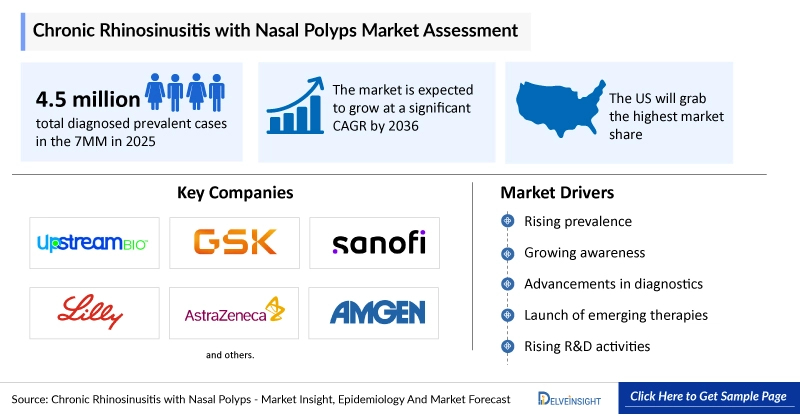
In 2023, the United States represented the largest share of the Chronic Rhinosinusitis with Nasal Polyps market, accounting for approximately 74% of the total 7MM market. Among the EU4 countries (Germany, France, Italy, and Spain) and the UK, Germany had the largest market at around USD 161 million, while Spain reported the smallest market size at nearly USD 44 million. In Japan, the CRSwNP market was estimated at approximately USD 88 million in 2023, representing 4% of the total 7MM market.
In 2025, the total prevalent cases of Chronic Rhinosinusitis across the 7MM were estimated at approximately 71 million, with a significant CAGR expected over the period 2022–2036. According to DelveInsight, the diagnosed prevalent cases in the 7MM were around 18 million in 2025 and are projected to grow at a notable CAGR from 2026 to 2036.
In 2025, the 7MM had approximately 4.5 million diagnosed prevalent cases of Chronic Rhinosinusitis with Nasal Polyps (CRSwNP), with numbers expected to rise over the study period. According to DelveInsight, about 25% of diagnosed Chronic Rhinosinusitis (CRS) cases in the US progress to CRSwNP. The US reported the highest diagnosed prevalence in the 7MM, with around 2 million cases in 2025. Gender distribution indicates a male predominance, with males representing 55% of the diagnosed CRSwNP cases in the US.
DelveInsight’s report, “Chronic Rhinosinusitis with Nasal Polyps Market Insights, Epidemiology, and Market Forecast-2036,” provides a comprehensive analysis of the Chronic Rhinosinusitis with Nasal Polyps landscape. The report delivers detailed insights into the disease, including historical and projected epidemiology, helping stakeholders understand the prevalence, incidence, and patient demographics across key regions.
Additionally, it examines Chronic Rhinosinusitis with Nasal Polyps market dynamics, offering a thorough assessment of current and emerging market trends, treatment patterns, and therapeutic developments. The analysis spans major markets, including the United States, EU4 (Germany, Spain, Italy, France, and the United Kingdom), and Japan, equipping decision-makers with actionable intelligence for strategic planning, investment, and research initiatives.
To Know in detail about the Chronic Rhinosinusitis with Nasal Polyps market outlook, drug uptake, treatment scenario and epidemiology trends, Click here; Chronic Rhinosinusitis with Nasal Polyps Market Forecast
Some of the key facts of the Chronic Rhinosinusitis with Nasal Polyps Market Report:
- With the anticipated introduction of new therapies, including TEZSPIRE (tezepelumab), the overall Chronic Rhinosinusitis with Nasal Polyps market is expected to experience significant growth in the coming years.
- Key Chronic Rhinosinusitis with Nasal Polyps Companies: AstraZeneca, Amgen, Keymed Biosciences, GlaxoSmithKline, Genentech, Inc, Novartis, Upstream Bio Inc., Regeneron Pharma, Genrix (Shanghai) Biopharmaceutical, Guangdong Hengrui Pharmaceutical, Keymed Biosciences Co.Ltd, and others
- Key Chronic Rhinosinusitis with Nasal Polyps Therapies: NUCALA (mepolizumab), TEZSPIRE (tezepelumab), FASENRA (benralizumab), Tezepelumab, CM310, GSK3511294 (depemokimab), Omalizumab, Xolair, Verekitug (UPB-101), Dupilumab SAR231893, GR1802 injection, SHR-1905 Injection, CM310, and others
- The Chronic Rhinosinusitis with Nasal Polyps market is expected to surge due to the disease's increasing prevalence and awareness during the forecast period. Furthermore, launching various multiple-stage CRSwNP pipeline products will significantly revolutionize the Chronic Rhinosinusitis with Nasal Polyps market dynamics.
Chronic Rhinosinusitis with Nasal Polyps Overview
Chronic Rhinosinusitis with Nasal Polyps (CRSwNP) is a long-term inflammatory condition of the nasal passages and sinuses characterized by the growth of soft, painless, noncancerous polyps in the nasal lining. These polyps can obstruct airflow and drainage, leading to persistent symptoms.
Common symptoms include nasal congestion, reduced or loss of smell, facial pressure, runny nose, and postnasal drip. The condition is often associated with underlying inflammation, allergies, asthma, or immune system dysfunction.
Get a Free sample for the Chronic Rhinosinusitis with Nasal Polyps Market Forecast, Size & Share Analysis Report:
https://www.delveinsight.com/report-store/chronic-rhinosinusitis-without-nasal-polyps-crssnp-market
Key Trends in Chronic Rhinosinusitis with Nasal Polyps Therapeutics Market:
- Rising Adoption of Biologics: Increased use of targeted biologic therapies, such as anti-IL-4/13 and anti-IL-5 agents, for patients with severe or refractory CRSwNP.
- Emphasis on Personalized Treatment: Use of biomarkers and endotyping to tailor therapies based on individual inflammatory profiles.
- Integration of Combination Therapies: Combining corticosteroids, surgery, and biologics to enhance treatment outcomes and reduce recurrence.
- Innovation in Drug Delivery Systems: Development of advanced intranasal formulations and devices for improved efficacy and patient adherence.
- Growing Awareness and Early Diagnosis: Enhanced physician education and patient awareness are driving timely intervention and adoption of advanced therapies.
Chronic Rhinosinusitis with Nasal Polyps Epidemiology
The Chronic Rhinosinusitis with Nasal Polyps epidemiology section provides insights into the historical, current, and forecasted epidemiology trends in the seven major countries (7MM) from 2022 to 2036. It helps to recognize the causes of current and forecasted trends by exploring numerous studies and views of key opinion leaders. The epidemiology section also provides a detailed analysis of the diagnosed patient pool and future trends.
Chronic Rhinosinusitis with Nasal Polyps Epidemiology Segmentation:
The Chronic Rhinosinusitis with Nasal Polyps market report proffers epidemiological analysis for the study period 2022–2036 in the 7MM segmented into:
- Total Prevalence of Chronic Rhinosinusitis with Nasal Polyps
- Prevalent Cases of Chronic Rhinosinusitis with Nasal Polyps by severity
- Gender-specific Prevalence of Chronic Rhinosinusitis with Nasal Polyps
- Diagnosed Cases of Episodic and Chronic Chronic Rhinosinusitis with Nasal Polyps
Download the report to understand which factors are driving Chronic Rhinosinusitis with Nasal Polyps epidemiology trends @ Chronic Rhinosinusitis with Nasal Polyps Epidemiology Forecast
Recent Development In The Chronic Rhinosinusitis with Nasal Polyps Treatment Landscape:
- In February 2026, GSK announced that the European Commission has approved EXDENSUR (depemokimab) as an add-on treatment alongside intranasal corticosteroids for adults with severe Chronic Rhinosinusitis with Nasal Polyps whose condition remains inadequately controlled despite the use of systemic corticosteroids and/or surgical intervention.
- In January 2026, GSK announced that Japan's Ministry of Health, Labour and Welfare has approved EXDENSUR (depemokimab) for the treatment of Chronic Rhinosinusitis with Nasal Polyps in patients whose condition is not adequately managed with standard therapies.
- In December 2025, The U.S. Food and Drug Administration approved depemokimab for the treatment of severe asthma but declined approval for its use in Chronic Rhinosinusitis with Nasal Polyps, without offering detailed justification. GSK has reiterated its confidence in the therapy’s potential for this indication and continues to engage in discussions with the FDA.
- In October 2025, TEZSPIRE has received approval in the United States as an add-on maintenance therapy for adult and pediatric patients aged 12 years and older with inadequately controlled Chronic Rhinosinusitis with Nasal Polyps. It is the first and only biologic approved for this condition that specifically targets thymic stromal lymphopoietin (TSLP).
- In September 2025, Upstream Bio announced positive top-line findings from the Phase II VIBRANT trial assessing verekitug for the treatment of Chronic Rhinosinusitis with Nasal Polyps. In the 24-week study, patients receiving 100 mg of verekitug every 12 weeks achieved the primary endpoint, showing a statistically significant and clinically meaningful placebo-adjusted reduction in endoscopic nasal polyp score (NPS) of –1.8.
- In September 2025, The US Food and Drug Administration (FDA) has approved Insmed’s Brinsupri, marking a major advancement in the treatment of non-cystic fibrosis bronchiectasis (NCFB) and a pivotal achievement for the company. As the first approved therapy in this indication, Brinsupri meets the critical unmet need to reduce exacerbations and slow NCFB progression in adults and adolescents aged 12 and older. The approval covers 10mg and 25mg tablets, without restrictions on prior pulmonary exacerbation history. For Insmed, this milestone strengthens its position in the respiratory therapy market. Additionally, Brinsupri is under investigation in early-stage trials for other conditions, including chronic rhinosinusitis without nasal polyps and hidradenitis suppurativa.
- In March 2025, UK-based pharmaceutical company GSK announced favorable results from two Phase III trials ANCHOR-1 and ANCHOR-2 evaluating depemokimab for the treatment of chronic rhinosinusitis with nasal polyps (CRSwNP) in adults. The studies demonstrated that administering the antibody twice a year resulted in statistically significant and clinically meaningful reductions in nasal polyp size and nasal obstruction when compared to placebo.
- In March 2025, Complete findings from the successful Phase III WAYPOINT trial revealed that AstraZeneca and Amgen’s TEZSPIRE® (tezepelumab-ekko) significantly lessened nasal polyp severity, reduced the need for additional surgeries, and lowered systemic corticosteroid use in individuals with chronic rhinosinusitis with nasal polyps (CRSwNP) compared to placebo. These results were published in the New England Journal of Medicine and also presented as a late-breaking oral session at the AAAAI/WAO Joint Congress in San Diego, CA.
- In November 2024, The U.S. Food and Drug Administration (FDA) has granted Priority Review to the supplemental Biologics License Application (sBLA) for DUPIXENT (dupilumab), developed by Sanofi and Regeneron Pharmaceuticals. This application requests approval for DUPIXENT as an additional maintenance treatment for adolescents aged 12 to 17 with inadequately controlled chronic rhinosinusitis with nasal polyposis (CRSwNP).
- In May 2024, The U.S. Food and Drug Administration (FDA) has granted Priority Review to the supplemental Biologics License Application (sBLA) for DUPIXENT (dupilumab), developed by Sanofi and Regeneron Pharmaceuticals. This application requests approval for DUPIXENT as an additional maintenance treatment for adolescents aged 12 to 17 with inadequately controlled chronic rhinosinusitis with nasal polyposis (CRSwNP).
Chronic Rhinosinusitis with Nasal Polyps Drugs Uptake and Pipeline Development Activities
The drugs uptake section focuses on the rate of uptake of the potential drugs recently launched in the Chronic Rhinosinusitis with Nasal Polyps market or expected to get launched during the study period. The analysis covers Chronic Rhinosinusitis with Nasal Polyps market uptake by drugs, patient uptake by therapies, and sales of each drug.
Moreover, the therapeutics assessment section helps understand the drugs with the most rapid uptake and the reasons behind the maximal use of the drugs. Additionally, it compares the drugs based on market share.
The report also covers the Chronic Rhinosinusitis with Nasal Polyps Pipeline Development Activities. It provides valuable insights about different therapeutic candidates in various stages and the key companies involved in developing targeted therapeutics. It also analyzes recent developments such as collaborations, acquisitions, mergers, licensing patent details, and other information for emerging therapies.
Chronic Rhinosinusitis with Nasal Polyps Therapies and Key Companies
- NUCALA (mepolizumab): GlaxoSmithKline
- TEZSPIRE (tezepelumab): AstraZeneca/Amgen
- FASENRA (benralizumab): AstraZeneca
- Tezepelumab: AstraZeneca/Amgen
- CM310: Keymed Biosciences
- GSK3511294 (depemokimab): GlaxoSmithKline
- Omalizumab: Genentech, Inc
- Xolair: Novartis
- Verekitug (UPB-101): Upstream Bio Inc.
- Dupilumab SAR231893: Regeneron Pharmaceuticals
- GR1802 injection: Genrix (Shanghai) Biopharmaceutical
- SHR-1905 Injection: Guangdong Hengrui Pharmaceutical
- CM310: Keymed Biosciences Co.Ltd
Discover more about therapies set to grab major Chronic Rhinosinusitis with Nasal Polyps market share @ Chronic Rhinosinusitis with Nasal Polyps Treatment Landscape
Chronic Rhinosinusitis with Nasal Polyps Market Driver
- Rising Disease Prevalence: Increasing cases of Chronic Rhinosinusitis with Nasal Polyps due to allergies, asthma, and environmental pollution are driving demand for effective treatments.
- Advancements in Biologic Therapies: Growing adoption of targeted biologics such as monoclonal antibodies is significantly improving disease management and boosting market growth.
- Increased Awareness & Diagnosis: Better awareness among patients and healthcare professionals is leading to early diagnosis and higher treatment rates.
- Technological Progress in ENT Treatments: Innovations in minimally invasive sinus surgeries and improved diagnostic tools are enhancing patient outcomes.
- Strong Pipeline and R&D Investments: Pharmaceutical companies are actively investing in novel therapies, expanding treatment options and fueling market expansion.
Chronic Rhinosinusitis with Nasal Polyps Market Barriers
- High Cost of Biologic Treatments: Advanced biologics are expensive, limiting accessibility for many patients, especially in developing regions.
- Limited Awareness in Low-Income Regions: Underdiagnosis and lack of awareness hinder timely treatment adoption.
- Risk of Recurrence: High recurrence rates even after surgery or treatment pose challenges in long-term disease management.
- Side Effects and Safety Concerns: Potential adverse effects of long-term corticosteroid or biologic use may restrict patient compliance.
- Reimbursement and Access Issues: Inconsistent reimbursement policies across regions can limit patient access to advanced therapies.
Scope of the Chronic Rhinosinusitis with Nasal Polyps Market Report
- Study Period: 2022–2036
- Coverage: 7MM [The United States, EU5 (Germany, France, Italy, Spain, and the United Kingdom), and Japan]
- Key Chronic Rhinosinusitis with Nasal Polyps Companies: AstraZeneca, Amgen, Keymed Biosciences, GlaxoSmithKline, Genentech, Inc, Novartis, Upstream Bio Inc., Regeneron Pharma, Genrix (Shanghai) Biopharmaceutical, Guangdong Hengrui Pharmaceutical, Keymed Biosciences Co.Ltd, and others
- Key Chronic Rhinosinusitis with Nasal Polyps Therapies: NUCALA (mepolizumab), TEZSPIRE (tezepelumab), FASENRA (benralizumab), Tezepelumab, CM310, GSK3511294 (depemokimab), Omalizumab, Xolair, Verekitug (UPB-101), Dupilumab SAR231893, GR1802 injection, SHR-1905 Injection, CM310, and others
- Chronic Rhinosinusitis with Nasal Polyps Therapeutic Assessment: Chronic Rhinosinusitis with Nasal Polyps current marketed and Chronic Rhinosinusitis with Nasal Polyps emerging therapies
- Chronic Rhinosinusitis with Nasal Polyps Market Dynamics: Chronic Rhinosinusitis with Nasal Polyps market drivers and Chronic Rhinosinusitis with Nasal Polyps market barriers
- Chronic Rhinosinusitis with Nasal Polyps Competitive Intelligence Analysis: SWOT analysis, PESTLE analysis, Porter’s five forces, BCG Matrix, Market entry strategies
- Chronic Rhinosinusitis with Nasal Polyps Unmet Needs, KOL’s views, Analyst’s views, Chronic Rhinosinusitis with Nasal Polyps Market Access and Reimbursement
To know more about Chronic Rhinosinusitis with Nasal Polyps companies working in the treatment market, visit @ Chronic Rhinosinusitis with Nasal Polyps Clinical Trials and Therapeutic Assessment
About DelveInsight
DelveInsight is a leading Healthcare Business Consultant, and Market Research firm focused exclusively on life sciences. It supports Pharma companies by providing comprehensive end-to-end solutions to improve their performance.
It also offers Healthcare Consulting Services, which benefits in market analysis to accelerate the business growth and overcome challenges with a practical approach.
Need more?
- ✅ Connect with our analyst to learn how this research was developed
- ✅ Expand the scope with additional segments or countries through free customization
- ✅ Discover how this report can directly influence your business growth
Related Reports

Chronic Rhinosinusitis with Nasal Polyps - Pipeline Insight, 2026
"Chronic Rhinosinusitis with Nasal Polyps Pipeline Insights, 2026" report by DelveInsight outlays comprehensive insights of present clinical development scenario and growth prospects across..

Chronic rhinosinusitis with nasal polyps - Epidemiology Forecast - 2034
DelveInsight's Chronic rhinosinusitis with nasal polyps - Epidemiology Forecast 2034 report delivers an in-depth understanding of the disease, historical, and forecasted epidemiology of Chronic rhinosinusitis with nasal polyps in the United States, EU5 (Germany, France, Italy, Spain, and the United Kingdom), and Japan.
